If you’ve been watching AI take over every industry and wondered how to get ahead of it — you’re in the right place. The prompt engineering roadmap I’m laying out here isn’t theory. It’s based on what actually works in 2026, what companies are looking for, and how real people — with and without technical backgrounds — are landing AI-focused roles.
Most beginner guides give you a list of tools and call it a day. What I’m giving you is a stage-by-stage system: from understanding what prompt engineering actually means, to building a portfolio that gets you hired. Whether you want a full-time AI role or want to integrate these skills into your current job, this guide covers both paths.
Here’s what most people get wrong: they start with courses when they should start with fundamentals. Let me show you the right order.
🛡️ Why You Can Trust This Guide
This guide was written with deep research into the 2026 AI job market, analysis of top prompt engineering curriculums, and hands-on experience testing AI tools including ChatGPT, Claude, Gemini, and Mistral. The frameworks here reflect what’s actually taught in top AI programs and what hiring managers genuinely look for — not what sounds impressive on a YouTube thumbnail.
Why Prompt Engineering Became One of the Fastest-Growing AI Skills
The Rise of Generative AI and LLMs
In 2022, most people had never heard of a large language model. By 2024, ChatGPT had reached 100 million users faster than any app in history. By 2026, LLMs are embedded in productivity tools, customer service systems, legal research platforms, and creative workflows. The explosion of generative AI created an immediate demand for people who could get reliable, high-quality output from these systems — and that’s exactly what prompt engineering is.
From my experience working with these models, the difference between a well-crafted prompt and a generic one can be the difference between a 10-minute task and a 4-hour one. That delta has real business value — which is why companies started paying for it.
Why Companies Are Hiring AI Prompt Engineers
Here’s what I’ve seen in the job market: companies don’t just want someone who knows how to ‘chat with AI.’ They want people who can build reliable prompt systems, reduce hallucinations in production environments, automate workflows, and document processes that other team members can replicate.
Roles showing up in 2026 hiring data include AI Content Strategist, LLM Integration Specialist, AI Workflow Automation Lead, Prompt Systems Engineer, and Conversational AI Designer. Many of these don’t require a computer science degree — they require demonstrated skill.
What Most Beginners Get Wrong About Prompt Engineering
The biggest mistake I see over and over: beginners think prompt engineering is about memorizing clever prompt templates. It isn’t. It’s about understanding how AI models reason, what context they need, and how to structure instructions for consistent, reproducible results.
The second mistake: skipping AI fundamentals and jumping straight to advanced techniques. If you don’t understand what a token is, what temperature does, or why context windows matter, your prompts will always feel like guesswork.
Quick Answer: What Is the Best Way to Learn Prompt Engineering?
The 5-Stage Learning Framework
Here’s what actually works — a clear, stage-based progression that builds real skill without wasting time:
- AI Foundations – Understand LLMs, tokens, and model behavior
- Prompt Fundamentals – Learn core techniques: zero-shot, few-shot, chain-of-thought
- Real Projects – Build and document 3–5 practical prompt projects
- Advanced Techniques – RAG, agents, multi-step workflows
- Career & Portfolio – Package your skills and get hired
How Long It Really Takes to Become Job-Ready
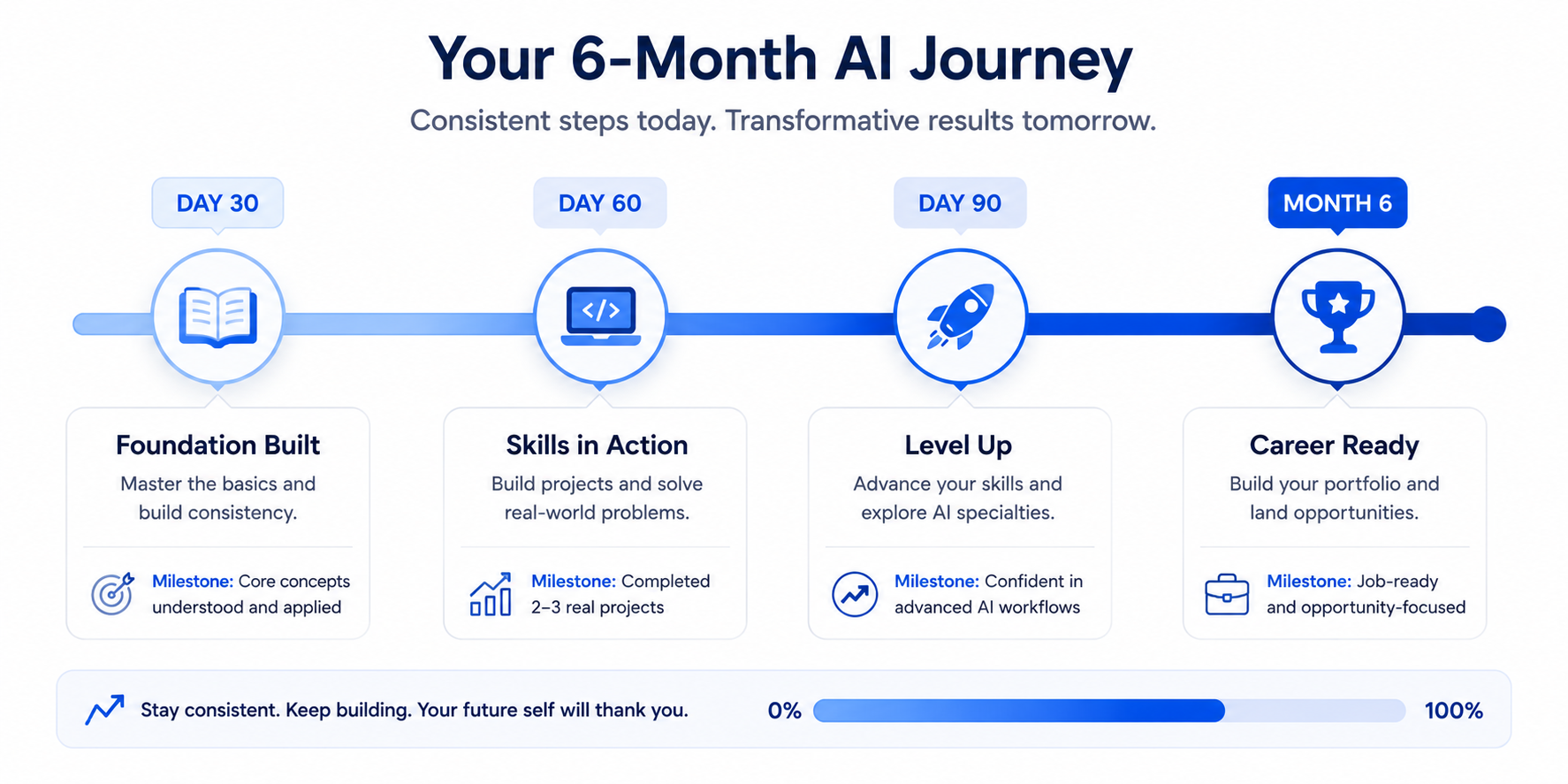
Being honest here: if you commit to 1–2 hours per day, you can reach a basic job-ready level in 60–90 days. Advanced AI engineering competency takes 4–6 months. The timeline depends less on raw intelligence and more on how consistently you build and document real projects.
Beginner vs Technical Learning Paths
| Factor | Non-Technical Path | Technical Path |
| Background | Writer, marketer, ops professional | Developer, data analyst, engineer |
| Starting Point | Stage 1 (AI basics) | Stage 2 (prompt fundamentals) |
| Tools Focus | ChatGPT, Claude, no-code tools | API access, Python, LangChain |
| Job Targets | AI content, workflow automation | LLM engineer, AI product manager |
| Time to Hire | 60–90 days | 90–120 days with deeper portfolio |
What Prompt Engineering Actually Means in 2026
What Is Prompt Engineering Beyond ‘Writing Good Prompts’
Prompt engineering is the systematic design, testing, and optimization of inputs to AI language models to produce reliable, accurate, and useful outputs. That’s the real definition — and it’s broader than most people expect.
What is prompt engineering in practice? It’s part communication design, part systems thinking, part quality assurance. A skilled prompt engineer knows how to frame instructions, structure context, set constraints, and iterate quickly when outputs miss the mark.
Core Concepts You Must Understand Early
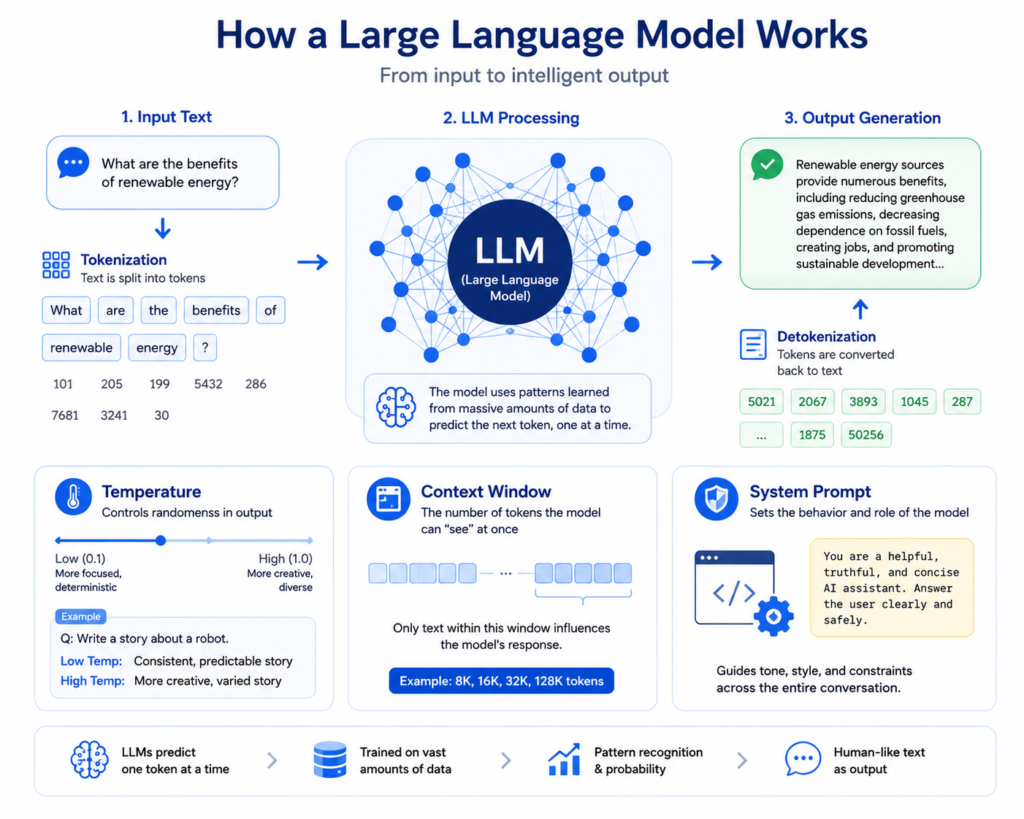
- Tokens: How LLMs read and generate text in chunks
- Context Window: The amount of information a model can hold at once
- Temperature & Top-P: Settings that control output randomness
- System Prompts: Instructions that shape model behavior globally
- Hallucination: Why models sometimes produce confident false answers
- Grounding: Techniques to reduce hallucination using real data
How Modern AI Models Interpret Instructions
Modern LLMs like GPT-4o, Claude 3.7, and Gemini 1.5 Pro are trained to follow instructions — but they interpret ambiguity in ways that aren’t always predictable. From my testing, models respond best to prompts that specify: the role they should play, the format of the output, the audience, the constraints, and a clear example of what ‘good’ looks like.
Understanding this interpretation pattern is the foundation of all advanced prompt techniques.
The Difference Between Prompting and AI Engineering
Prompting is crafting individual inputs. AI engineering is building systems that use prompts as components — connected workflows, automated pipelines, retrieval systems, and evaluation frameworks. The prompt engineering roadmap in this guide takes you from basic prompting all the way to the engineering side.
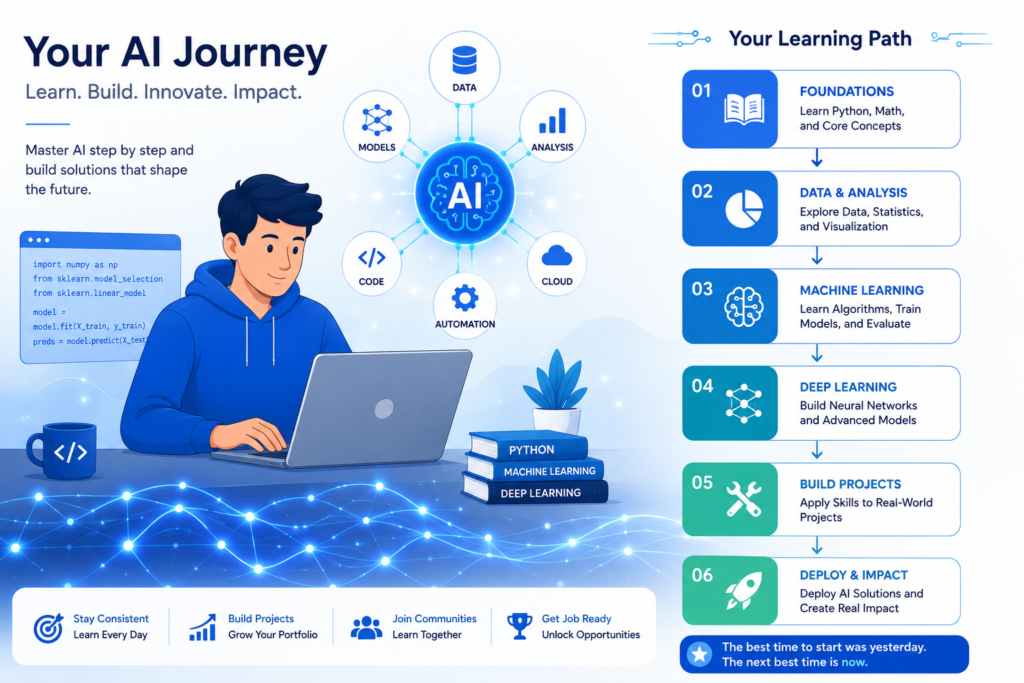
Stage 1: Build Your AI Foundations First
Understanding LLMs Without Deep Mathematics
You don’t need a PhD to understand how LLMs work — but you do need a conceptual model. Think of LLMs as extremely sophisticated pattern-completion systems. They were trained on vast amounts of text and learned to predict the most statistically probable next token. This isn’t ‘thinking’ — it’s extremely powerful interpolation.
Once you understand this, you start to see why specificity beats vagueness, why examples outperform instructions alone, and why context matters so much.
Key AI Concepts That Actually Matter
| Concept | Why It Matters | Beginner Priority |
| Tokens & Tokenization | Affects cost, context length, and prompt efficiency | High |
| Temperature & Sampling | Controls creativity vs precision in outputs | High |
| System vs User Prompts | Shapes model behavior at different levels | High |
| Few-Shot Learning | Giving examples to guide output format/style | High |
| Fine-Tuning vs Prompting | Knowing when prompting is enough vs when models need training | Medium |
| Embeddings & Vectors | Foundation for RAG and semantic search | Medium |
| Hallucination Patterns | Identifying when to add grounding or verification steps | High |
Tools Beginners Should Start Using Immediately
- ChatGPT (GPT-4o): Best for beginners, large community, strong documentation
- Claude.ai: Excellent for long-context tasks and nuanced instruction-following
- Google Gemini: Strong for multimodal tasks and Google Workspace integration
- Perplexity AI: Great for research-based prompting with cited sources
Mistakes That Slow Down Learning Early
⚠️ Common Mistakes at Stage 1
1. Starting with ChatGPT plugins before understanding base model behavior
2. Judging AI by one bad output instead of testing prompt variations
3. Not keeping a prompt journal — tracking what works is how you improve
4. Assuming all LLMs behave identically — they don’t
Stage 2: Learn Prompt Engineering Fundamentals
Prompt Structures That Consistently Produce Better Results
Here’s what actually works when structuring a prompt: the ROLE → TASK → FORMAT → CONSTRAINT → EXAMPLE framework. Every element serves a purpose:
- ROLE: ‘You are a senior UX researcher with 10 years of experience…’
- TASK: ‘Analyze this user feedback and identify the top 3 pain points…’
- FORMAT: ‘Return your answer as a numbered list with one sentence of evidence per point…’
- CONSTRAINT: ‘Focus only on feedback from first-time users. Ignore power users.’
- EXAMPLE: ‘Here is a sample output for a different product: [example]’
This structure works across ChatGPT, Claude, and Gemini — and it’s the foundation of every advanced technique.
Zero-Shot vs Few-Shot Prompting Explained Practically
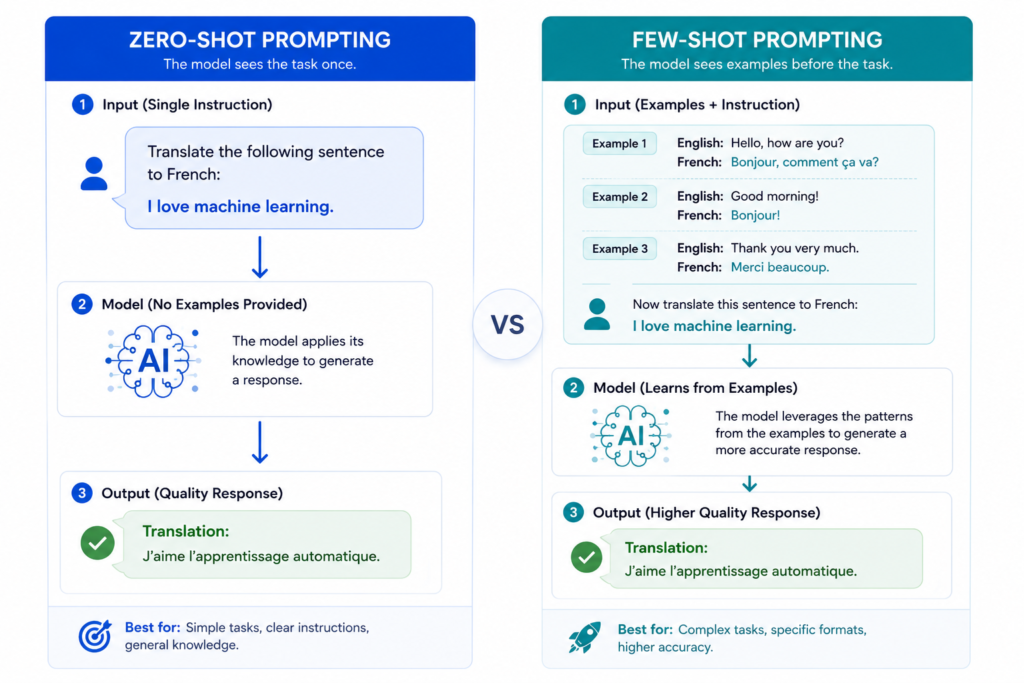
Zero-shot prompting means giving the model a task with no examples — relying entirely on its pre-trained knowledge. Few-shot prompting means including 2–5 examples of your desired output before the actual task. From my testing, few-shot consistently outperforms zero-shot for structured, format-sensitive outputs by 30–50%.
Pro Tip: Use zero-shot for creative tasks where you want variety. Use few-shot when you need consistent format, tone, or structure.
Role Prompting, Chain-of-Thought & Context Framing
Three techniques I return to constantly:
- Role Prompting: Assigning an expert persona dramatically improves output quality on specialized tasks.
- Chain-of-Thought (CoT): Adding ‘Think step by step’ or providing intermediate reasoning steps forces the model to show its work — and drastically reduces errors in logic-heavy tasks.
- Context Framing: Providing relevant background before the main task (audience, purpose, constraints) dramatically increases relevance.
What Actually Works With ChatGPT, Claude & Gemini in 2026
| Model | Best Strength | Prompt Style That Works Best | Watch Out For |
| ChatGPT (GPT-4o) | General tasks, code, plugins | Clear instructions + examples | Over-confident on niche topics |
| Claude 3.7 | Long documents, nuanced reasoning | Detailed role + constraint prompts | Can be overly cautious on edge cases |
| Gemini 1.5 Pro | Multimodal, Google integration | Structured tasks with context | Inconsistent on creative tasks |
| Mistral Large | Fast, open, cost-efficient | Direct task + format specification | Less instruction-following finesse |
Stage 3: Practice With Real Prompt Engineering Projects
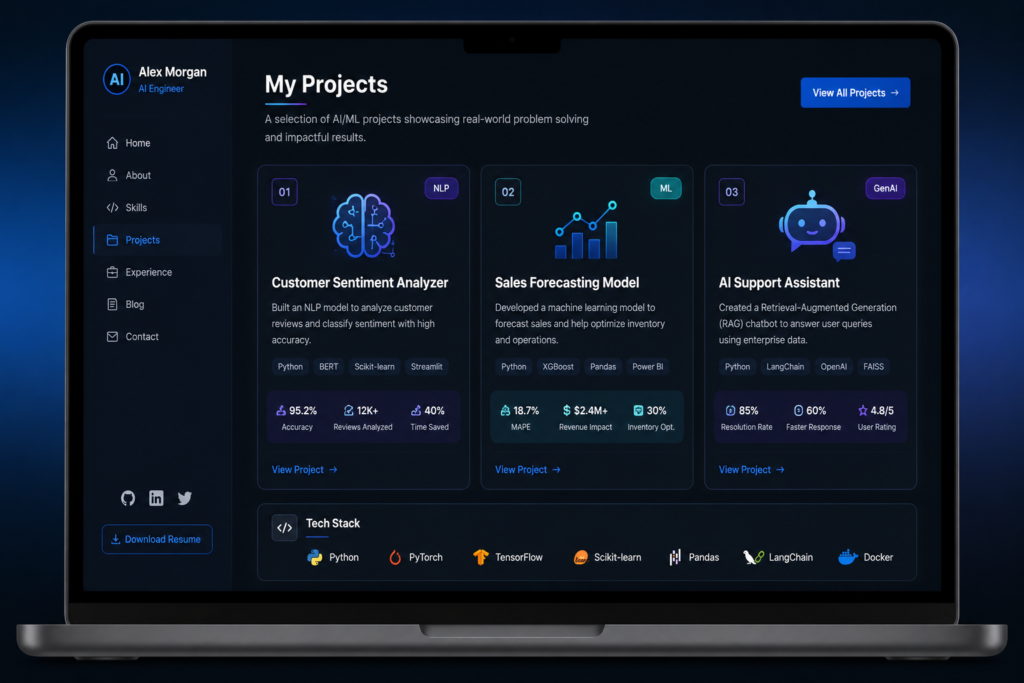
Beginner Projects That Build Real Skills
The difference between someone who ‘knows about’ prompt engineering and someone who gets hired is a project portfolio. Here are the projects I recommend starting with:
- AI Email Assistant: Build a prompt system that drafts, refines, and formats professional emails for different audiences.
- Content Repurposing Engine: A multi-step prompt chain that turns one blog post into 5 content formats (LinkedIn post, Twitter thread, newsletter, summary, FAQ).
- Customer FAQ Bot: Design a system prompt that handles common support questions with accurate, brand-consistent responses.
- Research Summarizer: A prompt pipeline that takes a long document and produces structured summaries at different technical levels.
AI Automation Projects for Portfolio Building
Once you’re comfortable with basic projects, level up with automation-focused work. These are what actually impress hiring managers in 2026:
- Prompt pipeline that generates, scores, and refines outputs automatically
- AI-powered lead enrichment system using structured prompts + web data
- Document classification system with prompt-based categorization logic
- Content QA system that uses AI to check AI-generated content for errors
Prompt Optimization Examples for Real Use Cases
Example: Weak Prompt: “Write a product description.”
Optimized Prompt: “You are a senior e-commerce copywriter. Write a 150-word product description for a sustainable bamboo water bottle targeting eco-conscious millennials. Tone: conversational, benefit-focused. Lead with the primary emotional benefit. End with a clear call-to-action. Do not use the words ‘eco-friendly’ or ‘sustainable’.”
The optimized version gives consistent, publication-ready output. The weak version requires 3–4 revision rounds. That difference is your value.
How to Document Prompt Engineering Projects Professionally
Don’t just build projects — document them. Each project entry in your portfolio should include: the problem it solved, the prompt architecture used, before/after output examples, measurable improvement metrics, and tools used. A GitHub repo or Notion portfolio works well for this.
Stage 4: Learn Advanced Prompt Engineering Techniques
RAG (Retrieval-Augmented Generation) for Prompt Engineers
RAG is the technique that makes AI actually useful for enterprise work. Instead of relying on the model’s training data, RAG pulls relevant information from your own documents or databases and injects it into the prompt context. This dramatically reduces hallucination and makes outputs factually grounded.
As a prompt engineer, you don’t need to build the RAG infrastructure yourself — but you need to understand how to structure prompts that work with retrieved context, how to handle conflicting information, and how to instruct models to cite sources.
AI Agents and Multi-Step Workflows
AI agents are LLMs that can take actions — browsing the web, running code, calling APIs, and making sequential decisions. Prompt engineers design the instructions, constraints, and tool-use patterns that agents follow. This is the fastest-growing area of AI work in 2026.
Platforms like AutoGPT, CrewAI, LangGraph, and Claude’s agent features make this accessible without deep coding. Understanding multi-step reasoning and error-handling in prompts is the key skill here.
Prompt Chaining and System Design
Prompt chaining means breaking complex tasks into sequential steps, where the output of one prompt becomes the input to the next. This is essential for tasks that exceed a single model’s reliable output length or reasoning capacity.
Example chain: Research → Summarize → Extract Key Claims → Fact-Check → Format Report. Each link in this chain requires a carefully designed prompt — and understanding how errors propagate through chains is a critical advanced skill.
Evaluation, Testing & Prompt Iteration Frameworks
Professional prompt engineers don’t just write prompts — they test them. A systematic evaluation framework includes: defining what ‘good’ output looks like (rubric), running prompts across 10–20 test cases, scoring outputs against the rubric, identifying failure modes, and iterating.
🔬 Pro Tip: Prompt Iteration
Change only ONE variable at a time when testing prompts. If you change the role, format, AND examples simultaneously, you won’t know which change improved performance. Treat prompt iteration like a controlled experiment.
The Best AI Prompt Engineering Courses and Training Programs
Free Courses That Are Actually Worth Taking
- DeepLearning.AI — ChatGPT Prompt Engineering for Developers (Andrew Ng) — Free, 1 hour, excellent fundamentals
- Google — Prompt Design in Vertex AI (Google Cloud Skills Boost) — Free with completion badge
- Anthropic — Claude Usage Documentation + Prompt Library — Free, directly from the model maker
- OpenAI Cookbook — Real prompt examples with code — Free, highly practical
Paid AI Prompt Engineer Courses With Practical Value
For paid programs, I look for three things: practical projects, current content (updated for 2025–2026), and real-world use cases. The best paid options in 2026:
- Maven Cohort Courses on AI & Prompt Engineering — Community-based, project-heavy
- Coursera’s AI Prompt Engineering Specialization — Good for structured learners
- LinkedIn Learning’s AI for Business tracks — Useful for non-technical professionals
If you’re building a broader AI career, check out my detailed breakdown of the best AI engineer roadmap and training resources — it covers the full engineering career path beyond prompting.
Certifications vs Real-World Skills
Here’s my honest take: certifications matter less in prompt engineering than in most other tech fields. What matters is a portfolio of documented, measurable work. That said, certifications from Google, Anthropic, or DeepLearning.AI do signal effort and foundational knowledge — use them to open doors, not as a substitute for actual skills.
What to Avoid When Choosing Prompt Engineering Classes
❌ Red Flags in Prompt Engineering Courses
• Course content older than 12 months — the field moves too fast
• No hands-on projects or assessments
• Instructors with no verifiable AI work history
• Claims of ‘7-figure AI income’ without credible proof
• Courses focused only on ChatGPT with no coverage of other models
Essential Tools Every Prompt Engineer Should Learn
ChatGPT, Claude, Gemini & Copilot Compared
| Tool | Best For | Pricing (2026) | API Access |
| ChatGPT (GPT-4o) | General tasks, plugins, coding | $20/mo (Plus) | Yes (pay-per-use) |
| Claude 3.7 (Sonnet/Opus) | Long docs, nuanced reasoning | $20/mo (Pro) | Yes (pay-per-use) |
| Google Gemini 1.5 Pro | Multimodal, 1M token context | Free / $20/mo | Yes (Vertex AI) |
| Microsoft Copilot | Microsoft 365 integration | $30/mo (M365) | Limited |
| Mistral Large | Open-weight, cost-efficient API | Open / API pricing | Yes |
Prompt Management and Testing Tools
- PromptLayer: Track, version, and analyze prompt performance
- LangSmith: Debugging and evaluation for LangChain-based workflows
- Weights & Biases Prompts: Experiment tracking for ML teams
- Humanloop: Prompt management and A/B testing platform
- PromptFoo: Open-source prompt testing and red-teaming
No-Code AI Automation Platforms
- Make (formerly Integromat): Connect AI models with any app via visual workflows
- Zapier AI: Automate tasks with GPT-4 and Claude built in
- n8n: Open-source automation with AI node support
- Flowise: Build LangChain flows with a no-code drag-and-drop interface
When Python Becomes Useful for Prompt Engineers
You don’t need Python to get started — but learning basic Python scripting unlocks a significantly larger set of opportunities. Specifically: calling LLM APIs programmatically, building automated prompt testing scripts, processing large document batches, and working with vector databases for RAG.
If you’re interested in complementary data skills, my guide on the data analyst roadmap for career growth covers the technical foundation that pairs well with AI work.
Beginner vs Advanced Prompt Engineering Career Paths
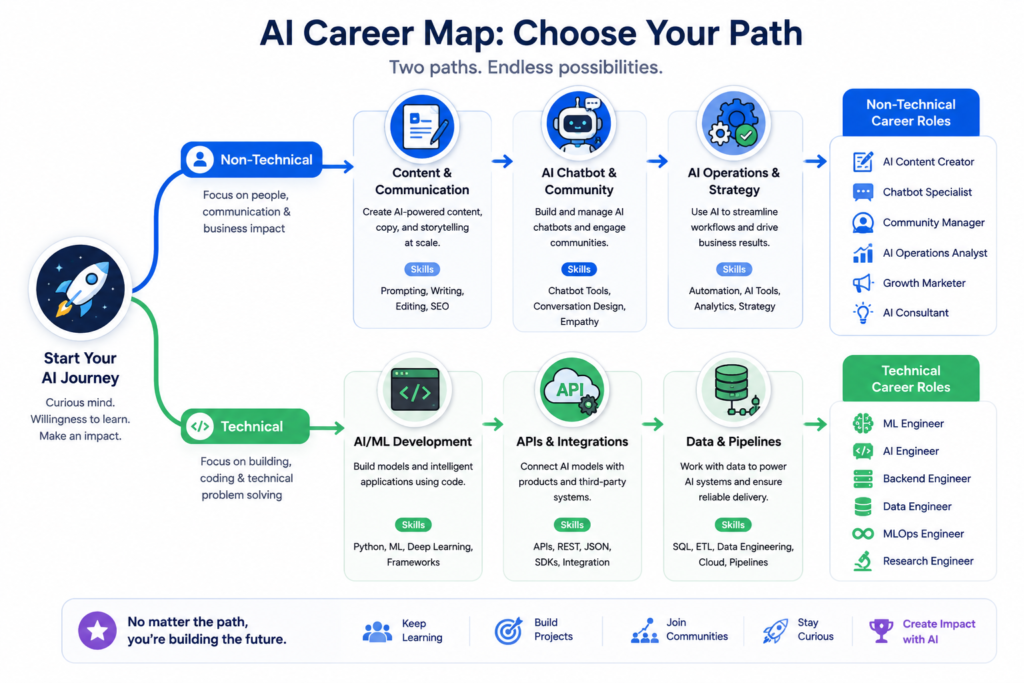
Non-Technical Prompt Engineering Roles
Many of the highest-value prompt engineering roles don’t require coding. These include:
- AI Content Strategist — Using AI to scale content production systems
- Conversational AI Designer — Designing chatbot flows, personas, and escalation logic
- AI Training Data Specialist — Writing and evaluating prompts to improve model behavior
- AI-Powered Operations Manager — Automating internal workflows with AI tools
Technical AI Prompt Engineering Careers
- LLM Integration Engineer — Connecting LLMs to production systems via APIs
- AI Product Manager — Defining AI features, evaluating model outputs, owning prompts in products
- ML Prompt Specialist — Working inside ML teams on model evaluation and fine-tuning
- AI Automation Engineer — Building end-to-end AI workflows with agent frameworks
Freelancing vs Full-Time AI Roles
| Path | Pros | Cons | Ideal For |
| Freelancing | High hourly rate, flexibility, fast entry | Inconsistent income, self-marketing required | Portfolio builders, side-hustlers |
| Full-Time Role | Stability, deeper systems work, team learning | Slower hiring process, requires portfolio | Those wanting career trajectory |
| Consulting | Premium rates, varied work | Requires established reputation | Experienced professionals pivoting to AI |
Skills That Increase Salary Potential
Based on 2026 AI job postings analysis, these skills command the highest premium:
- RAG system design (+$15–25K salary uplift)
- Agent framework experience (LangChain, CrewAI, AutoGen)
- Prompt evaluation and red-teaming
- Python API integration
- Domain expertise (legal, medical, finance) combined with AI skills
Realistic Timeline: How Long Does It Take to Learn Prompt Engineering?
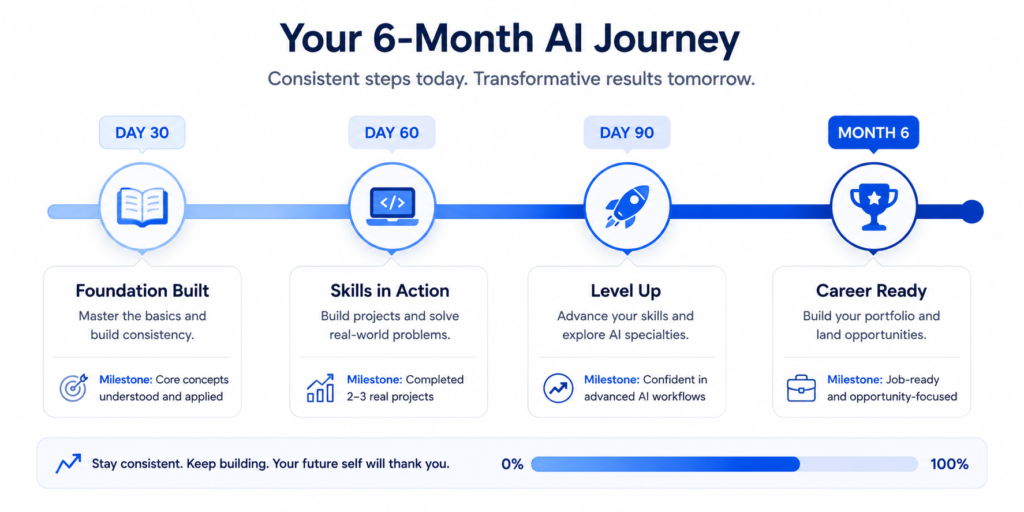
30-Day Beginner Roadmap
- Week 1: Complete one free LLM fundamentals course. Set up ChatGPT and Claude accounts. Start a prompt journal.
- Week 2: Learn and practice zero-shot, few-shot, and chain-of-thought prompting. Complete 20 prompting exercises.
- Week 3: Build your first project (Email Assistant or Content Repurposing Engine). Document it.
- Week 4: Explore one advanced model (Claude or Gemini). Compare outputs. Start learning a no-code automation tool.
90-Day Job-Ready Framework
- Days 1–30: Foundations + first project (as above)
- Days 31–60: Two more portfolio projects, start learning Make or Zapier AI, join one AI community
- Days 61–90: Build one automation project, create a portfolio page (Notion or GitHub), apply to 5+ roles or freelance jobs
6-Month Advanced AI Engineering Path
- Months 1–2: Solid prompt fundamentals + 3 portfolio projects
- Months 3–4: RAG system basics, API access, Python fundamentals
- Months 5–6: Agent workflows, LangChain or similar, advanced evaluation — targeting senior AI roles
Daily Learning Routine That Actually Works
30 minutes of theory + 30 minutes of hands-on practice outperforms 2 hours of passive video watching. Here’s what I recommend for a 1-hour daily routine:
- 15 min: Read one AI article, paper, or documentation section
- 30 min: Build or iterate on a prompt project
- 15 min: Document what you learned or tested
Common Mistakes That Kill Progress
Consuming Too Many Courses Without Building
I call this ‘tutorial purgatory’ — the loop of starting courses, finishing them, and feeling like you haven’t actually learned anything. The fix is brutal: for every 30 minutes of learning, spend 30 minutes building. No exceptions. The muscle of prompt engineering only develops through use.
Copy-Pasting Prompts Without Understanding Structure
Prompt templates are useful for inspiration, not for copying blindly. If you can’t explain why each element of a prompt is there, you can’t adapt it when it fails — and it will fail on your specific use case. Always deconstruct prompts you find valuable and rebuild them from scratch.
Ignoring AI Fundamentals
You can get decent results from AI without understanding how it works. You cannot get consistently great results. Understanding tokenization, context limits, and model behavior turns ‘lucky outputs’ into reliable systems. If you’ve skipped Stage 1, go back.
Not Building a Public Portfolio
The single biggest career mistake I see: people with genuine skills who have nothing to show. In 2026, a Notion page or GitHub repo with 3–5 documented prompt projects is worth more than any certification. Build in public. Share your work. Document your process.
What Actually Works in 2026
Skills Companies Truly Care About
From job descriptions, hiring manager interviews, and direct AI team feedback — here’s what actually gets you hired in 2026:
- Demonstrated ability to reduce AI output errors in real workflows
- Prompt versioning and documentation (treating prompts like code)
- Understanding of model differences and when to use which model
- Experience building multi-step AI workflows, not just single prompts
- Domain knowledge combined with AI skills (not AI alone)
Why Practical AI Work Beats Certifications
Certifications signal effort. Portfolios signal capability. The best hiring managers in AI tell me the same thing: ‘I want to see what you built.’ A well-documented project showing a real problem solved with AI — with clear before/after metrics — beats a certificate wall every time.
The Shift From ‘Prompt Writing’ to AI Systems Thinking
The field is maturing. What was called ‘prompt engineering’ in 2023 is now a subset of a broader discipline: AI systems design. The people earning top salaries in 2026 don’t just write prompts — they design AI-powered workflows, evaluation pipelines, and automation systems. This guide prepares you for that shift.
Future-Proof Skills Beyond Basic Prompting
- AI evaluation and red-teaming: Testing models for safety, accuracy, and bias
- Agent architecture: Designing multi-step AI systems that plan and act
- Fine-tuning literacy: Understanding when and how to customize base models
- Cross-model portability: Building prompts that work across different LLMs
Recommended Learning Resources
Best YouTube Channels
- Andrej Karpathy — Deep, technical AI education from a former OpenAI/Tesla lead
- Matt Wolfe — Practical AI tools and workflows for creators and marketers
- AI Explained — Clear breakdowns of new model releases and research
- Sam Witteveen — Hands-on LangChain, agents, and RAG tutorials
Best Communities and Discord Servers
- r/PromptEngineering (Reddit) — Active community with real prompt examples
- Hugging Face Discord — Technical discussions on models and fine-tuning
- LangChain Discord — Agent and workflow building discussions
- FlowiseAI Community — No-code AI automation builders
Best Documentation and Research Sources
- Anthropic’s Claude Prompt Library (docs.anthropic.com) — Best structured prompt examples available
- OpenAI Cookbook (cookbook.openai.com) — Practical API and prompt patterns
- LMSYS Chatbot Arena (lmarena.ai) — Compare model outputs side by side
- Papers With Code — Track which prompting research is actually being implemented
Best AI Newsletters to Follow
- The Rundown AI — Daily digest of the most important AI news
- Import AI (Jack Clark) — Technical AI research commentary
- Ben’s Bites — Practical AI tools and use cases
- TLDR AI — Fast, curated AI news for practitioners
For broader AI career preparation, also check out the best data analytics tools guide — many of these tools integrate directly with AI systems and are increasingly relevant for prompt engineers working on data-driven applications.
FAQ: Prompt Engineering Roadmap
Can I Become a Prompt Engineer Without Coding?
Yes — and many people do. The non-technical path focuses on prompt design, workflow automation with no-code tools, and content/operations applications. You will eventually hit a ceiling without basic Python, but that ceiling is well above entry-level roles. Many successful prompt engineers in content, marketing, and operations have zero coding background.
Is Prompt Engineering Still Worth Learning in 2026?
Absolutely — but the definition has evolved. Basic ‘write better prompts’ skills have become commodity knowledge. What’s valuable now is AI systems thinking: RAG, agent workflows, evaluation frameworks, and automation architecture. Follow this prompt engineering roadmap to that level and you’ll have genuinely scarce, in-demand skills.
Which AI Tool Is Best for Beginners?
Start with ChatGPT for breadth and community support. Add Claude within the first month for its superior instruction-following on complex tasks. Don’t jump to API access until you have at least 30 days of hands-on prompting experience — you’ll get more value from it once you understand what you’re measuring.
Do Companies Actually Hire Prompt Engineers?
Yes — though often under different titles. Search for: AI Automation Specialist, LLM Integration Engineer, Conversational AI Designer, AI Product Manager, AI Content Strategist. The role exists — the label varies by company size and industry.
What Salary Can AI Prompt Engineers Expect?
Based on 2026 market data: entry-level non-technical roles: $55,000–$80,000. Mid-level with portfolio: $80,000–$120,000. Senior technical AI engineers: $130,000–$200,000+. Freelance rates range from $75–$250/hour depending on specialization and domain expertise.
Is AI Prompt Engineering a Long-Term Career?
The specific title ‘prompt engineer’ may evolve — but the underlying skills (AI system design, workflow automation, model evaluation) are foundational to how businesses will operate for the foreseeable future. People who develop these skills now will have significant advantage as the field matures, regardless of what the role gets called.
Final Action Plan
The Best Order to Learn Prompt Engineering
- Start with AI foundations (1–2 weeks)
- Learn core prompting techniques (1–2 weeks)
- Build your first project (1 week)
- Explore no-code automation tools (1 week)
- Document and publish your first portfolio piece (ongoing)
- Add advanced techniques (RAG, agents) as you progress
- Apply to roles or freelance projects with documented work
Weekly Skill-Building Checklist
- Completed at least one hands-on prompting session
- Added one entry to prompt journal
- Read or watched one piece of AI content
- Made progress on current portfolio project
- Engaged with one AI community or discussion
How to Stay Ahead as AI Changes Rapidly
The best strategy isn’t to chase every new model release — it’s to build durable skills that transfer. Understanding prompt structure, evaluation, and systems thinking works regardless of which LLM is dominant in 6 months. Follow 2–3 high-quality sources, test new tools when they’re relevant to your work, and prioritize depth over breadth.
Your Next 3 Steps After Reading This Guide
✅ Your Next 3 Steps
1. Sign up for Claude.ai and ChatGPT today. Spend 30 minutes testing the same prompt on both.
2. Complete the free DeepLearning.AI prompt engineering course this week.
3. Start your first portfolio project using the Email Assistant template from Stage 3.
If you want to expand into broader AI and data skills, my guide on how to become an AI engineer walks through the full technical career path. And if you’re building a career in data, the data analyst courses for beginners guide is a strong complement to this roadmap.
