PMP Exam Prep: Top Training Courses and Tips for 2026
Table of Contents
- PMP Exam Prep: Top Training Courses and Tips for 2026
- 1. What Is a PMP Certification Course?
- 2. PMP Certification Requirements for 2026
- 3. Best PMP Certification Courses for 2026
- 4. PMP Certification Cost and Fees
- 5. How to Prepare for the PMP Exam
- 6. PMP Exam Day Tips
- 7. Real Career Benefits of PMP Certification
- 8. Final Thoughts
- Frequently Asked Questions About PMP Certification

If you’re serious about advancing in your career, enrolling in a strong PMP certification course is one of the best moves you can make in 2026. I’ve spent years working in project management — and I’ve helped dozens of professionals just like you go from feeling overwhelmed by the process to holding their certified project management professional credential in hand. Honestly, the journey is demanding, but it’s absolutely worth every hour you put in.
The demand for skilled project managers keeps growing across industries. Moreover, organizations now actively filter for candidates who hold a project management professional certification when filling senior roles. According to PMI’s own salary survey, PMP-certified professionals consistently earn significantly more than their non-certified peers — and that gap is widening each year.
In this guide, I’ll walk you through everything — from choosing the right PMP certification course online to understanding what the project management professional PMP exam actually tests you on, how much the whole process costs, and how to build a study plan that works around a full-time job. Whether you’re just starting your prep or almost ready to schedule your exam, this guide has what you need.
1. What Is a PMP Certification Course?
What Does PMP Mean?
PMP stands for Project Management Professional — the gold standard credential issued by the Project Management Institute (PMI). A project management professional PMP is someone who has demonstrated the skills, knowledge, and experience to lead and direct projects using globally recognized frameworks.
A PMP certification course is a structured training program that prepares you for the PMP exam. These courses typically cover both traditional (predictive/waterfall) and agile project management methodologies — which is exactly what the current exam tests. Furthermore, most courses are designed to fulfill PMI’s mandatory requirement of 35 contact hours of project management education before you can apply.
Here’s what a quality PMP course usually covers:
- Project initiation, planning, and execution fundamentals
- Agile and hybrid project management frameworks
- Risk identification and response planning
- Schedule, cost, and quality management
- Stakeholder engagement and team leadership
Why PMP Certification Matters in 2026
Let me be straight with you — getting your project manager PMP certification is one of the smartest career investments you can make right now. The job market is increasingly favoring professionals who can prove their competency through credentials, and the project management professional certification PMP is the one that consistently delivers results.
Here is why PMP certification matters more than ever:
- Salary boost: PMI reports that PMP-certified professionals earn up to 33% more than their non-certified peers globally
- Global recognition: The PMP is valued in over 200 countries across virtually every major industry
- Leadership access: Many senior PM roles now list PMP certification as a minimum requirement, not a preference
- Industry flexibility: Your project management certification travels with you across sectors — IT, construction, healthcare, finance, and beyond
- Career security: Certified project managers rank among the least replaceable professionals in the workforce
I’ve seen first-hand how a project manager certification transforms careers. Therefore, if you’re serious about growth, the PMP should be at the top of your list.
PMP vs CAPM Certification
A question I get asked all the time is: should I go for PMP or CAPM? Let me break it down clearly so you can make the right choice.
The CAPM (Certified Associate in Project Management) is also issued by PMI and is designed specifically for entry-level professionals or those with limited project experience. In contrast, the PMP targets experienced project managers who are already leading teams and delivering projects. Here’s a direct comparison:
| Factor | PMP | CAPM |
| Experience Required | 3–5 years of leadership | No experience needed |
| Education | Degree or diploma | Secondary diploma or higher |
| Exam Questions | 180 questions | 150 questions |
| Salary Impact | High (up to 33% more) | Moderate |
| Best For | Experienced PMs | Beginners and students |
| Exam Fee (PMI member) | $405 | $225 |
In short, if you’re new to project management, a CAPM certificate is a solid starting point. However, if you already have experience directing projects and leading teams, go straight for the PMP — the career payoff is much greater.
I’ve also written a detailed guide on AWS certification courses that shows just how career-defining the right credential can be — and the PMP works the same way in the project management space.
2. PMP Certification Requirements for 2026
Education Requirements
Before you enroll in a PMP certification course and start prepping, you need to confirm that you meet PMI’s eligibility criteria. The good news is that the PMP certification requirements are clear and achievable once you know what to gather.
Here is what PMI requires educationally:
- 4-year degree (bachelor’s or global equivalent): You need 36 months of project leadership experience
- High school diploma or associate’s degree: You need 60 months of project leadership experience
- All applicants must complete 35 hours of project management education or training — this is exactly what a quality PMP certification course provides
The 35-hour education requirement is non-negotiable. Therefore, before you choose your course, confirm that it explicitly states the number of contact hours and provides a certificate of completion. PMI will ask for this documentation.
Work Experience Requirements
Your work experience needs to clearly show that you’ve led projects — not simply participated in them. PMI wants genuine leadership, not general work history. Specifically, this means demonstrating that you have:
- Made decisions about project scope, schedule, budget, or resources
- Managed stakeholder relationships and cross-functional teams
- Directed project outcomes from initiation through closure
One of the most common mistakes I see applicants make is listing general employment history rather than specific project leadership moments. In addition, many people undersell themselves — if you’ve led initiatives, managed timelines, or directed team priorities, those experiences absolutely qualify.
Also, your experience does not have to be from a formal ‘Project Manager’ role. PMI accepts experience from any industry and any job title, as long as the work demonstrates project leadership. So, review your career honestly — you may have more qualifying experience than you realize.
Documents You Need Before Applying
Once you are confident you meet the PMP certification requirements, gather these items before starting your PMI application:
1. Create a PMI account at pmi.org — this is where you manage your entire application
2. Document all relevant project experience with clear descriptions of your leadership contributions and project timelines
3. Record your 35 hours of education with the course name, provider, and completion date
4. Have your academic credentials (degree or diploma) available for reference
5. Pay your exam application fee and schedule your exam date once approved
One important tip: PMI audits a portion of applications at random. Therefore, always keep your training certificate and educational records safely stored. If you’re selected for an audit, you’ll need to submit physical documentation within a short window.
3. Best PMP Certification Courses for 2026
Best PMP Certification Course Online
Finding a great PMP certification course online can feel overwhelming — there are literally hundreds of options. However, after reviewing and comparing dozens of programs over the years, I’ve found that the best ones consistently share a few key qualities that separate them from the rest.
Look for these features when choosing any online PMP course:
- Content aligned to the current PMP Exam Content Outline (ECO) — the exam changed significantly in 2021 and continues to evolve
- At least 35 contact hours of instruction to fulfill PMI’s mandatory education requirement
- Full-length practice exams with detailed answer explanations — not just answer keys
- Coverage of both predictive and agile methodologies, since roughly half the exam covers each
- Active instructor support or a live community forum where you can get questions answered
- A downloadable certificate of completion that you can submit directly to PMI
Some of the most trusted platforms for online PMP prep include PMI’s own training marketplace, Simplilearn, Brain Sensei, and PrepCast. Each has its strengths, so your choice should depend on your learning style and how much you’re willing to spend.
Best PMP Courses on Coursera
If you prefer a structured, academic-style learning experience, PMP certification Coursera programs are worth exploring. Coursera partners with top universities and training organizations to deliver peer-reviewed, professionally produced content.
The most popular project management-related program on Coursera is the Google Project Management Certificate. While it is not a direct PMP prep course, it provides excellent foundational knowledge — especially for professionals who are newer to formal project management frameworks. Furthermore, it covers agile, scrum, and traditional methodologies in an accessible and well-paced format.
For more focused PMP exam preparation on Coursera, look for:
- PMI-authorized programs listed directly on the platform with the 35-hour requirement specified
- Courses with recent content updates — avoid anything last updated before 2022
- Programs with strong learner reviews from verified PMP candidates
Coursera also offers financial aid and subscription options, so cost should not be a barrier. In addition, many courses allow you to audit content for free before committing to a paid enrollment.
Best PMP Courses on Udemy
When affordability is your top priority, Udemy PMP certification courses are genuinely hard to beat. You can often purchase a comprehensive, highly rated PMP prep course for under $20 during one of Udemy’s frequent promotional sales.
Among the most consistently reviewed courses on the platform are those by instructors like Joseph Phillips and Andrew Ramdayal. These programs receive strong ratings for their clear explanations, realistic practice questions, and practical real-world examples that align with the current exam format.
However, keep this in mind: Udemy courses are entirely self-paced and do not typically include live instructor support. Therefore, they work best for self-disciplined learners who can stay consistent without external accountability. If that sounds like you, Udemy offers exceptional value.
Speaking of online learning, if you’re also building technical skills alongside your PMP prep, check out my guides on AI courses for beginners andthe top AI skills for 2026 — both are increasingly valuable for project managers working in tech-driven environments.
Free PMP Certification Course Options
Let me address this clearly: there is no such thing as a completely free PMP certification. The exam itself has a fee, and PMI doesn’t waive it. However, there are genuinely useful free study resources that can significantly support your paid preparation.
Here are the best free options you can use alongside your main pmp certification course free study plan:
- PMI’s own free webinars and recorded PDU sessions — excellent for continuing education
- YouTube channels by instructors like Andrew Ramdayal (TIA Education) — detailed, exam-focused, and free
- Free limited-question practice exams on platforms like PM Exam Simulator
- PMI’s PMBOK Guide — available free for PMI members (membership is $139/year)
- Reddit’s r/pmp community — real exam experiences, weekly study threads, and peer motivation
The smartest approach is to use free resources to reinforce a paid course — not to replace it. The exam has changed significantly, and relying solely on free content is a risky strategy.
Instructor-Led vs Self-Paced PMP Training
Choosing between instructor-led and self-paced training comes down to your learning style, schedule, and budget. Here is a straightforward breakdown based on what I have seen work for different types of learners.
Instructor-led training works best if you:
- Learn most effectively through live interaction and real-time Q&A
- Need external accountability to stay consistent with your study schedule
- Want immediate feedback and discussion on tricky practice questions
Self-paced training is a better fit if you:
- Work full-time and need maximum schedule flexibility
- Are naturally self-disciplined and can set your own learning goals
- Want to move quickly through topics you already understand well
For most working professionals I’ve guided through this process, a self-paced course paired with a clear personal study schedule delivers the best results. Furthermore, many modern platforms now offer hybrid formats — pre-recorded lessons with periodic live Q&A sessions — giving you structure without sacrificing flexibility.
4. PMP Certification Cost and Fees
PMP Certification Cost Breakdown
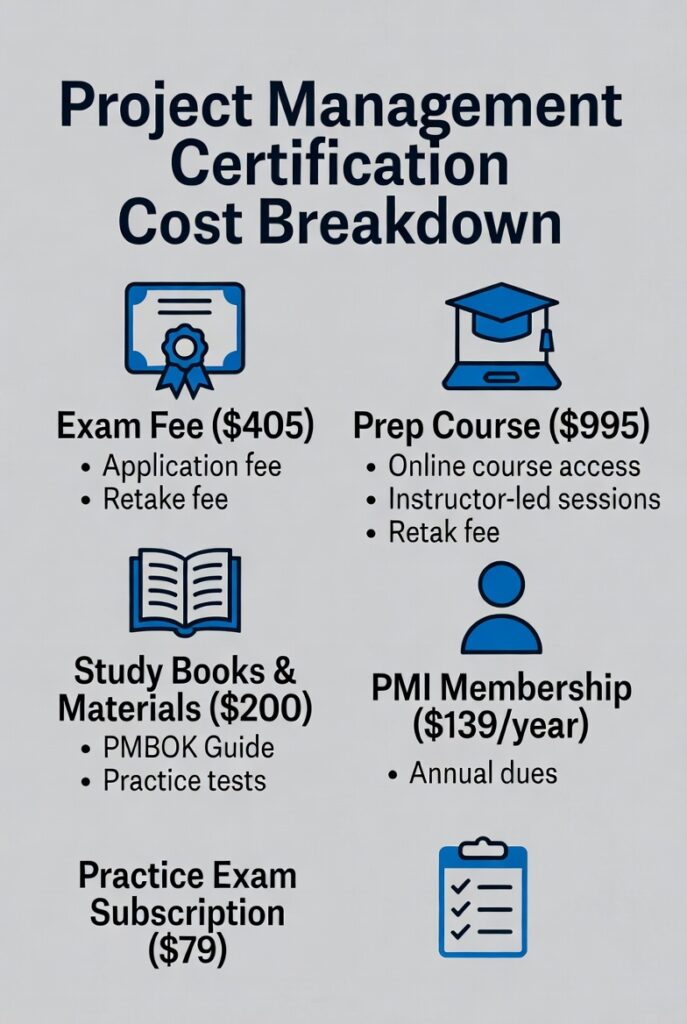
The total PMP certification cost varies depending on how you approach your preparation. Let me walk you through a realistic breakdown so there are no surprises along the way.
| Cost Item | Estimated Cost (USD) |
| PMI Membership (optional but highly recommended) | $139/year |
| PMP Exam Fee (PMI Member) | $405 |
| PMP Exam Fee (Non-Member) | $555 |
| Self-Paced Online Course (e.g., Udemy) | $20–$200 |
| Instructor-Led Bootcamp | $1,500–$3,000 |
| Practice Exam Subscription (e.g., PrepCast) | $69–$99 |
| Study Books (e.g., Rita Mulcahy’s PMP Prep) | $40–$60 |
| Total Estimated Range (with PMI membership) | $673–$3,500+ |
My personal recommendation: join PMI before you apply. The membership fee of $139 saves you $150 on the exam fee alone — which means it essentially pays for itself. Moreover, members receive the PMBOK Guide digitally at no extra cost, saving you another $50–$70.
Is PMP Certification Worth the Cost?
Absolutely — and I say that with full confidence based on both personal experience and consistent industry data. The return on investment for a PMP is among the highest of any professional certification available today.
Consider this: PMI’s Earning Power Salary Survey reports that PMP-certified professionals in the United States earn a median salary of around $123,000. That is significantly higher than comparable non-certified project managers in the same roles.
Beyond the salary, here is what you gain:
- Faster career progression — PMP holders often bypass one or two rungs on the career ladder
- More recruiter attention and higher-quality job offers
- Global mobility — the credential is respected across industries and countries
- Deeper confidence in your frameworks, tools, and decision-making
Even if the cost pmp certification requires feels high upfront, most professionals recoup it within their first year through salary increases alone. Therefore, treat it as an investment in your future — because that is exactly what it is.
5. How to Prepare for the PMP Exam
Create a 3-Month PMP Study Plan
The most common question I get from candidates is: can I pass PMP in 3 months? The honest answer is yes — absolutely — if you stay organized and consistent. In fact, three months is the sweet spot for most working professionals balancing prep with a full-time job.
Here is a practical 3-month framework that consistently works:
Month 1 — Build Your Foundation:
- Complete your PMP certification course and log all 35 contact hours
- Read through the PMBOK Guide or your course’s core materials — focus on understanding, not memorizing
- Study both predictive and agile frameworks side by side
- Create summary sheets and personal notes as you progress through each topic
Month 2 — Practice and Deepen Your Knowledge:
- Begin taking chapter-level practice questions immediately after finishing each topic
- Review agile, hybrid, and scrum concepts in detail — these carry roughly 50% of the exam
- Join a study group or the r/pmp Reddit community for peer support and motivation
- Target 50 to 100 practice questions per day to build stamina and test familiarity
Month 3 — Simulate and Refine:
- Take at least three to five full-length mock exams under timed conditions
- Carefully analyze your weakest areas and revisit those topics specifically
- Focus on scenario-based and situational questions — these dominate the real exam
- Simulate real exam conditions: timed, no breaks, no distractions
In addition to following this schedule, take short daily breaks and avoid burnout. Consistent, focused study sessions beat marathon cramming sessions every single time.
Best PMP Study Resources
Over the years, I’ve tested a wide range of study materials. Here are the resources that consistently produce the best results for PMP candidates:
- PMP Exam Prep by Rita Mulcahy — still one of the most respected books in the space
- PrepCast Exam Simulator — the closest thing to the actual exam experience available today
- Andrew Ramdayal’s Udemy course — exceptional for understanding the PMI mindset, not just the content
- PMI’s Agile Practice Guide — free for members and essential for the agile portion of the exam
- r/pmp on Reddit — genuine test-taker experiences, study strategies, and weekly community threads
- YouTube channels like TIA Education for free, structured video explanations of key concepts
Moreover, flashcards are genuinely underrated. I used them to drill key terms and formulas quickly during commutes and lunch breaks. Apps like Anki make this process simple and surprisingly effective.
If you’re also sharpening complementary technical skills alongside your PMP prep, my guides on the best Python courses in 2026 and cybersecurity skills are worth exploring — both are increasingly relevant for modern project managers.
Common PMP Exam Mistakes to Avoid
I’ve coached many PMP candidates over the years, and the same mistakes come up repeatedly. Here is what to actively watch out for:

How Difficult Is the PMP Exam?
Let me be genuinely honest with you: the PMP exam is challenging. However, it is far from impossible — thousands of people pass it every single month with the right preparation.
The exam is difficult for a few specific reasons:
- Situational questions require critical thinking and judgment, not simple knowledge recall
- The agile content shift has significantly changed the exam since its 2021 update
- Many questions present two equally plausible answers — you must identify the BEST one
- Time pressure is real: 230 minutes goes faster than you expect with 180 questions
Most candidates who fail on their first attempt either did not complete enough practice exams or did not fully understand the PMI mindset. Therefore, focus your preparation on thinking from the perspective of an experienced, proactive, and ethically grounded project manager — that is the lens PMI consistently uses.
How Long Does It Take to Become PMP Certified?
From the moment you start your PMP certification course to the day you hold your certified project management professional credential, here is what the timeline typically looks like:
6. Complete your 35-hour PMP course: 2 to 8 weeks depending on your pace
7. Submit your PMI application: 1 to 2 weeks to complete; PMI takes up to 10 business days to review
8. PMI audit if selected: Up to 90 additional days — though most applicants are not audited
9. Schedule and sit the exam: You have 1 year from application approval to take the test
10. Receive your results: Immediate — you find out on exam day before you leave
In total, most professionals become PMP certified within 3 to 6 months from the time they begin studying seriously. Therefore, if you start your course today, get your hours logged, and submit your application promptly, you could be certified before the end of the year.
6. PMP Exam Day Tips
What to Expect on Exam Day
Whether you choose to sit the exam at a Pearson VUE testing center or take it online from home, the structure is largely the same. Here is what to expect:
- 180 questions delivered over 230 minutes with two optional 10-minute breaks
- Question types include multiple choice, drag-and-drop, matching, and hotspot questions
- You can flag questions and return to them later within the same section
- The exam is entirely computer-based — no printed materials, no physical reference guides
- Online proctoring requires a quiet, clean room with a reliable internet connection and webcam
I always recommend arriving at the testing center at least 30 minutes early, or logging into the online proctoring system at least 15 minutes before your scheduled start time. Furthermore, bring a valid government-issued photo ID — it is mandatory and non-negotiable.
Time Management Strategies During the Exam
Effective time management on exam day can be just as important as your knowledge. Here are the strategies I share with every candidate I coach:
- Target approximately 1 minute per question as your default pacing benchmark
- Flag and skip particularly difficult questions on your first pass — return to them after completing easier items
- Use your two 10-minute breaks strategically — eat a light snack, stretch briefly, and mentally reset
- Trust your first instinct on scenario questions — overthinking often leads to correct-to-wrong answer changes
- In the final 15 minutes, verify that every single question has an answer selected — never leave a blank
Also, during the optional 15-minute tutorial at the start of the exam, use that time wisely. Write down any key formulas, mnemonics, or framework notes on the provided scratch paper — this time does not count against your exam minutes.
For a broader look at professional certifications and how they fit into a career development strategy, you might also enjoy my guide on CompTIA Security+ certification courses — another high-value credential that pairs well with your PMP journey.
7. Real Career Benefits of PMP Certification
Best Jobs After PMP Certification
Once you earn your project management professional certificate, a wide range of senior roles becomes accessible. In fact, many hiring managers and recruiters now specifically search for PMP holders when filling project leadership positions. Here are the most common and rewarding career paths:
- Project Manager — the most direct role; typical US salary range of $90,000 to $130,000
- Program Manager — overseeing multiple related projects simultaneously; often $110,000 to $150,000
- Operations Manager — applying PM frameworks to improve business efficiency and processes
- IT Project Manager — high demand in tech companies, often working within agile team environments
- Construction Project Manager — strong and consistent demand in infrastructure and real estate sectors
- Scrum Master or Agile Coach — combining PMP credentials with agile expertise is a powerful and sought-after combination
Industries That Value PMP Certification
One of the greatest advantages of PMP certification is that it is genuinely industry-agnostic. However, certain sectors actively prioritize it during hiring decisions:
- Information Technology: IT project managers are among the highest-paid PMP holders globally
- Healthcare: Hospitals and medical organizations need certified PMs to manage complex system rollouts and compliance projects
- Finance and Banking: Regulatory, compliance, and transformation projects demand rigorous PM frameworks
- Construction and Engineering: Tight timelines and large budgets make formal project management expertise essential
- Manufacturing: Process improvement, lean initiatives, and supply chain projects align naturally with PM skills
Furthermore, the public sector — including government agencies and defense contractors — frequently requires or strongly prefers PMP certification for anyone leading major projects or programs.
PMP Certification Salary Expectations
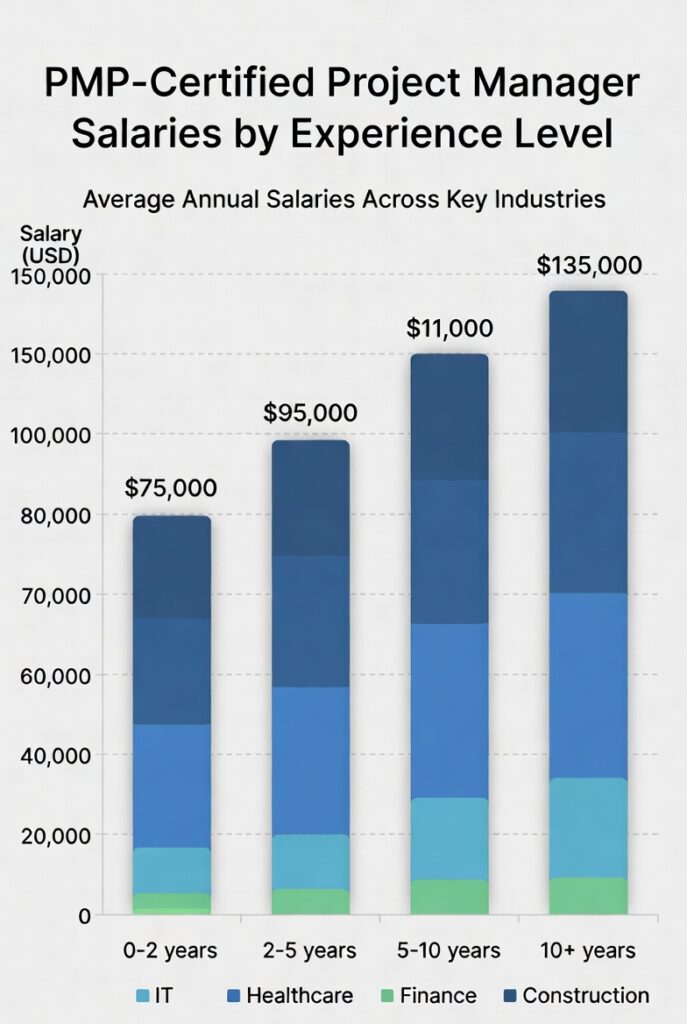
Let me share the numbers — because salary is usually the most motivating factor for people considering the PMP. Here is a realistic look at what you can expect after earning your project manager PMP certification:
| Experience Level | US Average Salary | Global Average |
| Entry-Level (0–3 years) | $75,000 – $90,000 | $40,000 – $60,000 |
| Mid-Level (3–7 years) | $95,000 – $120,000 | $55,000 – $85,000 |
| Senior Level (7+ years) | $120,000 – $160,000+ | $70,000 – $110,000+ |
Even globally, PMP holders consistently earn above the local average for project management roles. Moreover, as organizations continue adopting hybrid and agile delivery frameworks, the demand for certified professionals keeps rising — which means salaries are trending upward across the board.
If you’re building a broader professional skill set beyond project management, you might also find real value in exploring entrepreneurship courses for founders or digital marketing courses for business owners — both of which complement the strategic leadership thinking you develop through PMP training.
8. Final Thoughts
If there’s one thing I want you to take away from this guide, it’s this: choosing the right PMP certification course and committing to your preparation is one of the highest-return investments you can make in your professional life in 2026.
I’ve walked this path myself. I’ve also guided many professionals through it — from the initial application anxiety to the moment they found out they passed. The process takes real effort, consistent study, and a willingness to think differently about project management. However, the rewards are absolutely worth it.
Therefore, start by comparing your course options, matching your learning style to the right format, and getting those 35 training hours logged. Whether you choose a budget-friendly Udemy program, a structured Coursera path, or a full instructor-led bootcamp, the most important step is simply starting.
Your PMP journey begins with a single enrollment. Take that step today — your future career will thank you for it.
Frequently Asked Questions About PMP Certification
How Much Does It Cost to Get PMP Certification?
The total cost depends on how you approach your preparation. The exam fee alone is $405 for PMI members or $555 for non-members. When you add a prep course ($20 to $3,000 depending on format), study books (around $50), and a practice exam subscription (around $99), the realistic total falls between $673 and $3,500 or more. Joining PMI for $139/year is highly recommended — it reduces your exam fee by $150 and gives you free digital access to the PMBOK Guide.
Is PMP Better Than CAPM?
For experienced project managers, PMP delivers substantially better returns in terms of salary and career advancement. However, if you’re new to the field and don’t yet meet PMP’s experience requirements, the CAPM certification is a smart and practical first step. Think of CAPM as the foundation and PMP as the credential that opens senior doors.
Can I Take a PMP Certification Course Without Experience?
Yes — you can absolutely enroll in a PMP certification course before meeting the full experience requirements. In fact, starting your course early is a strategic move, as it gives you more time to accumulate qualifying experience while building your knowledge base simultaneously. However, you cannot submit your PMI exam application until you meet both the education and experience criteria.
Which PMP Certification Course Is Best for Beginners?
For beginners, I recommend Andrew Ramdayal’s course on Udemy or the Google Project Management Certificate on Coursera. Both offer clear explanations, manageable learning curves, and strong peer communities. Additionally, Udemy’s affordability makes it one of the most accessible options regardless of your budget.
Is a PMP Certification Course Online Worth It?
Absolutely. Online PMP courses are flexible, affordable, and consistently effective — often more so than in-person alternatives because you can control your pace and revisit difficult content. The key is selecting a reputable course that covers the latest PMP Exam Content Outline and explicitly provides the 35 PMI-required contact hours.
How Many Hours Should I Study for PMP?
Most successful candidates study for 150 to 250 hours in total. Spread across three months, that works out to roughly 12 to 20 hours per week. The exact number depends on your level of existing project management experience. Regardless of your starting point, focus the majority of your prep time on full-length practice exams and scenario-based questions — that’s where the real exam is won.