Table of Contents
2. What Makes a Good AI Course for Beginners?
3. Top 10 AI Courses for Beginners in 2026
4. Free vs Paid AI Courses for Beginners
5. How to Choose the Right AI Course for Beginners
6. Career Opportunities After Completing AI Courses
8. FAQ
Introduction

Artificial intelligence is no longer just a buzzword — it is reshaping every industry from healthcare to marketing. In 2026, AI skills are among the most in-demand in the global job market, and the good news is that you do not need a computer science degree to get started. The best AI courses for beginners are designed to meet you exactly where you are, whether you know how to code or not.
I know how overwhelming it can feel to start learning something this big. There are hundreds of options online, and it is hard to know which ones are actually worth your time. So, in this guide, I break down the top 10 AI courses for beginners in 2026 — covering free and paid options, what to look for, and how to match a course to your career goals.
Whether you are a student, a working professional, or simply someone who is curious about artificial intelligence, this article will help you find the right AI learning path and take that first confident step forward.
Why Learn AI in 2026?
Let me be honest with you — if there is one skill that can genuinely change your career trajectory right now, it is AI. The world is shifting faster than most people realize, and those who understand how to work with artificial intelligence tools will have a massive advantage in the job market.
According to the World Economic Forum, AI and machine learning are among the top skills employers are actively seeking in 2026. Companies across industries — from finance and retail to education and healthcare — are integrating AI into their daily operations. Furthermore, the demand for AI-literate professionals is growing at a rate that far outpaces the current supply of trained workers.
So, why should you start now? Here are the key reasons:
- AI jobs are growing across all major industries, not just tech.
- Salaries for AI-related roles average between $85,000 and $150,000+ per year in the US.
- Many beginner-friendly AI courses take only 4–12 weeks to complete.
- Free AI courses from top universities are widely available online.
- Starting early gives you a competitive edge over others who are still waiting.
Moreover, you do not have to aim for a full-time AI engineering role. Even understanding basic AI concepts can make you more effective in roles like marketing, sales, HR, or project management. Therefore, learning AI today is less about switching careers and more about future-proofing the one you already have.
If you are curious about how AI is being applied in real learning environments, I have also written about AI in education and machine learning — it is a great companion read.
AI Careers You Can Start After Learning
One of the most exciting things about entering the AI space today is how many different career paths are open to beginners. You do not need to be a PhD-level researcher to land a meaningful role. Here are five career options that are genuinely accessible after completing beginner AI courses:
- AI Analyst — Review and interpret data generated by AI systems, identify patterns, and present insights to business teams.
- Prompt Engineer — Design and refine text prompts that guide AI tools like ChatGPT to produce better results. This is one of the fastest-growing entry-level AI roles.
- Junior Machine Learning Engineer — With some coding skills, you can assist in building and testing basic machine learning models.
- Data Analyst — Use AI-powered tools to clean, visualize, and analyze large datasets for business decision-making.
- AI Product Specialist — Work with product teams to help design or improve AI-driven software products without needing deep technical expertise.
Each of these roles is beginner-accessible, well-paying, and in high demand. In addition, many of these positions allow remote work, which gives you even more flexibility as you launch your AI career.
What Makes a Good AI Course for Beginners?
Not all online courses are created equal. I have gone through dozens of AI programs, and I can tell you that the ones that actually help beginners succeed share a few important qualities. Before you invest your time or money, here is what to look for.
First, the teaching style matters more than you might think. A good beginner AI course uses plain language, real-world examples, and a step-by-step structure. It does not assume you already know what neural networks or algorithms are — it builds your knowledge from the ground up.
Second, hands-on projects are non-negotiable. Reading theory alone will not prepare you for the real world. The best AI training programs include practical exercises where you actually apply what you learn — even if it is something as simple as building a basic recommendation system or training a model on sample data.
Third, certificates and career value play a big role. A certificate from a recognized platform like Coursera, Google, or IBM carries weight with employers. Additionally, it gives you something tangible to add to your resume or LinkedIn profile.
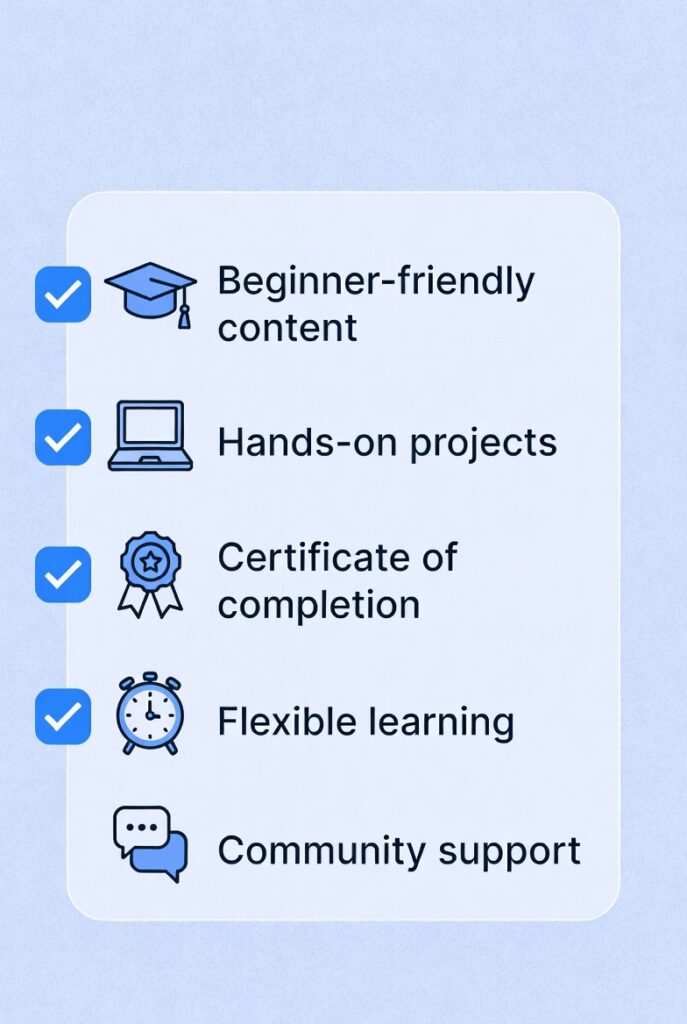
Here is a quick summary of what to prioritize:
- Beginner-friendly teaching style with no assumed technical knowledge
- Hands-on projects and real-world exercises
- Recognized certificates with employer value
- Flexible scheduling — self-paced or part-time options
- Active community forums or mentorship support
Features to Look for in AI Courses for Beginners
Beyond the basics, there are a few more specific features that separate a great beginner AI course from an average one. These are the things I always check before recommending any program:
- Clear explanations with visual aids and examples — especially for complex topics like neural networks
- Real projects you can add to your portfolio, not just quizzes
- No coding requirement for entry-level tracks — many strong courses teach AI concepts without any programming
- Updated content for 2026 that covers current tools like ChatGPT, Gemini, and Copilot
- Practical exercises that mimic real job tasks
Also, think about time commitment. Some courses are designed to be completed in a weekend, while others span several months. Choose based on how much time you can realistically dedicate each week. A course you finish is always better than a course you abandon halfway through.
Top 10 AI Courses for Beginners in 2026
Now, let us get into the main event. Below, I have reviewed the ten best AI courses for beginners available in 2026. Each one has been selected based on content quality, beginner-friendliness, career value, and overall reputation.
1. AI For Everyone by Andrew Ng (Coursera)
Best for: Non-technical beginners who want a solid conceptual foundation.
This is the course I recommend first to anyone who tells me they want to understand AI but have no technical background. Andrew Ng is one of the most respected AI educators in the world, and this course reflects exactly that. It is offered on Coursera and takes approximately 6 hours to complete — making it one of the most accessible AI learning paths available.
The course covers what AI can and cannot do, how to spot AI opportunities in your own organization, and how to navigate an AI-powered world as a non-technical professional. Furthermore, it is free to audit, with a paid certificate option available.
- Platform: Coursera
- Duration: ~6 hours
- Cost: Free to audit / ~$49 for certificate
- Certificate: Yes
- Coding required: No
If you are interested in building on these concepts with the latest tools, check out my guide on top AI skills for 2026 — it pairs perfectly with this course.
2. Introduction to Artificial Intelligence by IBM (Coursera)
Best for: Beginners who want a structured, credential-backed introduction to AI.
IBM’s AI course is another excellent entry point for beginners. It covers the basics of artificial intelligence, including machine learning, deep learning, neural networks, and natural language processing. The course is well-organized and builds concepts logically, so you never feel lost.
Moreover, IBM is a globally recognized name, and their certificate carries real credibility in the job market. This makes it especially valuable if you are looking to transition into an AI-adjacent role in a corporate environment.
- Platform: Coursera
- Duration: ~8 hours
- Cost: Free to audit / certificate with subscription
- Certificate: Yes (IBM badge)
- Coding required: No
3. Google AI Essentials (Google Career Certificates)
Best for: Professionals who want to use AI tools effectively in the workplace.
Google AI Essentials is a practical, skills-focused course designed to help working professionals integrate AI tools into their daily jobs. It covers topics like prompt writing, using generative AI responsibly, and boosting productivity with AI-powered tools.
This is not a theory-heavy course. Instead, it focuses on real, applicable skills you can start using immediately. For instance, you will learn how to write effective prompts, which is one of the most valuable skills in 2026’s AI-driven workplace.
Speaking of prompts — if you want to go deeper, my ChatGPT prompt engineering guide will help you master this skill fast.
- Platform: Google Career Certificates (via Coursera)
- Duration: ~5 hours
- Cost: ~$49 (one-time)
- Certificate: Yes (Google)
- Coding required: No
4. Microsoft AI Skills Challenge
Best for: Beginners who want free access to AI and cloud fundamentals.
Microsoft regularly offers its AI Skills Challenge through Microsoft Learn, and it is completely free. The program covers essential AI concepts alongside Azure cloud basics, making it ideal for students and career changers who want to get both AI and cloud credentials.
In addition, completing Microsoft’s AI learning path opens doors to official Microsoft certifications, which are highly valued in enterprise and government sectors. This is therefore one of the most strategically smart free options on this list.
- Platform: Microsoft Learn
- Duration: Variable (self-paced)
- Cost: Free
- Certificate: Yes (Microsoft Learn badges)
- Coding required: Minimal
5. Elements of AI (University of Helsinki)
Best for: True beginners who want a simple, jargon-free introduction.
Elements of AI was created by the University of Helsinki in partnership with Reaktor. It is one of the most widely completed AI courses in the world, with over one million students enrolled globally. The course is entirely free, browser-based, and requires absolutely no coding knowledge.
What I love most about this course is how clearly it explains core AI concepts. It uses everyday language and relatable examples to help you understand things like machine learning, neural networks, and decision trees without any technical overwhelm. It is, in my opinion, the ideal first step for any complete beginner.
- Platform: elementsofai.com
- Duration: ~30 hours (self-paced)
- Cost: Free
- Certificate: Yes (University of Helsinki)
- Coding required: No
6. Machine Learning Specialization by Andrew Ng (Coursera)
Best for: Beginners who are ready to add some coding to their learning.
Once you have completed a foundational course like AI For Everyone, the Machine Learning Specialization is a natural next step. Also taught by Andrew Ng and hosted on Coursera, this program teaches you the practical side of machine learning using Python.
The course covers supervised learning, unsupervised learning, and reinforcement learning — the three core areas of machine learning. However, do not let the technical-sounding topics intimidate you. The course is structured so that even beginners with basic Python knowledge can follow along comfortably.
- Platform: Coursera
- Duration: ~2 months (at 10 hrs/week)
- Cost: ~$49/month via Coursera subscription
- Certificate: Yes
- Coding required: Yes (Python basics helpful)
7. Harvard CS50 Introduction to AI with Python
Best for: Learners with some programming interest who want academic depth.
Harvard’s CS50 AI course is one of the most rigorous free courses on this list. It is offered through edX and covers fundamental AI concepts like search algorithms, machine learning, and neural networks, all implemented in Python.
This course is genuinely challenging, but also genuinely rewarding. If you are the kind of person who wants to really understand how AI works — not just use it — this is the course for you. It is free to audit, though a verified certificate has a fee attached.
- Platform: edX (HarvardX)
- Duration: ~7 weeks
- Cost: Free to audit / ~$199 for certificate
- Certificate: Yes
- Coding required: Yes (Python)
8. Udemy Complete AI Guide for Beginners
Best for: Budget-conscious learners who want broad AI coverage in one place.
Udemy’s AI guide is a popular one-time-purchase option that covers a wide range of AI topics — from machine learning basics to ChatGPT applications and image generation. Because Udemy courses are frequently discounted, you can often pick this up for as little as $10–$15 during a sale.
The content is practical, regularly updated, and comes with lifetime access. This means you can revisit it anytime new AI tools and techniques are added. For learners on a tight budget who still want comprehensive AI training, this is an excellent value choice.
- Platform: Udemy
- Duration: 15–25 hours
- Cost: ~$10–$85 (check for sales)
- Certificate: Yes (Udemy completion certificate)
- Coding required: Minimal to moderate
9. LinkedIn Learning AI Foundations
Best for: Working professionals who need short, flexible lessons.
LinkedIn Learning‘s AI Foundations path is ideal for busy professionals who want to learn AI concepts without committing to a long course. The content is broken into short video lessons — typically 5–15 minutes each — which means you can fit learning into a lunch break or commute.
Moreover, LinkedIn Learning integrates directly with your LinkedIn profile. When you complete the course, the certificate is automatically added to your profile, making it instantly visible to recruiters. For business users and professionals in non-technical roles, this is one of the most practical and career-relevant options available.
- Platform: LinkedIn Learning
- Duration: ~5–8 hours
- Cost: Included with LinkedIn Premium (~$39.99/month)
- Certificate: Yes (LinkedIn Learning)
- Coding required: No
10. DataCamp AI Fundamentals Track
Best for: Hands-on learners who want interactive coding practice.
DataCamp is one of the best platforms for interactive, practice-first learning. The AI Fundamentals track introduces you to Python, data analysis, and machine learning through browser-based coding exercises — so you learn by doing, not just by watching.
The platform uses a gamified structure with progress tracking, quizzes, and projects, which keeps learning engaging. If you are the type of person who learns best through immediate practice and feedback, DataCamp is arguably the most effective option on this list.
- Platform: DataCamp
- Duration: ~20–30 hours
- Cost: Free tier available / ~$25/month for premium
- Certificate: Yes
- Coding required: Yes (Python, beginner level)
Quick Comparison: Top 10 AI Courses for Beginners
| Course | Platform | Cost | Coding? | Certificate |
| AI For Everyone | Coursera | Free/Paid | No | Yes |
| IBM AI Introduction | Coursera | Free/Paid | No | Yes |
| Google AI Essentials | ~$49 | No | Yes | |
| Microsoft AI Skills | MS Learn | Free | Minimal | Yes |
| Elements of AI | Helsinki | Free | No | Yes |
| ML Specialization | Coursera | ~$49/mo | Yes | Yes |
| Harvard CS50 AI | edX | Free/Paid | Yes | Yes |
| Udemy AI Guide | Udemy | $10–$85 | Minimal | Yes |
| LinkedIn AI Foundations | $39.99/mo | No | Yes | |
| DataCamp AI Track | DataCamp | Free/Paid | Yes | Yes |
Free vs Paid AI Courses for Beginners
One of the most common questions I get is: ‘Are free AI courses actually worth it?’ The honest answer is yes — but with some important caveats.
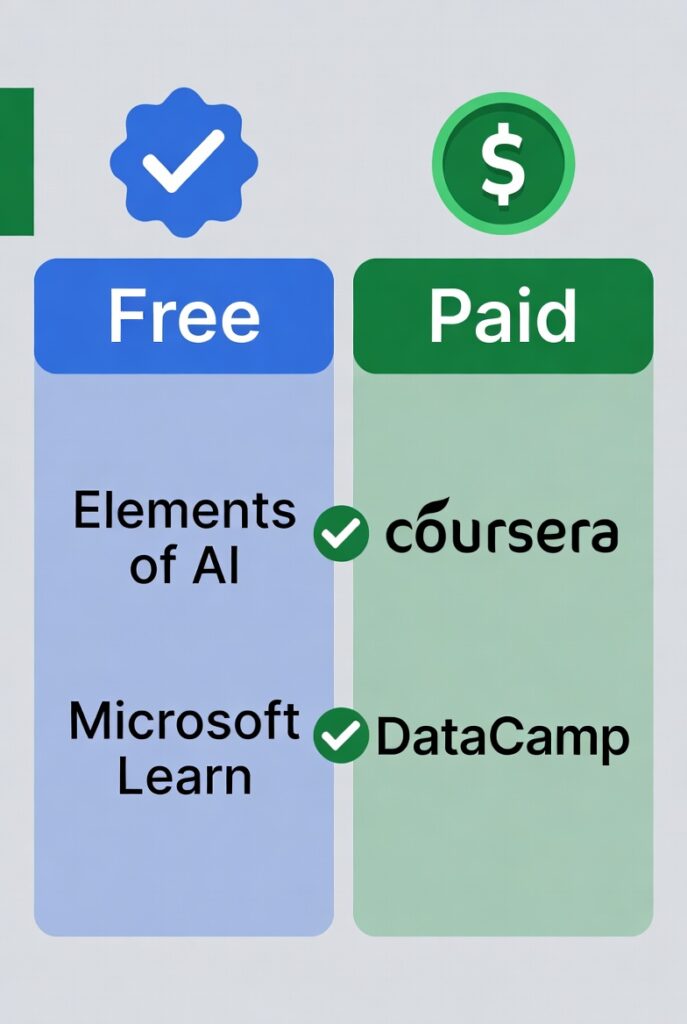
Free AI courses from reputable providers like the University of Helsinki, Google, and Microsoft offer genuine, high-quality learning. They are fully capable of giving you a solid foundation in artificial intelligence. However, they often come with limitations in terms of depth, mentorship access, and the value of the certificate you receive.
Paid courses, on the other hand, tend to offer more structured learning paths, graded projects, and certificates with broader employer recognition. For example, a certificate from Coursera’s Andrew Ng specialization or IBM carries more weight on a resume than a self-generated Udemy certificate.
Here is a simple breakdown to help you decide:
| Factor | Free Courses | Paid Courses |
| Cost | $0 | $10 – $200+ |
| Certificate value | Moderate | High |
| Content depth | Good to excellent | Excellent |
| Mentorship/support | Limited | Often included |
| Best for | Beginners exploring AI | Career changers & job seekers |
My recommendation: start with a free course to confirm your interest, then invest in a paid certification when you are ready to use it for job applications. This approach lets you explore without financial risk while still positioning yourself for career advancement.
How to Choose the Right AI Course for Beginners
With so many options available, choosing the right AI course can feel overwhelming. However, the decision becomes much simpler once you clarify a few things about your own goals and situation.
Start by asking yourself why you want to learn AI. Are you looking to change careers? Improve your current job performance? Satisfy your curiosity? Your answer will determine the type of course that is right for you.
Next, consider your current technical background. If you have never written a line of code in your life, start with a non-technical course like AI For Everyone or Elements of AI. On the other hand, if you already know some Python or have a data-related background, you can jump straight into a more technical track.
Finally, think honestly about your time commitment. If you can only spare 3–4 hours per week, a long specialization course may frustrate you. Instead, opt for a shorter, focused program that you can realistically complete in 4–8 weeks.
Best AI Courses Based on Career Goal
To make the choice even easier, here is a quick guide based on your specific career goal:
| Career Goal | Recommended Course |
| Business professional / manager | Google AI Essentials or LinkedIn AI Foundations |
| Student or recent graduate | Elements of AI or Microsoft AI Skills Challenge |
| Aspiring programmer / developer | ML Specialization or Harvard CS50 AI |
| Non-technical career changer | AI For Everyone or IBM AI Introduction |
| Budget-conscious learner | Elements of AI (free) or Udemy AI Guide (discounted) |
Also, do not overthink it. The best AI course for beginners is the one you will actually finish. Pick something that fits your schedule, your budget, and your learning style — and then commit to it. Starting imperfectly beats not starting at all.
And while you are at it, explore some free AI tools for students and professionals — using real tools alongside your course will accelerate your learning significantly.
Career Opportunities After Completing AI Courses for Beginners

Finishing an AI course is exciting — but what comes next? Let me walk you through the most realistic career opportunities available to beginners after completing an AI learning program.
First, let us talk about entry-level jobs. Roles like AI data annotator, junior data analyst, and AI content specialist are highly accessible to beginners. These positions typically require only foundational AI knowledge and a willingness to learn on the job. Furthermore, many of them are remote-friendly, which gives you geographic flexibility.
Freelancing is another strong option. As AI tools become more widely used by businesses, the demand for freelancers who can help set up, customize, and manage AI workflows is growing quickly. Platforms like Upwork and Fiverr already have active markets for prompt engineers, AI consultants, and automation specialists.
Building a portfolio is essential, regardless of which path you choose. As you complete your AI course, document your projects, write about what you learned, and share your work on GitHub or LinkedIn. A strong portfolio speaks louder than any certificate, especially for freelance and startup roles.
Here is a look at what the future holds for AI beginners:
- AI and machine learning roles are expected to grow by 40%+ through 2030 (World Economic Forum).
- Prompt engineering is becoming a formal, well-paid role at major tech companies.
- Non-technical AI roles in HR, marketing, and operations are multiplying rapidly.
- AI skills are increasingly listed as ‘preferred’ even in non-AI job postings.
- Freelance AI work is accessible and growing — many beginners land gigs within months of completing their first course.
In short, the career ceiling for someone who invests in AI learning today is extremely high. Therefore, the earlier you start, the more time you have to build expertise and earn opportunities.
Final Thoughts
Let me wrap this up with something I genuinely believe: the best time to start learning AI was a year ago. The second-best time is right now.
We are living through one of the most significant technological shifts in human history. AI is not a passing trend — it is the infrastructure of the future. The good news is that the barrier to entry has never been lower. There are free courses from world-class universities, affordable certifications from Google and IBM, and flexible platforms that let you learn at your own pace.
You do not need to know how to code to get started. You do not need a STEM degree. All you need is curiosity and a willingness to put in the time. The AI courses for beginners listed in this guide are specifically designed for people like you — people who are ready to start but not sure where to begin.
So here is my challenge to you: pick one course from this list today. Just one. Set aside a few hours this week and take the first lesson. That single step is all it takes to begin.
AI is not just for engineers anymore — it is for everyone. And with the right beginner AI course, you can be part of this exciting, fast-moving field no matter where you are starting from.
Frequently Asked Questions (FAQ)
Note: FAQ word count is not included in the main article total.
1. Which AI course is best for complete beginners?
If you have no technical background at all, I recommend starting with either AI For Everyone by Andrew Ng on Coursera or Elements of AI by the University of Helsinki. Both are beginner-friendly, require no coding knowledge, and are either free or very affordable.
2. Can I learn AI without coding?
Absolutely. Many of the best AI courses for beginners are designed for non-technical learners. Courses like AI For Everyone, Google AI Essentials, IBM AI Introduction, and Elements of AI teach core AI concepts without requiring any programming knowledge. You can always add coding skills later once you have a solid conceptual foundation.
3. Are free AI courses worth it?
Yes, free AI courses from reputable providers are absolutely worth your time. Programs from the University of Helsinki, Microsoft, and Google offer high-quality content at no cost. The main trade-off is that the certificates from free courses may carry less employer weight than paid, accredited programs. However, they are a great way to explore the field before committing financially.
4. How long does it take to learn AI?
It depends on your goals and time commitment. A foundational AI course can be completed in as little as 6–10 hours. A full specialization or technical track may take 2–4 months at a few hours per week. Most beginners can reach a job-ready level in AI in 3–6 months with consistent effort.
5. Which AI course offers a certificate?
All ten courses on this list offer some form of certificate. The most career-valuable certificates come from Coursera (Andrew Ng, IBM), Google Career Certificates, and edX (Harvard). Microsoft Learn badges are also well-regarded in enterprise environments. For freelancing, any certificate combined with a strong portfolio works well.
6. Is AI a good career in 2026?
Without a doubt, yes. AI is one of the fastest-growing career fields globally. Salaries for AI-related roles are well above average, and demand is growing faster than supply. Even non-technical AI roles — like AI product specialist, prompt engineer, and AI analyst — offer strong compensation and long-term growth potential. Starting your AI learning journey in 2026 puts you ahead of the curve.