When I first started researching the Microsoft certification roadmap, I wasted three months studying the wrong things in the wrong order. I passed a certification that barely moved my career — because nobody told me what actually matters. If you’re serious about building a real cloud career in 2026, this guide will save you from the same mistakes.
From my experience coaching dozens of cloud professionals, the biggest challenge isn’t the exams themselves — it’s choosing the right path, in the right sequence, at the right time. This guide covers the full Microsoft certification roadmap, including the Azure administrator roadmap, Azure DevOps certification roadmap, Azure cloud engineer roadmap, and role-specific paths for data engineers, architects, and career switchers.
📌 Quick Answer:
If you’re a complete beginner, start with AZ-900 (Azure Fundamentals). If you already work in IT, go straight to AZ-104 (Azure Administrator). If you’re a developer, target AZ-204 (Azure Developer Associate) next.
✅ Why You Can Trust This Guide: This Microsoft certification roadmap is built from real exam experience, community research across r/AzureCertifications and LinkedIn, and verified Microsoft Learn documentation. I’ve tracked hundreds of learner journeys to identify what actually accelerates Azure career growth — and what wastes your time and money.
Why Most People Fail Their Azure Certification Journey
The Real Problem Isn’t Difficulty — It’s Lack of Direction
Most people who fail Azure certifications aren’t failing because the content is too hard. From what I’ve seen consistently, they fail because they picked the wrong certification for their current skill level, studied in isolation without hands-on practice, or followed generic advice from outdated blog posts.
The Microsoft certification roadmap isn’t a single linear track — it’s a branching system where your starting point and career goal determine everything. Without a clear map, it’s easy to spend hundreds of dollars on exams you weren’t ready for.
What This Microsoft Certification Roadmap Will Help You Achieve
- Choose the right certification for your exact experience level
- Follow a proven azure learning roadmap — not a generic one
- Avoid the most expensive mistakes learners make in 2026
- Build real Azure skills alongside your certifications
- Get hired faster by targeting role-specific certification tracks
Who This Guide Is Actually For
This guide is for you if you’re a complete beginner who wants to break into cloud, an IT professional ready to specialize in Azure, a software developer who wants to move into cloud engineering, a data professional building toward Azure data certifications, or anyone confused about which Microsoft certification comes next.
The Big Picture: How Microsoft Certifications Are Structured
Fundamentals vs Associate vs Expert Certifications
Microsoft organizes its certifications into three clear tiers. Understanding this structure is the foundation of any smart azure roadmap certification strategy.
| Level | Example Certifications | Who It’s For | Typical Study Time |
| Fundamentals | AZ-900, DP-900, AI-900 | Complete beginners, non-technical roles | 2–4 weeks |
| Associate | AZ-104, AZ-204, AZ-500 | IT pros, developers, cloud engineers | 6–12 weeks |
| Expert | AZ-305, AZ-400 | Experienced professionals | 3–6 months |
| Specialty | AZ-700, SC-300 | Deep technical specialists | Variable |
Role-Based Certifications Explained Simply
Microsoft stopped organizing certifications by product and started organizing them by job role — and that was a smart move for learners. Each role-based certification is designed to prove you can actually do the job, not just memorize facts. When I mapped my first certification to a specific job title, my resume immediately became more relevant to hiring managers.
How Azure Certifications Connect to Real Cloud Careers
Here’s what certification guides rarely tell you: certifications open doors, but skills keep you employed. The azure certificate roadmap should always run parallel to real hands-on work. If you’re building toward an Azure Administrator role, pair AZ-104 study with actual Azure portal practice. If you’re targeting DevOps, build pipelines in Azure DevOps while preparing for AZ-400.
🔗 Related Reading:
If you’re exploring cloud for data-focused roles, read the full Data Analyst Roadmap.
The Best Microsoft Certification Roadmap for Beginners
Where Absolute Beginners Should Start in 2026
If you’ve never touched a cloud platform before, your first stop on the Microsoft certification roadmap is non-negotiable: start with cloud fundamentals before picking up any Microsoft product-specific content. Understand what cloud computing is, what IaaS vs PaaS vs SaaS means, and why organizations move to cloud. This foundation will make everything else faster to learn.
Why AZ-900 Is Still the Smart First Step
Some people argue AZ-900 is too basic to bother with. I disagree — and here’s why from my experience: AZ-900 forces you to think about Azure holistically before you dive into role-specific complexity. It’s also inexpensive, builds confidence with Microsoft’s exam format, and is recognized by non-technical hiring managers who evaluate cloud team members.
That said, AZ-900 alone will not get you a cloud job. Think of it as your launch pad, not your destination.
What Skills You Should Build Before Your First Exam
- Basic understanding of networking (IP addresses, DNS, firewalls)
- Familiarity with virtualization and what a virtual machine is
- Comfort navigating browser-based dashboards and portals
- Basic command-line experience (PowerShell or Bash is a bonus)
- Understanding of storage types: object, file, and block storage
The Biggest Beginner Mistakes That Slow Down Progress
⚠️ Common Mistakes: Trying to memorize every Azure service name without understanding what they do. Skipping the free Azure sandbox and studying only from slides. Picking an Associate-level cert before passing Fundamentals. Buying expensive courses before exploring Microsoft Learn for free.
Azure Administrator Roadmap (Best for Infrastructure & Operations)
Why AZ-104 Is the Foundation of Most Azure Careers
In my view, AZ-104 is the single most important certification on the azure administrator roadmap. It validates skills that almost every Azure role requires — managing virtual machines, configuring networking, managing storage, and handling identity and access. Even Azure architects and DevOps engineers who I’ve spoken with say AZ-104 gave them the clearest understanding of how Azure actually works.
Skills You Need Before Taking AZ-104
- Basic Azure navigation (portal, CLI, PowerShell)
- Understanding of virtual networks and subnets
- Familiarity with Active Directory concepts
- Experience managing virtual machines (even locally)
- Basic understanding of Azure storage types
What Actually Makes AZ-104 Difficult
The exam has a wide scope — it covers compute, networking, storage, identity, and monitoring. The difficulty isn’t depth, it’s breadth. Most people who fail AZ-104 on their first attempt tell me the same thing: they knew individual services well but couldn’t apply them together in scenario-based questions.
What actually works is building a small Azure environment and managing it yourself. Spin up a VM, configure a virtual network, set up Azure Active Directory — then study the underlying concepts.
The Best Next Certifications After AZ-104
| Next Cert | Best For | Why It Follows AZ-104 |
| AZ-500 | Security engineers | Builds on identity and network security from AZ-104 |
| AZ-305 | Architects | Requires admin fundamentals to design solutions |
| AZ-400 | DevOps engineers | Uses infrastructure knowledge for pipeline automation |
| AZ-700 | Network specialists | Deep dive into Azure networking post-AZ-104 |
Azure Cloud Engineer Roadmap
The Fastest Route to Becoming an Azure Cloud Engineer
The term ‘cloud engineer’ is broad — it can mean infrastructure, platform, or full-stack cloud development. From what I’ve seen in job postings, most Azure Cloud Engineer roles in 2026 expect a combination of AZ-104 (infrastructure), AZ-204 (developer associate), and real experience deploying and managing cloud-native applications.
The fastest route: AZ-900 → AZ-104 → AZ-204 → specialization based on your team’s stack.
Certifications That Matter Most for Cloud Engineering Roles
| Certification | Code | Priority for Cloud Engineer |
| Azure Administrator Associate | AZ-104 | Essential — core infrastructure |
| Azure Developer Associate | AZ-204 | High — application deployment & APIs |
| Azure Solutions Architect Expert | AZ-305 | Advanced — for senior/lead roles |
| Azure DevOps Engineer Expert | AZ-400 | High — if CI/CD is part of the role |
Practical Skills Most Certification Guides Ignore
- Infrastructure as Code (ARM templates, Bicep, Terraform on Azure)
- Container management with Azure Kubernetes Service (AKS)
- Azure Monitor and Log Analytics for observability
- Cost management and Azure Advisor recommendations
- Azure Policy and governance for multi-subscription environments
💡 Pro Tip:
Build a portfolio project on GitHub that deploys an Azure web app using Bicep or Terraform. This alone will differentiate you from 90% of certified candidates who have no hands-on proof of skills.
Beginner vs Experienced Engineer Learning Path
Beginners should follow: Cloud concepts → AZ-900 → AZ-104 → AZ-204 → portfolio project → job search.
Experienced engineers joining Azure from AWS or GCP should: Skip AZ-900 → map existing skills to Azure equivalents → AZ-104 → targeted specialization → AZ-305 or AZ-400 based on role.
Azure DevOps Certification Roadmap
When You Should Move Into Azure DevOps
I see too many people trying to jump into AZ-400 without the right foundation. The azure devops certification roadmap requires you to already understand infrastructure and development basics. If you can’t configure a virtual network or write a basic script, DevOps tools will feel completely overwhelming.
The right time to pursue AZ-400 is after you’ve completed AZ-104 and either AZ-204 or have solid development experience from another platform.
The Ideal Certification Sequence for DevOps Engineers
- AZ-900 (if new to Azure — optional for experienced engineers)
- AZ-104: Azure Administrator Associate
- AZ-204: Azure Developer Associate (recommended but not mandatory)
- AZ-400: Azure DevOps Engineer Expert (Expert-level, requires AZ-104 or AZ-204)
Skills Beyond Certifications That Employers Expect
- Building CI/CD pipelines in Azure DevOps or GitHub Actions
- Writing YAML pipeline definitions from scratch
- Container deployments with Docker and Azure Container Registry
- Monitoring DevOps pipelines with Azure Monitor and Application Insights
- Security integration in pipelines (DevSecOps awareness)
🔗 Related Resource: If you’re new to the data side of DevOps workflows, explore this guide on data analytics tools
Common DevOps Certification Mistakes
⚠️ Avoid These: Attempting AZ-400 without real CI/CD pipeline experience. Studying only theory without building a working DevOps pipeline. Ignoring the GitHub integration components of modern Azure DevOps. Underestimating the YAML pipeline questions — they appear heavily in the exam.
The Smartest Azure Learning Roadmap in 2026
What Actually Works for Learning Azure Faster
Here’s what I’ve tested with my own learning and observed in others: the fastest Azure learners combine structured study with daily hands-on time. Not 4-hour weekend sessions — 45 minutes of focused Azure portal work every single day consistently beats marathon weekend cramming.
The azure learning roadmap that works: learn a concept → immediately apply it in Azure → revisit the concept with fresh context → then test yourself.
The 80/20 Rule for Azure Certifications
In every Azure certification, roughly 20% of the topics will account for 80% of the exam questions. From my experience with AZ-104, the heavy-weight topics are virtual networking, virtual machines, and identity/access management. Learn these deeply before touching the lighter topics.
How to Combine Labs, Projects, and Certifications
- Study a module on Microsoft Learn
- Complete the associated sandbox or guided lab
- Replicate the same task manually in your own Azure subscription
- Take a 10-question practice quiz on that module
- Move to the next topic only after scoring 80%+
Free vs Paid Azure Learning Resources
| Resource | Cost | Best For |
| Microsoft Learn | Free | Official structured learning + sandboxes |
| Azure Free Account ($200 credit) | Free (12 months) | Hands-on practice |
| John Savill’s Azure Masterclass (YouTube) | Free | Deep conceptual understanding |
| A Cloud Guru / Pluralsight | Paid | Video courses + guided labs |
| Whizlabs / MeasureUp | Paid | Practice exams |
| Scott Duffy (Udemy) | Paid (~$15 sale) | Affordable structured video course |
Microsoft Certification Paths Based on Career Goals
Best Roadmap for Data Engineers
If your goal is Azure data engineering, your microsoft cloud certification roadmap looks different from the standard admin path. Focus on: DP-900 (Data Fundamentals) → DP-203 (Data Engineer Associate) → DP-300 (Database Administrator, optional) → AZ-305 (for architect-level data solution design).
🔗 Related Reading: Also check our guide on Data Analyst Certifications for certifications that complement the Azure data path.
Best Roadmap for Cloud Administrators
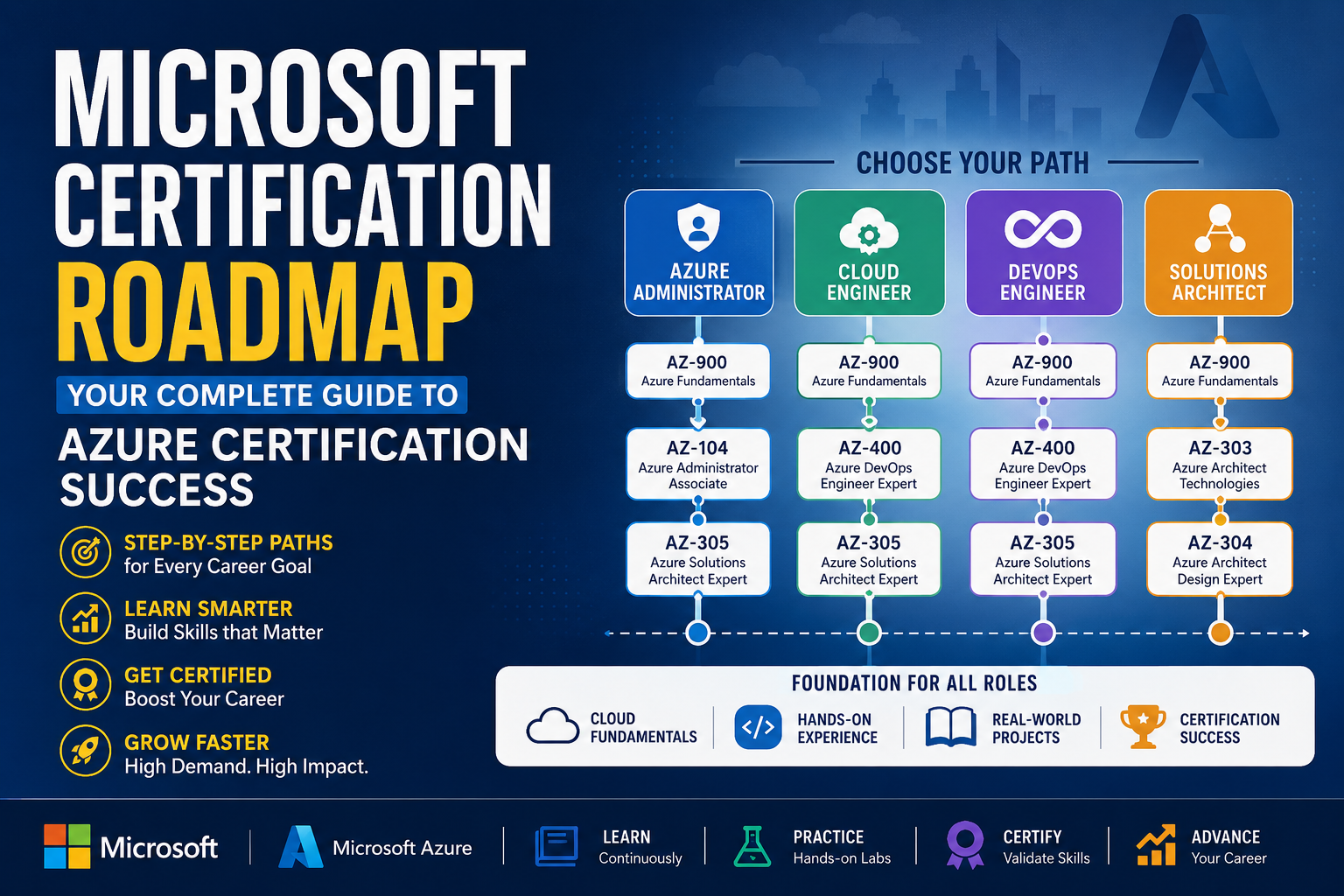
Azure Administrator roadmap: AZ-900 → AZ-104 → AZ-500 (Security) or AZ-700 (Networking) → AZ-305 (Architecture, for senior roles). This path builds from fundamentals to deep infrastructure expertise — which is exactly what enterprises are hiring for in 2026.
Best Roadmap for DevOps Engineers
AZ-900 (optional) → AZ-104 → AZ-204 → AZ-400. Supplement with GitHub Actions experience and Terraform on Azure for maximum market value. DevOps engineers with AZ-400 and real pipeline portfolios are among the highest-paid Azure professionals.
Best Roadmap for Solution Architects
AZ-104 (or strong admin experience) → AZ-204 → AZ-305 (Azure Solutions Architect Expert). This is the most prestigious and well-compensated certification track. AZ-305 requires either AZ-104 or AZ-204 as prerequisites.
Best Roadmap for Beginners Switching Careers
If you’re coming from a non-IT background: take a beginner cloud computing course first → AZ-900 → decide your role specialization → follow the appropriate path above. Don’t skip the role decision step — it determines everything about which certifications to prioritize.
🔗 Helpful Resource: If you’re completely new to data and tech, this Data Analyst Courses for Beginners guide can help you build foundational skills before entering cloud.
Certification Order That Actually Makes Sense
The Wrong Certification Sequence Most People Follow
The most common mistake I see: jumping to AZ-305 (Expert) right after AZ-900 because someone read it’s the ‘best paid’ certification. Without the associate-level foundation, the architecture concepts in AZ-305 don’t stick — and the exam failure rate reflects this.
Recommended Certification Order for 2026
| Stage | Certification | Role Target | When to Move On |
| 1 | AZ-900 | All beginners | After 2–4 weeks of study |
| 2 | AZ-104 | Admins, engineers | After 6–10 weeks + hands-on labs |
| 3A | AZ-204 | Developers, cloud engineers | After 8–12 weeks of coding practice |
| 3B | AZ-500 | Security engineers | After 8 weeks focused on security |
| 3C | DP-203 | Data engineers | After solid SQL + data pipeline experience |
| 4 | AZ-305 or AZ-400 | Architects / DevOps leads | After 6+ months of Azure work experience |
Certifications You Can Skip Depending on Experience
- AZ-900: Skip if you already have 1+ years of IT experience and understand cloud basics
- AZ-204: Skip if your role is purely operational (admin/infrastructure) with no development
- DP-900: Skip if you have data engineering experience and jump straight to DP-203
How Long Each Certification Usually Takes
| Certification | Beginner Timeline | Experienced Timeline |
| AZ-900 | 3–4 weeks | 1–2 weeks |
| AZ-104 | 8–12 weeks | 4–6 weeks |
| AZ-204 | 10–14 weeks | 6–8 weeks |
| AZ-400 | 12–16 weeks | 6–10 weeks |
| AZ-305 | 10–14 weeks | 6–8 weeks |
| DP-203 | 10–14 weeks | 6–8 weeks |
Real Examples of Azure Certification Journeys
Example Roadmap for a Complete Beginner
Maria, a retail manager, decided to switch careers into cloud. Her roadmap: Month 1–2: Free cloud fundamentals courses + AZ-900. Month 3–5: AZ-104 with daily Azure sandbox practice. Month 6–8: Entry-level cloud support job + AZ-500 study. Result: Junior Cloud Administrator role in 9 months with no prior IT experience.
Example Roadmap for an IT Support Professional
James worked IT helpdesk for 3 years. He skipped AZ-900 and went straight to AZ-104. His existing knowledge of networking and Active Directory made AZ-104 study take only 6 weeks. He passed on the first attempt and moved into an Azure Administrator contract role within 2 months.
Example Roadmap for a Software Engineer
Priya had 4 years of .NET development experience. She targeted AZ-204 directly after a 2-week Azure fundamentals self-study. She built a serverless Azure Functions app as her portfolio project. Passed AZ-204 in 8 weeks, then pivoted to AZ-400 for DevOps specialization.
🔗 Related Resource: If Priya’s path resonates with you, our guide on how to become an AI Engineer shows how Azure skills connect to AI/ML engineering roles.
Example Roadmap for a Data Professional
Kwame was a SQL analyst with 5 years of experience. His roadmap: DP-900 (2 weeks) → DP-203 (10 weeks) → AZ-104 (6 weeks for infrastructure context) → Senior Data Engineer role. He used the DP-203 study to also deepen his Azure Synapse Analytics and Data Factory skills — which became his key interview differentiator.
🔗 Related Reading: If you’re on a data path, also review this SQL Roadmap guide to strengthen your data engineering foundation.
Azure Certification Mistakes That Waste Time and Money
Collecting Certifications Without Real Skills
I call this ‘certification hoarding’ — and it’s one of the fastest ways to damage your credibility in a technical interview. Hiring managers at Azure-focused companies now include hands-on technical screens where you’ll be asked to configure something live in the Azure portal. If your certification didn’t involve real practice, that screen will expose it instantly.
Memorizing Instead of Building Projects
Brain dumps and memorized answers might get you through the exam, but they won’t help you in the job. What actually works long-term: for every concept you study, build something small with it. Deploy a resource. Configure a network rule. Create a storage account with lifecycle policies. Building reinforces learning in ways that passive reading never will.
Ignoring Hands-On Azure Experience
Microsoft Learn provides free Azure sandboxes for most certification modules. There is no excuse to study Azure without touching the actual platform. I always recommend setting up a free Azure account and treating it as your personal lab — even small experiments add up to real experience.
Choosing Expert Certifications Too Early
AZ-305 and AZ-400 are Expert-level certifications for a reason. Attempting them without solid associate-level foundation leads to frustration, exam failures, and wasted money. The azure roadmap certification structure exists to guide you — trust the sequence.
Tools and Resources That Make Azure Learning Easier
Best Official Microsoft Learning Platforms
- Microsoft Learn (learn.microsoft.com) — free modules, learning paths, and sandboxes
- Microsoft Azure Free Account — $200 credit + 12 months of free services
- Microsoft Certification Dashboard — track your certifications and exam history
- Azure Architecture Center — real-world reference architectures
Best Hands-On Azure Labs
- Microsoft Learn Sandboxes — integrated with official learning modules
- A Cloud Guru Playground — temporary Azure environments with guided labs
- GitHub: AZ-104 and AZ-204 Lab Exercises (official Microsoft lab repos)
- Whizlabs Hands-On Labs — structured lab scenarios with validation
Best Practice Test Platforms
| Platform | Price | Quality | Best For |
| MeasureUp | ~$99 | ★★★★★ | Official Microsoft practice tests |
| Whizlabs | ~$25 | ★★★★☆ | Budget-friendly, broad coverage |
| Udemy Practice Tests | ~$15 (on sale) | ★★★★☆ | High volume practice questions |
| ExamTopics (free) | Free | ★★★☆☆ | Community-reviewed questions — use carefully |
⚠️ Important Warning: Avoid ‘brain dump’ sites that distribute actual exam questions. Using them violates Microsoft’s exam NDA and can result in certification revocation. Practice tests from legitimate platforms like MeasureUp are sufficient — and legal.
Communities and YouTube Channels Worth Following
- John Savill’s Technical Training (YouTube) — best free Azure deep-dives
- Adam Marczak (YouTube) — clear, practical Azure explanations
- r/AzureCertifications (Reddit) — community tips, study plans, exam experiences
- Microsoft Tech Community — official blog and announcements
- LinkedIn Azure groups — good for networking with Azure professionals
🔗 Related Reading: For business intelligence tools that complement Azure data skills, see this Business Intelligence Developer guide
30-60-90 Day Azure Certification Action Plan
First 30 Days: Build Cloud Fundamentals
- Create a free Azure account and explore the portal
- Complete the AZ-900 learning path on Microsoft Learn
- Watch John Savill’s AZ-900 playlist on YouTube
- Take 2–3 practice tests and identify weak areas
- Schedule and sit the AZ-900 exam by day 28
🎯 30-Day Goal: Pass AZ-900 and have your Azure portal fully set up for hands-on practice.
Days 30–60: Hands-On Azure Practice
- Begin the AZ-104 learning path on Microsoft Learn
- Complete at least 3 lab exercises per week in your Azure account
- Build a simple virtual network with two connected VMs
- Practice Azure Active Directory: create users, groups, and RBAC roles
- Configure Azure Monitor and set up at least one alert
🎯 60-Day Goal: Complete 60% of AZ-104 study and have real hands-on labs in your portfolio.
Days 60–90: Certification Preparation Strategy
- Complete remaining AZ-104 modules
- Take full-length practice exams (target 80%+ before booking)
- Review every question you got wrong — understand why, not just what
- Book your AZ-104 exam 2 weeks out as a commitment deadline
- Day 88–90: light review only — no new topics, just confidence building
🎯 90-Day Goal: Pass AZ-104 and have a clear plan for your next certification.
How to Stay Consistent Without Burning Out
- Study 45–60 minutes daily instead of 3-hour weekend sessions
- Use a study tracker (Notion, spreadsheet, or Habitica) to maintain streaks
- Join an accountability group or study partner from Reddit or LinkedIn
- Reward yourself after each passed exam — the journey should feel like progress, not punishment
- Take one full day off per week — your brain consolidates learning during rest
Frequently Asked Questions
Which Azure Certification Should I Start With?
Start with AZ-900 if you have no cloud or IT background. If you already work in IT (networking, sysadmin, or helpdesk), go directly to AZ-104. The right first certification depends entirely on your current experience level.
Is AZ-900 Enough to Get a Job?
AZ-900 alone is not enough to get a cloud job. It demonstrates awareness of Azure, not ability to use it. Use AZ-900 as a launching pad toward AZ-104 or a role-specific associate certification. Some non-technical roles (sales, project management) value AZ-900 as a standalone credential.
Which Microsoft Certification Pays the Most?
Based on salary data from LinkedIn and Glassdoor, the highest-compensated Azure certifications in 2026 are AZ-305 (Solutions Architect Expert), AZ-400 (DevOps Engineer Expert), and DP-203 (Data Engineer Associate). Expert-level certifications with hands-on skills behind them consistently command the strongest salaries.
Are Azure Certifications Worth It in 2026?
Yes — with an important caveat. Azure certifications are worth it when they’re backed by real hands-on skills and used to target specific roles. Certifications alone, without practical Azure experience, have declining value. The azure cloud certification roadmap works best when study and practice happen simultaneously.
How Long Does It Take to Learn Azure?
To pass AZ-900: 2–4 weeks of focused study. To reach an employable AZ-104 level: 2–4 months. To be competitive for expert-level roles: 12–18 months of combined certification study and real-world Azure experience. Consistency matters more than speed.
Which Azure Certification Is Best for Beginners?
AZ-900 is the best starting certification for absolute beginners. It’s affordable ($165), widely recognized, and provides the conceptual foundation that every subsequent Azure certification builds on. After AZ-900, the best next step depends on your career goal — admin, developer, data, or security.
🔗 Related Reading: Check out our guide on Power BI Courses for Beginners if you’re interested in combining Azure with Microsoft’s analytics ecosystem.
Final Thoughts: Build Skills First, Certifications Second
The Microsoft Certification Roadmap That Actually Creates Career Growth
After everything I’ve shared in this guide, the most important thing I can tell you is this: certifications validate skills — they don’t create them. The Microsoft certification roadmap is most powerful when it runs alongside real Azure hands-on experience. Your resume with AZ-104 and three portfolio projects will always outperform a resume with five certifications and nothing built.
The azure cloud certification roadmap in 2026 rewards people who can demonstrate practical cloud skills in interviews and on the job. Start with the right certification for your level, build in public, and let your portfolio speak louder than your badge collection.
What to Focus on After Your First Certification
- Build at least one end-to-end project using the services from your certification
- Document your project on GitHub and LinkedIn
- Join Azure communities to stay current with service updates
- Identify the next certification that aligns with your career target
- Apply for roles 1–2 levels above your comfort zone — certifications give you that confidence
🔗 Related Reading: If your long-term path includes AI and ML on Azure, see our guide on the Prompt Engineering Roadmap to understand how AI skills complement your cloud career.
Your Next Step Starting Today
🚀 Your Action Plan:
1. Create your free Azure account today (azure.microsoft.com/free).
2. Start the AZ-900 learning path on Microsoft Learn.
3. Choose your target role (admin, developer, data, DevOps, architect).
4. Follow the certification sequence in this guide for that role.
5. Build something in Azure every single week. The best Microsoft certification roadmap is the one you actually start.