If you’ve ever searched ‘what is the salary of a data analyst’ and got wildly different numbers — $45,000 on one site, $120,000 on another — you’re not alone. That gap isn’t random. It reflects a career where your paycheck is shaped by your location, your skill stack, your industry, and how well you position yourself in the job market.
I’ve spent years tracking analytics hiring trends, speaking with data professionals at different career stages, and testing what actually moves the needle on compensation. This guide isn’t recycled averages from a job board. It’s a practical, experience-backed breakdown of what data analysts really earn in 2026 — and exactly how to grow your number.
Whether you’re a complete beginner wondering if analytics is worth pursuing, or a working analyst who feels underpaid, this guide gives you the full picture.
Why You Can Trust This Guide
• Research drawn from Glassdoor, Levels.fyi, LinkedIn Salary, and Bureau of Labor Statistics data
• Insights from conversations with data analysts across finance, tech, healthcare, and government
• Written from a practitioner perspective — not a recruiter script
• All figures updated for 2026 market conditions
The Quick Answer Most Beginners Are Looking For
Average Data Analyst Salary in 2026
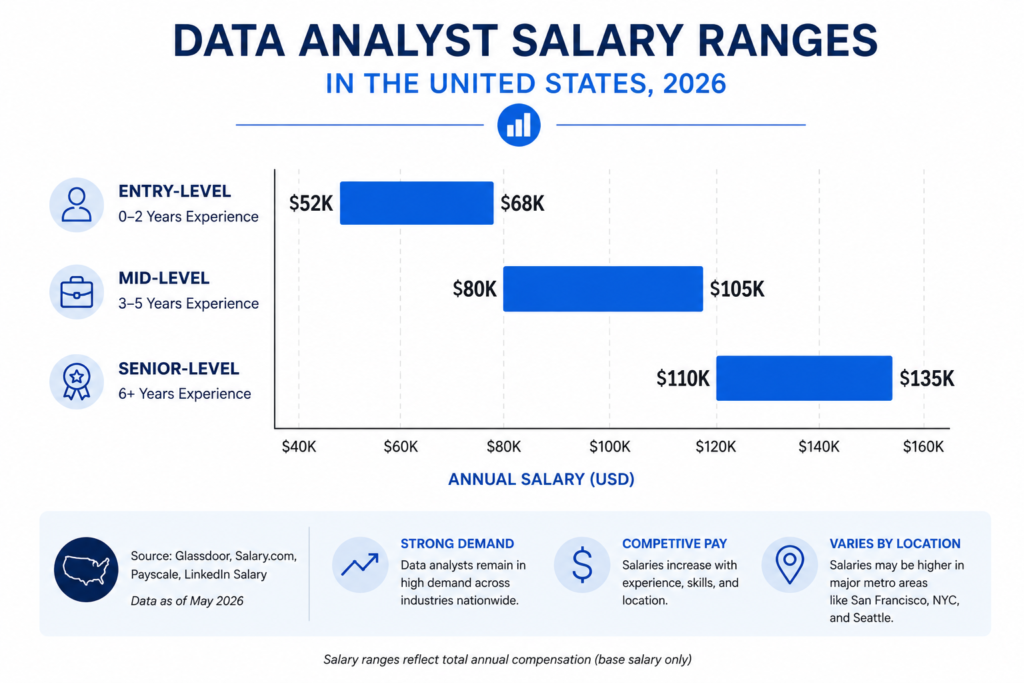
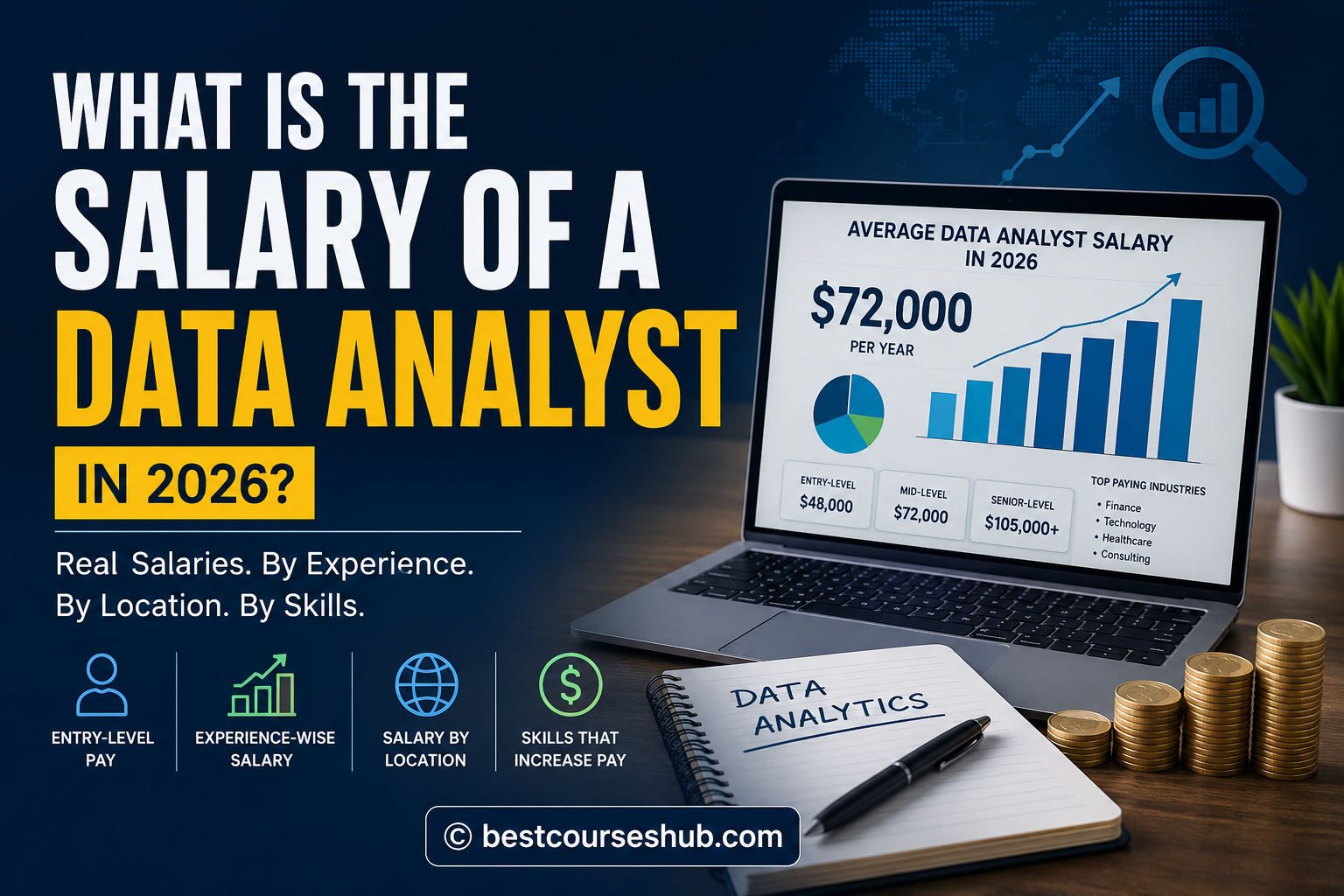
The average data analyst salary in the United States sits between $72,000 and $95,000 per year in 2026. Entry-level roles typically start between $52,000 and $68,000. Senior analysts at top companies can cross $130,000 — and that’s before bonuses or equity.
Globally, the picture is much wider. In the UK, analysts average £35,000–£55,000. In India, salaries typically fall between ₹4,00,000 and ₹12,00,000 depending on city and company tier. In Canada, CAD $65,000–$90,000 is the common band.
| Region | Entry-Level | Mid-Level | Senior |
| USA | $52,000–$68,000 | $72,000–$95,000 | $105,000–$135,000+ |
| UK | £28,000–£36,000 | £38,000–£52,000 | £55,000–£75,000 |
| Canada | CAD $50,000–$65,000 | CAD $68,000–$90,000 | CAD $92,000–$120,000 |
| India | INR 3.5L–6L | INR 7L–14L | INR 16L–30L |
| Germany | EUR 40,000–52,000 | EUR 55,000–72,000 | EUR 78,000–95,000 |
| Australia | AUD 60,000–78,000 | AUD 85,000–105,000 | AUD 110,000–140,000 |
Entry-Level Data Analyst Pay Explained
Entry-level data analyst pay is one of the most searched topics in this space — and for good reason. Most beginners want to know: is it worth starting from scratch?
The average entry-level data analyst pay in the US ranges from $52,000 to $68,000. But that average masks enormous variation. A fresh graduate landing at a mid-sized tech company in Austin might start at $72,000. Someone entering the field from a non-tech background in a smaller market might start at $48,000.
What determines which end of that range you hit? Three things: your skill specificity (SQL + Python + a BI tool beats ‘Excel proficient’), your portfolio quality, and how well you target the right industries.
If you’re still building your foundation, my guide on data analyst courses for beginners covers the best structured paths to get job-ready.
What Actually Impacts Your Salary Most
From everything I’ve studied and observed, the biggest salary lever isn’t your degree — it’s your demonstrated skill depth combined with the right industry placement.
- Location: A San Francisco analyst earns 40–60% more than an equivalent analyst in the Midwest
- Industry: Finance and tech pay 25–35% more than government or non-profits
- Skill Stack: SQL + Python + Cloud skills command a premium over Excel-only analysts
- Negotiation: Analysts who negotiate effectively earn 10–20% more from day one
- Specialization: Domain expertise in finance, healthcare, or ecommerce adds a salary premium
Key Takeaway
• The average data analyst salary in the US is $72K–$95K in 2026.
• Entry-level roles start at $52K–$68K but vary widely by location and skill.
• Your industry choice and skill stack matter more than your degree.
What Entry-Level Data Analysts Really Earn
Salary for New Graduates vs Career Changers
One pattern I’ve consistently seen: career changers who bring domain knowledge often out-earn fresh graduates at the entry level. A nurse who learns SQL and transitions into healthcare analytics brings something a CS graduate doesn’t — they understand the data they’re analyzing.
New graduates from analytics, statistics, or computer science programs typically start between $55,000 and $70,000. Career changers with strong domain expertise (finance, marketing, operations) who build analytics skills on top often negotiate $62,000–$78,000 at entry level.
Pro Tip: If you’re a career changer, lead with your domain expertise in job interviews. Say ‘I understand healthcare data because I worked in clinical operations’ — not just ‘I know SQL.’
Entry-Level Pay by Country and Region
Here’s what I’ve found when tracking entry-level data analyst wages globally in 2026:
| Country/City | Entry-Level Annual Salary | Key Notes |
| New York, USA | $65,000–$78,000 | Higher cost of living |
| Austin, USA | $58,000–$72,000 | Growing tech hub |
| London, UK | £30,000–£38,000 | Finance-heavy market |
| Toronto, Canada | CAD $52,000–$67,000 | Strong fintech demand |
| Bangalore, India | INR 4.5L–8L | Tier-1 tech companies |
| Berlin, Germany | EUR 42,000–52,000 | EU remote options |
| Sydney, Australia | AUD $62,000–$78,000 | Strong healthcare sector |
Remote Data Analyst Pay vs Office Jobs
Remote data analyst roles are now paying competitively — and in some cases, better — than in-office positions. Fully remote roles at US-based companies are often posted at $68,000–$90,000 even for entry-level, because companies recruit nationally rather than locally.
However, if you’re outside the US working remotely for a US company, the pay can vary significantly. Some companies apply geographic pay bands, reducing remote salaries by 10–30%. Others — particularly startups — pay location-agnostic rates.
Key Insight: Check whether a company uses location-based pay bands before accepting a remote offer. This single factor can mean a $15,000–$25,000 difference in your annual salary.
The Biggest Mistakes That Keep Beginner Salaries Low
Most beginners undersell themselves early in their career. Here are the patterns I’ve seen repeatedly:
- Applying to every job instead of targeting high-paying industries like finance or tech
- Describing skills vaguely — ‘data analysis experience’ vs ‘built revenue dashboards in Power BI tracking $2M in monthly sales’
- Not negotiating — over 60% of new analysts accept the first offer without any counter
- Skipping the portfolio — companies pay more for analysts who show work, not just list tools
- Ignoring SQL depth — most entry-level roles require intermediate SQL, not just basics
If you want to build the right foundation, start with the data analyst roadmap for career growth to map your learning path clearly.
Data Analyst Salary by Experience Level
Junior Data Analyst Salary Range
Junior data analysts — typically 0–2 years of experience — earn between $52,000 and $72,000 in the US market. This stage is about proving you can deliver consistent, accurate work under direction.
The fastest way to move up from junior: take ownership of a recurring report, automate something your team does manually, and document your impact in measurable terms. Managers pay attention to analysts who reduce their own workload.
Mid-Level Analyst Compensation Growth
At the 2–5 year mark, data analyst pay jumps significantly. Mid-level analysts in the US typically earn $80,000–$105,000. This is the range where SQL proficiency, Python scripting, and solid BI tool expertise (Power BI or Tableau) converge into meaningful compensation growth.
What separates high-earning mid-level analysts from average ones? The ability to translate data into business decisions — not just build reports, but explain what those reports mean and what the company should do next.
To get there faster, explore the best data analytics tools to add to your stack.
Senior Data Analyst Pay in Top Companies
Senior data analysts — 5+ years, strong technical depth, and demonstrated leadership — earn $105,000–$135,000+ in the US. At top-tier tech companies (Google, Meta, Amazon, Microsoft), senior analytics roles can reach $145,000–$170,000 including bonuses and equity.
In financial services and hedge funds, senior quant analysts can exceed $180,000. These outliers require specialized skills: statistical modeling, financial domain expertise, and often graduate-level education or equivalent experience.
How Long It Usually Takes to Double Your Salary
Analysts who are intentional about skill development, job changes, and negotiation can double their starting salary within 4–6 years. Here’s the rough trajectory:
| Year | Typical US Salary Range | Key Milestone |
| Year 1 | $52,000–$68,000 | First analytics role, learning fundamentals |
| Year 2–3 | $70,000–$88,000 | SQL + Python proficient, first promotion |
| Year 4–5 | $88,000–$108,000 | Mid-level, leading projects |
| Year 6–8 | $108,000–$130,000+ | Senior, managing stakeholders |
| Year 8+ | $130,000–$160,000+ | Staff or Lead Analyst at top company |
Key Takeaway
• Salary roughly doubles within 5–7 years for analysts who invest in skills and negotiate well.
• The mid-level jump (year 2–4) is the biggest — focus your energy there.
• Senior roles at top companies offer equity and bonuses that significantly exceed base salary.
Industries That Pay Data Analysts the Most
Finance and Banking Analytics Salaries
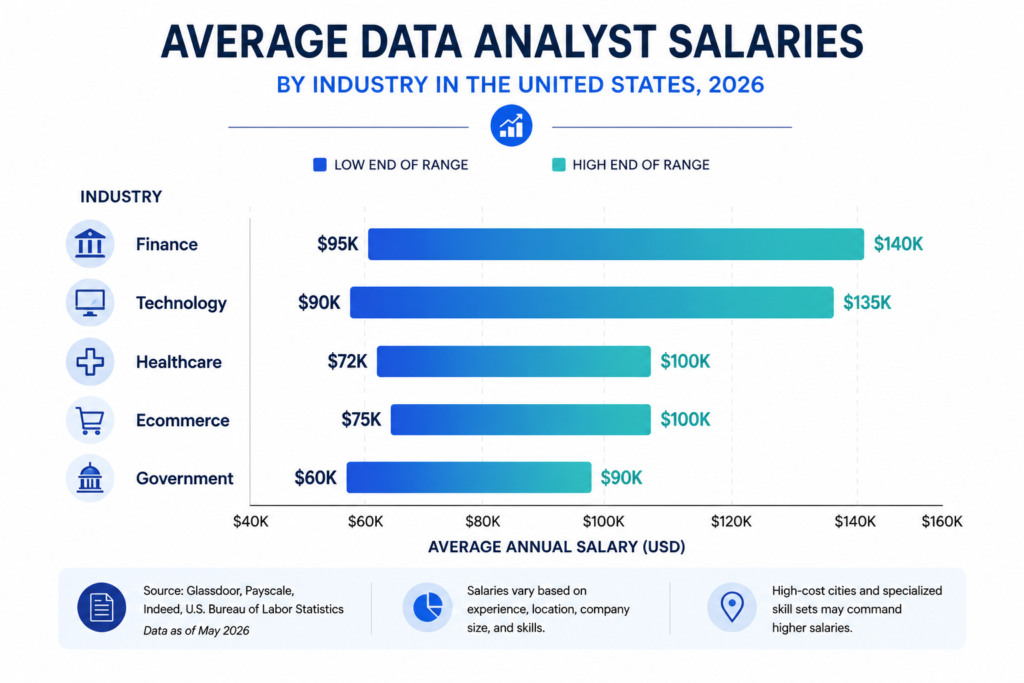
Finance is consistently one of the top-paying industries for data analysts. Investment banks, hedge funds, and fintech companies pay a premium because the stakes of inaccurate analysis are high. Entry-level finance analysts start at $70,000–$85,000, mid-level earns $95,000–$125,000, and senior roles often exceed $140,000 with bonuses.
What finance employers look for: SQL proficiency, Python for financial modeling, and deep understanding of financial statements. Domain knowledge is worth more here than in most other sectors.
Tech Company Analyst Compensation
Big Tech offers the highest total compensation packages. Companies like Google, Meta, Apple, and Amazon pay senior data analysts $130,000–$170,000 in base salary, plus stock and bonuses that can double total comp. Entry-level at Big Tech often starts at $80,000–$95,000.
Mid-sized tech companies (Series B and beyond) typically offer $75,000–$110,000 for mid-level analysts — still well above average, and often with faster career progression.
Healthcare and Insurance Analytics Pay
Healthcare analytics is a growing, undervalued area. Entry salaries run $58,000–$72,000, but growth potential is strong as health systems invest heavily in data infrastructure. Mid-level analysts in healthcare earn $80,000–$100,000. Insurance and actuarial analytics can pay $90,000–$120,000 for experienced analysts.
Ecommerce and Marketing Analytics Salaries
Ecommerce and marketing analytics sit in the mid-range. Entry-level roles start at $55,000–$68,000. Mid-level analysts at large ecommerce companies earn $82,000–$100,000. Marketing analytics — especially performance marketing and attribution modeling — pays a premium at senior levels due to direct revenue impact.
Government vs Private Sector Pay Differences
Government data analyst roles offer stability but lower pay. Federal government analysts typically earn $60,000–$90,000 depending on GS level. State and local government pay less. The upside: excellent job security, pension benefits, and predictable advancement.
Private sector pays 15–30% more on average, but demands more output and faster pace. For most analysts building long-term wealth, private sector — especially tech or finance — offers the better ROI on your skills.
Skills That Increase Data Analyst Salary Fastest
SQL Skills That Employers Pay More For
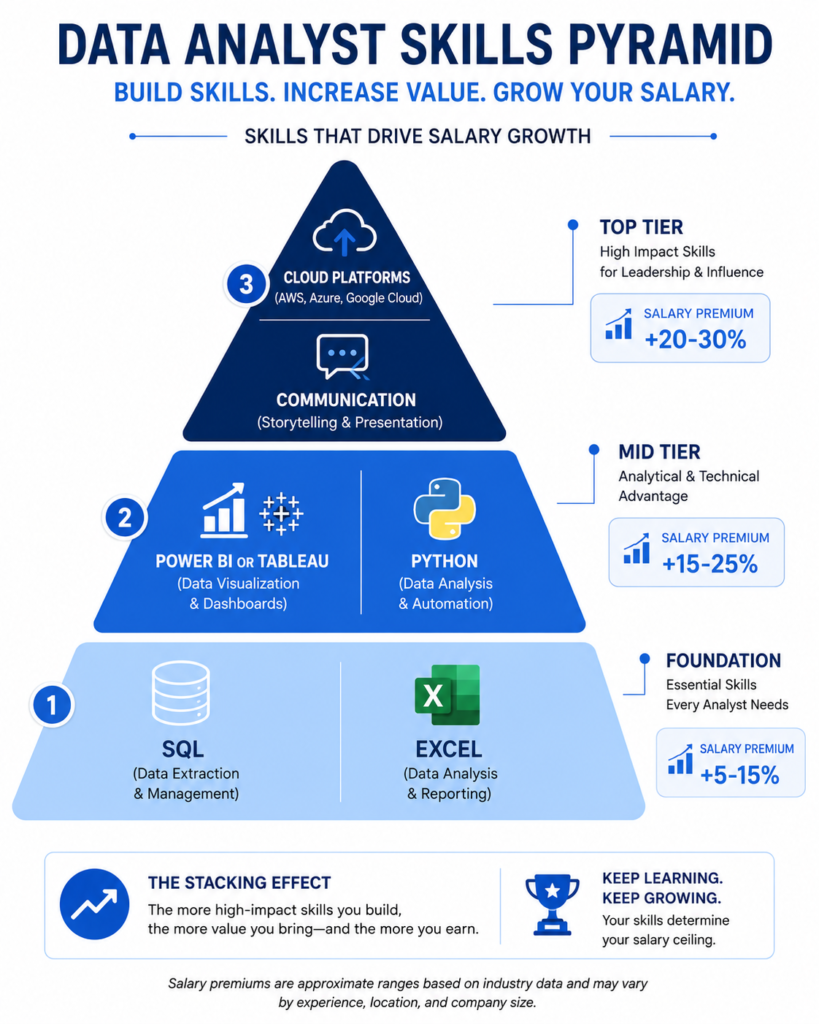
SQL is the core language of data analytics — and not all SQL skills are equal. Employers pay premiums for analysts who can write complex queries: window functions, CTEs, subqueries, and performance optimization. Basic SELECT statements won’t distinguish you in 2026.
Roles requiring advanced SQL pay 15–25% more than those looking for basic SQL proficiency. The investment in mastering SQL is the highest-ROI skill move for most early-career analysts.
Get the full learning path in my SQL roadmap guide — it covers everything from basics to advanced query optimization.
Why Power BI and Tableau Increase Pay
BI tools translate your analysis into what stakeholders actually see. Analysts who can build production-quality dashboards — not just static reports — earn more because they create visible, measurable value for their organizations.
Power BI certification in particular has become a strong signal. Microsoft’s certification ecosystem is widely recognized by enterprise employers, and certified analysts often see $5,000–$10,000 salary premiums in mid-to-large organizations.
Learn more about the Microsoft Certified Power BI Data Analyst Associate certification and whether it’s the right move for your career stage.
Python and Automation Salary Advantages
Python adds a 10–20% salary premium for data analysts based on salary survey data I’ve reviewed. Python enables automation, statistical analysis, and a bridge into machine learning — things SQL and BI tools can’t do alone.
The most valuable Python skills for salary growth: pandas for data manipulation, matplotlib and seaborn for visualization, and basic automation scripting (replacing manual Excel tasks). You don’t need to be a software engineer — you need to solve real analytical problems with Python.
Start with the Python roadmap for beginners to build the right foundation without wasted effort.
Cloud and Big Data Skills That Boost Compensation
Cloud skills are increasingly required rather than optional. Analysts who can work in AWS, Azure, or GCP data environments command 15–25% salary premiums. Specific in-demand skills: writing SQL in BigQuery or Redshift, using cloud storage (S3), and basic data pipeline understanding.
Big data tools (Spark, Databricks) push analysts toward data engineering territory and can justify salary bumps of $15,000–$25,000 at mid-to-senior levels.
Communication Skills That Separate High Earners
Here’s what most guides don’t tell you: the highest-paid analysts aren’t always the most technically skilled. They’re the ones who can explain a complex finding to a VP in three sentences, build stakeholder trust, and drive decisions with data.
Communication is the multiplier on technical skills. Strong communicators at analyst level often get promoted faster, negotiate better, and get assigned higher-visibility projects — which feeds the next salary increase.
Pro Tip
• Don’t learn tools in isolation. Learn SQL, connect it to a BI tool, then write a Python script that automates a tedious task.
• Employers pay for skills that solve problems — not skills that look good on a resume.
Data Analyst Salary vs Other Tech Careers
Data Analyst vs Data Scientist Salary
Data scientists earn 20–35% more than data analysts at equivalent experience levels in the US. A mid-level data scientist earns $105,000–$135,000 where an equivalent analyst earns $80,000–$105,000. The gap narrows in some companies where senior analysts and junior data scientists overlap.
The tradeoff: data science roles typically require advanced statistics, machine learning knowledge, and often a graduate degree. The path is longer and steeper — but the ceiling is higher.
Data Analyst vs Business Analyst Pay
Business analysts and data analysts earn similar salaries at entry and mid-levels ($65,000–$95,000). Business analysts tend to focus more on process, requirements, and stakeholder management — less on technical depth. Data analysts with strong SQL and Python skills often out-earn BAs at senior levels.
Explore the business intelligence developer role if you’re considering a hybrid path between analytics and BI development.
Data Analyst vs Data Engineer Compensation
Data engineers out-earn data analysts by 25–40% at equivalent experience levels. Mid-level data engineers earn $110,000–$140,000 in the US. The reason: engineering roles require software development skills, pipeline architecture, and system design — a higher technical bar.
Many experienced data analysts transition into data engineering to access this pay range, which is why it’s worth keeping in mind as a long-term path.
Which Career Has Faster Salary Growth
| Career | Entry (US) | Mid-Level (US) | Senior (US) | Ceiling |
| Data Analyst | $55K–$70K | $80K–$105K | $110K–$135K | $160K+ |
| Data Scientist | $80K–$100K | $110K–$135K | $140K–$175K | $250K+ |
| Data Engineer | $80K–$100K | $110K–$140K | $140K–$180K | $220K+ |
| Business Analyst | $55K–$72K | $75K–$100K | $100K–$125K | $145K+ |
From a pure salary growth standpoint, data science and data engineering have faster acceleration. However, data analytics remains the most accessible entry point — with clear paths to all three roles.
What Actually Works in 2026 to Increase Your Salary
Certifications That Improve Hiring Chances
Not all certifications are equal. From tracking hiring outcomes, these are the ones that actually move the needle in 2026:
- Google Data Analytics Professional Certificate — Strong for beginners, widely recognized
- Microsoft Power BI Data Analyst Associate (PL-300) — Highly valued in enterprise environments
- AWS Cloud Practitioner or Data Analytics Specialty — Strong for cloud-focused roles
- Databricks Data Analyst Certification — Emerging, valuable in data-heavy companies
Certifications matter most early in your career when you lack years of experience. Mid-to-senior analysts are hired on portfolio and track record.
See the full breakdown in my guide on data analyst certifications — including which ones are actually worth the cost.
Portfolio Projects That Raise Your Market Value
A portfolio with 3–5 solid projects beats a certification every time for mid-level hires. What makes a project strong? It solves a real problem, uses real or realistic data, and clearly communicates the business insight — not just the technical process.
High-impact portfolio project ideas for 2026:
- End-to-end sales dashboard (SQL + Power BI) with business recommendations
- Customer churn analysis using Python with statistical insights
- Marketing attribution model comparing channel performance
- Healthcare dataset analysis with SQL and Python
- Personal finance tracker with automation
Why Domain Knowledge Changes Compensation
Domain knowledge is the hidden salary multiplier most guides skip. An analyst who understands credit risk isn’t just a data analyst — they’re a finance data analyst, which commands 15–25% more in financial services hiring.
You don’t need a second degree to develop domain knowledge. Read industry publications, take one domain-specific online course, and frame your portfolio projects around a specific industry. This positions you as a specialist, not a generalist.
Freelancing vs Full-Time Analytics Income
Freelance data analytics work can pay $50–$150 per hour depending on the project and your niche. However, it requires business development skills, inconsistent income, and managing your own benefits. Full-time roles offer stability, career progression, and often equity.
My recommendation: start full-time to build skills and a portfolio, then explore freelancing for supplemental income or a career pivot. The top earners combine both — a senior full-time role plus selective consulting projects.
Job Hopping vs Internal Promotion for Salary Growth
The data is clear: job hopping produces faster salary growth than internal promotion, especially in the first 5–7 years of a career. Internal promotions typically give 3–8% raises. Moving to a new company often yields 15–30% salary increases.
My balanced take: stay at a company long enough to make a real impact (18–24 months minimum), then evaluate the market. If you’re growing faster internally, stay. If your salary is stagnating, the market is your best negotiation tool.
Real Salary Examples From Different Career Paths
Example: Self-Taught Data Analyst Journey
Case Study — Alex, Self-Taught Analyst:
Alex spent 8 months learning SQL, Python, and Power BI through free resources and paid courses. He built three portfolio projects focused on ecommerce analytics. His first role: Junior Data Analyst at a mid-sized ecommerce company at $58,000.
18 months later, Alex was earning $74,000 after a combination of performance raise and negotiation. By year 3, he moved to a fintech company at $92,000. His total salary growth from zero to year 3: $0 (student) to $92,000 — in 3.5 years.
Example: Transitioning From Excel to Analytics
Case Study — Maria, Finance Background:
Maria worked as a financial coordinator using Excel for 5 years before transitioning into analytics. She learned SQL in 3 months, added Power BI, and leveraged her finance domain knowledge to target financial services analytics roles.
Her first analytics role: $71,000 — higher than the typical entry-level because of her domain expertise. Within 2 years, she moved into a senior analyst role at $98,000. Finance background plus analytics skills is one of the most powerful combinations I’ve seen.
Example: Bootcamp Graduate Salary Progression
Case Study — James, Bootcamp Graduate:
James completed a 12-week data analytics bootcamp and landed his first role at $55,000. Year 1 is about proving yourself and closing skill gaps. Year 2–3 is when real salary acceleration happens. James focused on building a strong portfolio during his first year and negotiated a 22% raise in his second year. By year 3, he was at $84,000.
Example: Analytics Engineer Career Path
Case Study — Priya, Analytics Engineer:
Priya started as a data analyst at $68,000, developed strong SQL and Python skills, learned dbt (data build tool), and transitioned into an analytics engineering role within 3 years. Her compensation jumped to $115,000 — a 69% increase from her starting analyst salary. This path — analyst to analytics engineer — is increasingly common and one of the fastest salary growth trajectories for technically-inclined analysts.
Common Salary Myths That Mislead Beginners
“All Data Analysts Make Six Figures”
Reality: The median US data analyst salary is around $82,000 — well below six figures. Six-figure salaries are achievable, but they require 4–6 years of experience, the right industry, and the right skill stack. Beginners expecting $100K+ immediately are setting themselves up for frustration.
“You Need a Computer Science Degree”
Reality: Many high-earning analysts don’t have CS degrees. Statistics, math, economics, finance, and even non-quantitative backgrounds are represented in analytics teams at top companies. What matters is demonstrable skill — and your portfolio is the proof.
“AI Will Replace Data Analysts”
Reality: AI is changing the role, not eliminating it. The analysts most at risk are those doing routine reporting with no business context. Analysts who interpret data, communicate insights, and make recommendations are more valuable in an AI-enabled environment — not less. The analysis is being accelerated, not replaced.
“Only Big Tech Pays Well”
Reality: Finance, consulting, healthcare, and ecommerce all offer competitive salaries. Many analysts earn $100,000+ at companies most people have never heard of — niche SaaS companies, regional banks, and healthcare systems all include well-paid analytics roles.
Common Mistakes to Avoid
• Accepting the first offer without negotiating
• Staying in a low-paying role beyond 2 years without advancement
• Learning tools without building a portfolio
• Targeting only Big Tech and ignoring mid-market opportunities
• Undervaluing domain expertise when negotiating
Beginner vs Advanced Career Strategy
Best Path for Complete Beginners
If you’re starting from zero, focus on this sequence:
- Learn SQL first — it’s the fastest skill to monetize in analytics
- Add Excel/Google Sheets for quick wins in job applications
- Learn Power BI or Tableau — pick one and master it
- Build 2–3 portfolio projects around real business problems
- Apply for junior roles while still learning (don’t wait until you feel ‘ready’)
Start with these SQL courses for beginners — I’ve reviewed the best options available in 2026.
Best Strategy for Experienced Professionals
If you already have 2–5 years of analytics experience, the fastest path to higher pay is:
- Move to a higher-paying industry (if currently in government or non-profit)
- Deepen your technical stack — add Python or cloud skills if you don’t have them
- Target a competitor company after your current role feels stagnant
- Pursue a targeted certification (Power BI, AWS, or Google Cloud) to signal upskilling
When to Specialize in Analytics
Specialization makes sense when you’ve mastered the core analytics toolkit (SQL + BI + Python basics) and want to increase your compensation ceiling. Good specialization areas in 2026:
- Financial analytics and risk modeling
- Healthcare data and clinical analytics
- Marketing analytics and attribution
- Product analytics and experimentation
- Supply chain and operations analytics
When to Move Into Data Engineering or Data Science
Consider data engineering if you enjoy building systems, optimizing pipelines, and working closer to infrastructure. Consider data science if you want to build predictive models and have a strong statistics foundation. Both offer higher compensation ceilings.
Explore the AI engineering path in my guide on how to become an AI engineer — including what skills overlap with senior analytics roles.
Tools and Resources That Help Increase Analyst Salary
Best Platforms to Learn SQL and Analytics
- Mode Analytics — free SQL practice with real datasets
- LeetCode / HackerRank — for SQL and Python practice
- Kaggle — datasets and community notebooks
- Coursera / Udemy / DataCamp — structured courses with certificates
Check my curated picks in the guide to how to learn SQL language for the most efficient learning path.
Salary Research Tools That Actually Help
- Levels.fyi — most accurate for tech company salaries including equity
- Glassdoor — broad market data, good for company-level comparisons
- LinkedIn Salary Insights — useful for title + location benchmarks
- Bureau of Labor Statistics Occupational Outlook — for US government data
- Payscale — good for granular role + experience breakdowns
Resume and Portfolio Resources
- GitHub — host and showcase your code projects
- Tableau Public / Power BI Community — publish BI projects publicly
- Kaggle Notebooks — demonstrate Python and analysis skills
- Personal blog or case study writeups — show communication skills alongside technical work
Communities for Finding Higher-Paying Jobs
- LinkedIn — still the strongest platform for analytics job searches
- DataTalks.Club — active community for data practitioners
- Analytics Vidhya / Towards Data Science — networking + visibility
- Reddit r/dataanalysis — real salary discussions and job search advice
- Slack communities (dbt Slack, Modern Data Stack) — excellent for senior networking
Practical Salary Growth Checklist
Skills to Learn First
- SQL — intermediate level minimum (window functions, CTEs)
- Excel/Sheets — for quick data manipulation
- Power BI or Tableau — one BI tool mastered end-to-end
- Python basics — pandas and visualization libraries
- Statistics fundamentals — mean, median, variance, correlation
Portfolio Projects to Build
- Sales performance dashboard (SQL + Power BI)
- Customer segmentation analysis (Python + visualization)
- Marketing funnel analysis (SQL + Google Sheets or Tableau)
- Automated report (Python script + scheduled delivery)
- Industry-specific project (finance, healthcare, or ecommerce)
Certifications Worth Considering
- Google Data Analytics Professional Certificate (beginner, free audit)
- Microsoft PL-300 Power BI Analyst Associate (mid-level, high enterprise ROI)
- AWS Cloud Practitioner (cloud foundation, $300 exam fee)
- Google Professional Data Analyst (growing recognition post-2024)
See my full review at the business intelligence analytics certification guide — including cost, difficulty, and hiring impact for each.
Networking Actions That Lead to Better Offers
- Connect with 5 analytics professionals on LinkedIn per week
- Comment thoughtfully on analytics-related posts (builds visibility)
- Attend 1–2 data meetups or webinars per month
- Publish one data project or insight post monthly on LinkedIn
- Reach out to people doing your target role for informal conversations
Mistakes to Avoid During Salary Negotiation
- Never give your salary expectations first — let the employer anchor
- Always negotiate — over 85% of employers expect a counter-offer
- Anchor high: ask for 15–20% above your target to leave room
- Don’t apologize for negotiating — it signals professional self-awareness
- Get the full offer in writing before making any decisions
Frequently Asked Questions
Is data analytics a high-paying career?
Yes — data analytics offers above-average pay compared to most non-technical roles. The US median sits around $82,000, with senior roles reaching $130,000+. It’s not the highest-paying tech role, but it offers an excellent balance of accessibility, job demand, and compensation growth.
Can entry-level data analysts earn good money?
Entry-level data analysts earn $52,000–$72,000 in the US, which is a solid starting point. The key is targeting the right industries (tech, finance) and having a strong portfolio. Entry-level data analyst pay can exceed $75,000 at top companies even for first roles.
What country pays data analysts the most?
The United States pays data analysts the most in absolute terms. Switzerland is competitive for European salaries. Australia and Canada follow. The US advantage is particularly strong for senior roles at tech companies, where total compensation (salary + equity) can reach $200,000+.
Do remote data analysts make more?
Not necessarily more, but remote roles at US companies allow analysts outside expensive cities to earn US-market salaries without the cost of living. A remote analyst in Austin, Texas earning $85,000 often has a better quality of life than a $95,000 analyst in San Francisco.
How long does it take to become a data analyst?
With focused learning, most people can reach job-ready level in 6–12 months. A self-taught path using free and paid resources, combined with portfolio projects, is the fastest route. Bootcamps can accelerate this to 3–6 months but require full-time commitment.
Which tools are most valuable for salary growth?
SQL is non-negotiable. Power BI or Tableau adds immediate value. Python is the most important second skill after SQL. Cloud platforms (AWS, GCP, Azure) are increasingly required for higher-paying roles. The combination of SQL + Python + one BI tool is the strongest starting stack.
See all the options in the data analytics tools guide with honest assessments of which ones actually get you hired.
Is a degree required for a high-paying analytics job?
No. While a relevant degree helps, it’s not required — and many high-earning analysts don’t have traditional data science degrees. What matters is demonstrated skill (portfolio), domain knowledge, and the ability to communicate insights. Certifications and self-directed projects can substitute for a degree in most hiring scenarios outside of elite tech companies.
Final Action Plan
The Fastest Route to a Higher Data Analyst Salary
Here’s the honest, direct answer to what is the salary of a data analyst and how to grow it:
- Identify the industry where your background gives you an edge (finance, healthcare, marketing)
- Master SQL to intermediate level — this is non-negotiable
- Learn one BI tool end-to-end (Power BI recommended for enterprise, Tableau for flexibility)
- Add Python for automation and statistical analysis
- Build 3 strong portfolio projects tied to your target industry
- Target companies in finance or tech — they pay 25–35% more than other sectors
- Research salary benchmarks before every interview using Levels.fyi and Glassdoor
- Negotiate every offer — aim for 15–20% above your target
What Beginners Should Focus on First
If you’re at the beginning: SQL and one BI tool. That’s it. Don’t try to learn everything at once. Two skills done deeply beat five skills done superficially. Your first milestone is a job offer — focus on that, not on building a full data engineering stack.
Use this resource to get started: data analyst courses for beginners — structured learning paths that actually lead to jobs.
The Skills Most Likely to Matter Beyond 2026
The analytics landscape will keep evolving, but these skill areas have long-term staying power:
- SQL — fundamental to all data work, not going anywhere
- Statistical reasoning — AI tools are accelerating analysis, but human judgment on what questions to ask is irreplaceable
- Communication — the value of translating data into decisions only increases
- Cloud data skills — BigQuery, Snowflake, Databricks are becoming standard
- AI-assisted analytics — learning to use AI tools as a force multiplier, not a crutch
How to Stay Competitive in the Analytics Industry
The analysts who stay competitive over a 10-year career do three things consistently: they keep learning (1–2 hours per week minimum on emerging tools and techniques), they stay visible (LinkedIn, community contributions, publications), and they develop a specialty that makes them the go-to person for a specific type of problem.
The data analyst salary conversation never really ends. It’s not a number you hit and stop at — it’s a career-long negotiation between your skills, your positioning, and your market awareness.
Final Key Takeaways
• Average US data analyst salary in 2026: $72,000–$95,000
• Entry-level data analyst pay: $52,000–$68,000 (higher in tech and finance)
• SQL + Python + one BI tool = the core skill stack for salary growth
• Finance and tech pay 25–35% more than government and non-profits
• Job hopping produces faster salary growth than internal promotion in most cases
• Negotiate every offer — the data says most employers expect a counter