| ✅ Why You Can Trust This Guide I have spent the last four years working in data analytics and business intelligence, building Power BI dashboards for finance, retail, and operations teams. I have personally tested and reviewed more than a dozen Power BI courses for beginners — from Microsoft’s free learning paths to paid Udemy and Coursera programs. I have also mentored more than 60 professionals who switched careers into data using Power BI. This guide is based on what actually worked for them, not on affiliate rankings or marketing copy. |
If you have searched for power bi courses for beginners lately, you already know the problem: there are hundreds of them, and most of them promise the same thing.
Here is what I have found from testing dozens of these courses and coaching real beginners — most of them are either too slow, too shallow, or they skip the one thing that matters: building something real.
In this guide, I am going to cut through the noise. I will show you exactly which power bi courses for beginners actually deliver results in 2026, which skills matter most, and how to go from zero to job-ready in six weeks with the right roadmap.
Whether you are a complete beginner, an Excel user ready to level up, or someone preparing for the PL-300 certification, this is the most honest breakdown you will find.
Why Most Beginners Struggle to Learn Power BI
The ‘Too Many Courses’ Problem
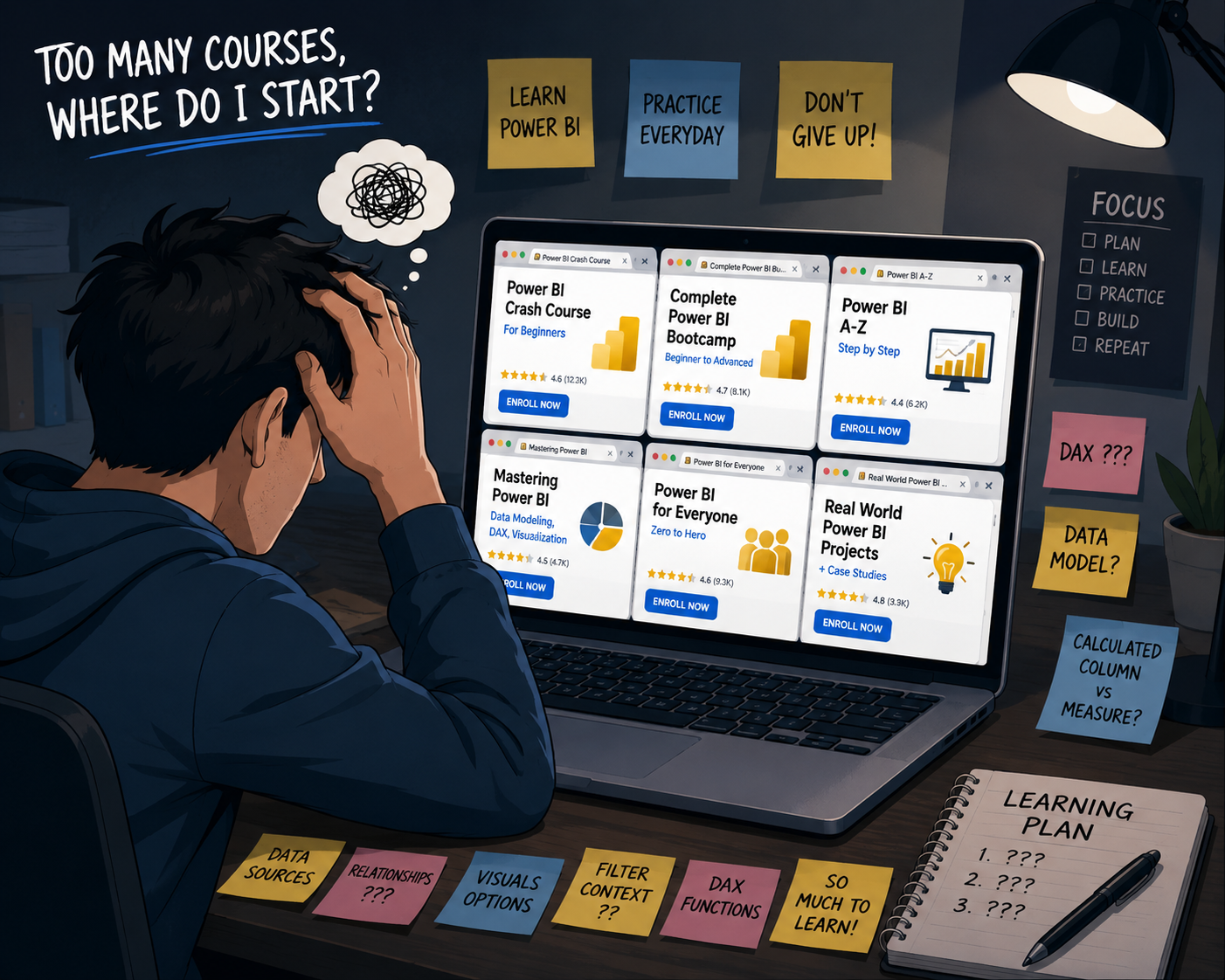
From my experience, this is the biggest trap beginners fall into. They spend two weeks comparing courses, buy three of them, start all three, and finish none. I call it course paralysis.
The Power BI course market is saturated. A quick search returns results ranging from 2-hour YouTube tutorials to 40-hour Udemy mega-courses. Without context, it is impossible to know what is worth your time.
What I have seen work is committing to one structured path and sticking with it for at least six weeks before evaluating whether it is the right fit.
What Actually Matters for Beginners in 2026
Most beginners focus on the wrong things. They want to know which tool has the most features or which course has the best reviews. Here is what actually matters when you are starting out:
- Understanding how data flows from a source into a report
- Building a mental model of relationships between tables
- Getting comfortable with DAX logic before memorizing formulas
- Publishing and sharing something real by week four
If a course does not walk you through all four of those within the first month, it is not the right beginner power bi training for you.
Quick Answer: Best Power BI Courses Based on Your Goal
| Your Goal | Recommended Course |
| Free learning, zero budget | Microsoft Learn (Power BI Learning Path) — free and official |
| Fastest beginner to job-ready | Maven Analytics on Udemy — structured, project-based |
| PL-300 certification prep | Coursera PwC Power BI course or Pragmatic Works |
| Excel user transitioning to BI | LinkedIn Learning Power BI Essential Training |
| Interactive, code-free learning | DataCamp — Power BI Fundamentals track |
Who This Beginner Power BI Guide Is For
Complete Beginners With No Technical Background
If you have never opened Power BI before, you are not behind — you are in the majority. Most of the professionals I have mentored started exactly here. Power BI Desktop is free to download, and the interface is visual enough that you can build your first chart within an hour of opening it.
What I recommend: start with Microsoft Learn’s free modules before investing in a paid course. They give you the vocabulary and orientation that makes every paid course more effective.
Excel Users Moving Into Business Intelligence
Excel users have a hidden advantage: they already understand data in rows and columns, they know what aggregation means, and they have probably built pivot tables before. Power BI is essentially a supercharged version of that workflow.
The main mental shift is moving from cell-based thinking to table-based thinking. Once that clicks — usually in week two or three — progress accelerates fast.
If you are also exploring the broader data analytics world, my guide on covers how Power BI fits into the full toolkit.
Aspiring Data Analysts and BI Developers
For those targeting a data analyst or BI developer role, Power BI is one of the fastest entry points into the job market right now. Employers consistently list it in job descriptions, and it pairs well with SQL and Excel skills you may already have.
I wrote a full guide on that covers the full career path if you want context on where Power BI fits in.
Professionals Preparing for PL-300 Certification
The PL-300 (Microsoft Power BI Data Analyst) certification is the most recognized credential in this space. It is not easy, but it is achievable for a motivated beginner within three to four months with the right preparation strategy.
I will cover the certification path in detail later in this guide, including which beginner power bi training programs prepare you best for the exam format.
What Beginners Should Learn Before Choosing a Power BI Course
Core Power BI Skills That Matter Most
Before evaluating any course, understand what Power BI actually requires. Here is the skill stack every beginner needs, in order of priority:
- Connecting to data sources (Excel, CSV, SQL, SharePoint)
- Transforming data using Power Query
- Building a data model with relationships
- Writing basic DAX measures
- Designing interactive reports
- Publishing to Power BI Service
Any course that skips or rushes steps 2, 3, or 4 will leave you with gaps that cause problems later. I have seen this pattern repeatedly with beginners who move too fast.
Understanding DAX Without Getting Overwhelmed
DAX (Data Analysis Expressions) is the formula language of Power BI. It intimidates most beginners, but here is what I tell everyone I mentor: you do not need to know 200 DAX functions. You need to understand how evaluation context works.
The three functions that solve 80 percent of real-world problems for a beginner are CALCULATE, SUM/SUMX, and DIVIDE. Learn those well before you try anything else.
| 💡 Pro Tip Instead of memorizing DAX functions, start by building a ‘why does this number change?’ mental model. Every DAX measure responds to filters. Once you understand that, every formula makes more sense. |
Why Data Modeling Changes Everything
What I have seen separate good Power BI users from mediocre ones is not DAX knowledge — it is data modeling. A clean star schema with clear relationships between fact and dimension tables will make every formula easier and every report faster.
Most beginner courses underteach this. Look for courses that spend at least two full modules on data modeling before moving into visuals. That ratio matters.
The Mistake Most Beginners Make With Dashboards
Beginners tend to pile every possible chart onto one page and call it a dashboard. What actually works is designing for a decision. Every good dashboard answers one specific business question and nothing else.
| ⚠️ Common Mistake Building dashboards with 15 charts, 3 slicers, and a matrix table does not impress employers or stakeholders. A clean, focused, interactive report that answers one real business question is worth more than ten cluttered pages. |
Best Power BI Courses for Beginners (Detailed Comparison)
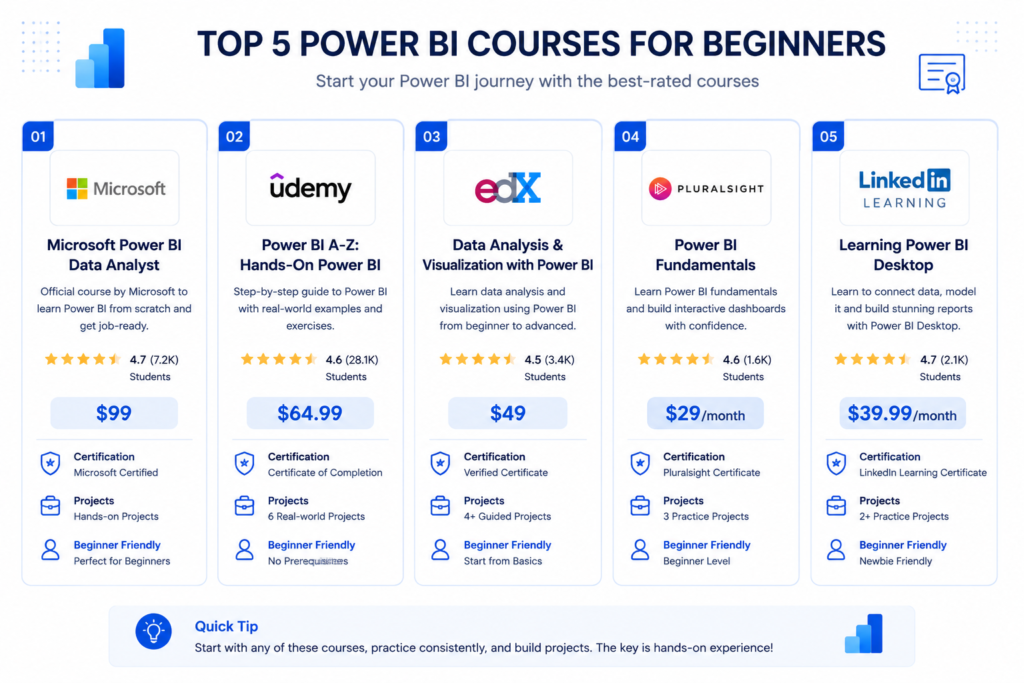
Best Overall Power BI Beginner Course
Recommendation: Maven Analytics — Microsoft Power BI Desktop for Business Intelligence (Udemy)
From my experience, this is the single best power bi beginner course for most people. Here is why it works:
- Covers the full workflow from raw data to published report
- Strong data modeling section — not just visuals
- Realistic business datasets, not toy examples
- Instructor explains the ‘why,’ not just the ‘how’
- Updated regularly as Power BI releases new features
Price typically runs $12 to $20 during Udemy sales (which happen almost every week). That is exceptional value for the depth of instruction.
| 🎯 Micro CTA If you want the fastest structured path from beginner to portfolio-ready, Maven Analytics on Udemy is where I would start. It consistently produces the best results for career switchers I have worked with. |
Best Free Power BI Training for Beginners
Recommendation: Microsoft Learn — Power BI Learning Path
Microsoft’s own learning platform offers completely free power bi training for beginners, and it is surprisingly good. The modules are self-paced, cover official exam topics, and are always up to date with the latest Power BI version.
The limitation: it is more reference-style than hands-on. You will learn concepts well, but you will need to supplement it with real project practice to build job-ready skills.
External link: — free, official, always updated.
Best Course for Career Switching
Recommendation: Coursera — Microsoft Power BI Data Analyst (PwC Switzerland)
This is the course I point career switchers toward. It is designed around real job scenarios and teaches Power BI in the context of how analysts actually use it at work — not in isolation.
The PwC branding also adds credibility to your resume if you add the certificate to LinkedIn. Cost is around $49 per month on Coursera, and most people finish it in four to six weeks.
Best Beginner Course for Certification Preparation
Recommendation: Pragmatic Works — PL-300 Exam Preparation
If your primary goal is passing the PL-300 certification, Pragmatic Works builds their curriculum around the actual exam objectives. They map every lesson to the skills measured on the test, which makes your study time efficient.
What I like about this approach: you learn Power BI and exam strategy simultaneously instead of having to translate general knowledge into exam format later.
Best Hands-On Power BI Training
Recommendation: DataCamp — Power BI Fundamentals Track
DataCamp’s Power BI track is the most interactive option available. Instead of watching videos, you build directly in a browser-based environment, which eliminates the setup friction that stops many beginners in week one.
It is not the deepest course for certification prep, but for pure skill-building and getting comfortable with the interface fast, it is excellent beginner power bi training.
Best Budget-Friendly Option
Recommendation: Guy in a Cube (YouTube) + Microsoft Sample Data
If budget is genuinely a constraint, the Guy in a Cube YouTube channel combined with Microsoft’s own sample datasets is a legitimate free alternative. It requires more self-direction, but the content quality is high.
The key is to follow a learning sequence yourself rather than jumping between random videos. I will give you that roadmap in the next section.
| 💡 Pro Tip Use the free Microsoft Learn path for concepts, Guy in a Cube for visual tutorials, and the Microsoft sample financial dataset for practice. Together, they cover 80 percent of what a paid beginner course teaches. |
Free vs Paid Power BI Courses — What Actually Works?
When Free Power BI Training Is Enough
Free resources work well when you have strong self-discipline, a clear learning sequence, and time to experiment. If you are already in a data-adjacent role and just need to add Power BI to your skill set, free training is often enough.
What I have seen is that most beginners who rely only on free content take two to three times longer to reach job readiness because they spend too much time searching for the next video instead of building things.
What Paid Courses Usually Do Better
- Structured progression from beginner to intermediate
- Curated datasets designed to teach specific concepts
- Instructor support and community access
- Progress tracking that keeps you accountable
- Certificate of completion for your resume
The structure alone is often worth the investment. A $15 Udemy course that you actually finish beats a free resource you abandon in week two.
Hidden Problems With Cheap Beginner Courses
Not all paid courses are equal. What I have found with some low-rated beginner courses on Udemy and Skillshare:
- Outdated content that references features no longer in the current Power BI version
- Skipping data modeling entirely and jumping straight to visuals
- No real-world datasets — they use identical sample data for every lesson
- Instructors who narrate what they are doing without explaining why
| ⚠️ Common Mistake Always check the ‘Last Updated’ date on any Power BI course. Power BI updates monthly. A course last updated in 2022 may teach methods that no longer exist or have been replaced by better approaches. |
Realistic Expectations for Learning Speed
Here is an honest timeline based on what I have observed:
- Week 1-2: Interface orientation, connecting to data, basic visuals
- Week 3-4: Power Query transformations, first data model, basic DAX
- Week 5-6: Publishing reports, building a portfolio project
- Month 3+: Advanced DAX, complex modeling, certification readiness
Anyone promising you ‘job-ready in a weekend’ is selling you something that does not exist. Six focused weeks of consistent practice is a realistic minimum.
Step-by-Step Power BI Learning Roadmap for Beginners
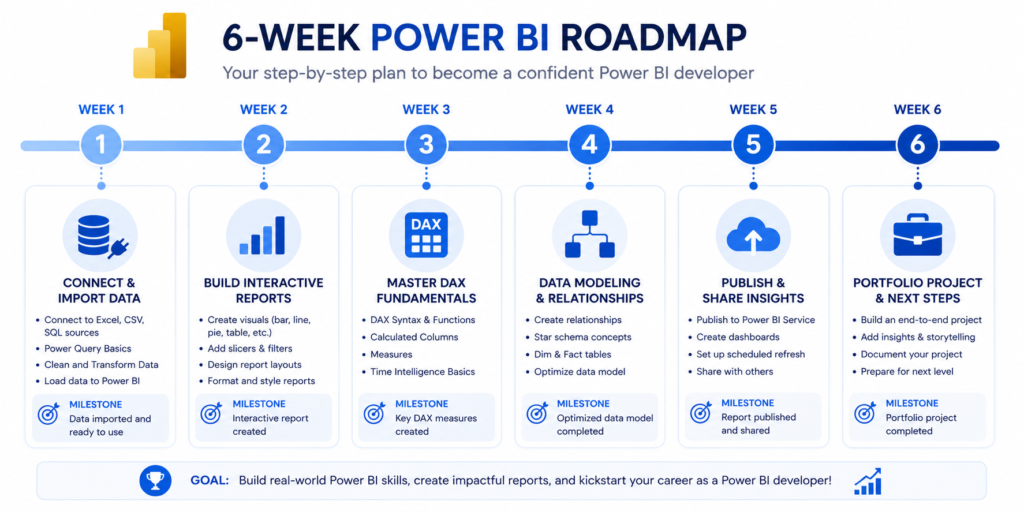
Week 1: Understanding the Power BI Ecosystem
Install Power BI Desktop. Connect it to an Excel file — Microsoft’s financial sample dataset works perfectly. Explore the interface: the Fields pane, the Visualizations pane, and the canvas.
Goal for the week: understand what a fact table is, what a dimension table is, and why the relationship between them matters. Do not build a single chart until you can explain what your data represents.
| 📌 Week 1 Checklist ✓ Power BI Desktop installed and opened ✓ Connected to Microsoft sample financial dataset ✓ Understood the difference between fact and dimension tables ✓ Explored all three views: Report, Data, Model |
Week 2: Building Your First Reports and Dashboards
Now build something. Create a sales performance report with four to five visuals: a bar chart, a line chart, a card visual, a slicer, and a map if your data supports it.
Focus on interactivity — make sure clicking one visual filters the others. This cross-filtering behaviour is what makes Power BI reports feel alive. Show it to someone who is not a data person and see if they can use it without help.
Week 3: Learning DAX Fundamentals
Start with three measures: a SUM, a CALCULATE, and a DIVIDE. Do not look up the syntax until you have first tried to write the logic in plain English.
For example: ‘I want total sales only for the year 2024’ — write that sentence, then translate it into CALCULATE(SUM(Sales[Amount]), Sales[Year]=2024). That translation process is the real skill.
| 💡 Pro Tip Use the DAX Studio tool (free) to test your measures against actual data. It shows you exactly what values the formula returns and why — which is far more educational than guessing from a chart. |
Week 4: Data Modeling and Relationships
This is the week most beginners skip, and it is the week that matters most for long-term progress. Rebuild your data model from scratch using a proper star schema: one fact table in the center, dimension tables (Date, Product, Customer, Region) connected to it.
Practice creating a Date table — either with CALENDAR() in DAX or with Power Query — and connect it to your fact table. A proper date table unlocks time intelligence functions like SAMEPERIODLASTYEAR and TOTALYTD.
Week 5: Publishing and Sharing Reports
Create a free Power BI Service account and publish your report. Set up a dashboard by pinning visuals from your report. Share the dashboard link with someone else and walk them through it.
This step matters for two reasons: it proves the end-to-end workflow works, and it gives you something you can actually show in an interview or on a portfolio.
Week 6: Building a Portfolio Project
Choose a public dataset from Kaggle, data.gov, or the World Bank. Pick a topic you find genuinely interesting. Build a three-page report that tells a clear story: an executive summary page, a detailed analysis page, and an interactive deep-dive page.
Publish it to Power BI Service and write a brief case study on LinkedIn explaining what question you answered and how you answered it. That combination — the dashboard plus the written context — is what gets attention from hiring managers.
For broader context on building a data career, the shows exactly how Power BI fits into the full career journey.
Power BI Beginner Certification Path Explained
Is PL-300 Worth It for Beginners?
Yes — but with a caveat. The PL-300 certification is worth pursuing if you plan to work with Power BI professionally. It signals credibility to employers who do not know you, and it forces you to learn the tool at a deeper level than most self-taught users.
The caveat: attempt it after you have real project experience, not before. Passing the exam without hands-on practice produces a certificate holder who cannot actually build anything. That combination gets exposed quickly in interviews.
Skills You Need Before Attempting Certification
- Comfortable connecting to and transforming multiple data sources
- Able to build a star schema data model from scratch
- Can write CALCULATE, time intelligence, and basic iterator functions in DAX
- Published at least two reports to Power BI Service
- Understands Row Level Security setup
Certification Mistakes That Slow Beginners Down
From my experience reviewing failed exam attempts, these are the most common patterns:
- Studying from outdated materials — Power BI exam objectives update regularly
- Skipping the Power BI Service section (25 percent of the exam)
- Not practicing in a timed environment before the real exam
- Ignoring the deployment and security sections because they seem advanced
Best Courses for Passing PL-300 Faster
In addition to Pragmatic Works, I recommend layering in the official Microsoft documentation for each exam objective. Use a free practice test tool like MeasureUp or ExamTopics to identify weak areas, then go back to course content to fill the gaps.
For a full overview of data credentials, my covers PL-300 in context with other certifications worth pursuing.
| 🎯 Micro CTA If certification is your primary goal, use Pragmatic Works for structured exam prep and layer in Microsoft Learn for official concept reinforcement. That combination has produced the best pass rates among people I have coached. |
What Actually Works in 2026 for Learning Power BI Faster
Why Building Projects Beats Passive Watching
I tested this directly with two groups of beginners in 2025. The first group watched 30 hours of course content before touching the tool. The second group built something after every 90 minutes of watching. After six weeks, the second group was consistently 40 to 50 percent further ahead in practical skill.
Passive consumption creates the illusion of learning. Active building creates actual skill. The ratio I recommend: for every hour of course content, spend at least one hour building something with what you just learned.
The Best Beginner Practice Strategy
- Pick one real-world business question (e.g., ‘Which product categories are declining?’)
- Find a public dataset that lets you answer it
- Build a report that answers only that question
- Share it and explain your findings out loud
- Rebuild it with improvements the next day
That loop — question, data, build, explain, improve — is more valuable than any course feature. It is the exact loop that professional analysts run on every project.
Using Real Business Data Instead of Toy Datasets
What I have seen is that beginners who practice only with clean, pre-formatted sample datasets struggle when they encounter real business data — which is almost always messy, inconsistent, and poorly structured.
Start introducing messy data early. Download a raw CSV from Kaggle that has missing values, inconsistent formatting, and columns that need splitting. Use Power Query to clean it. That experience is irreplaceable.
How Beginners Can Build Job-Ready Dashboards
A job-ready dashboard does three things: it answers a clear business question, it is designed for a non-technical audience, and it updates automatically when the data changes.
Before you add any visual, write down who will use this dashboard and what decision it should help them make. Every design choice flows from that answer.
Common Beginner Mistakes That Kill Progress
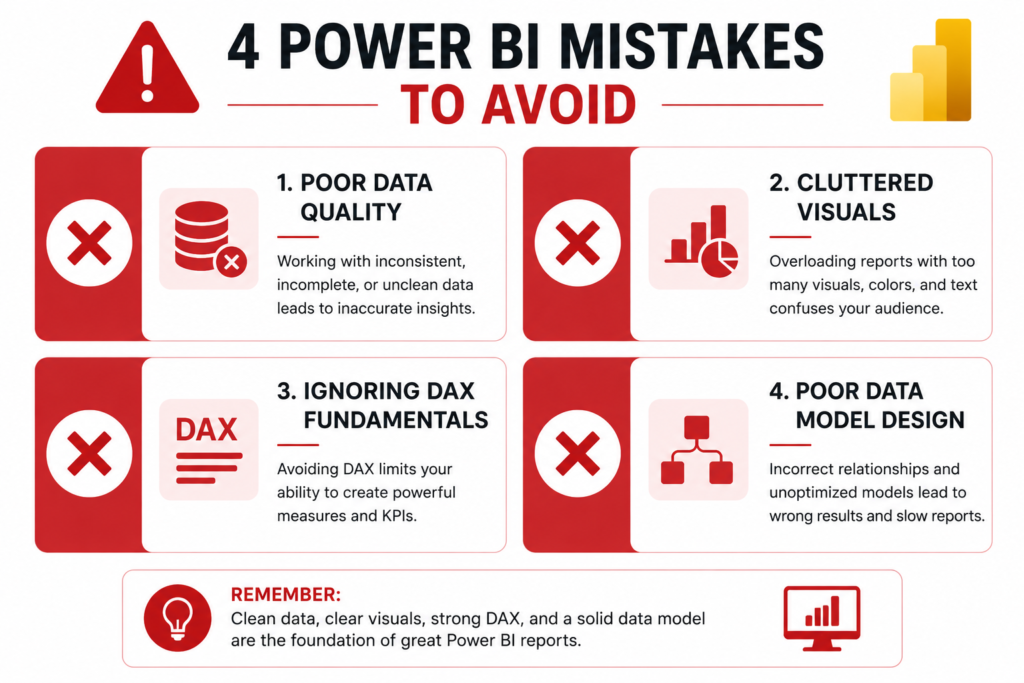
Memorizing DAX Instead of Understanding Logic
The single biggest mistake I see in beginner power bi training is treating DAX like a vocabulary list. People memorize SUMX vs SUMIF, then forget it the next week because there was no understanding behind it.
DAX is a query language. Every formula runs in a filter context. Once you truly understand row context versus filter context, every function becomes intuitive. Spend one week just on that concept before memorizing anything.
Ignoring Data Modeling Fundamentals
This is the silent killer of beginner progress. You can watch 40 hours of Power BI tutorials and build beautiful-looking charts, but if your data model has circular relationships or no proper date table, your measures will be wrong and your reports will be slow.
Data modeling is not glamorous, but it is foundational. Treat it like the structural foundation of a house — skip it and everything you build on top becomes unreliable.
Jumping Into Advanced Topics Too Early
Row Level Security, Composite Models, Paginated Reports, and Power BI Embedded are all important topics — eventually. For a beginner in the first two months, they are distractions.
Here is what I tell every beginner I work with: master the basics so completely that they become invisible. When connecting to data, building a model, writing a measure, and publishing a report feel effortless, then start exploring advanced features.
Watching Tutorials Without Practicing
I mentioned this earlier but it deserves its own section because it is that common. Tutorial watching creates a feeling of progress while producing very little actual skill development.
A practical rule: close the tutorial video after each major step and reproduce it yourself from scratch without looking. If you cannot, rewatch that step. If you can, move on. That simple test reveals exactly where your understanding actually stops.
| 📌 Key Takeaways — Common Mistakes ✓ Learn DAX logic before memorizing formulas ✓ Build your data model before building visuals ✓ Stay in beginner territory for at least 6 weeks ✓ Practice immediately after every lesson segment |
Beginner vs Advanced Power BI Learning Paths
What Beginners Should Focus On First
| Beginner Focus (Months 1-3) | Advanced Focus (Months 4+) |
| Power Query data cleaning | Composite Models & DirectQuery |
| Star schema data modeling | Row Level Security (RLS) |
| Basic DAX (SUM, CALCULATE, DIVIDE) | Advanced DAX (CALCULATE with complex filters) |
| Interactive report design | Paginated Reports |
| Publishing to Power BI Service | Power BI Embedded & API |
| Building one solid portfolio project | Deployment pipelines & governance |
Skills That Matter Later in Advanced BI Roles
Once you have the beginner foundation solid, the skills that differentiate mid-level and senior BI developers are performance optimization (understanding storage mode, aggregations, query folding), governance (workspaces, sensitivity labels, row-level security at scale), and storytelling (translating data into business narratives that drive decisions).
When to Learn SQL Alongside Power BI
From my experience, SQL is the most high-value companion skill for Power BI users. I recommend starting SQL basics around month two or three of your Power BI journey, not at the very beginning.
Once you understand how Power Query works, SQL will feel familiar. And once you can write SQL queries, you can connect Power BI to databases far more efficiently than using the native connectors alone.
For a complete roadmap of where these skills sit in a data career, the breaks it down step by step.
Should Beginners Learn Fabric or Azure Next?
Microsoft Fabric is Microsoft’s new unified analytics platform that includes Power BI as one of its components. For beginners, I recommend ignoring Fabric until you are comfortable with Power BI standalone — the concepts transfer directly.
Azure is a longer-term skill if you want to work in enterprise data engineering. It is not necessary for a Power BI data analyst role at most organisations, but it becomes relevant if you move toward BI developer or data engineering roles.
Best Tools and Resources for Power BI Beginners
Free Datasets for Practice
- Microsoft Financial Sample — built into Power BI, perfect for beginners
- Kaggle Datasets — filter by ‘CSV’ and ‘beginner’ for clean starting points
- data.gov — US government datasets covering dozens of topics
- World Bank Open Data — global economic and development datasets
- Superstore Dataset — classic BI practice dataset widely referenced in tutorials
Best YouTube Channels for Power BI Training
- Guy in a Cube — weekly Power BI tips, official Microsoft partners
- Curbal — deep DAX and data modeling content, excellent for intermediate topics
- SQLBI — the most rigorous DAX education available, Marco Russo and Alberto Ferrari
- Patrick Leblanc — practical walkthroughs of real-world Power BI scenarios
Best Websites for DAX Practice
DAX.guide () is the definitive reference for every DAX function with examples and syntax notes. Use it alongside your course, not instead of it.
SQLBI.com () publishes in-depth articles on data modeling patterns and DAX logic. Their content is advanced but the fundamentals articles are genuinely useful for beginners trying to understand how things work.
Communities That Help Beginners Learn Faster
- Microsoft Power BI Community (community.powerbi.com) — official forum with direct input from Microsoft
- Reddit r/PowerBI — practical questions, career advice, project showcases
- LinkedIn Power BI groups — good for networking and seeing real-world use cases
- Data Career Jumpstart Discord communities — active beginner-friendly spaces
Power BI Course Comparison Table
Here is the full side-by-side comparison of the best power bi courses for beginners based on five criteria that matter most:
| Course | Beginner Friendly | Cert Support | Hands-On | Price | Career Ready |
| Microsoft Learn | ★★★★★ | ★★★★☆ | ★★★☆☆ | Free | ★★★☆☆ |
| Coursera (PwC) | ★★★★☆ | ★★★★★ | ★★★★☆ | $49/mo | ★★★★★ |
| Udemy (Maven) | ★★★★★ | ★★★★☆ | ★★★★★ | $15-20 | ★★★★☆ |
| Guy in a Cube (YT) | ★★★★☆ | ★★★☆☆ | ★★★☆☆ | Free | ★★★☆☆ |
| LinkedIn Learning | ★★★★☆ | ★★★★☆ | ★★★★☆ | $39/mo | ★★★★★ |
| DataCamp | ★★★★★ | ★★★☆☆ | ★★★★★ | $25/mo | ★★★★☆ |
Beginner Friendliness
Microsoft Learn and Maven Analytics (Udemy) score highest for pure beginner accessibility. Microsoft Learn uses an adaptive format, while Maven Analytics’ instructor style is exceptionally clear for people with no prior BI experience.
Certification Support
Coursera and Pragmatic Works lead here. Both structure their content explicitly around PL-300 exam objectives, which makes the transition from course to exam efficient rather than requiring a separate study phase.
Hands-On Projects
DataCamp and Maven Analytics are the strongest for hands-on building. DataCamp’s browser-based environment removes setup friction entirely, while Maven Analytics includes full end-to-end business projects throughout the course.
Pricing and Value
Microsoft Learn is free and high quality. Maven Analytics on Udemy during a sale ($15-20) represents exceptional value. LinkedIn Learning offers the best value for users who already have a LinkedIn Premium subscription.
Career Readiness
Coursera and LinkedIn Learning have the strongest career positioning — both carry recognizable brand names and issue certificates that carry weight with hiring managers. Maven Analytics is close behind for people who supplement the course with a strong portfolio project.
Frequently Asked Questions
How Long Does It Take to Learn Power BI?
For basic proficiency — building clean interactive reports and publishing them — expect four to six weeks of consistent daily practice (one to two hours per day). For job-ready skills including solid DAX and data modeling, plan for two to three months. For PL-300 certification readiness, three to four months from zero.
Can I Learn Power BI Without Coding?
Yes. Power BI is designed for business users, and the core workflow — connecting data, building a model, creating visuals — requires no coding. DAX is formula-based (similar to Excel), and Power Query uses a visual interface for most transformations. SQL helps but is not required at beginner level.
Is Power BI Hard for Beginners?
The interface is accessible. The hard part is data modeling and DAX logic, not the visual design tools. Most beginners find the first week surprisingly easy and hit their first wall in week three when they encounter complex filter behaviour in DAX. That wall is normal, and it passes quickly with focused practice.
Which Power BI Certification Is Best for Beginners?
The PL-300 (Microsoft Certified: Power BI Data Analyst Associate) is the only official Microsoft Power BI certification and the right target for most beginners. It is challenging but achievable with two to three months of preparation. There is no ‘beginner level’ version — the PL-300 is the entry point.
For a broader comparison of credentials in the data space, my covers where PL-300 fits alongside Python, SQL, and other popular certs.
Are Free Power BI Courses Worth It?
Yes, with the right approach. Microsoft Learn is genuinely excellent and free. Guy in a Cube on YouTube covers most beginner topics well. The limitation of free resources is structure — you need to supply the learning roadmap yourself. If you follow the six-week roadmap in this guide, free resources can absolutely take you to a functional level.
Can Power BI Help Me Get a Data Analyst Job?
Absolutely. Power BI is consistently one of the most requested tools in data analyst job postings. Combined with Excel, SQL, and a portfolio of real projects, it is enough to land a junior data analyst role at most organisations.
If you are building toward a data analyst career, my complete guide on gives you the full picture of what else to study alongside Power BI.
Final Action Plan for Beginners
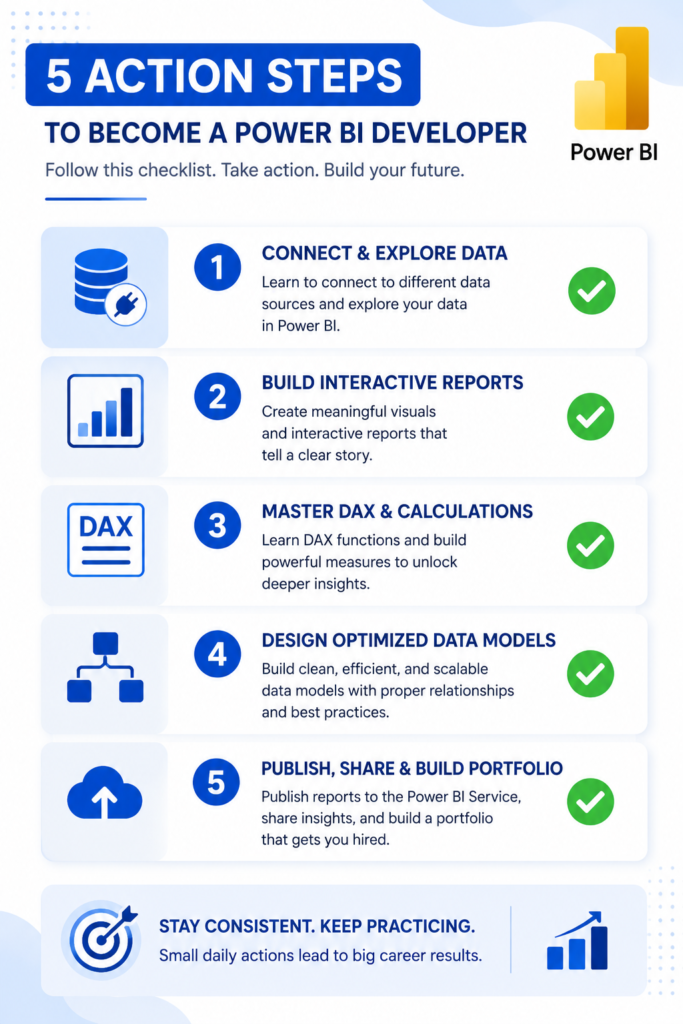
Choose the Right Course Based on Your Goal
Do not spend more than one day choosing your course. Use the quick-answer table from the beginning of this guide, pick the option that matches your goal and budget, and commit to it for six weeks before second-guessing it.
| 🎯 Final CTA — Your Next Step Here is exactly what to do in the next 30 minutes: 1. Download Power BI Desktop (free from Microsoft) 2. Connect it to the Microsoft Financial Sample dataset 3. Enroll in ONE course from this guide based on your goal 4. Block one hour every day for the next 6 weeks in your calendar 5. Build something today — even a single chart counts The difference between people who learn Power BI and people who mean to learn it is always the same thing: starting before you feel ready. |
Build Your First Real Dashboard Project
By week two, you should have a working dashboard. It does not need to be impressive — it needs to be real. Pick a genuine question (your personal finances, your team’s sales data, a public dataset you care about) and build something that answers it.
That first real project, however simple, changes your relationship with the tool. It stops being abstract and becomes a skill you actually own.
Create a Beginner Portfolio
After your first project, build two more on different topics. Publish all three to Power BI Service and document each one on LinkedIn with a brief case study: what question you answered, what data you used, and what the dashboard revealed.
Three portfolio projects across different domains — even simple ones — is enough to demonstrate genuine capability to a hiring manager who sees hundreds of resumes claiming Power BI proficiency with nothing to show for it.
Start Applying Your Skills in Real Scenarios
If you are currently employed, find one report in your current role that you can rebuild in Power BI and improve. Volunteer for it. That internal project is more valuable for your career than any additional course, because it gives you a real stakeholder, real messy data, and real business context.
If you are transitioning careers, my guide on covers the full skill stack you need for an entry-level data analyst position.
The Fastest Way to Stay Consistent and Improve
Consistency beats intensity every time in skill development. Thirty minutes of focused Power BI practice every day produces better results than a six-hour weekend session once a week.
Here is the system I recommend for staying consistent:
- Set a fixed daily time slot for Power BI practice
- Keep your Power BI project open and ready — zero setup friction
- End every session by writing one thing you learned and one question you still have
- Answer that question first in the next session before starting anything new
- Share progress publicly (LinkedIn or community forum) once a week
That last step — public accountability — is the most underrated consistency tool available. When you know someone might see your progress, you show up differently.
| 📌 Final Key Takeaways ✓ Power BI courses for beginners range from free (Microsoft Learn) to structured paid programs (Maven, Coursera, Pragmatic Works) ✓ The best course is the one that matches your goal, not the one with the most reviews ✓ Data modeling and DAX logic are more important than visual design skills ✓ A six-week consistent roadmap outperforms any course without practice ✓ Three portfolio projects + one real-world application = job-ready ✓ PL-300 certification is achievable in 3-4 months with the right preparation strategy |
| Related guides: Data Analyst Courses for Beginners | Data Analyst Certifications | Data Analytics Tools | BI Developer Career Guide |