
In fact, the shift from traditional degrees toward skill-based certifications has been one of the most dramatic changes I’ve witnessed in the hiring world. Hiring managers openly tell me they’d rather see a Google Data Analytics Professional Certificate combined with a solid portfolio than a generic bachelor’s degree with no hands-on experience. That tells you everything you need to know.
However, the certification market is noisy. There are dozens of platforms, hundreds of courses, and endless debate — especially on Reddit — about which certifications actually move the needle and which are just digital paper. Therefore, I’ve put together this comprehensive guide to cut through all the noise and give you a clear, honest, experience-based breakdown of every major data analyst certification online in 2026.
By the end of this guide, you’ll know exactly which certification fits your goal, whether you’re starting from zero or upskilling from an existing analyst role, what the real costs are, and most importantly — how to turn a certificate into an actual job offer.
Quick Answer: Best Data Analyst Certification Online (2026 Snapshot)
I know some of you are here for the short answer. So before diving deep, here’s my honest 2026 snapshot.
Top Certifications Based on Career Goals
| Career Goal | Best Certification | Platform | Time |
| Complete beginner | Google Data Analytics Professional Certificate | Coursera | ~6 months |
| Hands-on technical focus | IBM Data Analyst Professional Certificate | Coursera | ~3–5 months |
| Power BI / Microsoft tools | Microsoft Power BI Data Analyst (PL-300) | Microsoft Learn | ~2–3 months |
| Modern data engineering stack | Databricks Associate Data Analyst | Databricks Academy | ~1–2 months |
| Visualization specialist | Tableau Certified Data Analyst | Tableau / Trailhead | ~2–3 months |
| Healthcare/clinical track | AHIMA / CHDA + domain courses | Multiple | ~4–6 months |
| Fast, free option | Microsoft Data Analyst (free prep) + DataCamp | Microsoft Learn / DataCamp | ~1–3 months |
Fastest Way to Get Job-Ready
In my experience, the fastest path to job-readiness is not the cheapest, and it’s not the most prestigious on paper either. The fastest path is: one solid foundational certification + two to three real portfolio projects + consistent SQL and Excel practice. That combination, done in 90 days, beats two years of collecting certificates any day of the week.
📌 Pro Tip: Don’t wait until you finish your certification to start building projects. Start on Week 2. Employers hire people who demonstrate skill, not people who plan to demonstrate it someday.
Free vs Paid Options (Quick Breakdown)
There are genuinely free options that carry weight — including Microsoft’s learning paths, Deloitte’s data analytics program, and Google’s certificate (available via financial aid on Coursera). However, ‘free’ doesn’t always mean valuable. I’ll break this down in detail later, but for now: free options are great for skill-building, while paid industry certifications like PL-300 or Tableau Certified carry more employer recognition.
Who This Guide Is For
Before you go any further, let me be clear about who will benefit most from this guide — because the right certification genuinely depends on where you’re starting from.
Beginners Starting from Zero
If you have zero experience with data analysis, SQL, or Excel — welcome, you’re in the right place. Data analysis certification online for beginners is more accessible in 2026 than ever before. Platforms like Coursera, edX, and DataCamp have designed beginner-friendly learning paths that assume nothing. The Google Data Analytics Professional Certificate, for example, starts from scratch and walks you through everything step by step. I’ve recommended it to dozens of career-changers and most of them landed interviews within three months of completing it, provided they also built portfolio projects.
Professionals Switching Careers
Career switchers are actually some of the best data analyst candidates I’ve seen. Why? Because domain knowledge is incredibly valuable. A teacher who learns data analysis brings something a fresh CS graduate can’t — real-world context. If you’re switching from finance, healthcare, marketing, or education, your existing expertise is a genuine asset. Therefore, your certification path should be fast-tracked and targeted. You don’t need to start at absolute zero — you need to fill specific skill gaps.
Analysts Upskilling with Tools (Power BI, Databricks, etc.)
If you’re already working as an analyst and want to level up your value, tool-based certifications are your best bet. The Microsoft Power BI Data Analyst certification (PL-300), Databricks Associate Data Analyst certification, and Tableau Certified Data Analyst are all respected in the industry and demonstrate specific, measurable technical skills. These certifications also tend to come with salary bumps — in my network, Power BI-certified analysts report 15–25% increases in earning potential.
Specialized Roles (Healthcare, Clinical, Domain-specific)
Healthcare data analyst certification online is one of the fastest-growing search terms in this space, and for good reason. Healthcare data is exploding, driven by electronic health records, insurance analytics, and clinical trial management. If you’re targeting this path, you’ll need a combination of general data analytics training and domain-specific certifications like CHDA (Certified Health Data Analyst). I cover this in detail in the Specialized Paths section below.
What Actually Works in 2026: Certification Strategy That Gets Jobs
Why Most Certifications Alone Don’t Work
Here’s the uncomfortable truth most certification providers won’t tell you: a certificate alone, without accompanying skills and portfolio evidence, will not get you hired. I’ve seen this play out over and over. Someone spends six months on a data analyst certification course, passes every quiz, earns the badge, and then gets ghosted by every application they send. Why? Because the certificate proves you sat through the course — it doesn’t prove you can solve real business problems.
Employers are smart. They’ve been flooded with certificate holders since 2022. What actually stands out in 2026 is someone who can say, ‘Here’s a real project I built. Here’s the problem I solved, here’s the SQL I wrote. Here’s the dashboard I delivered.’ That combination is unstoppable.
Skill Stack That Employers Actually Look For
Based on current job postings and direct feedback from hiring managers, here’s what the market wants:
- SQL — non-negotiable. Every data analyst role requires it. Period.
- Excel / Google Sheets — still essential for 80% of business environments.
- Power BI or Tableau — at least one visualization tool is expected.
- Python (pandas, matplotlib) — increasingly required, especially for mid-level roles.
- Data storytelling and communication — overlooked by beginners, critical in practice.
- Basic statistics — mean, median, standard deviation, regression concepts.
🔗 Related Reading: If you’re wondering where Python fits in, check out my detailed guide on the best Python courses in 2026 — it pairs perfectly with any data analyst certification path.
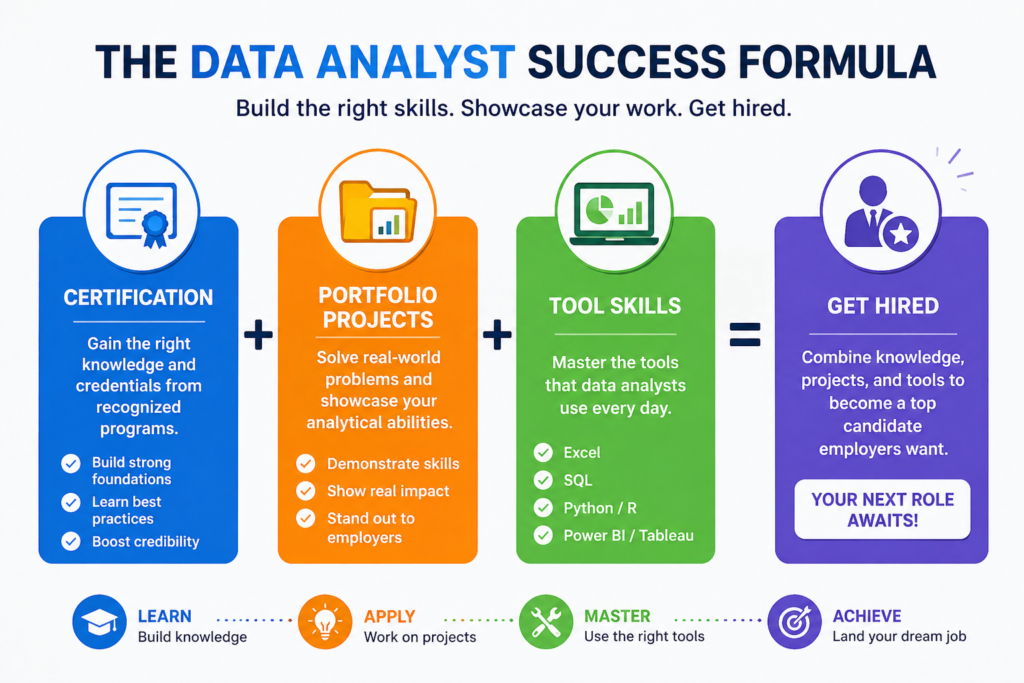
Certification + Projects + Tools = Hiring Formula
I call this the hiring formula, and I’ve seen it work consistently. Here’s how it breaks down: First, you earn one credible certification that validates your foundational knowledge. Second, you build two to three real portfolio projects using publicly available datasets — think Kaggle, data.gov, or company datasets. Third, you demonstrate proficiency in at least two industry tools. Combined, this creates a profile that hiring managers can actually evaluate. Without projects and tools, a certification is just a line on a resume.
Step-by-Step Framework: How to Get Data Analyst Certification Online
I’ve helped mentor dozens of people through this process. Here’s the exact framework I walk everyone through, regardless of their starting point.
Step 1: Choose Your Career Path (General vs Specialized)
Before you enroll in anything, get clear on your destination. Are you going for a general data analyst role in any industry? Or are you targeting something specific like healthcare data analytics, marketing analytics, or financial analysis? This decision shapes everything — which certification you choose, which tools you learn, and which portfolio projects you build. Spending 30 minutes on this step saves you months of misdirected effort.
Step 2: Select the Right Certification Platform
Once you know your path, match it to a platform. General beginners should start with Coursera (Google or IBM certificates). Tool-focused learners should go directly to Microsoft Learn, Databricks Academy, or Tableau’s official learning paths. Career switchers with time constraints might prefer DataCamp’s structured tracks, which are highly focused and faster to complete. I cover each platform in detail in the section below.
Step 3: Build Real Projects Alongside Certification
This is where 90% of people fail. They finish their course and then start thinking about projects. Don’t do that. Instead, start a project during Week 2 or 3 of your certification course. Use what you’re learning in real time. Pick a dataset you find genuinely interesting — sports statistics, public health data, e-commerce transaction data. Clean it, analyze it, visualize it, and document your process on GitHub or a personal site.
Step 4: Learn Tools (SQL, Excel, Power BI, Python)
Tools are the hard skills that make you hirable. SQL is your first priority — without it, you cannot function as a data analyst. Excel comes second, because it’s everywhere in the business world. After those two, choose Power BI or Tableau based on where you want to work. For more technical roles, add Python. This doesn’t all have to happen at once — but it should all happen within your 90-day plan.
Step 5: Validate with Industry Certification Exams
Once you’ve completed foundational training and built some projects, consider sitting for a proctored exam-based certification. The Microsoft PL-300 exam, Tableau Certified Data Analyst exam, or Databricks Associate exam all require you to demonstrate real knowledge under pressure. These carry more weight than self-paced course badges because they’re harder to fake.
Step 6: Build Portfolio + Apply Strategically
Your portfolio is your proof of work. At minimum, it should include three projects with clear documentation, a GitHub profile with active commits, and a LinkedIn profile that tells the story of your transition into data. When applying, target roles that match your current skill level — junior analyst, data analyst associate, or business intelligence analyst — rather than reaching for senior roles before you’re ready.
💡 Tip: A strong resume matters just as much as your certification. Make sure your data analyst skills and certifications are highlighted clearly with measurable outcomes on every bullet point.
Best Data Analyst Certification Online: Detailed Breakdown
Google Data Analytics Professional Certificate (Best for Beginners)
The Google Data Analytics Professional Certificate is, without a doubt, the most popular entry-level data analyst certification online in 2026. Offered through Coursera, it covers the full analytical workflow — from asking the right questions to cleaning data, analyzing with spreadsheets and SQL, visualizing with Tableau, and presenting insights. The course is designed for absolute beginners and requires no prior technical experience.
In my honest assessment, it’s a great starting point — but it’s not a finish line. I have a detailed breakdown of the Google Data Analytics Professional Certificate on BestCourseHub.com if you want an in-depth review of whether it’s worth your time and money in 2026.
- Duration: Approximately 6 months at 10 hours/week
- Cost: ~$49/month on Coursera (financial aid available — essentially free)
- Tools Covered: Spreadsheets, SQL, Tableau, R
- Best For: Absolute beginners, career switchers
- Employer Recognition: High — Google’s name carries significant weight
💰 Cost Tip: Financial aid on Coursera is genuine and widely approved. Don’t let the listed price deter you — apply for aid and complete this certification for free if budget is a concern.
IBM Data Analyst Professional Certificate (Best for Hands-on Learning)
The IBM Data Analyst Professional Certificate is another Coursera favorite, and in my experience it edges out Google in terms of technical depth. IBM’s program covers Python for data analysis — specifically pandas and matplotlib — alongside SQL, Excel, and visualization tools. It also includes a capstone project, which gives you something concrete to show employers.
For anyone who wants more technical exposure and is comfortable with a slightly steeper learning curve, IBM’s certificate is the better choice over Google’s. The combination of Python + SQL + visualization tools is exactly what mid-level data analyst roles require.
- Duration: ~3–5 months at 10 hours/week
- Cost: ~$49/month on Coursera
- Tools Covered: Python (pandas, matplotlib), SQL, Excel, Cognos Analytics, Tableau
- Best For: Learners who want a technical foundation, not just conceptual knowledge
- Employer Recognition: Strong — IBM certification is widely recognized
Microsoft Data Analyst Certification (Power BI Focus)
The Microsoft Power BI Data Analyst certification — formally known as PL-300 — is one of the most employer-recognized tool-based certifications available. Unlike Coursera-based certificates, this is a proctored Microsoft exam that carries serious industry weight. If you’re going to work in any corporate environment that uses Microsoft’s data ecosystem (which is most of them), this is arguably the single most impactful certification you can earn.
Microsoft Learn offers free preparation materials for the PL-300 exam, making the microsoft data analyst certification essentially free to study for. You only pay for the exam itself (~$165 USD). This is the best value in the data certification world, in my opinion.
- Exam Cost: ~$165 USD (study materials free on Microsoft Learn)
- Tools Covered: Power BI, DAX, Power Query, data modeling
- Best For: Analysts targeting corporate BI roles, Microsoft environments
- Difficulty: Intermediate — requires real hands-on Power BI experience
- Employer Recognition: Very high in enterprise settings
Databricks Data Analyst Certification (Modern Data Stack)
The Databricks Associate Data Analyst certification is relatively new but rapidly gaining traction, especially in companies running modern cloud-native data stacks. If you want to work with large-scale data, Spark, or Lakehouse architecture, this certification signals that you understand data beyond basic spreadsheets and dashboards.
I’ll be honest — Databricks certifications are more niche than Google or Microsoft options. However, in the right company (think tech, fintech, healthcare analytics platforms), the Databricks analyst certification can be a major differentiator. The exam covers SQL analytics, data exploration in notebooks, and understanding of the Databricks ecosystem.
- Exam Cost: ~$200 USD
- Tools Covered: Databricks SQL, Delta Lake, Databricks Notebooks
- Best For: Analysts in data engineering or cloud analytics environments
- Employer Recognition: Growing — niche but high-value in the right context
Tableau Data Analyst Certification (Visualization Focus)
Tableau remains one of the dominant visualization tools in the industry, and the Tableau Certified Data Analyst credential is the official recognition of that expertise. This certification demonstrates your ability to connect data sources, build dashboards, and communicate visual insights effectively — skills that are genuinely in demand across industries.
In terms of pure visualization credibility, Tableau certification often beats Power BI in creative and marketing-adjacent industries, while Power BI dominates in corporate finance and operations. However, choosing one over the other should be driven by the job market you’re targeting, not personal preference.
- Exam Cost: ~$250 USD
- Tools Covered: Tableau Desktop, Tableau Prep, data connections, calculated fields
- Best For: Roles requiring strong data visualization and storytelling
- Employer Recognition: High in business intelligence, consulting, and analytics-heavy roles
DataCamp and Alternative Platforms
DataCamp is a platform I genuinely like for skill-building, even if its certificates carry less employer weight than Google, IBM, or Microsoft options. DataCamp’s Data Analyst certification covers Python and R-based analytics in a very hands-on, code-focused way. The platform forces you to write real code in every lesson, which accelerates skill development significantly.
Other platforms worth mentioning include edX (MIT and UC Berkeley data courses), Udemy (affordable but unaccredited), LinkedIn Learning (good supplementary content), and Kaggle (free, highly respected community platform for projects and competitions). Use these as supplements, not replacements, for industry-recognized certifications.
Free vs Paid Certifications: What You Should Choose
Truly Free Certifications (Microsoft, Deloitte, etc.)
There are a few genuinely free certification options that I recommend without hesitation. Microsoft Learn offers free training content for the PL-300 exam — while the exam itself costs money, all the preparation is free and comprehensive. The Deloitte data analyst certification is another solid free option — Deloitte offers a free data analytics program through Forage, which simulates real-world client work and is well-regarded by employers who recognize it.
Additionally, the Google Data Analytics Professional Certificate is available through Coursera’s financial aid program at essentially zero cost. If you qualify — which most applicants do — you get the full course and certificate for free.
Free with Certificate vs Free Without Value
Not all free certifications are equal, and this is where I see a lot of beginners get burned. Some platforms offer ‘free’ courses that give you a certificate of completion — but the certificate carries zero employer recognition. YouTube tutorials, generic online modules, and random MOOC certificates from unknown providers fall into this category. They’re great for learning, but they add no credibility to your resume on their own.
⚠️ Warning: A ‘free’ certificate from an unknown platform is only worth the time it took you to learn the skills — not the certificate itself. Focus on recognized names: Google, IBM, Microsoft, Tableau, Databricks.
Paid Certifications That Deliver ROI
The certifications that consistently deliver return on investment are the ones tied to proctored exams or globally recognized programs. Microsoft PL-300, Tableau Certified Data Analyst, and Databricks Associate all require real exam preparation and carry employer credibility that directly translates to hiring leverage. Based on what I’ve seen in the job market, analysts with one of these certifications regularly land roles 20–40% faster than those without.
Cost Breakdown: What You Actually Pay
| Certification | Study Cost | Exam Cost | Total | ROI Rating |
| Google Data Analytics (Coursera) | $49/mo × 6mo or free w/ aid | Included | $0–$294 | ⭐⭐⭐⭐⭐ |
| IBM Data Analyst (Coursera) | $49/mo × 3–5mo or free w/ aid | Included | $0–$245 | ⭐⭐⭐⭐⭐ |
| Microsoft PL-300 | Free (Microsoft Learn) | ~$165 | ~$165 | ⭐⭐⭐⭐⭐ |
| Tableau Certified Data Analyst | $35–75/mo (Tableau Learning) | ~$250 | ~$285–$350 | ⭐⭐⭐⭐ |
| Databricks Associate | $0–$50 prep | ~$200 | ~$200–$250 | ⭐⭐⭐⭐ |
| Deloitte (Forage) | Free | Free | $0 | ⭐⭐⭐⭐ |
| DataCamp Certification | $25/mo subscription | Included | $25–$75 | ⭐⭐⭐ |
Certification Comparison: Which One Is Right for You
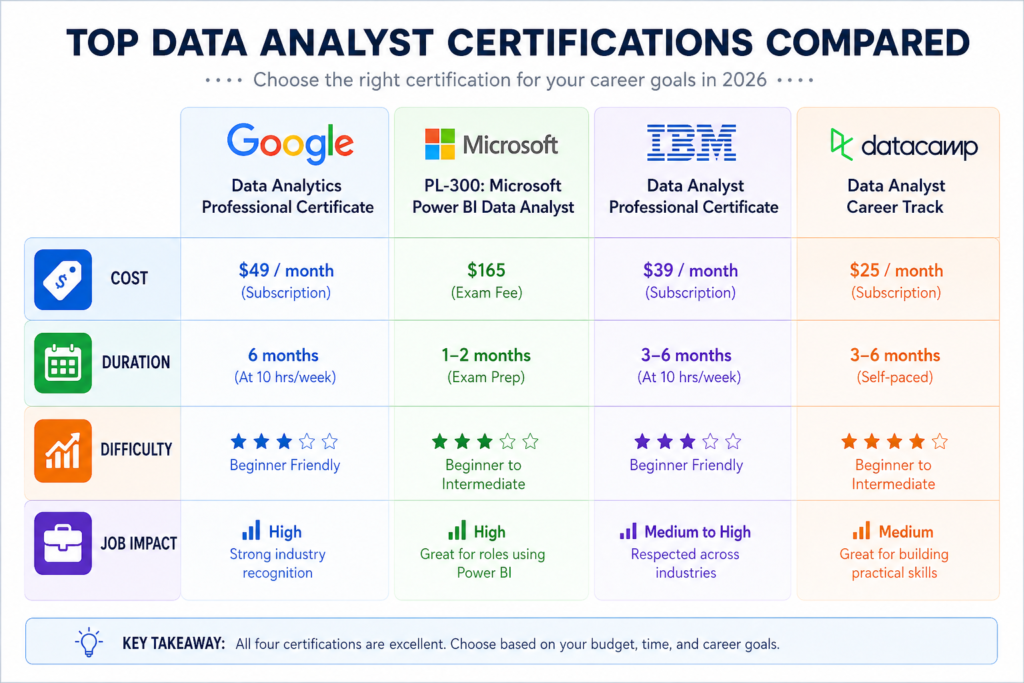
Google vs IBM vs Microsoft vs Databricks
Let me be direct here. If you’re a beginner with no technical background, start with Google. If you want more technical depth right away, go IBM. And if you’re targeting corporate business intelligence roles, Microsoft PL-300 is your best move. If you’re in or moving toward a data engineering-adjacent role, Databricks is your differentiator. None of these are wrong choices — the right one depends entirely on where you want to end up.
| Factor | IBM | Microsoft PL-300 | Databricks | |
| Difficulty | Beginner | Beginner–Intermediate | Intermediate | Intermediate–Advanced |
| Best For | Career starters | Technical learners | BI/corporate roles | Cloud/data eng roles |
| Exam Format | Course-based | Course-based | Proctored exam | Proctored exam |
| Cost (approx.) | $0–$294 | $0–$245 | ~$165 | ~$200–$250 |
| Employer Recognition | Very High | High | Very High | High (growing) |
| Tool Coverage | SQL, Tableau, R | Python, SQL, Excel | Power BI, DAX | Databricks SQL |
Beginner vs Intermediate vs Advanced Certifications
Matching your certification to your current skill level is critical. I’ve seen beginners attempt the Databricks exam and waste both time and money. Here’s a simple rule of thumb: if you can’t write a basic SQL query yet, you’re a beginner. If you can query data and build charts, you’re intermediate. If you can build data pipelines and model complex datasets, you’re advanced. Choose your certification accordingly, and don’t skip levels to impress employers — it usually backfires.
Tool-Based vs Role-Based Certifications
There’s an important distinction between tool-based certifications (Power BI, Tableau, Databricks) and role-based certifications (Google Data Analytics, IBM Data Analyst). Role-based certifications teach you how to think and work like an analyst. Tool-based certifications prove you can use a specific technology. In an ideal world, you have both — one role-based certification as your foundation, then one or two tool-based certifications to show specific technical capability.
Online Accredited vs Non-accredited Programs
Accreditation is a frequently misunderstood concept in the online certification world. Most data analyst certification online accredited programs come from universities and may be more expensive — think edX MicroMasters or university-issued certificates. These carry weight in academic contexts. However, for most employer hiring decisions, ‘accredited’ matters far less than ‘recognized.’ Google, IBM, and Microsoft certifications are not ‘accredited’ in the traditional sense, but they’re trusted and recognized globally by employers.
Specialized Paths: Beyond General Data Analyst
Healthcare Data Analyst Certification Path
Healthcare data analyst certification online is one of the most searched topics in this space, and I completely understand why. Also healthcare generates enormous volumes of data — patient records, claims data, clinical trials, population health metrics — and there is a serious shortage of analysts who can interpret it intelligently.
For anyone targeting this path, I recommend a two-track approach. First, complete a general data analytics certification like Google or IBM to build your technical foundation. Second, layer on domain-specific training in healthcare data standards like HL7, FHIR, ICD-10 coding, and HIPAA compliance. The AHIMA CHDA certification (Certified Health Data Analyst) is the gold standard in this space and is recognized across hospital systems, insurance companies, and government health agencies.
- Recommended Path: Google/IBM Certificate → CHDA Exam → Healthcare portfolio project
- Key Skills: SQL, Excel, EHR systems, HL7/FHIR standards, HIPAA basics
- Salary Premium: Healthcare analysts often earn 10–20% more than general analysts
Clinical Data Analyst Career Track
Clinical data analytics is a subset of healthcare analytics focused specifically on clinical trial data, patient outcomes, and evidence-based medicine. And Clinical data analyst certification online programs often overlap with bioinformatics or biostatistics. Key tools in this space include SAS (widely used in pharma), R, and specialized clinical data management software.
If you’re coming from a life sciences, nursing, or pharmacy background, this path is a natural extension. The SAS certification and CCDM (Certified Clinical Data Manager) credential are highly recognized in pharmaceutical and medical device companies.
Industry-Specific Certifications (Finance, Marketing, etc.)
Beyond healthcare, several industries have developed their own data analytics specializations. Financial analytics professionals often pair data certifications with CFA or FRM credentials. Marketing analysts benefit from combining data certification with Google Analytics and Meta Blueprint certifications. Retail and supply chain analysts should look at certifications that cover SQL-based inventory and logistics analytics. In each case, the formula is the same: general data foundation + industry-specific credential + domain portfolio project.
When Specialization Actually Makes Sense
Specialization makes the most sense when you already have domain knowledge and want to add data skills — or when the job market you’re targeting has specific requirements. However, if you’re brand new to both data and the industry, I’d recommend getting your general foundation right first. Don’t try to specialize before you can analyze. The sequencing matters.
Tools You Must Master Alongside Certification
SQL, Excel, and Data Cleaning Fundamentals
I want to be unambiguous here: SQL is the most important skill a data analyst can have in 2026. I’ve reviewed hundreds of job descriptions, and SQL appears in virtually every single one. Whether you’re working with a small MySQL database or a massive cloud data warehouse, SQL is how you talk to data. Learn it early, practice it constantly, and keep practicing even after you feel comfortable.
Excel remains equally important, especially in small and mid-sized businesses. VLOOKUP, pivot tables, conditional formatting, and basic formulas are non-negotiable skills. Data cleaning — removing duplicates, handling null values, standardizing formats — is also something most certifications touch on but not deeply enough. Spend real time here.
Power BI vs Tableau: Which Tool to Learn
This is one of the most common questions I get. My answer: look at the job market in your target city or industry. Power BI dominates in corporate environments, finance, and healthcare. Tableau leads in consulting, tech, and data-heavy startups. If you can only learn one, Power BI is the safer bet for most people given Microsoft’s enterprise dominance. However, if you want maximum visualization skill and flexibility, Tableau’s capabilities are genuinely superior for complex, custom visualizations.
📌 Strategy: You don’t need to master both from day one. Pick the one that appears most frequently in your target job listings. Master one tool deeply before learning a second.
Python for Data Analysis
Python has become increasingly important in data analyst roles, especially as companies blur the line between analysts and data scientists. If you’re aiming for mid-to-senior analyst roles, Python is no longer optional. The core libraries you need are pandas (data manipulation), matplotlib and seaborn (visualization), and NumPy (numerical operations).
The good news is that Python for data analysis is genuinely learnable in 60–90 days of consistent practice. I’ve written a comprehensive guide on the best Python courses in 2026 that will pair perfectly with your certification journey.
Modern Tools: Databricks, Cloud, Big Data
For analysts targeting modern data stacks, understanding cloud environments is increasingly expected. Basic familiarity with AWS, Azure, or Google Cloud — specifically their data services like Redshift, Synapse, or BigQuery — signals that you’re ready for enterprise-scale data work. Databricks is increasingly standard in companies that manage large datasets. You don’t need deep expertise at the junior level, but awareness and basic usage knowledge will give you an edge.
Real Examples: Certification Paths That Actually Work
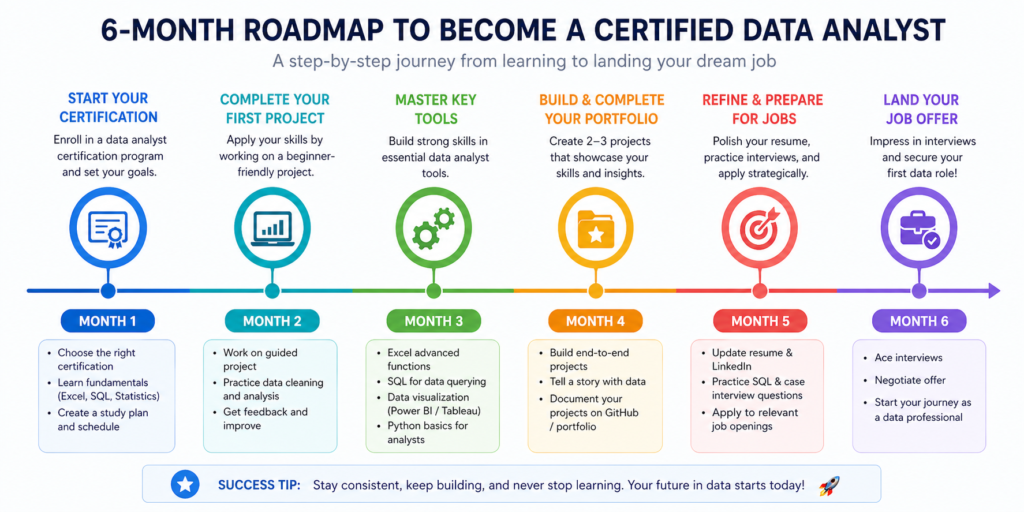
Beginner to Job in 6 Months (Case Flow)
Here’s a real-world scenario that I’ve seen play out multiple times with people in my network. A retail store manager with zero technical background decides to transition into data analytics. She starts with the Google Data Analytics Professional Certificate on Coursera using financial aid — total cost: zero. Month one and two she focuses entirely on the course. And month three, she starts a personal project analyzing her local grocery chain’s publicly available pricing data in SQL and Excel. Month four, she learns Power BI and builds a dashboard, Month five, she creates a GitHub portfolio and updates her LinkedIn. Month six, she applies to 40 junior analyst roles and lands three interviews. She accepts an offer as a Business Analyst with a 30% pay increase over her retail salary.
The formula: one certification, one real project, two tools, a GitHub portfolio, and focused applications. Nothing magical — just disciplined execution.
Career Switch Example (Non-tech to Analyst)
A high school teacher with a background in math decides to make the switch. He goes through the IBM Data Analyst Professional Certificate for the Python exposure. Alongside the course, he builds a project analyzing standardized test score data from public education datasets — domain he already understands deeply. He adds SQL practice through LeetCode and Mode Analytics. In month four, he earns the Microsoft PL-300 certification to add tool credibility. Eight months after starting, he’s hired as a Data Analyst at an edtech startup, with his education domain knowledge being a key selling point.
The takeaway: domain expertise is an asset, not a liability. Lean into what you already know while building the technical skills you don’t yet have.
Upskilling Example (Analyst to Senior Analyst)
An existing data analyst with two years of experience wants to move into a senior role. She already knows SQL and Excel well. Her gap is in advanced visualization and Python. She earns the Tableau Certified Data Analyst credential in two months of focused prep and simultaneously works through a DataCamp Python track. She then builds a capstone project combining Python analysis with Tableau dashboards. Six months later, she’s promoted internally to Senior Data Analyst with a significant salary increase, using her new certifications as the catalyst for a performance review conversation.
Common Mistakes That Kill Your Chances
Collecting Certificates Without Skills
This is, without a doubt, the biggest mistake I see. People earn three, four, five certifications and then wonder why they’re not getting interviews. The reason is simple: certificates without demonstrable skills and projects are just decorations. Employers have figured this out. If you can’t discuss your projects intelligently in an interview, your stack of certificates means nothing.
Ignoring Real Projects
Closely related is the project problem. Every certification course gives you exercises and quizzes. None of those are portfolio projects. A portfolio project is something you conceived, built, and can explain end to end. It doesn’t have to be complex — but it has to be yours. Without projects, your resume has no evidence, and without evidence, there’s no interview.
Choosing the Wrong Certification Path
I’ve seen people choose certifications based on what’s trending on Reddit rather than what the actual job market in their area or industry needs. Before enrolling in anything, spend 30 minutes searching actual job listings on LinkedIn, Indeed, or Glassdoor. Filter for ‘data analyst’ in your target city or remote positions. See which tools and certifications appear most frequently. That data should guide your decision — not forum opinions.
Not Aligning with Job Market Demand
Specializing too early or choosing a niche certification before you have foundational skills is another common trap. I’ve seen people go straight for Databricks certification without knowing basic SQL. That’s backwards. Build your foundation first, then layer on specialization. The market rewards depth on top of breadth, not depth without foundation.
Beginner vs Advanced Certification Paths
Beginner Roadmap (0 Experience)
If you’re starting from absolute zero, follow this progression:
- Week 1–2: Complete a free intro to data concepts on Coursera or edX
- Week 3+: Enroll in Google Data Analytics Professional Certificate
- Month 2: Start a real project using a public dataset
- Month 3: Learn SQL through Mode Analytics or SQLZoo
- Month 4: Learn basic Excel / Google Sheets pivot tables
- Month 5: Build your GitHub portfolio and LinkedIn profile
- Month 6: Apply for junior analyst roles aggressively
Intermediate Roadmap (Some Skills)
Already know SQL and Excel basics? Skip the beginner track and accelerate:
- Month 1: IBM Data Analyst Certificate (fast-track with Python)
- Month 2: Microsoft PL-300 certification (Power BI)
- Month 3: Build two advanced portfolio projects
- Month 4: Apply for mid-level analyst roles ($60K–$85K range)
Advanced / Specialist Path
For experienced analysts targeting senior or specialized roles:
- Choose specialization: cloud analytics, healthcare, finance, marketing
- Earn: atabricks Associate or Tableau Certified credential
- Build: domain-specific portfolio project (complex, documented)
- Contribute: o open-source data projects or Kaggle competitions
- Target: enior analyst, analytics engineer, or BI developer roles
Tools and Platforms to Get Certified
Coursera, edX, DataCamp, Microsoft Learn
Coursera is the top platform for recognized data analyst certifications, hosting both Google and IBM’s professional programs. edX is strong for university-affiliated courses and MicroMasters programs. DataCamp excels at hands-on, code-focused training — if you want to write code every day while you learn, DataCamp delivers that experience better than any other platform. Microsoft Learn is completely free and essential for anyone pursuing the PL-300 or other Microsoft credentials.
Vendor Certification Platforms
For tool-based certifications, go directly to the source. Tableau’s official learning environment at Trailhead/Tableau Learning is the best prep resource for Tableau certification. Databricks Academy is the official platform for Databricks Associate certification preparation. These vendor-official platforms align exactly with what appears on the exams, which gives you a significant preparation advantage over third-party study resources.
Community Insights (Reddit, Peer Reviews)
Reddit — specifically r/dataanalysis, r/learnpython, and r/analytics — is a genuinely useful resource for honest peer reviews of certifications. The data analyst certification Reddit community is active and candid. I’d recommend spending time there not just to read reviews, but to ask questions, share your progress, and learn from people a few steps ahead of you. Community accountability accelerates learning dramatically.
Checklist: Choosing the Right Data Analyst Certification
Use this checklist before enrolling in any certification program:
Career Goal Alignment
- Does this certification align with my target role and industry?
- Have I searched actual job listings to validate demand for this credential?
- Does this certification serve as a stepping stone to my longer-term career goal?
Tool Coverage
- Does this certification cover the tools most requested in my target job listings?
- Is SQL covered? (If not, I need a supplementary SQL resource)
- Does it include visualization tools (Power BI, Tableau, or equivalent)?
Industry Recognition
- Is this certification from a recognized provider (Google, IBM, Microsoft, Tableau, Databricks)?
- Have I seen this certification mentioned in job postings or by hiring managers?
- Is there a verifiable credential I can share on LinkedIn?
Cost vs ROI
- Can I access this for free or reduced cost via financial aid?
- Is the exam cost proportional to the career benefit?
- Will this certification likely increase my earning potential?
Portfolio Opportunity
- Does this certification include capstone projects I can use in my portfolio?
- Does the curriculum teach skills I can immediately apply to real datasets?
- Is there a community or cohort I can collaborate with?
FAQ: People Also Ask About Data Analyst Certification Online
Which data analyst certification is best online?
The best data analyst certification online in 2026 depends on your experience level and career goal. For beginners, the Google Data Analytics Professional Certificate is the most accessible and widely recognized starting point. And for technical depth, the IBM Data Analyst Professional Certificate adds Python to the mix. For tool-specific roles, Microsoft PL-300 (Power BI), Tableau Certified, or Databricks Associate are the strongest options. In most cases, pairing one foundational certificate with one tool-based certification is the ideal strategy.
Can I get a data analyst certification for free?
Yes, there are several legitimately free options. The Google Data Analytics Professional Certificate is available through Coursera financial aid at no cost. Microsoft Learn provides completely free study materials for the PL-300 exam. Deloitte’s data analytics virtual experience through Forage is free and respected. DataCamp offers limited free content, and many SQL platforms like Mode Analytics, SQLZoo, and Khan Academy are completely free.
Is Google Data Analytics certificate worth it?
In my experience — yes, especially for beginners. Google’s name carries significant brand recognition, and the curriculum genuinely covers the core skills a junior analyst needs. However, the certificate alone won’t get you hired. The real value comes from the skills you build during the course, combined with the projects you create alongside it. I’ve done a deep-dive review of the Google Data Analytics Professional Certificate on BestCourseHub.com if you want the full breakdown.
How long does it take to become a certified data analyst?
The honest answer: 3–6 months for a foundational certification, assuming 10–15 hours per week of study. Add another 1–2 months for building your portfolio and applying for roles. The full journey from zero to first job offer typically takes 6–12 months for most people, with the variation depending on how consistently you study and whether you build real projects alongside your certification.
Do certifications help get a data analyst job?
Certifications help — they’re not the whole answer, but they’re a meaningful signal. A certification from a recognized provider (Google, IBM, Microsoft, Tableau, Databricks) tells an employer that you’ve committed to structured learning and verified your skills. However, it’s the combination of certification, projects, tools, and communication skills that actually gets you hired. Without projects demonstrating applied skill, a certificate is a conversation starter, not a job offer.
Which certification is best for beginners?
For absolute beginners with no prior experience in data or technology, I consistently recommend the Google Data Analytics Professional Certificate. It requires no prerequisites, covers the complete analyst workflow from data questions to visualization, and is available at low or no cost. It’s designed for beginners, moves at an accessible pace, and produces a credential that employers actually recognize. After Google’s certificate, pursue the Microsoft PL-300 as your second certification to add tool-specific credibility.
Final Action Plan: Start Your Data Analyst Certification Journey Today
30-Day Beginner Action Plan
- Day 1–3: Search LinkedIn for ‘junior data analyst’ roles in your area. Note the tools and certifications mentioned most often.
- Day 4–5: Apply for Coursera financial aid for the Google or IBM Data Analytics certificate.
- Day 6–30: Complete Weeks 1–4 of your chosen certification. Focus on understanding, not just watching videos.
- Day 15+: Find a public dataset on Kaggle or data.gov and start a small exploratory project in parallel.
- Day 28–30: Set up a free GitHub account and upload your first project, even if it’s incomplete.
60–90 Day Job-Ready Plan
- Day 31–45: Complete your foundational certification and finalize your first portfolio project.
- Day 46–60: Learn SQL through structured practice (Mode Analytics, LeetCode easy/medium SQL problems).
- Day 61–75: Begin Microsoft Learn for Power BI (free) or Tableau’s trial environment.
- Day 76–90: Build a second portfolio project specifically showcasing visualization and SQL.
- Day 85–90: Update LinkedIn, create a portfolio page, and begin applying to roles.
Certification + Project Execution Strategy
The most effective approach I’ve seen is running certification and project work in parallel rather than in sequence. Don’t wait until you finish your course to start a project. Instead, by the end of your first month of study, you should already have a dataset selected and at least some exploratory analysis started. This approach reinforces your learning, gives you something real to discuss in interviews, and dramatically accelerates your readiness for the job market.
Next Steps to Start Today
- Choose your certification path from the comparison table above
- Apply for financial aid on Coursera (takes 10 minutes, approved in ~2 days)
- Create a free account on Kaggle and browse beginner-friendly datasets
- Set up GitHub and start a repository — even if it’s empty for now
- Update your LinkedIn headline to reflect your current learning path
🚀 Final Word: The best time to start your data analyst certification journey was a year ago. The second-best time is today. Pick one certification. Begin this week. The rest will follow.
Conclusion
If there’s one thing I want you to take away from this guide, it’s this: getting a data analyst certification online in 2026 is genuinely achievable for anyone willing to commit to consistent, structured effort. The barriers that existed five years ago — cost, access, time — have largely been removed. Google, IBM, and Microsoft have made high-quality certification programs available to virtually everyone, at low or no cost.
However, the certification is just the starting gun, not the finish line. The people I’ve seen succeed in data analytics careers are the ones who combined their certification with real projects, consistent tool practice, and strategic applications. They didn’t wait until they felt ‘ready’ — they started imperfect and improved in motion.
Therefore, my final recommendation is simple: choose one certification from this guide that matches your current skill level and career goal. Start this week. Build your first project by month two. Have your portfolio live by month four. Apply by month five or six. The job market for skilled data analysts remains strong in 2026, and a well-prepared candidate with real evidence of their skills will find opportunities.
If you found this guide helpful, explore the related resources on BestCourseHub.com — particularly the in-depth review of the Google Data Analytics Professional Certificate and the best Python courses for data analysts. Both will complement your certification journey significantly.