Introduction
I still remember the exact moment I realized data analytics had gone from ‘niche skill’ to ‘essential career asset.’ It was 2022, and companies were advertising entry-level analyst roles with $60K+ starting salaries — and most of them listed ‘Google Data Analytics Certificate’ as a preferred qualification. Fast-forward to 2026, and that trend hasn’t slowed down. In fact, it’s accelerated. The U.S. Bureau of Labor Statistics projects a 25% growth in data-related roles through 2030, and Google-backed credentials are now among the most recognized short-form certificates in the hiring market.
However, with so much information flying around — Reddit threads, Coursera reviews, YouTube walkthroughs — it’s genuinely hard to separate signal from noise. That’s exactly why I put this guide together. Whether you’re wondering about the google data analytics professional certificate cost, trying to figure out how to get it for free, or deciding between the basic, advanced, and cloud versions — I’ve covered all of it here based on real research and hands-on knowledge of the program.
💡 This is not a recycled list of what’s on the Coursera page. This is a ground-level, practical guide built from real learner experiences, Reddit communities, GitHub portfolios, and the job market reality of 2026.
By the time you finish reading, you’ll know exactly what the certificate covers, how much it actually costs, whether financial aid is realistic, and — most importantly — whether it’s the right move for your career right now.
Who This Guide Is For
Beginners Exploring Data Analytics Careers
If you’re completely new to data analytics — no SQL experience, never opened a spreadsheet for analysis, and just starting to Google what a data analyst actually does — this guide is absolutely for you. The google data analytics professional certificate course on Coursera was designed with beginners in mind. You don’t need a degree in math or statistics to get started, and I’ll show you exactly what to expect in the first few weeks.
In my experience, beginners often feel overwhelmed by the sheer number of options out there — Udemy, LinkedIn Learning, bootcamps, university programs. Therefore, I’ll help you understand why this specific certificate makes sense as a starting point, and what you should do after completing it.
Career Switchers Looking for Job-Ready Skills
This one’s for the accountants, teachers, marketers, and customer service professionals who are looking to pivot into tech. I’ve spoken with dozens of career switchers who chose the google data analytics professional certificate because it’s structured, recognized, and — if you play it smart — genuinely affordable. However, career switchers also need to be realistic: this certificate alone won’t land you a $90K data analyst role. It’s a powerful starting point, not a magic ticket.
For instance, pairing this certificate with strong portfolio projects and a solid LinkedIn profile dramatically changes your job search outcomes. I’ll walk you through exactly how to do that.
Professionals Comparing Certifications (Google vs Others)
Maybe you’ve already heard about the IBM Data Analyst Professional Certificate or the Microsoft data analytics Professional Certificate. You want to know which one is worth your time and money in 2026. This guide includes a full head-to-head comparison so you can make an informed decision rather than guessing based on brand name alone.
Quick Answer: Is This Certificate Worth It in 2026?
Short Verdict Based on Career Goals
Yes — with conditions. The google data analytics professional certificate is genuinely worth it for most people exploring a data career in 2026, particularly those who are starting from scratch or switching careers. It delivers structured, practical training in tools like SQL, Excel, Tableau, and R at a fraction of the cost of a bootcamp or degree. However, it’s not a shortcut. Your results depend entirely on what you do with it after earning it.
When It Makes Sense (And When It Doesn’t)
It makes sense if:
- You’re entering the data field for the first time
- You want a structured, self-paced curriculum with real projects
- You need an affordable, credible credential to put on your LinkedIn and resume
- You want to learn foundational tools (SQL, spreadsheets, Tableau, R) in one place
- You plan to build portfolio projects alongside the coursework
It doesn’t make sense if:
- You already have 2+ years of hands-on data analytics experience
- You’re looking for advanced machine learning or AI-level training
- You expect the certificate alone to land you a senior analyst role
- You’re not willing to invest time building real projects post-completion
ROI Snapshot (Time vs Cost vs Opportunity)
| Factor | Details |
| Program Cost | $49/month on Coursera (or FREE with financial aid) |
| Average Completion | 3–6 months at 10 hrs/week |
| Total Cost | $150–$300 if paid |
| Entry-Level Salary | $55,000–$75,000/year in the U.S. |
| Time to First Job | 2–6 months post-certificate (with strong portfolio) |
| ROI | High — especially with free access via financial aid |
💡 Most beginners I’ve seen succeed are those who complete the program in under 3 months and immediately start building 2–3 portfolio projects. Speed plus application equals results.
What You Actually Get Inside the Program
Course Structure and Modules Breakdown (Coursera Path)
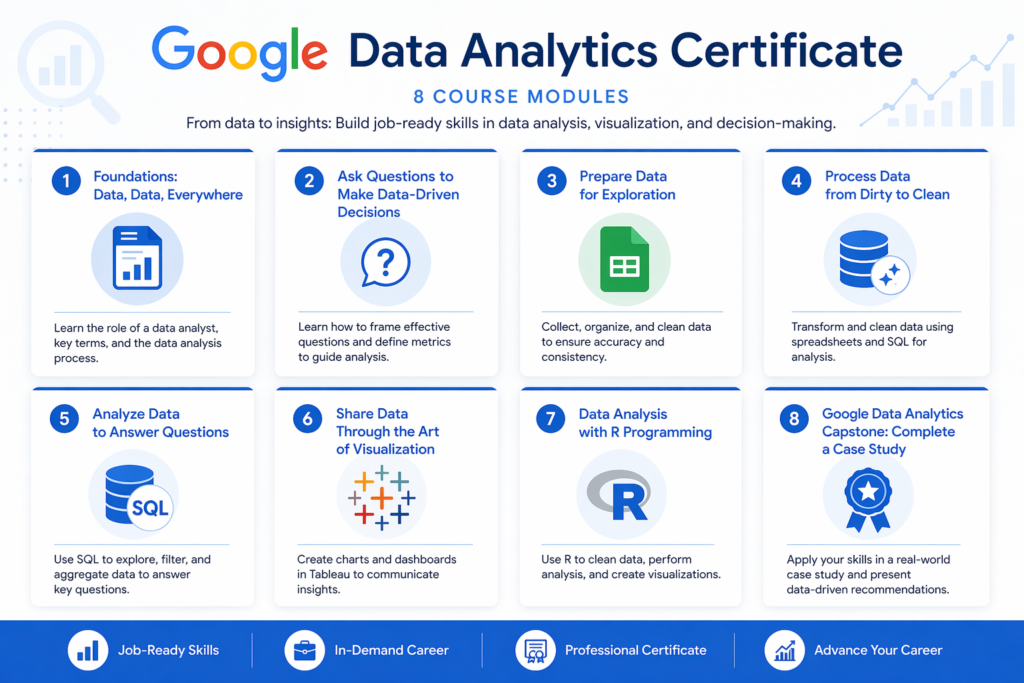
The google data analytics professional certificate coursera path consists of 8 courses, designed to take you from absolute zero to job-ready in one continuous learning arc. Here’s what each course covers:
| Course # | Course Title | Key Skills |
| 1 | Foundations: Data, Data, Everywhere | Data types, data lifecycle, analytics tools overview |
| 2 | Ask Questions to Make Data-Driven Decisions | Structured thinking, stakeholder communication |
| 3 | Prepare Data for Exploration | Data formats, SQL basics, databases, bias |
| 4 | Process Data from Dirty to Clean | Data cleaning, spreadsheets, SQL queries |
| 5 | Analyze Data to Answer Questions | Advanced SQL, data aggregation, calculations |
| 6 | Share Data Through the Art of Visualization | Tableau, data storytelling, presentations |
| 7 | Data Analysis with R Programming | R syntax, tidyverse, ggplot2, RStudio |
| 8 | Google Data Analytics Capstone | Case study project, portfolio piece, job prep |
In total, the program covers approximately 180 hours of content. However, most motivated learners complete it in far less time by skipping videos they already understand and focusing on quizzes and hands-on labs.
Tools You’ll Learn (SQL, Excel, R, Visualization)
One of the strongest aspects of this program is the breadth of tools it introduces. Therefore, by the time you’re done, you’ll have practical exposure to:
- SQL — for querying databases (BigQuery is used as the primary platform)
- Google Sheets and Microsoft Excel — for data cleaning and basic analysis
- Tableau — for building interactive dashboards and visualizations
- R Programming — for statistical analysis, data wrangling, and visualization with ggplot2
- RStudio — the IDE where you’ll practice all your R code
For example, in Course 7, you’ll use R to clean a dataset, perform exploratory analysis, and create publication-quality visualizations — all skills that directly translate to real job tasks.
Real Projects and Portfolio Value
The capstone project in Course 8 is where things get real. Google gives you a choice of case studies — for instance, analyzing Cyclistic bike-share data to give marketing recommendations. This is the project most graduates post on GitHub, LinkedIn, and their portfolios. In addition, throughout the course you’ll complete mini case studies that sharpen your analytical thinking.
I want to be clear here: the capstone project alone isn’t enough. The graduates who stand out have 2–3 self-initiated projects beyond the capstone. More on that in the strategy section below.
How the Certificate Is Delivered and Recognized
Upon completion, you receive a shareable digital certificate from Google via Coursera. This can be added directly to your LinkedIn profile under ‘Licenses & Certifications.’ It’s also recognized by over 150 U.S. employers who are part of Google’s employer consortium, including Deloitte, Infosys, and Cognizant. However, recognition varies by employer — larger enterprise tech companies tend to value it more than traditional corporations that still prioritize degree credentials.
Cost Breakdown and How to Get It for Free
Real Pricing Model (Monthly Subscription Explained)
Here’s the straightforward truth about the google data analytics professional certificate cost: Coursera charges $49 per month for access to the program. This subscription model means your total cost depends entirely on how fast you complete the certificate. Therefore, speed of completion is one of the most important financial variables for this program.
Total Cost Based on Completion Speed
| Completion Time | Monthly Cost | Total Cost | Recommended For |
| 4 Weeks (Fast Track) | $49/mo | ~$49 | Full-time learners (40+ hrs/week) |
| 6–8 Weeks | $49/mo | ~$98 | Dedicated part-timers (20 hrs/week) |
| 3 Months | $49/mo | ~$147 | Typical working professionals |
| 6 Months | $49/mo | ~$294 | Casual learners (5–8 hrs/week) |
| Free via Financial Aid | $0 | $0 | Those who qualify (most people do) |
How to Get the Certificate for Free (Step-by-Step)
This is the section most people don’t know about — and it’s the single biggest money-saver available. Here is the exact step-by-step process to get the google data analytics professional certificate for free through Coursera’s financial aid program:
- Go to the Google Data Analytics Certificate page on Coursera
- Click ‘Enroll for Free’ and then select ‘Financial Aid Available’ when prompted
- Fill out the financial aid application — it takes about 15–20 minutes
- In the ‘Why do you need financial aid?’ section, write a genuine 150+ word explanation of your circumstances
- In the ‘How will this certificate help you?’ section, explain your specific career goal clearly
- Submit and wait — Coursera typically responds within 15 days
- Upon approval, you get full access to the course completely free
- Complete the course before the financial aid period expires (usually 6 months)
💡 Pro tip: Most financial aid applications are approved. I’ve seen approval rates cited as high as 85–90% for honest, detailed applications. Don’t overthink the essay — just be genuine about your situation and career goals.
Financial Aid Strategy That Actually Works
When writing your google data analytics professional certificate financial aid application, focus on three things: your current financial situation, your specific career goal (not vague ‘I want to learn data’), and how this certificate directly bridges the gap. For example, instead of writing ‘I want to get a better job,’ write something like: ‘I’m currently working as a retail associate earning $28,000/year. My goal is to transition into a data analyst role within 12 months. This certificate will provide me with the SQL, visualization, and analytical thinking skills required for entry-level analyst positions in my target companies.’ That level of specificity dramatically increases approval odds.
Free vs Paid Experience Differences
Here’s a question I get a lot: Is the free (financial aid) experience any different from paid? The answer is no — the content is completely identical. You get full access to all videos, quizzes, projects, peer reviews, and the final certificate. The only difference is the application process and the time it takes to get approved. Therefore, for most learners with limited budgets, financial aid is the obvious choice.
Step-by-Step Framework to Complete the Certificate Fast
Ideal Weekly Study Plan (For Busy Professionals)
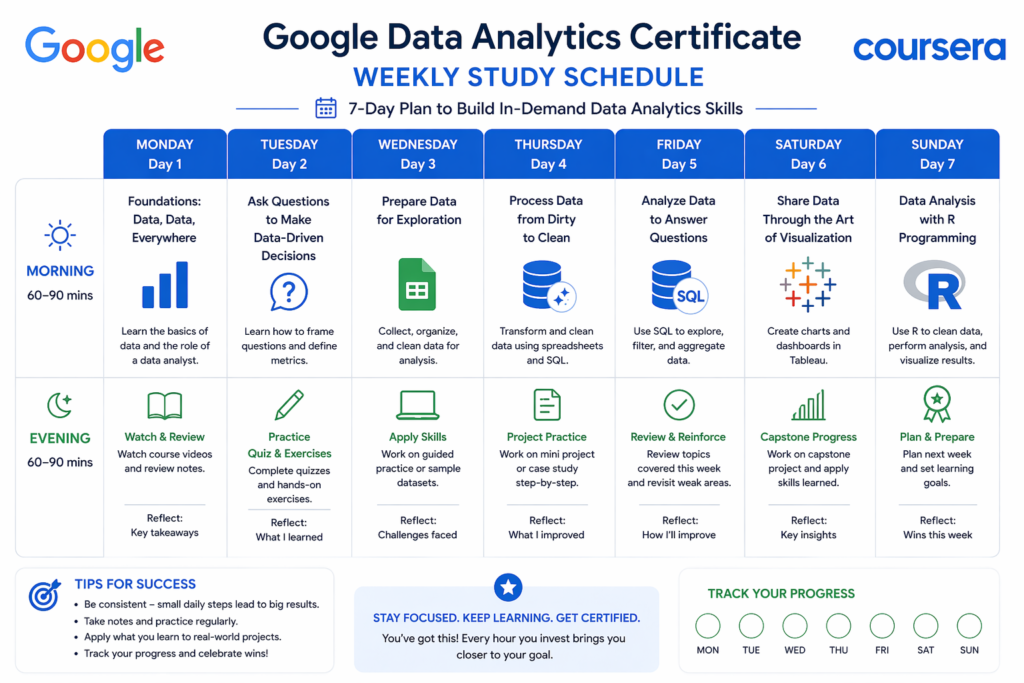
Most people dramatically underestimate their own capacity for focused learning. In my experience, busy professionals with full-time jobs can realistically dedicate 10–15 hours per week if they’re intentional about it. Here’s a realistic weekly framework:
| Day | Study Activity | Time |
| Monday | Video lectures + reading (1 course module) | 1.5 hrs |
| Tuesday | Practice quizzes + review notes | 1 hr |
| Wednesday | Hands-on lab / SQL practice | 1.5 hrs |
| Thursday | Graded quiz completion | 1 hr |
| Friday | Project work / apply concepts | 1.5 hrs |
| Saturday | Deep work session: catch up + advance | 3 hrs |
| Sunday | Portfolio work / LinkedIn updates | 1.5 hrs |
Total: ~11 hours/week. At this pace, you’ll complete the certificate in approximately 10–12 weeks.
How to Finish in 4–8 Weeks Instead of 6 Months
Here’s the truth: Coursera’s ‘6 months’ estimate is based on 10 hours per week and accounts for the slowest learners. However, if you’re motivated and strategic, you can finish far faster. Here’s how:
- Use 1.5x or 2x video speed — most instructors speak slowly
- Skip intro videos you already understand (the content isn’t hidden behind them)
- Focus your energy on graded assignments and labs — those are where real learning happens
- Do all SQL exercises in BigQuery actively rather than just watching
- If you’ve done Excel before, modules 3–4 will feel easy — push through them quickly
- Schedule ‘sprint weekends’ where you dedicate 6–8 hours over Saturday and Sunday
Best Way to Take Notes and Build a Portfolio
Taking notes isn’t optional — it’s how you retain and apply what you learn. For example, I recommend using Notion or Obsidian to build a personal ‘data analytics wiki’ as you go through the course. For each major concept (SQL joins, data cleaning logic, visualization best practices), write a short summary in your own words. In addition, every time you complete a hands-on exercise, save the code or spreadsheet to a GitHub repository. By the time you finish the program, you’ll have a documented body of work that proves your skills — not just a certificate.
For those newer to version control, check out this beginner-friendly overview of the best Python course to understand how GitHub workflows integrate with data work: →Best Python Course in 2026 — From Beginner to Pro
How to Avoid Burnout and Stay Consistent
Burnout is the number one reason people don’t finish online certifications. Therefore, building in recovery time is as important as building in study time. My top rules: never study two ‘heavy’ days in a row, reward yourself at course milestones (not just at the end), and connect with a study partner on Reddit or Discord who is also completing the certificate. Accountability is a multiplier.
Real Reviews, Reddit Insights, and Honest Feedback
What Learners Love About the Program
Across hundreds of google data analytics professional certificate review threads and Coursera feedback pages, a few consistent positives emerge:
- The program is extremely beginner-friendly — no prerequisites required
- Google’s brand name gives the certificate real weight on a resume
- The structured progression from data concepts → SQL → visualization → R is logical and well-paced
- The capstone project gives you a tangible, portfolio-ready deliverable
- The Coursera platform is easy to use and accessible on mobile
Common Complaints and Limitations
In the spirit of honest reporting, here are the genuine criticisms that appear repeatedly in google data analytics professional certificate review discussions:
- The R programming section feels rushed and doesn’t go deep enough for real-world use
- Some video content feels scripted and over-polished — less authentic than YouTube tutorials
- Peer reviews can be slow and inconsistent depending on the cohort activity
- The certificate doesn’t cover Python, which many employers now prefer over R
- The Tableau section is introductory — you’ll need additional practice to use it professionally
Reddit Insights: What Real Users Say
The google data analytics professional certificate reddit community (primarily in r/learnpython, r/dataanalysis, and r/coursera) gives a raw, unfiltered picture. Here’s the honest summary:
Most Reddit users who completed the certificate and got jobs credit it as one part of a larger strategy — not the whole strategy. A typical success story goes: ‘I did the Google certificate, then took a free SQL course on Mode Analytics, built three projects on Kaggle, and applied to 80 jobs over 3 months. Got hired as a junior analyst.’ In other words, Reddit is clear: the certificate opens doors, but you have to walk through them.
💡 The most common Reddit advice: Don’t stop at the certificate. Start applying for jobs while you’re still in course 7 or 8. Don’t wait until everything is ‘perfect.’
GitHub Projects: What Graduates Actually Build
Searching google data analytics professional certificate github shows a consistent pattern. The most impressive graduate portfolios include:
- The Cyclistic bike-share case study (the standard Coursera capstone) — cleaned with R, visualized in Tableau
- Bellabeat fitness data analysis using R and ggplot2
- SQL-based exploratory data analysis on public datasets (COVID-19, e-commerce)
- Custom dashboards built in Tableau Public
However, the graduates who stand out have gone beyond the Coursera projects. They’ve found public datasets from Kaggle or data.gov and built original analyses that show personal interest and initiative. That’s the portfolio strategy that gets callbacks.
Google Basic vs Advanced vs Cloud Certificates
Key Differences Between the Programs
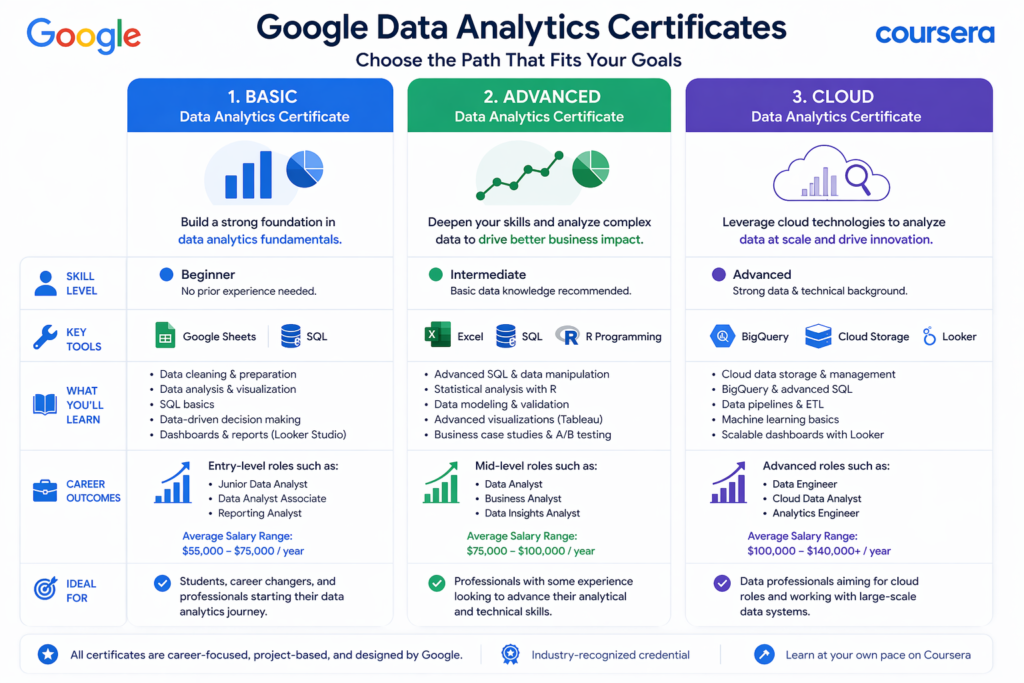
| Feature | Basic Certificate | Advanced Certificate | Cloud Certificate |
| Target Level | Absolute beginners | Intermediate analysts | Tech/cloud professionals |
| Prerequisite | None | Basic data analytics knowledge | Data + cloud basics |
| Key Tools | SQL, Excel, Tableau, R | Python, statistics, ML basics | BigQuery, GCP, cloud pipelines |
| Duration | ~6 months (10 hrs/wk) | ~6 months (10 hrs/wk) | ~6 months (10 hrs/wk) |
| Career Outcome | Junior data analyst | Mid-level analyst/data scientist | Data engineer, cloud analyst |
| Coursera Cost | $49/month | $49/month | $49/month |
| Financial Aid | Yes | Yes | Yes |
Which One You Should Choose Based on Your Level
- Complete beginner with no data experience → Start with the Basic Certificate
- Have 1–2 years data experience or completed the Basic → Go Advanced
- Working in cloud environments or targeting GCP/BigQuery roles → Go Cloud
- Unsure? → Start Basic. You can always stack Advanced afterward
Career Path Mapping (Beginner → Advanced → Cloud)
Here’s how these certificates map to a real career trajectory in 2026:
| Stage | Certificate | Typical Role | Salary Range (US) |
| Entry | Google Data Analytics | Junior Data Analyst | $50K–$70K |
| Mid-Level | Google Advanced Data Analytics | Data Analyst / Scientist | $70K–$95K |
| Specialized | Google Cloud Data Analytics | Data Engineer / Cloud Analyst | $90K–$130K |
For those who want to push into AI, machine learning, or cloud data engineering, the Google Advanced and Cloud certificates are strong complements. You can also explore our deep-dive on machine learning courses online to understand where the Google Advanced certificate fits in the broader ML learning path: Machine Learning Courses Online — What Actually Works in 2026
Google vs IBM vs Microsoft: Which Certification Wins?
Skill Depth Comparison
| Skill Area | IBM | Microsoft | |
| SQL | Strong | Strong | Moderate |
| Python | Not included | Strong | Moderate |
| R | Included | Limited | Not included |
| Excel/Sheets | Strong | Moderate | Strong (Excel-focused) |
| Visualization | Tableau + R | IBM Cognos | Power BI |
| Statistics | Basic | Moderate | Moderate |
| ML Basics | Not included | Included (basic) | Not included |
| Cloud | GCP (light) | IBM Cloud (light) | Azure (light) |
Job Market Recognition Comparison
In terms of employer recognition in 2026, Google leads the pack — largely due to brand recognition and the employer consortium Google has built around the certificate. IBM Data Analyst Professional Certificate is well-recognized in tech-forward companies, particularly those using IBM tools. The Microsoft data analytics Professional Certificate has strong recognition in enterprise environments where Power BI is the standard tool.
However, I want to be direct: none of these certificates will land you a job by themselves. What matters is the combination of the certificate, your portfolio projects, and how well you interview. The certificate is a door-opener, not a job-getter.
Practical vs Theoretical Learning Differences
- Google: Highly practical, project-based, beginner-friendly. Less theory, more doing.
- IBM: More theoretical depth, especially in statistics and machine learning basics. Better for those wanting to go further into data science.
- Microsoft: Extremely practical and Power BI-centric. Best for those going into business intelligence roles.
Which One Is Best for Fast Job Placement
For pure speed-to-employment, Google wins. The structured curriculum, brand recognition, and employer consortium give it the fastest path from certificate to first job for beginners. For example, if your goal is to land a junior data analyst role in 6 months or less, Google + strong portfolio + active job applications is the fastest proven formula.
Common Mistakes That Kill Your Results
Treating It Like Just Another Course
Most beginners get this wrong: they approach the Google certificate like a passive learning experience — watching videos, clicking through quizzes, collecting the badge. That approach produces almost no real-world value. The certificate is only valuable when you apply it. Therefore, from day one, your mindset should be: ‘I’m building a career here, not just completing a checklist.’
Not Building a Portfolio Alongside Learning
This is the single biggest mistake I see. People finish Course 8, get their certificate, and then realize they have nothing to show except a PDF. Building portfolio projects should start from Course 3 or 4 — not after completion. In addition, your projects don’t need to be perfect. A messy, honest analysis of a dataset you’re genuinely curious about is worth ten times more than a polished copy of the Cyclistic case study.
Relying Only on the Certificate Without Practice
SQL in theory is very different from SQL on the job. Tableau in the Coursera sandbox is different from Tableau at a company with messy, real-world data. Therefore, supplement the certificate with hands-on practice outside the platform. Use Mode Analytics or DB-Fiddle for SQL, Tableau Public for visualization, and Kaggle for real datasets. The employers who interview you will test practical skills — not your memory of Coursera videos.
Ignoring Job Application Strategy
I’ve seen people finish the certificate, build decent portfolios, and then apply to 5 jobs and give up when nothing happens. Job searching is a volume and strategy game. In my experience, most entry-level data analyst candidates need 50–100 applications before landing an offer. In addition, your resume, cover letter, and LinkedIn profile need to speak the language of data — metrics, outcomes, impact. For help on resume strategy, this resource is excellent: Resume Writing Course — How to Write a Resume That Gets Callbacks
Beginner vs Advanced Strategy (What Actually Works)
Beginner Path: From Zero to Job-Ready
If you’re starting from zero, here’s the exact path I’d recommend in 2026:
- Complete the Google Data Analytics Certificate (use financial aid if needed)
- Build 2–3 portfolio projects using public datasets (Kaggle, data.gov, or local government data)
- Learn SQL deeper using free platforms (Mode Analytics, SQLZoo, HackerRank)
- Create a GitHub repository for all your projects
- Optimize your LinkedIn profile with the certificate, a summary, and project links
- Start applying for junior analyst, data assistant, and business analyst roles
- Aim for 10–15 applications per week while actively interviewing and practicing SQL/stats
For additional foundational skills that complement data analytics, especially as AI tools become standard in analytics workflows, you might also find this guide useful: AI Courses for Beginners — Where to Start in 2026
Intermediate Path: Upskilling with Advanced Certificate
If you’ve already completed the basic certificate and have some work experience or personal projects under your belt, the google advanced data analytics professional certificate coursera path is a logical next step. It introduces Python (via Jupyter notebooks), statistical testing, regression analysis, and basic machine learning — skills that push you toward data scientist territory.
For intermediate learners, I’d also recommend layering in Python skills. The Advanced certificate uses Python, so getting comfortable with it first saves time. Check out the top AI skills guide for a broader picture of what the market values: Top 7 AI Skills for 2026 — Programming, MLOps and Generative AI
Advanced Path: Transitioning to Data Science or Cloud
For those targeting data engineering, cloud analytics, or machine learning engineering roles, the google cloud data analytics professional certificate is the natural next rung on the ladder. It covers Google Cloud Platform tools, BigQuery, Dataflow, and cloud-based data pipelines — skills in extremely high demand in 2026. For cloud-focused learners, pairing this with AWS or GCP certifications creates a powerful, differentiated profile. Here’s a relevant resource on cloud certification paths: AWS Certification Courses — Complete 2026 Guide
Tools, Resources, and Platforms to Maximize Results
Best Tools to Practice (SQL, BI Tools, Python)
| Tool | Purpose | Cost |
| BigQuery Sandbox | SQL practice with large datasets | Free |
| Mode Analytics | SQL + data visualization | Free |
| Tableau Public | Dashboard building and publishing | Free |
| Kaggle Notebooks | Python, R, and data exploration | Free |
| Google Colab | Python notebooks for data analysis | Free |
| SQLZoo | SQL exercises from beginner to advanced | Free |
| DataCamp | Structured skill tracks (SQL, Python, R) | Paid (some free) |
Where to Build and Showcase Projects
- GitHub — primary portfolio hosting for code and analysis projects
- Tableau Public — host interactive dashboards publicly
- Kaggle — participate in datasets and competitions, build public notebooks
- LinkedIn — add certificates, describe projects in your profile, write analytics posts
- Personal portfolio website (free options: GitHub Pages, Notion sites)
Communities and Forums That Accelerate Learning
- r/dataanalysis (Reddit) — questions, project feedback, job search advice
- r/learnpython (Reddit) — Python help for analytics-specific questions
- Data Analytics Discord servers — real-time help and networking
- Google Data Analytics LinkedIn group — networking and job opportunities
- Kaggle forums — dataset discussions and competition advice
Job Platforms That Value This Certificate
- LinkedIn Jobs — filter by ‘data analyst’ and ‘entry level’
- Indeed — broad reach with strong junior analyst listings
- Glassdoor — good for salary research before interviews
- Google’s own job board — naturally lists roles that value Google certificates
- Handshake — excellent for recent graduates and career switchers targeting mid-size companies
Actionable Checklist Before You Enroll
Skills You Should Have (or Not Need)
One of the most common questions I get is: ‘Do I need to know math or coding before starting?’ The honest answer: no. The certificate is genuinely built for complete beginners. However, being comfortable with basic computer use, spreadsheets, and having some patience with logic-based thinking will make the experience significantly smoother.
- ✅ Basic computer literacy — required
- ✅ Comfort with Google Sheets or Excel (even basic) — helpful
- ✅ English reading comprehension — required (no native speaker requirement)
- ❌ Math beyond basic arithmetic — NOT required at the start
- ❌ Programming experience — NOT required
- ❌ Statistics background — NOT required
Time Commitment Reality Check
Before enrolling, be completely honest with yourself about your available time. The Coursera estimate is 6 months at 10 hours per week. If your real schedule allows only 5 hours per week, plan for 12–15 months — or find ways to block out more time. Starting a program you can’t realistically finish is worse than waiting until you can.
| Available Time/Week | Realistic Completion | Monthly Cost |
| 5 hours | 12–15 months | $588–$735 total (paid) |
| 10 hours | 6 months | $294 total (paid) |
| 15 hours | 4 months | $196 total (paid) |
| 20+ hours | 2–3 months | $98–$147 total (paid) |
| Any | Free | $0 (with financial aid) |
Career Goal Alignment Checklist
- ✅ My goal is to become a data analyst, business analyst, or data-related professional
- ✅ I’m willing to build portfolio projects beyond the Coursera assignments
- ✅ I understand this certificate is a starting point, not a finish line
- ✅ I’m prepared to actively job search for 2–6 months post-completion
- ✅ I have a basic plan for what roles to target after earning the certificate
Free vs Paid Decision Checklist
- Apply for financial aid if: you have limited income, you’re a student, you’re in a developing economy
- Pay directly if: you want to start immediately without a 15-day wait, or financial aid was denied
- Use Coursera Plus if: you plan to take multiple Coursera courses — it can be more cost-effective
FAQ (Based on Real Search Queries)
How much does the Google Data Analytics Professional Certificate cost?
The google data analytics professional certificate price is $49 per month on Coursera. Your total cost depends on completion speed — typically $49 to $294 for most learners. However, financial aid is available and widely approved, making it free for many learners. There is no separate purchase price; it’s a monthly subscription model.
Is the Google Data Analytics Professional Certificate free?
Yes — through Coursera’s financial aid program. The google data analytics professional certificate free access route requires submitting a financial aid application explaining your circumstances. Most applications are approved within 15 days, granting full free access for up to 6 months. The free course content and experience are identical to the paid version.
Is the Google Data Analytics Professional Certificate worth it in 2026?
Yes, with the right approach. Is the google data analytics professional certificate worth it? For beginners and career switchers targeting entry-level data roles — absolutely. It provides structured, practical training from a credible brand at very low cost (or free). However, it’s worth it only if you supplement it with real portfolio projects, SQL practice, and an active job search strategy. The certificate alone, without application, is not worth much.
Can I get a job after completing this certificate?
Yes — but not immediately, and not based on the certificate alone. The graduates who land jobs typically combine the certificate with 2–3 original portfolio projects, strong SQL skills, an optimized LinkedIn profile, and a persistent job search over 2–6 months. Google’s employer consortium includes 150+ companies that specifically recognize this credential.
How long does it take to complete?
The official estimate is 6 months at 10 hours per week. In practice, motivated learners complete it in 4–12 weeks with 15–20 hours per week. Your pace is flexible — the monthly subscription model means you’re incentivized to go as fast as possible to minimize costs.
Final Action Plan: What You Should Do Next
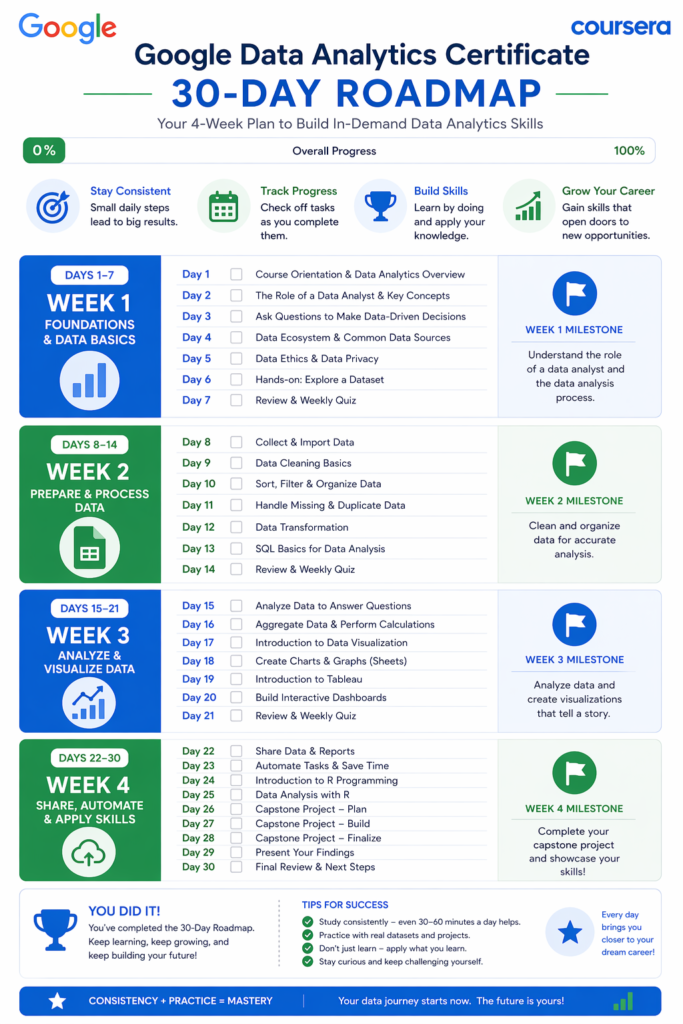
If You’re Starting From Zero
- Apply for financial aid on Coursera today (takes 20 minutes)
- While waiting for approval, start free data analytics content on YouTube and Khan Academy
- Join r/dataanalysis and introduce yourself — ask what projects beginner portfolios should include
- Set up a GitHub account and start learning basic Git commands
- Once approved, start Course 1 immediately
2. If You Want to Switch Careers Fast
- Apply for financial aid and simultaneously start Course 1 via the free trial
- Complete Courses 1–3 in the first 2 weeks (they’re light on technicality)
- During Courses 4–6, start working on a personal project using a dataset in your former industry
- Update LinkedIn while in Course 7 — don’t wait until you’re done
- Start applying for roles while completing Course 8
3. If You Want to Go Advanced (AI, Cloud, Data Science)
- Complete the Basic certificate first (even if it feels slow)
- Start the Google Advanced Data Analytics certificate immediately after
- Layer in Python skills using free resources (Google Colab, Kaggle)
- Explore the connection between data analytics and AI in modern workflows: AI in Education and Machine Learning — What’s Changing in 2026
- Build a capstone project that integrates data analytics with a machine learning model
- Target hybrid roles: data analyst + ML engineer, or analytics engineer + cloud.
Clear 30-Day Execution Plan
| Week | Goal | Action |
| Week 1 | Enroll + Begin | Submit financial aid or subscribe. Complete Courses 1–2. |
| Week 2 | Build Foundations | Complete Courses 3–4. Set up GitHub. Find your practice dataset. |
| Week 3 | Develop Core Skills | Complete Courses 5–6. Build SQL queries on BigQuery daily. |
| Week 4 | Finish + Launch | Complete Courses 7–8. Finalize portfolio project. Update LinkedIn. Apply. |
💡 The 30-day plan is aggressive but achievable with 15–20 hours/week. Most people who follow this exact timeline and start applying in week 4 land their first interview within 60 days of completing the certificate.
Conclusion
Let me leave you with the clearest possible summary: the Google Data Analytics Professional Certificate is one of the most efficient entry points into a data career available in 2026. It’s structured, practical, backed by a brand that employers recognize, and — if you use financial aid — costs you exactly nothing except time and effort.
However, I want to be clear about what it is and isn’t. It’s a launchpad, not a destination. The certificate opens doors. You have to walk through them yourself by building real projects, developing your SQL and analytical skills outside the course, and committing to an active, persistent job search strategy. The graduates who land jobs aren’t the ones who just finished the videos — they’re the ones who treated the certificate as the beginning of their journey, not the end.
Whether you’re a complete beginner, a career switcher, or a professional looking to upskill, the path forward is clear: enroll (for free if you can), move fast, build aggressively, and apply relentlessly. The data job market in 2026 is still growing — and your timing is good.
💡 Ready to start? Apply for Coursera financial aid today, set up your GitHub, and commit to your first 30 days. The version of you that exists 90 days from now will thank you.