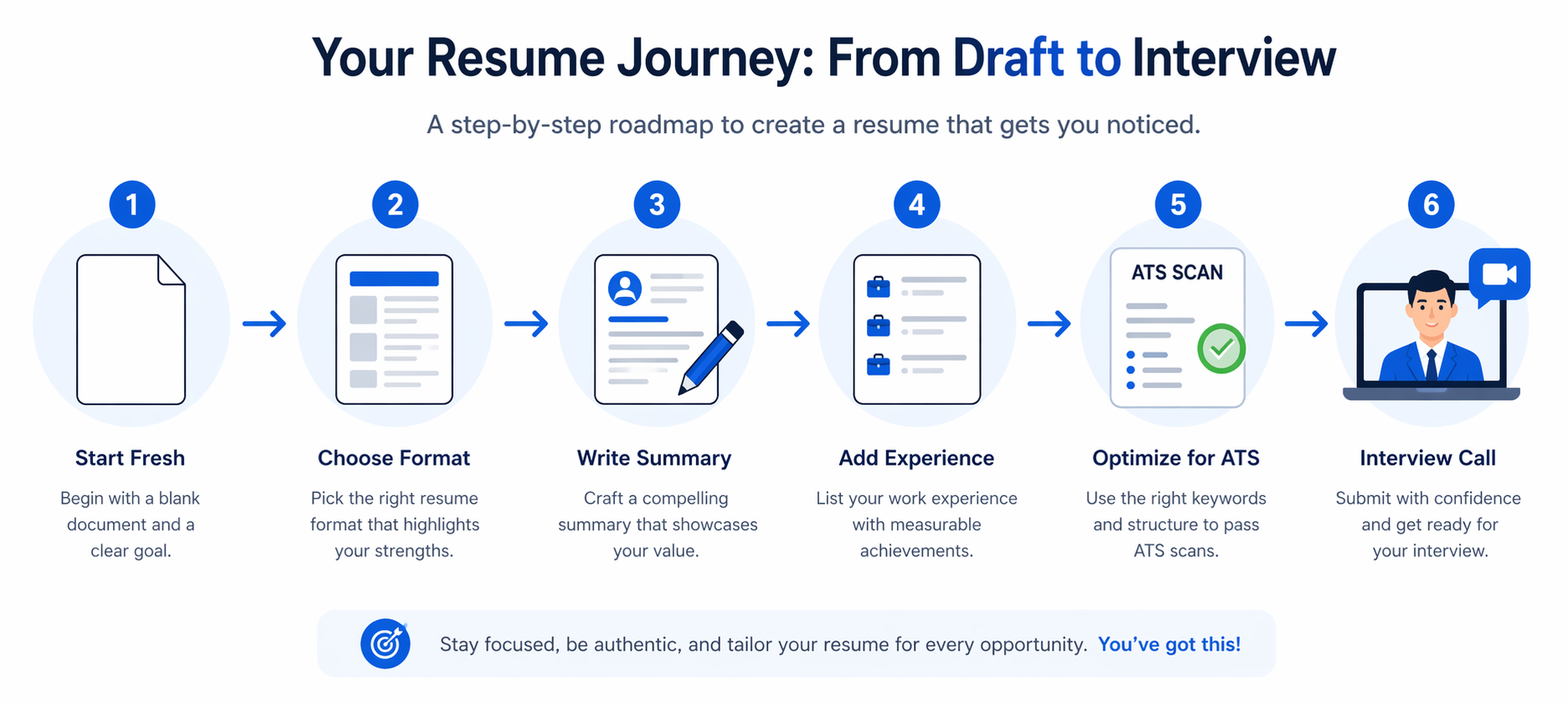
Introduction
Your resume is not just a document. It is your first impression, your marketing pitch, and often the only thing standing between you and your dream job. And yet, most people treat it as an afterthought.
In 2026, the hiring landscape has changed dramatically. Applicant Tracking Systems (ATS) now screen up to 75% of resumes before a human ever reads them. AI-powered hiring tools analyse keyword density, formatting, and experience relevance in seconds. If your resume is not optimised, it simply disappears into a digital void.
That is where a resume writing course comes in. Whether you are a fresh graduate, a professional switching careers, or someone who has been sending applications with zero results, the right course can completely transform your job search outcomes.
In this guide, you will learn exactly what a resume writing course teaches, which platforms offer the best options (free and paid), and how to build a job-winning CV step by step. You will also find a 7-day action plan, a checklist, comparison tables, and real before-and-after examples so you leave with everything you need to get started today.
| Section | Recommended Word Count |
| Introduction | 150–200 words |
| Who This Is For | ~150 words |
| Why It Matters (ATS Reality) | ~200 words |
| Framework / Steps | 900–1,200 words |
| Course Comparison | 600–800 words |
| Tools & Resources | ~300 words |
| Mistakes Section | ~300 words |
| Before vs After Example | ~300 words |
| Checklist | ~200 words |
| FAQ | 400–600 words |
| Final Action Plan (7-Day) | ~200 words |
Quick Answer: Do You Actually Need a Resume Writing Course?
The short answer is: it depends. But for most job seekers in 2026, the answer is yes — at least once.
Here is a quick way to think about it:
| A course IS worth it if… | A course may NOT be needed if… |
| You have been rejected repeatedly | You already have a strong, proven resume |
| You are entering the job market for the first time | A hiring manager recently praised your CV |
| You do not know what ATS is | You are applying at companies that skip ATS (small startups) |
| You are switching industries | You just need minor formatting tweaks |
| You struggle to articulate your achievements | You have a professional writing background |
Many people try to self-learn from random blog posts and YouTube videos. That works to a degree. However, structured learning — which is what a certified resume writing course provides — is far more efficient. It eliminates guesswork and gives you a repeatable framework.
| 💡 Expert Tip: Free courses are a great starting point, but if you are serious about landing interviews, a structured paid course or resume workshop provides significantly more practical value — including templates, peer feedback, and real ATS testing. |
Who Should Take a Resume Writing Course (And Who Should Skip It)
Ideal Candidates for a Resume Writing Course
- Beginners with zero resume experience — Students and fresh graduates who have never written a formal resume benefit most from a structured resume workshop that covers the fundamentals.
- Professionals struggling with ATS rejection — If you are applying to 50+ jobs and hearing nothing back, it is usually an ATS problem. A course fixes this.
- Career switchers — Transitioning from one industry to another requires a very different resume strategy. A resume writing course teaches you how to reframe your experience.
- Freelancers transitioning to corporate roles — Freelancers often undersell themselves on resumes. A resume writing workshop bridges the gap between project-based work and traditional job descriptions.
- Anyone targeting large employers — Big companies like Amazon, Google, or Unilever use heavy ATS filtering. Knowing the rules is non-negotiable.
Who Probably Does NOT Need a Course
- Someone with a recent, high-performing resume that is already generating interview calls.
- Professionals with a strong recruiter network who largely bypass online ATS systems.
- Experienced copywriters or HR professionals who already understand resume frameworks.
| 📝 Note: Even if you fall into the ‘skip it’ category above, attending a free resume writing workshop once a year is still a great way to stay updated on current hiring trends. |
Why Resume Writing Skills Matter More in 2026 (AI + ATS Reality)
The job market in 2026 is not the same as it was even three years ago. Two major forces have reshaped how resumes are evaluated: Applicant Tracking Systems (ATS) and AI screening tools.
How ATS Filters Work (Simplified)
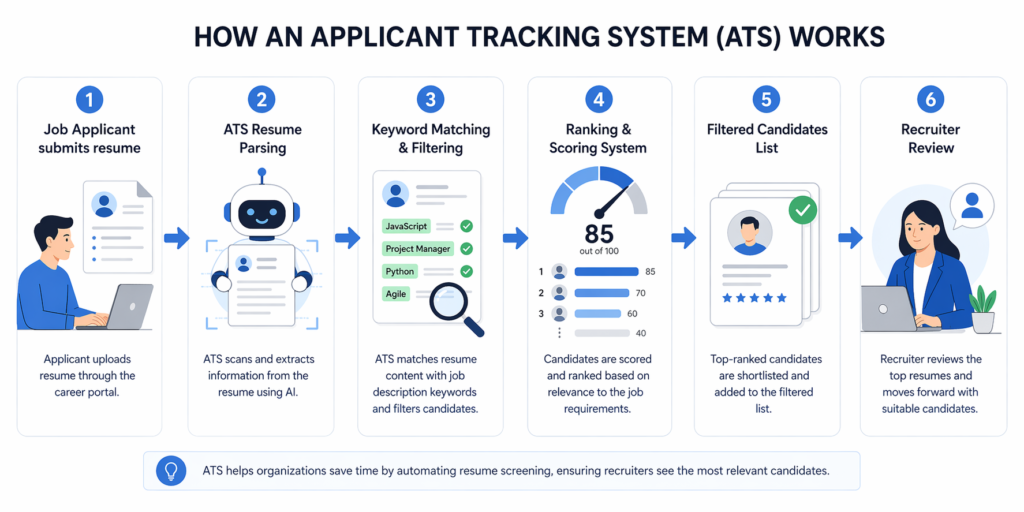
An Applicant Tracking System is software that employers use to collect, sort, and rank resumes automatically. When you submit your resume online, ATS does the following:
- Parses your resume into text and structured data.
- Scans for keywords that match the job description.
- Ranks your application against other candidates.
- Forwards only top-ranked resumes to a human recruiter.
According to research from Jobscan, over 98% of Fortune 500 companies use ATS software. The implication is clear: if your resume is not ATS-optimised, it will not be seen — no matter how qualified you are.
AI Screening vs Human Screening
Beyond traditional ATS, many companies now use AI tools that evaluate tone, career trajectory, and even writing quality. These systems are trained to reward clarity, specificity, and keyword alignment. Generic summaries, vague descriptions, and poor formatting are penalised automatically.
Resume vs Portfolio vs LinkedIn
Many candidates ask: ‘If I have a great LinkedIn profile, do I still need a resume?’ The answer is yes. Here is why:
- Resumes are still required for almost all formal job applications.
- ATS systems process resumes — not LinkedIn profiles.
- Portfolios support your resume but rarely replace it.
- LinkedIn complements your resume but is evaluated at a different stage.
A resume writing course teaches you to align all three: your resume, LinkedIn profile, and portfolio into a consistent personal brand narrative. If you are also interested in developing your digital presence, our guide on
top AI skills for 2026 (Top AI Skills for 2026) is a great complement to resume optimisation for tech roles.
What You Will Actually Learn in a High-Quality Resume Writing Course
Not all resume writing courses are equal. The best ones cover two tiers of skills: core fundamentals and advanced strategies. Here is what to expect:
Core Modules
| Module | What You Learn |
| Resume Structure | Modern formats (chronological, functional, hybrid), when to use each |
| ATS Keyword Strategy | How to extract keywords from job descriptions and integrate them naturally |
| Achievement-Based Writing | The Action + Metric + Result formula for writing powerful bullet points |
| Industry Customisation | How to tailor a single master resume for different job types and sectors |
Advanced Modules
| Module | What You Learn |
| Personal Branding | How to position yourself as a specialist rather than a generalist |
| Resume + LinkedIn Alignment | Creating a consistent professional narrative across platforms |
| Data-Driven Writing | Using numbers, percentages, and measurable outcomes to strengthen claims |
| Portfolio Integration | When and how to link your portfolio without cluttering your resume |
| 💡 Expert Tip: Look for courses that include real examples and downloadable templates. Theory without application rarely produces results. The best resume writing workshops include practice assignments with actual recruiter feedback. |
Step-by-Step Framework to Build a Job-Winning Resume (What Courses Teach)
This is the core framework taught in virtually every high-quality resume writing course. Follow these five steps and you will have a solid, ATS-friendly resume ready to send out.
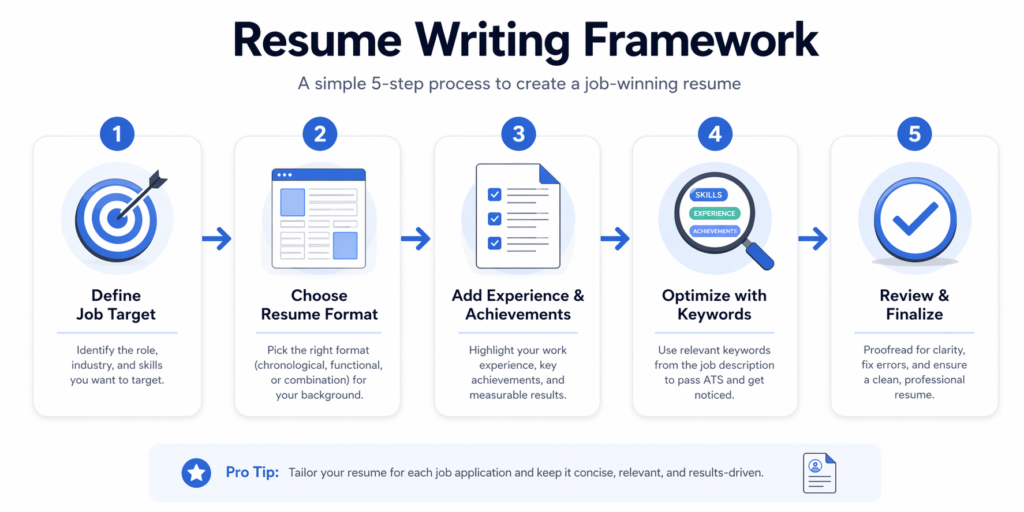
Step 1: Define Your Career Positioning
Before you write a single word, you need to know exactly who you are targeting. Vague resumes get vague results.
- Identify 3–5 specific job titles you are targeting.
- Research 5–10 job descriptions for those roles.
- Highlight recurring skills, qualifications, and tools mentioned across multiple postings — these are your core keywords.
- Decide on your professional identity: Are you a generalist or a specialist? A team leader or an individual contributor?
This positioning exercise is the foundation of everything. Skip it, and your resume will feel generic.
Step 2: Build a Strong Resume Structure
A modern, ATS-friendly resume has a clear hierarchy. Here are the key sections and what each one should accomplish:
| Section | Purpose & Best Practice |
| Header | Name, phone, email, LinkedIn URL, and portfolio link — keep it clean and professional |
| Professional Summary | 3–4 lines that answer: Who are you? What do you do? What is your value? Include your top keyword. |
| Work Experience | Listed in reverse chronological order. Each role should have 3–5 bullet points. |
| Skills Section | Hard skills and tools relevant to the job. Avoid fluff like ‘good communicator’. |
| Education | Degree, institution, year. Include certifications here too. |
| Optional Sections | Projects, volunteering, publications, awards — only if relevant and space allows |
Step 3: Write Impactful Bullet Points
This is where most resumes fail. Generic bullets like ‘Responsible for managing a team’ tell the recruiter nothing useful. Instead, use the Action + Metric + Result formula:
| 📌 Formula: Strong Bullet = Action Verb + What You Did + Measurable Result Example: Led a cross-functional team of 8 to redesign the onboarding process, reducing new-hire ramp time by 35% over two quarters. |
A few rules for powerful bullet points:
- Always start with a strong action verb (Led, Built, Increased, Reduced, Developed, Managed).
- Add a number wherever possible — percentages, revenue, team size, timeframes.
- Focus on results, not tasks. What changed because of your work?
- Keep each bullet to one line (two at most). Brevity signals clarity.
Step 4: Optimise for ATS
Even a brilliant resume will be filtered out if it is not ATS-compatible. Here is what matters:
- Use the exact job title from the posting (e.g., ‘Digital Marketing Manager’, not just ‘Marketer’).
- Include keywords in context — not as a keyword-stuffed list at the bottom.
- Avoid tables, text boxes, headers, footers, images, and graphics — most ATS systems cannot parse these.
- Use standard section names: ‘Work Experience’ (not ‘Where I Have Worked’), ‘Skills’, ‘Education’.
- Save and submit as a .docx or .pdf file — check what the job posting specifies.
| ⚠️ Common ATS Mistake: Using a ‘creative’ resume template with columns, icons, and coloured boxes looks impressive to humans — but most ATS systems cannot read them correctly. Always test your resume through a free ATS checker like Jobscan before submitting. |
Step 5: Customise for Each Job
This is the step that separates average applicants from great ones. A single master resume will not cut it for every role.
- Create a master resume with everything included.
- For each application, create a tailored version that mirrors the language in the specific job description.
- Adjust your professional summary to reflect the exact role you are applying for.
- Reorder your skills and experience to prioritise what is most relevant to each employer.
- Use a version control system (even a simple Google Drive folder) to track which resume was sent where.
Best Resume Writing Courses (Free vs Paid vs Certified)
The resume writing course landscape is broader than most people realise. Whether you want a free resume class or a full certification in resume writing, there is an option for you. Here is an honest breakdown of each tier:
Free Resume Writing Courses
Free courses are a great entry point, especially if you are just starting out. However, they do come with real limitations.
| What Free Courses Offer | Limitations |
| Core resume structure basics | No personalised feedback |
| Basic ATS awareness | Limited template variety |
| Resume examples to study | No certification value |
| Accessible at no cost | Often surface-level content without real depth |
Best free platforms for resume courses include Coursera (audit option), LinkedIn Learning (free trial), Alison.com, and YouTube channels by career coaches like Austin Belcak or Jeff Su.
Paid Resume Writing Courses
Paid courses provide structure, depth, and accountability. For serious job seekers, this is often the right investment — particularly if your job search has been going on for more than a month.
- Platforms: Udemy, LinkedIn Learning, career coaching platforms, and specialised resume schools.
- Typical cost: $15 – $200 depending on depth and certification.
- Benefits: Real assignments, downloadable templates, ATS testing tools, expert-recorded modules, and often community support.
- Best for: Anyone who needs to see significant improvement in their resume performance within weeks.
| 💡 Pro Tip: Udemy frequently runs sales where courses drop to $10–$15. Watch for those before paying full price. Check whether the course includes updated 2025–2026 ATS guidelines — older courses may be outdated. |
Resume Writing Certification Programs
A certification in resume writing serves two purposes: it makes your own resume stronger (showing continuous learning), and it can open a side income stream as a professional resume writer.
- Certification bodies include PARW/CC (Professional Association of Resume Writers and Career Coaches), NRWA (National Resume Writers’ Association), and CDI (Career Directors International).
- These programmes typically cost $300–$1,500 and require passing an exam or submitting sample resumes for evaluation.
- A certificate in resume writing carries real weight when applying to HR, career coaching, or talent acquisition roles.
- Professionals seeking to become freelance resume writers will find certification invaluable for credibility.
Resume Writing Course Comparison Table
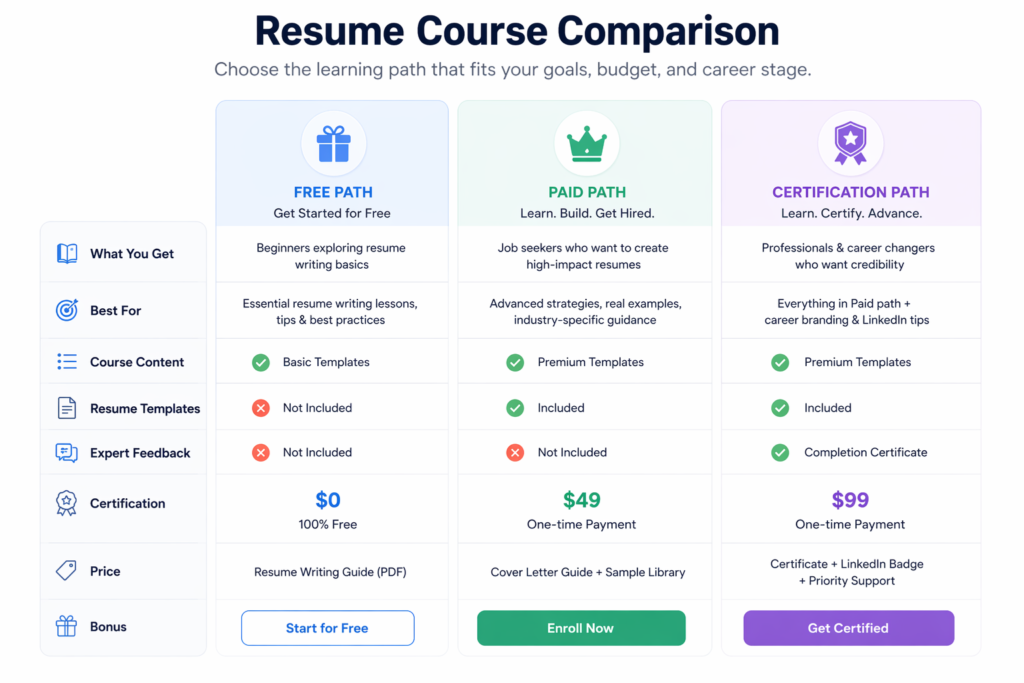
| Course Type | Cost | Certification | Best For | ATS Focus |
| Free Courses | $0 | Limited / None | Absolute beginners | Medium |
| Paid Courses | $15–$200 | Yes (some) | Active job seekers | High |
| Resume Workshops | $50–$300 | Attendance cert. | Targeted skill-building | High |
| Certifications (PARW etc.) | $300–$1,500+ | Strong / Industry-recognised | Professionals & coaches | Very High |
Best Platforms Offering Resume Writing Courses
Coursera
Coursera offers resume writing courses from universities like UC Davis and Johns Hopkins. Their certificate programmes carry institutional credibility and are recognised by employers. You can also access Coursera resume templates as part of these courses. The Google Career Certificates — which we reviewed in detail in our
Google Data Analytics Certificate review — also include a resume and LinkedIn optimisation module.
Udemy
Udemy is arguably the most accessible platform for paid resume writing courses. With frequent discounts, course quality varies widely — look for instructors with HR or recruiting backgrounds, high ratings (4.5+), and a minimum of 1,000 reviews. Courses like ‘The Complete Resume Writing Course’ tend to be comprehensive and practical.
LinkedIn Learning
LinkedIn Learning integrates directly with your LinkedIn profile, meaning completed courses appear as credentials on your profile automatically. This is a significant advantage. They offer dedicated courses on ATS resume writing, achievement-based writing, and resume workshops led by career coaches.
University-Backed Certifications
For those seeking the highest level of credibility, organisations like PARW/CC, NRWA, and CDI offer professional certifications in resume writing. These are aimed at practitioners but can also be pursued by professionals who want to demonstrate a commitment to career development excellence.
| 📚 Related Resource: If you are building your broader career skills alongside resume writing, our guide on the best public speaking courses (https://bestcourseshub.com/best-public-speaking-course-build-confidence/) is a great companion — because the interview that follows your resume matters just as much. |
Tools & Resources You Will Use Alongside a Resume Course
The best resume writing courses teach you not just what to write, but which tools to use. Here is the essential toolkit for building and optimising your resume:
| Tool Category | Best Tools | What It Does |
| ATS Checker | Jobscan, Resume Worded | Scores your resume against a job description |
| Resume Builder | Canva, Novoresume, Zety | Creates clean, formatted resumes (check ATS compatibility) |
| Keyword Research | Jobscan, Google Jobs, LinkedIn Job Search | Identifies the most frequent keywords in your target roles |
| Grammar & Clarity | Grammarly, Hemingway Editor | Improves readability and eliminates errors |
| AI Writing Assistant | Claude, ChatGPT | Helps rewrite bullet points and summaries (use with caution) |
| ⚠️ Important Note on AI Tools: AI writing tools can help you get started, but they cannot replace authentic, personalised storytelling. Recruiters are increasingly trained to spot AI-generated resumes. Use AI as a starting point — not a final solution. For a deeper dive into how AI is reshaping education and career tools, read our piece on AI in Education (https://bestcourseshub.com/ai-in-education-machine-learning/). |
Beginner vs Advanced Resume Writing Strategy
Your approach to resume writing should evolve as your career progresses. Here is a breakdown of what to focus on at each level:
| Level | Primary Focus | Core Strategy |
| Beginner | Structure & Formatting | Use professional templates, follow standard sections, avoid creative formatting that blocks ATS |
| Intermediate | Optimisation & Metrics | Add numbers to every bullet point, align keywords with job descriptions, run ATS checks |
| Advanced | Personal Branding | Craft a consistent narrative across resume, LinkedIn, and portfolio; position around a specific niche or value proposition |
If you are at the intermediate stage and also working to build digital skills, pairing your resume course with our guide on digital marketing courses for business owners can help you position your resume for cross-functional roles.
Check out: Digital Marketing Courses for Business Owners
Common Resume Writing Mistakes That Courses Help You Avoid
These are the most frequent resume errors — and the ones a good resume writing course eliminates immediately.
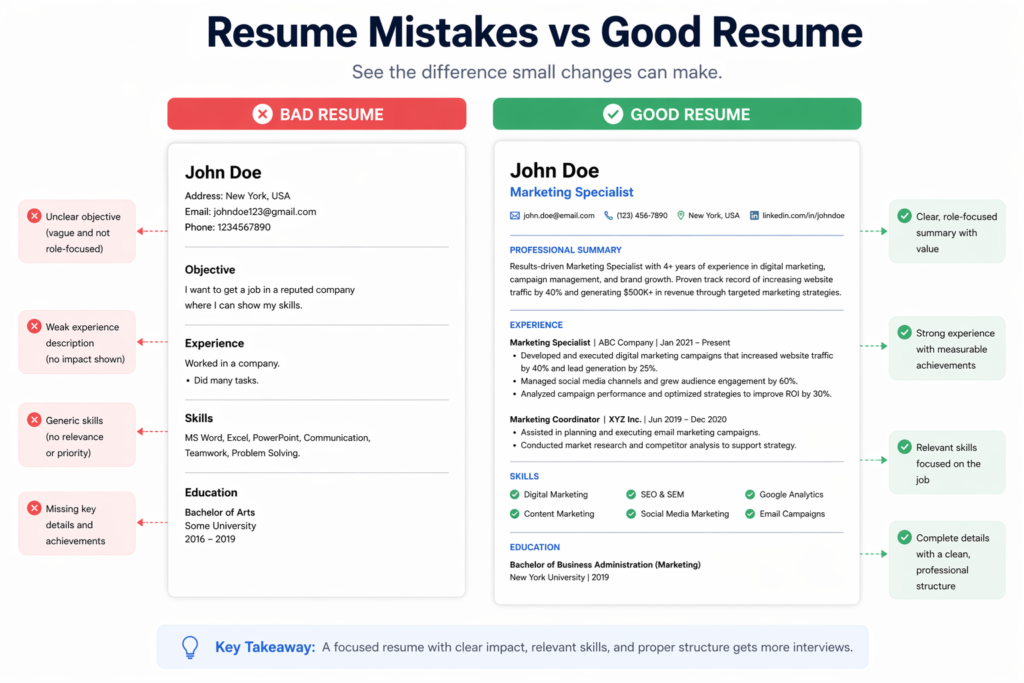
| ❌ Common Mistake | ✅ What to Do Instead |
| Generic, one-size-fits-all resume | Tailor your resume to every job description using target keywords |
| No measurable achievements | Add numbers: revenue, percentages, team size, time saved |
| ATS-incompatible formatting (tables, images) | Use clean, single-column text-based formatting |
| Overloading the skills section with buzzwords | List only relevant, specific hard skills tied to the role |
| Weak or missing professional summary | Write a 3-line summary that positions you for the specific role |
| Using the same resume for 6+ months | Update your resume before each job application batch |
| Listing job duties instead of achievements | Always answer: ‘What changed as a result of my work?’ |
Real Example: Before vs After Resume Transformation
Here is an anonymised example based on a real job seeker (a marketing coordinator targeting a digital marketing manager role). Notice how the transformation applies the Action + Metric + Result formula and improves ATS alignment.
Before (Weak Version)
| Resume Excerpt (Before): Professional Summary: Marketing professional with experience in social media and content. Looking for a challenging role where I can grow. Experience Bullet: Responsible for managing social media accounts and writing content for the company blog. |
After (Optimised Version)
| Resume Excerpt (After): Professional Summary: Results-driven Digital Marketing Coordinator with 4 years of experience driving brand growth through SEO-optimised content and social media strategy. Increased organic traffic by 62% YoY and grew Instagram following from 8K to 41K. Experience Bullet: Managed 5 social media channels (Instagram, LinkedIn, Facebook, Twitter, TikTok), producing 30+ monthly pieces of content that drove a 62% increase in organic website traffic within 12 months. |
Breakdown of Improvements
- Added specific metrics: 62% traffic increase, follower growth from 8K to 41K.
- Named exact platforms (stronger keyword coverage for ATS).
- Replaced passive language (‘responsible for’) with strong action verbs (‘Managed’, ‘producing’, ‘drove’).
- The summary now answers: Who? What value? Proof?
- Overall keyword density for ‘digital marketing’, ‘SEO’, ‘content’, and ‘social media’ is significantly higher.
| 💡 Takeaway: This transformation took less than 30 minutes using the framework above. Imagine what a structured resume writing course could do for your entire resume. |
Resume Writing Course Checklist (Before You Enrol)
Use this checklist before committing to any resume writing course or workshop. It helps you avoid wasting money on low-quality content:
| Check | What to Verify |
| ☐ | Does the course cover ATS optimisation specifically? (Not just resume structure) |
| ☐ | Does it include downloadable templates that are ATS-friendly? |
| ☐ | Does it provide real resume examples and before/after comparisons? |
| ☐ | Is the certification recognised (PARW/CC, NRWA, CDI, or an accredited institution)? |
| ☐ | Is the instructor credible? (HR professional, certified career coach, or recruiter background) |
| ☐ | Was the course updated within the last 12 months? |
| ☐ | Does it include practice assignments or feedback? |
| ☐ | Are reviews from verified buyers positive and recent? |
FAQ – Resume Writing Courses
Is a resume writing course worth it?
Yes — for most job seekers. If you are applying for jobs and not getting callbacks, a structured resume writing course will almost certainly identify and fix the problems. The ROI is high: even one additional interview from an improved resume can lead to a job offer worth tens of thousands of dollars more in salary.
Are free resume courses enough?
Free courses are a solid starting point for absolute beginners. However, they tend to be surface-level and lack personalised feedback, real ATS testing tools, and meaningful certification. If you are actively job hunting, a paid course or resume workshop is a better investment.
Which is the best resume writing certification?
The most recognised certifications are: CPRW (Certified Professional Resume Writer) from PARW/CC, NCRW (Nationally Certified Resume Writer) from NRWA, and MRW (Master Resume Writer) from CDI. For beginners, starting with a verified Udemy or LinkedIn Learning course is a more accessible entry point before pursuing formal certification.
How long does it take to learn resume writing?
A basic resume writing course can be completed in 3–5 hours. A more comprehensive course covering ATS strategy, personal branding, and advanced techniques typically takes 8–15 hours of learning time. Applying the skills to your own resume usually takes an additional 2–4 hours. Overall, most people complete a full resume overhaul within one week of focused effort — which is why the 7-day plan at the end of this article works so well.
Do recruiters care about resume certifications?
Generally, recruiters do not look for resume writing certifications on a candidate’s resume (unless you are applying for HR or career coaching roles). However, completing a resume course signals self-development and attention to detail — both valued qualities. The real value is in the improved resume itself, not the certificate.
Can I learn resume writing without a course?
Technically, yes. Many people self-teach through reading blog posts, watching YouTube videos, and using ATS checkers. However, self-learning is slower, more prone to gaps, and lacks the structure that produces consistent results. A good resume writing course compresses the learning curve significantly — often from months of trial and error into a few focused hours.
What is the best free resume writing course?
Coursera’s free audit option for university-backed resume courses is one of the best. Alison.com also offers free resume writing certifications. LinkedIn Learning offers a 30-day free trial that includes access to resume writing courses. For video-based learning, the career channels on YouTube by coaches like Jeff Su or Austin Belcak are excellent free resources.
How do I make my resume ATS-friendly?
Use a clean, single-column layout with no tables, images, or text boxes. Use standard section headings. Include exact keywords from the job description in context throughout your resume. Save in .docx or .pdf format (check what the employer prefers). Run your resume through a free ATS checker like Jobscan before submitting.
Final Action Plan: How to Build Your Resume in 7 Days
This 7-day plan takes you from scratch to a fully optimised, ATS-friendly resume ready to send out. It is based on the exact framework taught in the best resume writing courses.
| Day | Focus | What to Do |
| Day 1 | Research & Positioning | Collect 5–10 job descriptions for your target role. Highlight recurring keywords, skills, and requirements. |
| Day 2 | Draft Your Structure | Set up your resume sections (Header, Summary, Experience, Skills, Education). Use a clean template. |
| Day 3 | Write Your Experience | Use the Action + Metric + Result formula for every bullet point. Aim for 3–5 bullets per role. |
| Day 4 | Keyword Optimisation | Compare your resume against your top 3 target job descriptions using Jobscan or Resume Worded. Fill keyword gaps. |
| Day 5 | ATS Test | Run your resume through a free ATS checker. Fix any parsing errors, formatting issues, or score gaps. |
| Day 6 | Review & Refine | Read the entire resume aloud. Check for clarity, typos, and consistency. Get a second pair of eyes if possible. |
| Day 7 | Apply | Submit to your top 5 target roles with a tailored version of your resume for each. Track applications in a spreadsheet. |
| 🚀 Ready to Start?: If you want to accelerate this process even further, enrol in a structured resume writing course on Coursera or Udemy before Day 1. The templates, ATS guidelines, and expert feedback will cut your revision time in half and significantly improve your results. |
Related Reading on BestCoursesHub
Building a strong resume is just one part of a successful career strategy. Explore these related guides to level up further:
| Article | Why It Helps |
| Top AI Skills for 2026 | Add in-demand AI skills that make your resume stand out in tech roles |
| Best Public Speaking Course | Prepare for the interview that follows your improved resume |
| Time Management Course Online | Build the discipline to follow your 7-day resume plan |
| AI Courses for Beginners | Expand your skill set to add more value to your resume |
| Digital Marketing Courses | Great for marketing professionals building targeted resumes |
Top AI Skills for 2026 | Best Public Speaking Course | Time Management Course | AI Courses for Beginners | Digital Marketing Courses
Conclusion
A resume writing course is one of the highest-ROI investments a job seeker can make. In an era where ATS software filters out most applications before human eyes ever see them, knowing how to write a resume is no longer optional — it is a career-critical skill.
Whether you start with a free resume writing course to build your foundations, invest in a structured paid course for faster results, or pursue a full certification in resume writing to become a professional yourself, the most important step is to take action.
Your resume is not just a document. It is your career’s first handshake. Make it count.
Use the 7-day plan above, apply the framework, test your resume against ATS tools, and enrol in a course that matches your level and goals. The interviews will follow.