If you have ever ended a long day feeling exhausted yet somehow unproductive, you are not alone. In my experience working with students, freelancers, and corporate professionals, the single biggest barrier to career and academic success is not skill — it is time. Specifically, the inability to manage time effectively.
In 2026, distraction is everywhere. Smartphones, social media, back-to-back meetings, and endless notifications have made it harder than ever to stay focused on what truly matters. However, the good news is that time management is a learnable skill, and the right time management course can genuinely transform how you work, study, and live.
I have reviewed dozens of online courses, tested several productivity frameworks, and spoken with learners across multiple industries. In this guide, I will walk you through the best time management courses available today — including free options, courses with certificates, courses for students, and programs that combine communication skills training with productivity systems. Whether you are a busy professional, a college student, or an entrepreneur juggling multiple responsibilities, there is a course here for you.
Quick Answer: Which Time Management Course Is Best?
If you are short on time right now (the irony is noted), here is a fast summary of my top picks:
| Category | Best Pick | Platform | Price |
| Best Overall | Time Management Mastery | Udemy | ~$15–$20 |
| Best Free Course | Work Smarter, Not Harder | Coursera | Free to audit |
| Best with Certificate | Productivity Specialization | Coursera | Paid / Financial Aid |
| Best for Students | Study Skills & Time Management | Skillshare / Udemy | $10–$20 |
| Best for Professionals | Time Management Fundamentals | LinkedIn Learning | Subscription |
| Best Communication Bundle | Communication + Productivity | Udemy | $15–$25 |
| Best Short Course | 15-Minute Productivity Reset | Skillshare | Subscription |
Keep reading to understand which course is the best fit for your specific situation, budget, and goals.
Why So Many People Struggle to Manage Time in 2026
Over the past few years, I have noticed a clear pattern. People are not lazy or undisciplined. They are simply overwhelmed by an environment that was never designed for deep focus. Therefore, before recommending any course, it is worth understanding why time management has become so difficult in the first place.
How Modern Work and Smartphones Drain Productivity
The average person checks their smartphone more than 100 times per day. Meanwhile, remote work has blurred the boundaries between personal life and professional responsibilities. Because of constant notifications, most people operate in a reactive mode — responding to whatever demands their attention instead of working on what actually matters.
In my experience, even highly motivated people can spend entire days answering emails, attending unproductive meetings, and scrolling through social media — and still feel like they accomplished nothing. Traditional productivity advice like “just wake up earlier” or “write a to-do list” no longer addresses the root causes of modern distraction.
The Hidden Cost of Poor Time Management
Poor time and time management habits carry a steep price. Most people only notice the surface-level consequences — missed deadlines and late submissions. However, the deeper costs are far more serious:
- Chronic stress and eventual burnout from always feeling behind
- Lower academic or career performance due to poor task prioritisation
- Reduced confidence when goals are repeatedly missed
- Damaged relationships when work consistently spills into personal time
- Missed opportunities because important work never gets the attention it deserves
The right time management strategies, taught through a well-structured course, can address all of these issues systematically.
Who This Guide Is For
This article is useful for a wide range of people. In fact, I wrote it specifically with the following readers in mind:
- Students who want better study routines and want to reduce last-minute exam stress
- Professionals trying to balance heavy workloads with personal wellbeing
- Freelancers and remote workers who manage multiple clients and projects simultaneously
- Entrepreneurs juggling strategy, operations, and personal development at the same time
- Busy parents trying to coordinate home, work, and family life without burning out
- Team leaders who need to model good time management for their teams
- Anyone preparing for exams, career transitions, or major life changes
If any of those descriptions sound familiar, you are in exactly the right place.
Signs You Need a Time Management Course
Sometimes people are unsure whether a structured course is really necessary for them. In my experience, however, these clear warning signs suggest that a dedicated time management skills programme would make a significant difference:
- You consistently miss deadlines or submit work at the very last minute.
- You feel busy all day but rarely complete the tasks that truly matter.
- You procrastinate even on tasks that you actually care about.
- You struggle to balance work, study, and personal responsibilities without sacrificing one of them.
- You often multitask but feel like you achieve very little with the time spent.
- You feel anxious or overwhelmed when you think about everything on your plate.
- Your mornings feel chaotic and unstructured, leading to unproductive days.
If three or more of these resonate with you, a time management course is not just a nice idea — it is genuinely one of the most practical investments you can make.
What to Look for in a Good Time Management Course
Not all courses are created equal. After reviewing many options across multiple platforms, I have identified the factors that separate truly effective programmes from generic filler content:
Practical Exercises Over Pure Theory
The best courses force you to apply what you learn immediately. Look for courses that include worksheets, daily planning templates, habit trackers, and action-oriented exercises. Theory alone will not change your behaviour. Additionally, courses that use real-world case studies are far more effective than those that rely on abstract concepts.
Proven Productivity Systems
A strong course should teach systems that are widely validated — such as the Pomodoro Technique, the Eisenhower Matrix, time blocking, or the Getting Things Done (GTD) framework. In my experience, learners who follow a structured system consistently outperform those who rely on motivation alone.
Certificate Availability
For students and professionals building their résumé or LinkedIn profile, a certificate adds tangible value. Specifically, look for courses on Coursera or LinkedIn Learning that offer shareable certificates backed by a university or recognised organisation.
Flexible and Mobile-Friendly Access
Because most learners today are busy, the best time management courses are available on mobile devices and allow you to learn at your own pace. Lifetime access is a significant advantage — particularly on platforms like Udemy where you can revisit material whenever you need a refresher.
Strong Reviews and Instructor Credibility
Always check recent student reviews. A course with thousands of positive reviews from real learners is far more trustworthy than one with polished marketing materials but few genuine endorsements. Similarly, look for instructors with real-world professional experience in the field they are teaching.
Communication Skills as a Bonus
Some of the most effective productivity programmes also cover communication skills training. This combination is powerful because a large portion of workplace time waste stems directly from unclear communication, unnecessary meetings, and poor delegation.
Best Time Management Courses Online in 2026
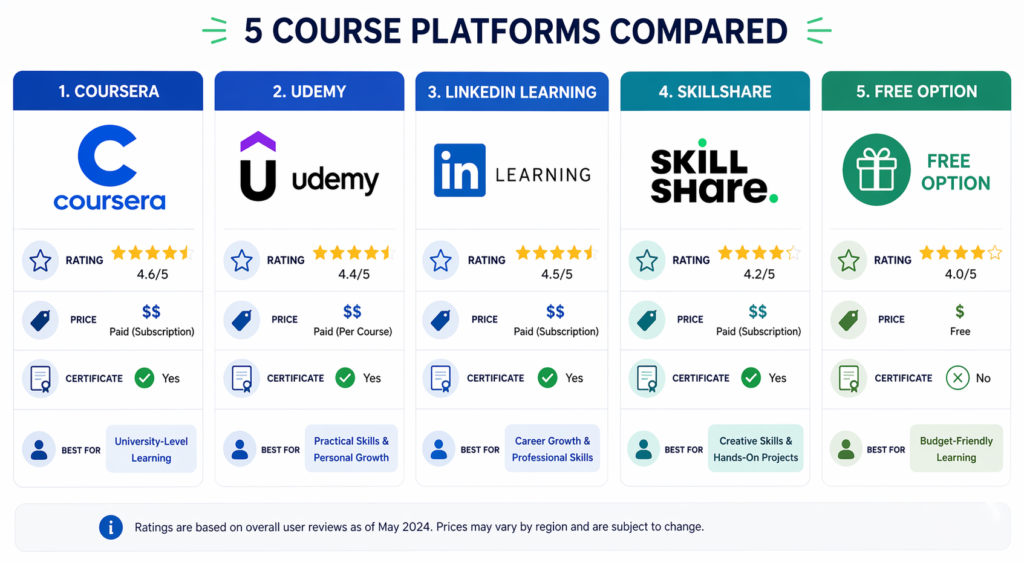
Here is a full comparison of the top platforms and courses:
| Course / Platform | Price | Certificate | Best For | Duration | Rating |
| Time Management Mastery – Udemy | ~$15 | Yes | General learners | 4–6 hrs | ⭐ 4.6 |
| Work Smarter, Not Harder – Coursera | Free audit | Paid | Professionals | 5–8 hrs | ⭐ 4.7 |
| Productivity Specialization – Coursera | $49/mo | Yes | Deep learners | 4 weeks | ⭐ 4.5 |
| Time Mgmt Fundamentals – LinkedIn | Subscription | Yes | Office workers | 3 hrs | ⭐ 4.6 |
| Productivity for Creatives – Skillshare | Subscription | No | Creatives/freelancers | 2–4 hrs | ⭐ 4.4 |
| Communication + Productivity – Udemy | ~$20 | Yes | Teams/professionals | 5 hrs | ⭐ 4.5 |
1. Coursera – Best for University-Level Learning and Certificates
Coursera remains one of my top recommendations for anyone who wants structured, university-backed content. The platform partners with leading universities including UC San Diego, Vanderbilt, and Michigan, offering courses that go well beyond surface-level productivity advice.
Popular time management courses on Coursera include Work Smarter, Not Harder and the full Productivity and Time Management Specialization. The free audit option is particularly valuable — you can access most course content at no cost, and only pay if you want the certificate. Additionally, financial aid is available for learners who cannot afford the subscription.
Pros: University-backed credibility, flexible schedule, shareable certificates, structured assignments.
Cons: Some specialisations require a monthly Coursera Plus subscription after the initial trial period.
2. Udemy – Best for Affordable One-Time Access
Udemy is my go-to recommendation for learners on a tight budget. Courses on Udemy frequently go on sale for as little as $10 to $20, and you get lifetime access once purchased — which is ideal if you want to revisit the material later.
The most popular time management courses on Udemy include Time Management Mastery, Productivity and Personal Effectiveness, and combined time management and communication skills training packages. The last option is particularly useful for professionals who want to tackle both productivity and workplace communication in a single programme.
Pros: Budget-friendly, lifetime access, frequent discounts, huge course selection.
Cons: Course quality varies significantly between instructors, so always check reviews before purchasing.
3. LinkedIn Learning – Best for Busy Professionals
LinkedIn Learning is specifically designed for working professionals who need practical, applicable skills fast. The platform offers strong content on productivity systems, calendar management, workplace communication, and delegation strategies.
In my experience, LinkedIn Learning courses tend to be shorter and more focused than Coursera or Udemy options — which makes them ideal for professionals with limited time. Furthermore, completed courses automatically display on your LinkedIn profile, which adds career value without extra effort.
Pros: Professional focus, LinkedIn profile integration, strong communication skills courses, quality instruction.
Cons: Requires a monthly or annual subscription, though LinkedIn Premium members get access included.
4. Skillshare – Best for Creative Workers and Freelancers
Skillshare takes a different approach. Rather than formal academic content, the platform specialises in practical, project-based classes taught by real practitioners. For content creators, designers, writers, and freelancers, Skillshare’s productivity classes are highly relevant and immediately applicable.
The class formats are shorter and more visual than traditional courses, which I find useful for creative learners who struggle with conventional teaching styles. However, Skillshare does not offer formal certificates, so it is better suited for personal development than résumé building.
Pros: Creative focus, practical projects, short class formats, affordable subscription.
Cons: No formal certificates, less structured than university-backed platforms.
5. Dhruv Rathee – A Popular Search Topic Worth Addressing
Many learners search specifically for a Dhruv Rathee time management course. Dhruv Rathee is a popular Hindi-language content creator known for his clear, data-driven communication style. While he produces informative videos on personal development topics, he does not currently offer a dedicated structured time management course in the traditional sense.
However, if you prefer learning in Hindi or enjoy his teaching style, I suggest exploring his YouTube content as a starting point and then pairing it with a structured course from Coursera or Udemy for deeper learning. Similarly, other Hindi-language educators on Udemy offer excellent time management courses that may suit this audience.
Free vs Paid Time Management Courses: Which Is Worth It?
This is one of the most common questions I receive. The honest answer depends entirely on your goals. Therefore, here is a clear comparison to help you decide:
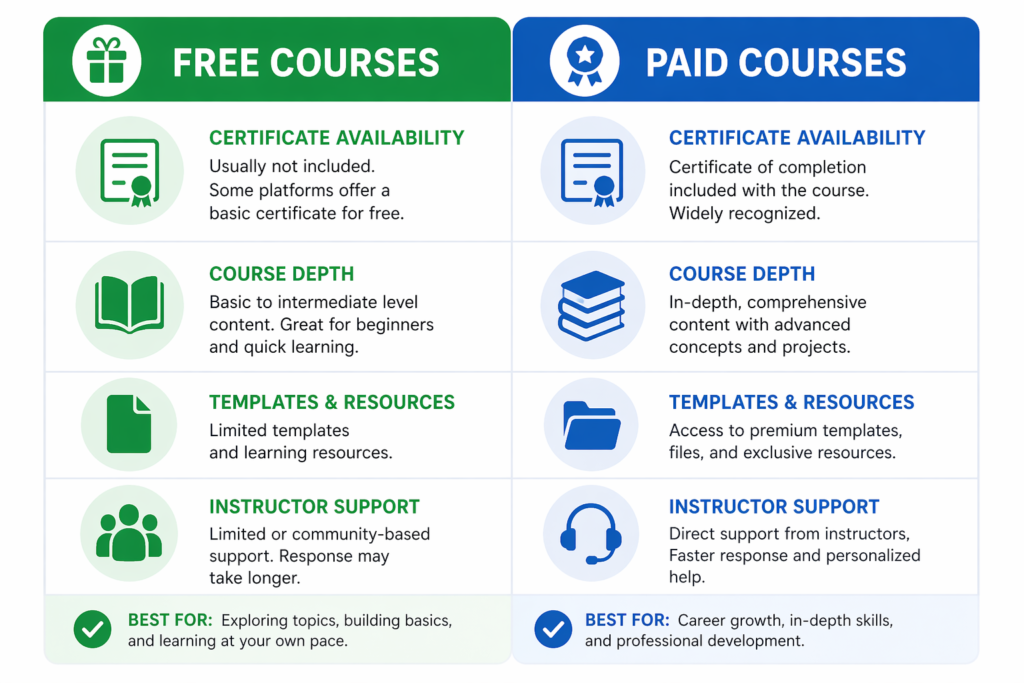
| Feature | Free Courses | Paid Courses |
| Cost | No cost | One-time or subscription |
| Certificate | Limited / rare | Usually included |
| Course depth | Basic overview | Detailed and structured |
| Templates & worksheets | Rarely included | Commonly included |
| Instructor support | Rare or none | Often available (Q&A) |
| Accountability | Low | Higher (assignments) |
| Best for | Beginners exploring the topic | Serious learners with goals |
My recommendation: Start with a free audit on Coursera to see whether the content resonates with you. If it does, consider investing in the full course for the certificate and additional resources. For time management courses free with certificate, Coursera’s financial aid programme is genuinely worth applying for.
What Actually Works: Time Management Strategies Taught in Top Courses
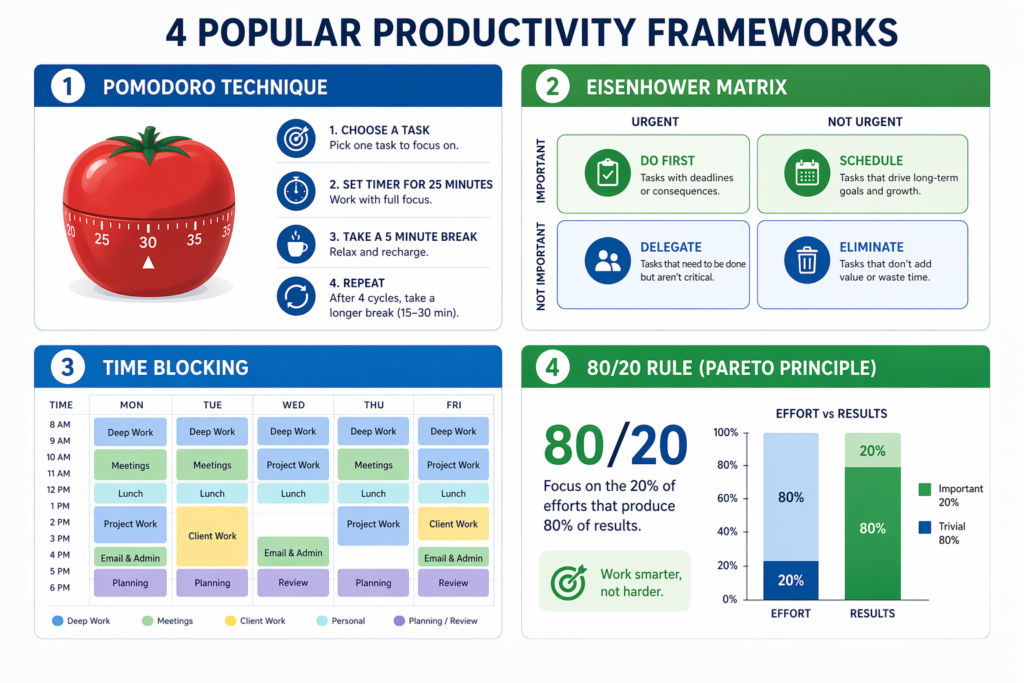
The best time management skills programmes do not just teach you to work harder. They teach you to work smarter by applying proven systems. Here are the most effective frameworks I have seen taught across top-rated courses:
The 80/20 Rule (Pareto Principle)
The 80/20 rule suggests that roughly 80% of your results come from 20% of your efforts. In practice, this means identifying the small number of high-impact tasks that drive most of your progress — and prioritising them above everything else. For example, a student who focuses on mastering the top 20% of exam topics will likely achieve better results than one who tries to cover everything equally. Most top courses dedicate significant time to this concept because it fundamentally changes how learners approach their task lists.
The Pomodoro Technique
The Pomodoro Technique involves working in focused 25-minute intervals, followed by a 5-minute break. After four cycles, you take a longer 15 to 30-minute break. When I first tested this method, I was sceptical — however, the structured rhythm genuinely reduces mental fatigue and makes large tasks feel far more manageable. It is particularly effective for students studying for exams or professionals working on complex reports.
Time Blocking and Calendar Planning
Time blocking means scheduling specific tasks into defined time slots on your calendar — rather than working from a vague to-do list. In my experience, this is one of the most powerful time management strategies available. It forces you to be realistic about how long tasks take and eliminates the trap of multitasking. Many professionals I know block time for deep work, communication, planning, and personal commitments separately — and report significant improvements in both productivity and work-life balance.
The Priority Matrix (Eisenhower Matrix)
The Eisenhower Matrix divides tasks into four categories based on urgency and importance: Urgent and Important (do immediately), Important but Not Urgent (schedule), Urgent but Not Important (delegate), and Neither (eliminate). This framework is taught in virtually every serious time management strategy course because it solves the most common productivity mistake — spending too much time on urgent but low-importance tasks.
The 3-3-3 Rule for Time Management
The 3-3-3 rule is a simple daily planning framework: spend 3 hours on your most important project, complete 3 shorter urgent tasks, and do 3 maintenance activities. This structure prevents the common mistake of only reacting to incoming demands while neglecting long-term priorities. I recommend this particularly to freelancers and entrepreneurs who manage their own schedules without external accountability.
The 5 P’s of Time Management
The 5 P’s stand for: Prioritise, Plan, Prepare, Perform, and Pause. This framework provides a complete cycle for managing any project or goal. Prioritise your most important outcomes. Plan the specific actions required. Prepare your environment and resources. Perform with focused execution. Pause to reflect, review, and adjust. When applied consistently, this system transforms reactive workers into proactive, high-performing professionals.
The 7-Step Time Management Framework
Most structured courses teach a variation of this seven-step framework: (1) Clarify your goals, (2) Identify all tasks required, (3) Prioritise by impact, (4) Schedule tasks into your calendar, (5) Eliminate or delegate low-value activities, (6) Execute with focused attention, and (7) Review and improve weekly. This complete cycle is the backbone of every serious time management course and the foundation of long-term productivity improvement.
Beginner vs Advanced Time Management Strategies
One thing I always emphasise is that the right approach depends on where you are starting from. Therefore, here is a clear breakdown:
| Aspect | Beginner Approach | Advanced Approach |
| Planning | Simple daily to-do list | Time-blocked weekly schedule |
| Reminders | Basic phone alarms | Priority-based workflow systems |
| Focus | Single-tasking attempts | Deep work sessions (90+ mins) |
| Review | Daily planning only | Weekly and monthly review cycles |
| Mode | Reactive (responding to demands) | Proactive (pre-planned execution) |
| Tools | Notes app or paper planner | Notion, Todoist, Google Calendar |
| Accountability | Self-monitored | Peer review or coach support |
If you are a beginner, I suggest starting with a simple daily planning habit before investing in advanced tools or frameworks. However, once the basics are solid, advanced systems like time blocking and weekly reviews dramatically accelerate your results.
Communication Skills and Time Management: Why They Work Together
Many people overlook the connection between communication skills training and personal productivity. However, in my experience, the two are deeply interrelated — and addressing both together produces far better results than focusing on either alone.
How Poor Communication Wastes Enormous Time
Consider how much time is lost in the average workplace due to unclear instructions, unnecessary meetings, ambiguous email threads, and poor delegation. Research consistently shows that professionals spend a significant portion of their working week managing communication problems that should never have arisen in the first place. Therefore, taking a communication skills course alongside a time management programme is one of the most effective productivity investments available.
Communication Courses Worth Combining with Productivity Training
On platforms like Udemy and Coursera, you can find excellent communication skills courses online that pair naturally with time management learning. Specifically, look for programmes covering written communication efficiency, meeting management, delegation frameworks, and assertive communication. Some Udemy bundles combine time management and communication courses in a single package — which I find excellent value for professionals.
Best Tools and Resources to Support Your Time Management Course
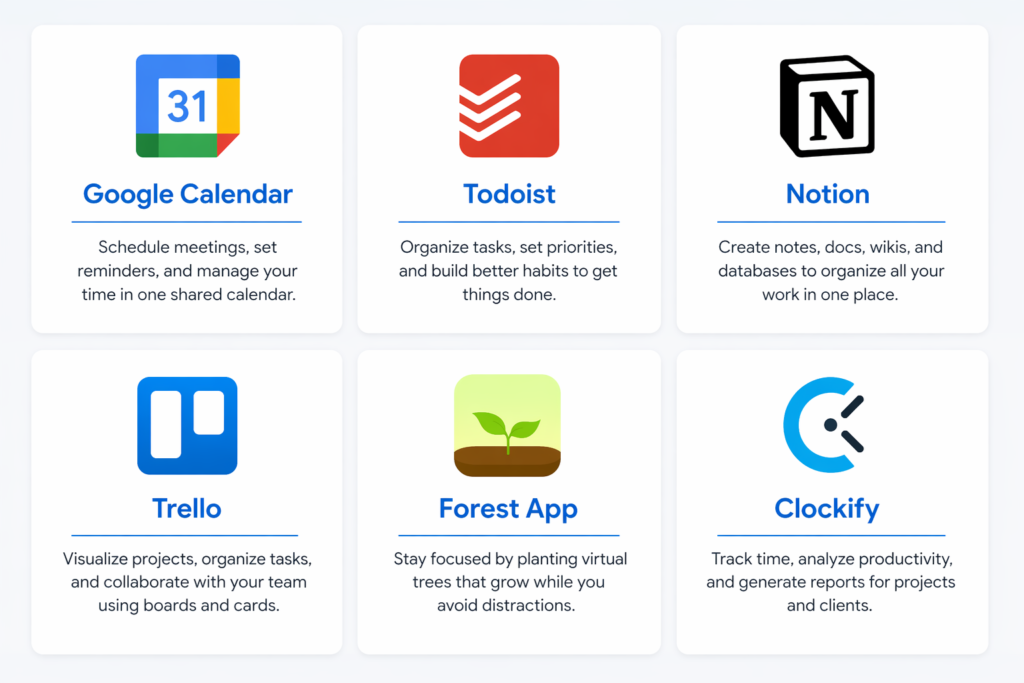
The right tools can reinforce the habits you build during your course. However, I recommend keeping your toolkit simple at first — because tool overload is a common productivity pitfall. Here are my top picks:
| Tool | Best Use Case | Free Plan | Platform |
| Google Calendar | Time blocking and scheduling | Yes | Web, iOS, Android |
| Todoist | Task management and priorities | Yes (limited) | All platforms |
| Notion | Planning, note-taking, databases | Yes | All platforms |
| Trello | Visual project and task boards | Yes | All platforms |
| Forest App | Focus and distraction blocking | Freemium | iOS, Android |
| Clockify | Time tracking and analysis | Yes | Web, all platforms |
Recommended Time Management Books
If you want to go deeper than any single course, these books are among the most impactful in the field:
- Atomic Habits by James Clear — focuses on building sustainable productivity habits
- Deep Work by Cal Newport — explores the power of focused, distraction-free work sessions
- Getting Things Done by David Allen — a classic system for capturing and organising all commitments
- The One Thing by Gary Keller — teaches the power of radical prioritisation
Common Mistakes People Make When Taking Productivity Courses
In my experience, learners often make the same mistakes when investing in time management skills training. Being aware of these pitfalls beforehand can save you a significant amount of time and frustration:
Taking Too Many Courses Simultaneously
This is the most common mistake I see. Learners get excited, enrol in three or four courses at once, and end up finishing none of them. Instead, choose one course, complete it fully, and apply the principles for at least 30 days before starting another programme.
Watching Videos Without Building Habits
Passive watching creates an illusion of learning without producing real change. The courses that deliver results are those where learners do the exercises, fill in the worksheets, and test the frameworks in their actual daily life. Therefore, always treat course exercises as mandatory, not optional.
Copying Someone Else’s Routine Exactly
Many learners try to replicate the exact morning routines or scheduling systems of their instructors. However, effective time management is highly personal. Use frameworks as starting points, then adapt them to your specific lifestyle, responsibilities, and energy patterns.
Focusing Only on Tools Instead of Behaviour
Tools do not create productivity — habits do. I have seen people spend weeks perfecting their Notion setup without actually completing any meaningful work. Use tools to support good habits, not as a substitute for them.
Time Management Course Selection Checklist
Before enrolling in any course, I recommend using this quick checklist to ensure it meets your needs:
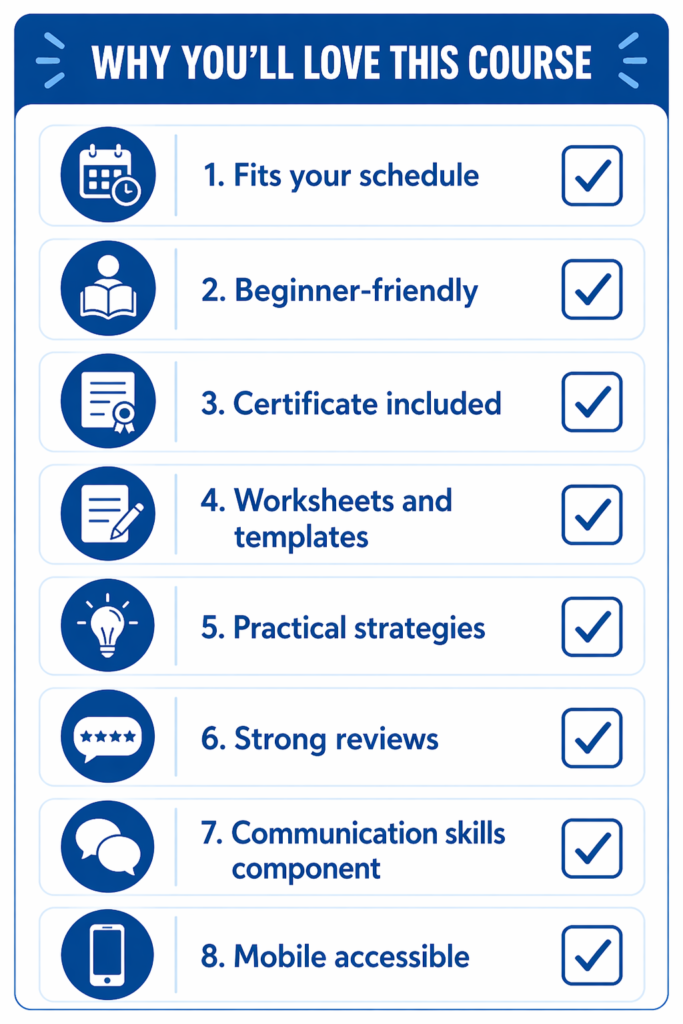
- ✅ Does the course fit your current schedule and time commitment?
- ✅ Is it designed for your experience level (beginner, intermediate, advanced)?
- ✅ Does it include a certificate for career or academic purposes?
- ✅ Are worksheets, templates, or planners included?
- ✅ Does it teach practical, immediately applicable strategies?
- ✅ Does it have strong recent reviews from real learners?
- ✅ Does it include communication skills or team productivity components?
- ✅ Is it accessible on mobile so you can learn on the go?
Related Learning Resources on BestCoursesHub
If you are building your skills across multiple areas, here are some related guides that complement what you are learning about time management:
For learners combining productivity with technology: AI Courses for Beginners provides a perfect next step. Similarly, Free AI Tools for Students and Professionals in 2026 shows how AI tools can automate routine tasks and free up valuable time.
Entrepreneurs and business owners will also find Entrepreneurship Courses for Founders and Small Business Management Courses valuable companions to any time management programme.
For professionals expanding their digital skill set,Digital Marketing Courses for Business Owners and Social Media Marketing Courses are excellent resources that pair well with improved time management habits.
If you are interested in project management certification, our PMP Certification Course Guide covers everything you need to know about managing projects efficiently — a natural extension of strong time management skills.
Final Action Plan: Choose the Right Course Based on Your Goal
Rather than leaving you with a long list of options without guidance, here is my specific recommendation based on your situation:
| If you are a student:Start with the free audit of Work Smarter, Not Harder on Coursera. Apply the Pomodoro Technique immediately to your study sessions. If you need a certificate for your portfolio, apply for financial aid — it is available and genuinely accessible. |
| If you are a working professional:Begin with LinkedIn Learning’s Time Management Fundamentals for a fast, professional-focused overview. Then consider adding a Udemy course that combines time management and communication skills training for maximum workplace impact. |
| If you want a free certificate:Coursera’s financial aid programme offers access to full certified courses at no cost. Apply with a genuine explanation of your situation — most applications are approved. This is the best route for time management courses free with certificate. |
| If you need both communication and productivity skills:Look for bundled programmes on Udemy that combine time management and communication skills courses. These packages typically offer excellent value and address the two most impactful areas of professional performance simultaneously. |
Most importantly, start today. Choose one course, block one hour in your calendar this week to begin it, and commit to completing it before exploring additional options. The most effective time management strategy of all is simply starting.
Frequently Asked Questions
| Q: Which course is best for time management?A: Based on my research and experience, the best overall time management course for most learners is the Time Management Mastery course on Udemy for affordability and depth, or the Work Smarter, Not Harder course on Coursera for university-level credibility. Your best option depends on whether you need a certificate, have a budget, or prefer a specific learning style. |
| Q: Are there free time management courses with certificates?A: Yes. Coursera offers free auditing of most courses, and their financial aid programme provides full access including certificates at no cost. Simply apply with a brief explanation of your situation. This is the most reliable route to obtaining time management courses free with certificate. |
| Q: What are the 7 steps of time management?A: The 7 steps commonly taught in top courses are: (1) Clarify your goals, (2) Identify all required tasks, (3) Prioritise by impact, (4) Schedule tasks into your calendar, (5) Eliminate or delegate low-value work, (6) Execute with focused attention, and (7) Review and improve weekly. |
| Q: What is the 3-3-3 rule in time management?A: The 3-3-3 rule is a daily structure that involves spending 3 hours on your most important project, completing 3 shorter urgent tasks, and handling 3 ongoing maintenance activities. It balances deep work with operational responsibilities and prevents the trap of only reacting to incoming demands. |
| Q: What are the 5 P’s of time management?A: The 5 P’s are: Prioritise, Plan, Prepare, Perform, and Pause. This framework provides a complete cycle for approaching any project or goal effectively, from initial goal-setting through to execution and post-completion review. |
| Q: Which time management course is best for students?A: For students, I recommend Coursera’s Work Smarter, Not Harder as the best starting point — it is free to audit, university-backed, and directly applicable to academic life. Udemy also offers affordable student-focused courses that cover study planning, procrastination, and exam preparation strategies. |
| Q: Can communication skills courses improve productivity?A: Absolutely. A significant amount of workplace and academic time is lost due to unclear communication, poorly run meetings, and ambiguous instructions. Taking a communication skills course alongside a time management programme addresses both the planning and execution aspects of productivity — which produces dramatically better results. |
| Q: Are online productivity courses worth it?A: Yes — when chosen carefully and applied consistently. The key is selecting a course that teaches practical systems rather than generic motivation, and then actually implementing the frameworks in your daily life. Many learners report significant improvements in both output and work-life balance within 4 to 8 weeks of consistent practice. |
| Q: How long does it take to improve time management skills?A: In my experience, learners who apply course frameworks consistently begin noticing meaningful improvements within 2 to 4 weeks. However, deeply ingrained habits typically take 60 to 90 days to fully transform. The important thing is to start with one system, practise it daily, and build from there. |
| Q: Which productivity tools work best with time management courses?A: The tools I recommend most frequently are Google Calendar for time blocking, Todoist for task management, and Notion for comprehensive planning and note-taking. For focus specifically, the Forest app or a simple Pomodoro timer works excellently alongside any structured course. |