
Introduction
Let me be straightforward with you: in 2026, leadership is no longer a soft skill — it is a career-defining competency. I have spent years evaluating leadership development courses, coaching professionals who wanted to climb into management, and watching companies transform entire teams through structured leadership training. And here is what I keep seeing — the people who invest in leadership skill development courses early are the ones who get promoted, build stronger teams, and earn more.
However, the market is flooded with options. There are free leadership development courses, expensive executive programs, online leadership development courses with certifications, and niche programs like OPM or Navy leadership development courses. Most people waste months picking the wrong one. Therefore, I created this guide — to cut through the noise and help you choose exactly what fits your goal, your budget, and your career stage.
In this guide, you will find a step-by-step framework for choosing the right course, my top picks for 2026, a full comparison of free vs paid programs, real-world examples, and an actionable plan to start immediately. Whether you are a first-time manager or a senior executive upgrading your toolkit, this guide is built for you.
Who This Guide Is For
Before diving into course recommendations, it helps to know whether this guide actually speaks to your situation. In my experience, leadership development courses attract four very different types of learners — and each one needs a different path.
Professionals Aiming for Promotion into Leadership Roles
If you are an individual contributor who has been told ‘you need to develop your leadership skills’ before the next promotion, you are in the right place. I have worked with dozens of professionals in this situation. The challenge is not ambition — it is knowing which specific skills will make your manager say ‘yes, they are ready.’ Therefore, this guide will show you basic leadership development courses that build foundational authority, influence, and team communication quickly.
Managers Struggling with Team Performance or Decision-Making
You already have the title, but something is not clicking. Maybe your team misses deadlines, conflict keeps surfacing, or you find yourself doing too much work alone. In my experience, this is the most common scenario — and it is completely fixable. Management and leadership development courses specifically targeting decision-making frameworks, emotional intelligence, and performance coaching are built for you.
Entrepreneurs Building Leadership Skills from Scratch
When you launch a business, nobody teaches you how to lead. You learn by hiring, firing, and sometimes failing. However, structured leadership and personal development courses give you frameworks that accelerate that learning dramatically. I have seen founders cut years off their leadership learning curve by enrolling in the right online leadership development program early.
Advanced Leaders Upgrading Skills for Modern Workplaces
If you are already in a senior role, the question is not whether you need leadership development — it is whether your leadership style is built for 2026. Remote teams, AI-augmented workflows, diverse workforces, and data-driven culture require new capabilities. Leadership professional development courses at the executive level are now essential, not optional.
Quick Answer — What Actually Works in 2026
The Fastest Way to Choose the Right Leadership Development Course
Most people overthink this. In my experience, the fastest filter is this: match the course to your next career move, not your current position. If you are trying to become a team lead, do not enroll in an executive strategy course. If you are scaling a startup to 50 people, skip the basic leadership development courses. The clearer your goal, the faster you will find the right program.
| 💡 PRO TIPQuick Filter Rule: Ask yourself — ‘What ONE leadership problem is costing me opportunities right now?’ That answer points directly to the course type you need. |
Free vs Paid vs Online — What Delivers Real Results
Here is the honest truth I tell everyone: free leadership development courses are excellent for awareness — they teach concepts, frameworks, and vocabulary. However, paid programs are where accountability, feedback, and certification live. Online leadership development courses now match in-person quality for most leadership skill types, especially for communication, strategy, and emotional intelligence. For hands-on team simulations, in-person programs still have an edge.
Key Skills Modern Leadership Courses Actually Teach Today
The new leadership development courses focus on subject matter that goes far beyond traditional management theory. In 2026, you will find courses covering emotional intelligence (EQ), psychological safety, data-driven decision-making, inclusive leadership, remote team management, AI collaboration, and strategic communication. These are the skills that actually drive promotions and business results.
Types of Leadership Development Courses You Can Choose From
Online Leadership Development Courses (Flexible Learning Paths)
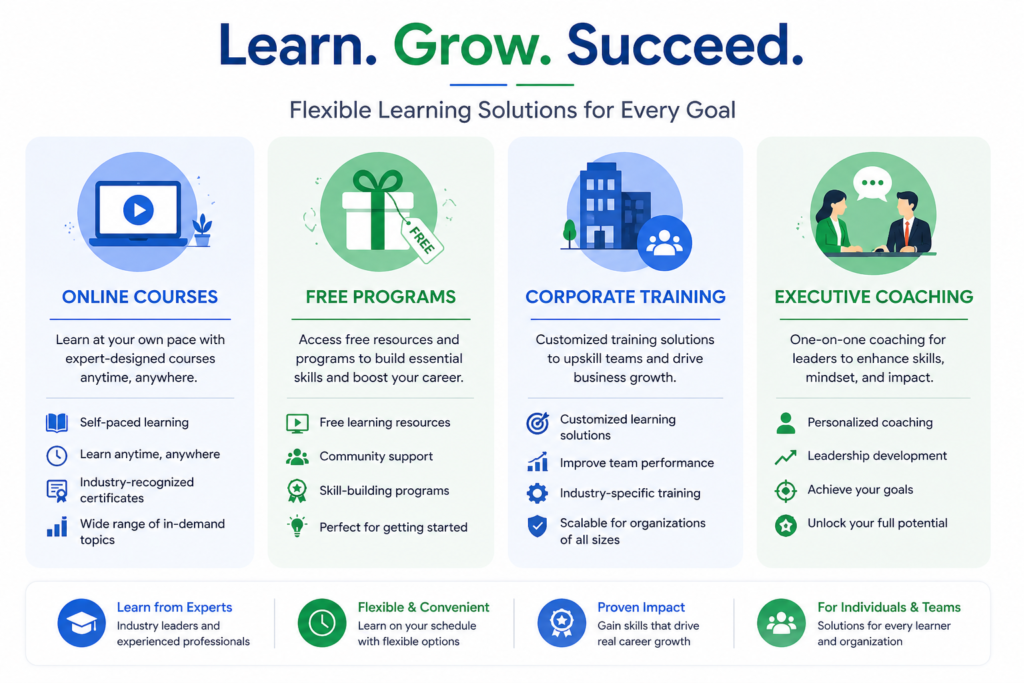
Online leadership development courses have completely transformed how professionals grow. Platforms like Coursera, LinkedIn Learning, edX, and Udemy now offer courses built by Harvard, Wharton, and Google — accessible from anywhere, at any pace. For most professionals, online is the smartest starting point. You can test a program for free, validate the content quality, and only invest money when you are sure it fits. In addition, the flexibility means you can apply what you learn in real time at work.
Free Leadership Development Courses vs Premium Programs
I have personally gone through both, and here is the real difference: free leadership development courses online give you the ‘what’ — models, frameworks, and theory. Premium programs give you the ‘how’ — with structured assignments, peer coaching, live sessions, and certificates that carry weight on a resume. My recommendation: start free, validate your learning style, then invest in a paid program once your goal is crystal clear.
Management and Leadership Development Courses for Corporate Growth
These programs sit at the intersection of people management and business strategy. They are specifically designed for mid-level managers who need to align team performance with company goals. Leadership and management development courses from institutions like Wharton, INSEAD, or Cornell cover delegation, accountability frameworks, performance reviews, and cross-functional leadership. They are particularly powerful for managers in corporate environments who want to move into director or VP roles.
Leadership and Organizational Development Programs
Leadership and organizational development courses take a systems view — they train you to lead not just individuals but entire organizations through change. If your role involves HR, culture transformation, or company scaling, these programs provide essential tools. They cover change management, organizational design, employee engagement, and strategic workforce planning.
Basic vs Advanced Leadership Development Courses
Basic leadership development courses are ideal for first-time managers and aspiring leaders — they cover foundational skills like giving feedback, running meetings, setting priorities, and building trust. Advanced programs target experienced leaders and cover topics like crisis leadership, executive presence, board communication, and global team management. Picking the wrong level is one of the most common mistakes I see — it either bores you or overwhelms you.
Step-by-Step Framework to Choose the Right Course
I developed this framework after reviewing hundreds of courses and coaching professionals who had already wasted money on the wrong programs. Follow these five steps in order — they work for any level, any budget, and any career goal.
Step 1: Define Your Leadership Goal
Everything starts here. Are you aiming for a specific promotion? Trying to fix team performance? Building a company? Write it in one sentence: ‘I want to become a department head within 12 months’ or ‘I need to improve my team’s accountability.’ Vague goals produce vague results. Therefore, the more specific your goal, the more precisely you can match it to a program.
Step 2: Identify Your Current Skill Gap
Once you know your goal, ask: ‘What specific skill is the gap between where I am and where I want to be?’ Common gaps include: conflict resolution, strategic thinking, influence without authority, executive communication, and delegation. Most leadership skill development courses specialize — knowing your gap helps you avoid wasting time on skills you already have.
Step 3: Match Course Type to Your Situation
Use this simple match:
- First-time manager with no budget → Free online leadership development courses
- Mid-level manager targeting promotion → Paid certification (Coursera, LinkedIn Learning)
- Executive or senior leader → University-backed executive program or coaching cohort
- Niche roles (military, government) → Navy leadership development courses or OPM programs
- Location-specific needs → Search ‘leadership development courses near me’ filtered by outcome
Step 4: Evaluate Course Credibility and Outcomes
Not all courses are created equal. Before enrolling, verify: Who designed the curriculum? (University, company, solo instructor?) What do past graduates say about career outcomes? Is there a recognized certificate? Are there practical assignments — not just videos? I always recommend reading at least 20 reviews on platforms like Coursera or LinkedIn Learning, specifically looking for comments about practical application.
Step 5: Validate ROI — Career Impact, Salary Growth, Opportunities
This step separates smart course investments from expensive hobbies. Before paying, ask: ‘Does this certificate appear in job postings for the role I want?’ ‘Have people from this program moved into the role I am targeting?’ For example, several leadership professional development courses from Wharton and Cornell are actively listed as preferred credentials in senior management job postings. That is measurable ROI.
Best Leadership Development Courses — Top Picks for 2026
Best Online Leadership Development Courses (Global Platforms)
These are the programs I consistently recommend based on curriculum quality, instructor credibility, and real-world career outcomes:
| Course | Platform | Level | Cost | Certificate |
| Inspiring and Motivating Individuals | Coursera (Michigan) | Beginner | Free to audit | Yes (paid) |
| Leadership Development Program | edX (MIT) | Intermediate | $150–$300 | Yes |
| Executive Leadership | Cornell eCornell | Advanced | $1,500–$3,000 | Yes |
| Becoming a Great Leader | LinkedIn Learning | Beginner | Subscription | Yes |
| Leadership: Practical Leadership Skills | Udemy | Beginner–Mid | $15–$20 | Yes |
| Strategic Leadership & Management | Coursera (Illinois) | Intermediate | Free to audit | Yes (paid) |
Best Free Online Leadership Development Courses
If budget is a constraint right now, these free programs are genuinely valuable — not just watered-down previews:
- Inspiring and Motivating Individuals — Coursera (University of Michigan) — Free audit
- Leadership Through Social Influence — Northwestern University on Coursera — Free audit
- The Art of Leadership — edX — Free audit available
- Google’s Project Management Certificate — Coursera — Includes strong leadership modules
- Microsoft’s Leadership Essentials — LinkedIn Learning — Free with trial period
In my experience, the Coursera free audits are the best starting point. You get full video access and can test the content quality before deciding to pay for the certificate. However, if you want accountability and graded assignments, pay for at least one month — it dramatically increases completion rates.
Best Leadership and Management Development Programs
For professionals targeting corporate leadership roles, these programs carry the most weight with hiring managers and promotion committees in 2026:
- Wharton Online — Business and Leadership Fundamentals Specialization (Coursera)
- Harvard Business School Online — Management Essentials
- Cornell ILR School — Leadership and Strategic Management
- IMD Business School — Leadership in 21st Century Organizations
- INSEAD — Leadership and Management in Health (for healthcare leaders)
Leadership Professional Development Courses for Executives
At the executive level, the game changes. These programs are less about learning concepts and more about refining judgment, building strategic networks, and developing executive presence. My top picks for senior leaders in 2026 are: Harvard’s Advanced Management Program, Kellogg’s Executive Leadership Program, and the Stanford Executive Program. All three combine peer cohort learning, case studies, and personalized coaching — which in my experience is the most effective combination for leaders at this stage.
Leadership Courses by Location — What to Know Before You Search ‘Near Me’
Leadership Development Courses in the UK, Canada, NZ, and South Africa
Location matters more than people think — not just for convenience, but for regional relevance in curriculum and networking. Here is what I have found across regions:
| Region | Top Provider | Notable Focus | Cost Range |
| UK | Chartered Management Institute (CMI) | Accredited management qualifications | £500–£3,000 |
| Canada | Queens University Executive Education | Organizational leadership | CAD $1,500–$5,000 |
| New Zealand (NZ) | University of Auckland Business School | Leadership in Pacific context | NZD $800–$4,000 |
| South Africa | GIBS Business School | African leadership & strategy | ZAR $5,000–$20,000 |
| USA (Federal) | OPM (Office of Personnel Mgmt) | Government leadership tracks | Subsidized/Free |
When Location-Based Courses Make Sense vs Online Learning
Leadership development courses in the UK, Canada, NZ, and South Africa have distinct advantages over fully online options: you build local professional networks, you gain credentials recognized by regional employers, and you access in-person peer learning. However, online learning wins on flexibility, cost, and global content access. My rule: choose location-based programs when networking and employer recognition in your region are your primary goals. Choose online when speed, cost, and immediate skill application matter more.
How to Evaluate ‘Leadership Development Courses Near Me’
When you search for leadership development courses near me, apply these filters before shortlisting: Is the provider accredited (university, professional body, or recognized institute)? Does the course include a recognized certificate or credential? Are there alumni in roles you are targeting? Is the cohort size small enough for real interaction (under 25 participants)? Does the facilitator have real-world leadership experience — not just academic theory? These five filters alone will eliminate 80% of mediocre local programs.
Specialized Leadership Programs — For Niche Career Paths
Navy Leadership Development Courses and Structured Discipline Training
Navy leadership development courses represent some of the most rigorous, structured leadership training available anywhere. I have spoken with Navy veterans who transitioned into corporate leadership, and they consistently credit their military training as more impactful than any MBA program. The Navy Enlisted Leadership Development (NELD) program specifically teaches decision-making under pressure, team cohesion, mission clarity, and leading in high-stakes environments. Even for civilians, studying Navy leadership frameworks — like mission command and decentralized leadership — provides a powerful mental model for managing teams under complexity and stress.
OPM Leadership Development Courses (Government-Focused Leadership)
The U.S. Office of Personnel Management (OPM) offers one of the most comprehensive government leadership development ecosystems in the world. OPM leadership development courses are built around five Executive Core Qualifications (ECQs): Leading Change, Leading People, Results Driven, Business Acumen, and Building Coalitions. These are not soft-skills workshops — they are career-defining credentials for federal employees targeting Senior Executive Service (SES) roles. If you work in government or the public sector, OPM programs are simply non-negotiable on your development path.
Organizational vs Personal Leadership Development Focus
Leadership and organizational development courses prepare you to lead systems — culture, change, structure, and teams at scale. Leadership and personal development courses, on the other hand, focus inward — building self-awareness, emotional regulation, resilience, and authentic leadership style. Both are necessary, but at different career stages. In my experience, early-career leaders need personal development first — they need to understand themselves before they can lead others. Mid-to-senior leaders need organizational development tools to operate at scale.
What Modern Leadership Courses Actually Teach in 2026
This is where many people are genuinely surprised. The new leadership development courses focus on subject matter that would have seemed unconventional ten years ago. Today’s best programs have moved far beyond ‘management by objectives’ into territory that is deeply human and tech-informed at the same time.
Emotional Intelligence and People-First Leadership
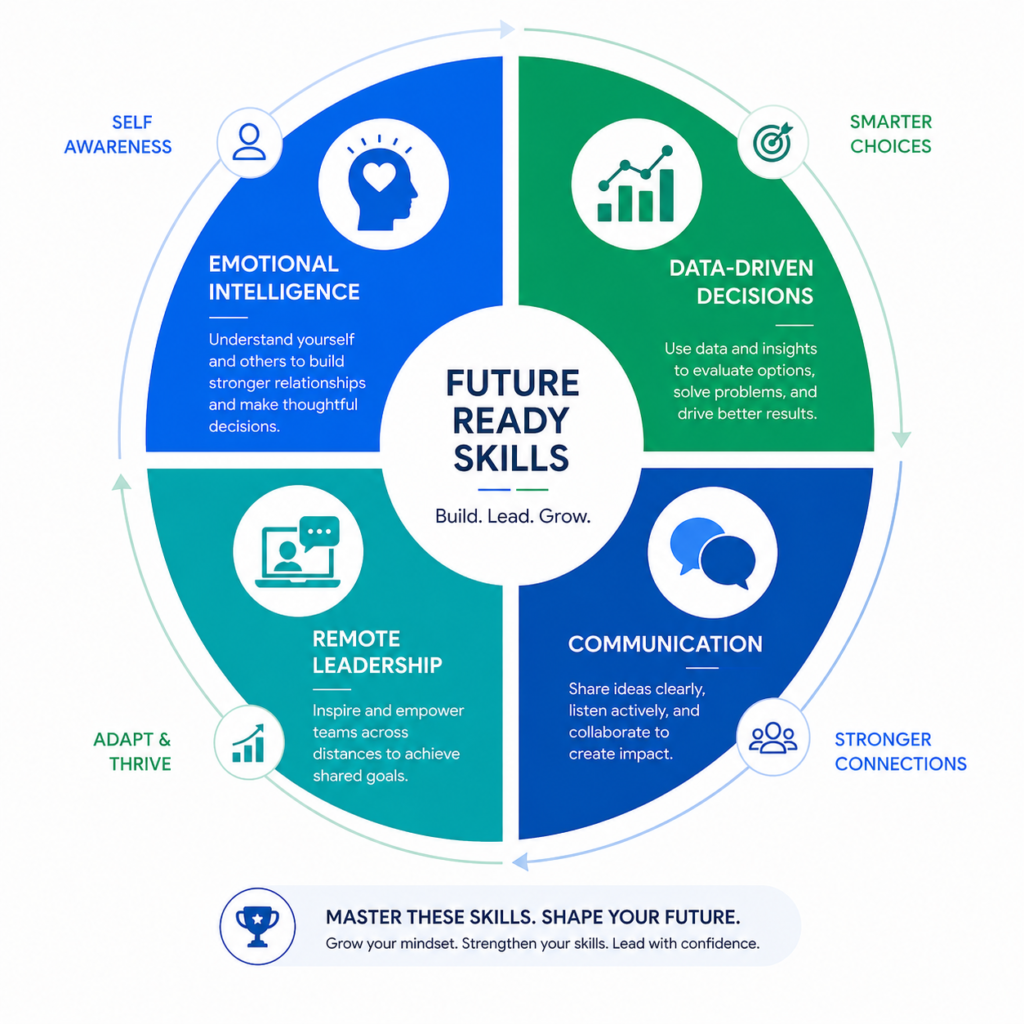
EQ has moved from optional to essential. Research consistently shows that leaders with high emotional intelligence outperform technically superior leaders who lack people skills. Modern leadership courses now dedicate entire modules to self-awareness, empathy, psychological safety, and managing emotional dynamics in teams. In my experience, this single skill area is responsible for more promotions and team breakthroughs than any technical leadership framework I have ever seen applied.
Data-Driven Decision Making and Strategic Thinking
Leaders in 2026 are expected to read dashboards, interpret KPIs, and make decisions grounded in evidence — not gut instinct alone. Therefore, modern leadership and management development courses now include modules on analytics literacy, OKR frameworks, evidence-based decisions, and strategic scenario planning. If you are interested in building analytical thinking alongside leadership skills, I would also recommend exploring resources like Google Data Analytics professional certificates as complementary tools.
For a deeper dive into analytical thinking for leaders, check out our guide on Google Data Analytics Certificate: Is It Worth It in 2026?
Remote Team Leadership and Digital Collaboration
Remote leadership is no longer an emergency adaptation — it is a core competency. The best leadership development courses online now include dedicated modules on asynchronous communication, virtual team culture, digital trust-building, and managing performance across time zones. Leaders who are not skilled in remote team dynamics are already falling behind. For example, companies like GitLab and Automattic have entire internal leadership programs built around remote-first leadership — and many of these frameworks are now embedded in commercial courses.
Influence, Communication, and Conflict Resolution
Leadership without influence is just a title. Modern programs teach leaders how to communicate upward to executives, laterally to peers, and downward to their teams — all with different strategies. Conflict resolution, difficult conversations, and persuasion under pressure are now standard curriculum in leadership professional development courses. I have seen professionals completely transform their career trajectory simply by mastering these communication skills. If this is a specific gap for you, I highly recommend pairing your leadership course with a dedicated
public speaking course — here is our review of the Best Public Speaking Course: Build Confidence in 2026.
Real Examples — How Leadership Courses Impact Careers
From Individual Contributor to Team Leader
Consider a software engineer who had been a top performer for three years but kept being passed over for team lead roles. After completing the Inspiring and Motivating Individuals specialization on Coursera, they applied a structured 1:1 feedback framework with a junior colleague they were informally mentoring. Within four months, their manager cited ‘demonstrated leadership impact’ in their performance review — and they received the promotion. The course cost $49 for one month of Coursera access. The ROI was a $15,000 salary increase. That is what choosing the right leadership development course looks like in practice.
Mid-Level Manager to Senior Leadership Transition
A marketing manager I worked with was consistently described as ‘strong executor but not a strategic thinker’ in her reviews. She enrolled in the Wharton Business and Leadership Fundamentals Specialization and specifically focused on the strategic communication and stakeholder management modules. Within six months, she restructured how her team presented quarterly reports to the C-suite — and within a year, she had been moved into a Senior Director role. Therefore, the key was not just learning — it was applying the frameworks immediately and visibly.
Entrepreneur Scaling Teams Using Leadership Frameworks
A founder I know built a tech company from 3 to 35 employees in two years. However, at 15 employees, everything broke: communication, accountability, and culture. After completing a leadership and organizational development program, they introduced OKRs, structured team rituals, and a values-based hiring framework. Within six months, voluntary turnover dropped by 60% and product velocity increased by 40%. The leadership course paid for itself in the first quarter. If you are an entrepreneur building teams, I also recommend checking out our guide on Best Entrepreneurship Courses for Founders as a complementary resource.
Common Mistakes That Kill Results
Choosing Courses Based Only on Price or Popularity
The most popular course is not always the most effective one for your situation. I have seen professionals spend $2,000 on a prestigious executive program that was completely misaligned with their current career stage — and get zero practical value from it. Conversely, I have seen a $15 Udemy course completely transform someone’s management style. Price and popularity are signals, not substitutes, for relevance.
Ignoring Practical Application and Real-World Scenarios
Leadership development is not a spectator sport. Courses that are purely video-based, with no assignments, peer discussion, or real-world practice, produce learners who can talk about leadership theory but cannot actually lead. Always choose programs with application exercises — role-play scenarios, case studies, peer feedback, or live simulations. In my experience, the implementation gap is the number one reason talented professionals see no career movement after completing courses.
Not Aligning Courses with Career Goals
This is the mistake I see most often. A professional in a corporate role enrolls in an entrepreneurship-focused leadership program because it sounded exciting — and finds that none of the frameworks apply to their daily reality. Or someone targeting a federal government role ignores OPM leadership development courses and takes a generic online program instead. Always start with your goal, then match the course — never the other way around.
Taking Too Many Courses Without Implementation
Course collecting is not leadership development. I have coached professionals who had seven certificates on LinkedIn but no evidence of leadership impact at work. Therefore, my rule is simple: complete one course, implement one skill for 30 days, then move to the next. Quality of implementation beats quantity of completion every single time.
| ⚠️ IMPLEMENTATION RULERule of One: For every course you complete, pick ONE skill, apply it in ONE real work situation, and track ONE measurable outcome before moving to the next course. |
Beginner vs Advanced Leadership Learning Paths
Beginner Roadmap — First Leadership Role
If you are preparing for or just stepping into your first leadership role, follow this path:
- Month 1–2: Complete a free online leadership development course (Coursera Michigan Specialization)
- Month 3: Read ‘The First 90 Days’ by Michael Watkins alongside your course
- Month 4: Apply the 1:1 feedback framework with your team — document results
- Month 5–6: Enroll in a paid course targeting your specific gap (communication, delegation, conflict)
- Month 6+: Pursue a recognized certification (CMI, LinkedIn Learning certificate)
Intermediate Roadmap — Team Management & Influence
For managers with 1–5 years of leadership experience, the focus shifts to scale and influence:
- Quarter 1: Enroll in a management and leadership development course (Wharton or Illinois on Coursera)
- Quarter 2: Focus on influence skills — take a negotiation or stakeholder management course
- Quarter 3: Apply OKR or accountability frameworks with your full team — track results
- Quarter 4: Get 360-degree feedback, identify the next gap, and select your next program
Advanced Roadmap — Executive Leadership & Strategy
For senior leaders targeting C-suite or executive roles:
- Year 1: Enroll in a university-backed executive program (Harvard, Kellogg, Stanford, or Cornell)
- Year 1 ongoing: Engage a professional executive coach alongside your program
- Year 2: Lead a high-visibility organizational initiative using new frameworks
- Year 2 ongoing: Build a personal advisory board of senior mentors
- Year 3: Speak, write, or teach leadership — external visibility compounds your credibility
Tools and Platforms to Learn Leadership Skills
Top Platforms Offering Leadership Development Courses Online
| Platform | Best For | Price | Certificates |
| Coursera | University-backed courses, specializations | Free audit / $49–$300/mo | Yes |
| LinkedIn Learning | Career-focused, short courses | $39.99/month | Yes |
| edX | MIT, Harvard, global university courses | Free audit / $150–$300 | Yes |
| Udemy | Budget-friendly, practical skills | $10–$25 per course | Yes |
| Harvard Online | Executive-level, credibility | $1,500–$3,500 | Yes |
| eCornell | Professional certification programs | $1,500–$3,500 | Yes |
| Skillshare | Creative and soft leadership skills | $32/month | No |
| MindTools | Frameworks and tools library | $27/month | Partial |
Free Platforms vs Paid Certification Providers
My practical advice: use free platforms (Coursera free audits, YouTube masterclasses, TED courses) to explore and validate your interest area. Then invest in a paid, accredited program once you are committed. The certificate matters most for job applications and promotions — in those situations, a Coursera certificate from a top university carries more weight than a generic completion badge.
How to Combine Courses with Real-World Practice
The most effective leadership learners I have seen follow a 70-20-10 model: 70% learning through real work challenges, 20% through feedback and coaching, and 10% through formal courses. This means your leadership development courses should be the 10% input that powers the 70% application. Use every concept you learn in a real team situation within 48 hours — that is when the retention and impact are highest. Additionally, if you are developing digital and tech skills alongside leadership, consider exploring Top 7 AI Skills for 2026 to round out your modern leadership toolkit.
Leadership Course Comparison — What’s Worth Your Time
Free vs Paid Leadership Development Courses
| Factor | Free Courses | Paid Courses |
| Content Quality | Good — university-level available | Excellent — structured, deep |
| Certificate Value | Low to moderate | High — employer recognized |
| Accountability | None (self-paced) | High — deadlines, grades, cohort |
| Practical Assignments | Rare | Standard |
| Peer Learning | Limited | Cohort-based, high value |
| Best For | Exploring, building awareness | Career advancement, certification |
Online vs In-Person Leadership Programs
| Factor | Online Programs | In-Person Programs |
| Flexibility | High — learn anywhere, anytime | Low — fixed location and schedule |
| Cost | Low to moderate ($0–$300) | High ($500–$5,000+) |
| Networking | Limited, virtual only | Strong, face-to-face connections |
| Practice Scenarios | Good — simulated, peer forums | Excellent — live role-play |
| Certificate Quality | High (university platforms) | High (established institutions) |
| Best For | Skill building, busy professionals | Network building, exec programs |
Certification vs Skill-Based Learning
Certifications are the currency of credibility — they prove to employers and hiring managers that you completed a structured, assessed program. Skill-based learning is the currency of performance — it is what actually changes how you lead on Monday morning. My advice: pursue both simultaneously. Enroll in a course that delivers a recognized certificate AND includes practical assignments that force real-world application. That combination produces both the credential and the capability.
Actionable Checklist Before You Enroll
| 📋 PRE-ENROLLMENT CHECKLIST✅ I have defined my leadership goal in one clear sentence ✅ I know my primary leadership skill gap right now ✅ I have matched the course type to my career stage ✅ I have verified the instructor has real leadership experience ✅ The course includes practical assignments, not just videos ✅ I have read at least 20 recent student reviews ✅ The certificate is recognized in job postings for my target role ✅ I have a 30-day implementation plan for after the course ✅ The course aligns with my industry and specific career path ✅ I have a way to measure my progress and ROI |
Define Your Leadership Goal Clearly
Write it in one sentence before you search for a course. Without this, you will end up comparing courses on price, duration, and star ratings — none of which predicts whether a course will move your career forward.
Check Course Credibility and Instructor Background
Look for instructors who have actually led teams, managed organizations, or built businesses — not just academics who study leadership from a distance. Real-world credibility in the instructor directly transfers to practical content quality.
Ensure Practical Assignments and Real-World Use Cases
Any leadership development course worth your time will include scenarios you can apply at work immediately. If the entire course is passive video watching, look elsewhere — leadership is a practice, not a theory.
Align Course with Your Industry and Career Path
A healthcare leader needs different leadership frameworks than a tech startup founder. A government executive needs OPM qualifications, not general corporate leadership training. Industry alignment dramatically increases the relevance — and therefore the real-world impact — of your learning.
FAQ — Leadership Development Courses
Are Leadership Development Courses Worth It?
Yes — but only if you choose the right course and implement what you learn. In my experience, professionals who complete a relevant leadership development course and actively apply the skills within 30 days see measurable career impact: faster promotion cycles, higher performance review scores, stronger team results, and — in many cases — salary increases of 15–30% within 12–18 months of completing a program.
Can I Learn Leadership Skills Online for Free?
Absolutely. Free online leadership development courses on platforms like Coursera, edX, and LinkedIn Learning offer genuinely high-quality content. The University of Michigan’s leadership specialization on Coursera, for example, is one of the best beginner programs available — and you can audit it for free. However, for career advancement, pairing free learning with a paid certificate program will deliver stronger results.
Which Leadership Development Courses Are Best for Beginners?
For beginners, I recommend starting with: (1) Inspiring and Motivating Individuals — Coursera (Michigan), (2) Becoming a Great Leader — LinkedIn Learning, and (3) Leadership Essentials — edX. These three programs build foundational leadership skills — feedback, motivation, communication, and team dynamics — without overwhelming you with advanced strategy content you are not ready to use yet.
How Long Does It Take to Develop Leadership Skills?
Leadership development is not a one-time event — it is an ongoing practice. That said, you can build meaningful, visible leadership skills in 90 days if you combine a structured course with deliberate real-world application every week. The fundamentals — giving feedback, running effective meetings, making decisions, and communicating clearly — can be dramatically improved in three to six months of focused effort.
Do Leadership Certifications Help in Career Growth?
Yes — especially for mid-to-senior career moves. Leadership certifications from recognized platforms (Coursera, LinkedIn Learning, eCornell, CMI, OPM) are increasingly listed as preferred credentials in management job postings. In addition, they signal to hiring managers and promotion committees that you have invested deliberately in your leadership capability — which is a differentiator in a competitive talent market.
Final Action Plan — Start Your Leadership Journey Today
Here is the thing: information without action is just entertainment. You have read this guide — now the question is what you are going to do in the next 24 hours. I have kept this plan simple and immediate because complexity is the enemy of action.
Pick One Course Based on Your Current Level
Do not spend three weeks researching. Using the framework in this guide, pick one course today — right now. If you are a beginner, start with the Michigan Coursera specialization (free audit). and if you are mid-level, start with the Wharton Business and Leadership Fundamentals. If you are advanced, book a discovery call with Harvard Online or eCornell. Decision made in 10 minutes. Enrollment done in 20.
Apply One Leadership Skill Immediately
Within the first week of your course, identify ONE skill you are learning and apply it at work tomorrow. If the course covers the feedback model — give one piece of structured feedback this week. If it covers delegation frameworks — delegate one task you would normally do yourself. Immediate application is what separates learning from leadership growth.
Track Progress and Real-World Impact
Keep a simple leadership journal — just 5 minutes per week. Note what you applied, how people responded, and what you are adjusting. After 90 days, you will have a clear picture of your growth that you can articulate in your next performance review or job interview. This documentation also becomes powerful evidence of your leadership ROI.
Build a Continuous Leadership Learning System
Leadership development is a system, not an event. Build yours: one formal course per quarter, one leadership book per month, one mentor conversation per month, one peer feedback session per week. Leaders who build these systems consistently outperform those who learn in bursts. If you are also building skills in project management and career development, our guides on PMP Certification,Time Management Courses, and Small Business Management Courses will complement your leadership journey powerfully.
Conclusion
Leadership development courses are one of the highest-ROI investments you can make in your career in 2026. I have seen them turn individual contributors into respected team leads, transform struggling managers into high-performing leaders, and help entrepreneurs build cultures that scale. However, the course only works when it is matched to your goal, applied with intention, and treated as a starting point — not a finish line.
Whether you start with free leadership development courses online, invest in a university-backed certification, explore OPM or Navy leadership development programs, or search for leadership development courses near you — the most important step is the first one. Pick a course. Enroll today. Apply what you learn by Friday.
Leadership is not a title you receive — it is a capability you build, one deliberate skill at a time.