Let me be straight with you: I’ve been in the networking and IT certification space for over a decade, and the Cisco Certified Network Associate certification remains one of the most powerful career moves you can make in 2026. Yes, even with AI, automation, and cloud computing reshaping everything around us.
Here’s the thing — AI doesn’t replace network engineers. It creates more demand for people who actually understand how networks are designed, secured, and optimized. The cisco certified network associate ccna is still the industry’s go-to credential for proving you have that foundation.
However, the challenge most beginners face isn’t a lack of motivation. It’s the overwhelming number of options. Do you pick a paid cisco certified network associate online course or go free? How long does it actually take? What’s the real cisco certified network associate cost? How do you know if a training course is worth your money?
In this guide, I’ll walk you through everything — from choosing the right cisco certified network associate course to building a study plan that actually works, understanding the full cost breakdown, and passing the CCNA 200-301 exam on your first attempt. No fluff. No generic advice. Just what genuinely works.
Who This Guide Is For
Before we dive in, I want to be clear about who will benefit most from this content. Not every section will apply to you at the same depth — and that’s fine. I’ve structured this so you can jump to what’s relevant.
Beginners Entering Networking or IT
If you’re starting from scratch with no prior networking knowledge, this guide is built specifically for you. I’ll show you exactly where to begin, what fundamentals to lock in first, and how to avoid the most common beginner mistakes that derail people in the first two weeks.
In my experience, most beginners who fail CCNA don’t fail because the content is too hard. They fail because they didn’t build the right foundation before jumping into advanced topics. We’ll fix that here.
Career Switchers Targeting High-Demand Tech Roles
Maybe you’re coming from a completely different field — sales, marketing, finance, teaching — and you’ve decided tech is where your future lies. The cisco certified network associate certification is one of the fastest, most credible on-ramps into a well-paying tech career.
Therefore, if you’re pivoting into networking or IT, I’ll give you a realistic timeline, the best resources for your situation, and a roadmap that accounts for your limited background without wasting your time.
IT Professionals Looking to Validate Skills with CCNA
Perhaps you’ve been working in IT for a few years — helpdesk, system admin, maybe some basic networking — but you’ve never formally certified. The cisco certified network associate ccna certification is your chance to validate what you already know and fill in the gaps you might not even realize you have.
For this group, the good news is that your timeline is much shorter. You’ll likely be able to fast-track through fundamentals and focus your energy on the exam-specific areas where CCNA goes deeper than your daily work.
Quick Answer: The Fastest Path to Getting CCNA Certified
I get this question constantly. People want a direct answer, so here it is before we go deep into the details.
The 4-Step Roadmap (Learn → Practice → Revise → Pass)
In my experience, every successful CCNA candidate follows some version of this four-step framework, whether they realize it or not:
- Step 1: Learn — Study core concepts systematically using a structured course or study guide
- Step 2: Practice — Simulate real network configurations using Packet Tracer or GNS3 labs
- Step 3: Revise — Identify weak areas through practice exams and targeted review
- Step 4: Pass — Schedule your exam strategically and execute with confidence
The biggest mistake people make is skipping between these steps or spending 90% of their time on step one. Learning without practicing is like reading a swimming manual and never getting in the water.
Typical Timeline Based on Experience Level
| Experience Level | Recommended Study Time | Estimated Timeline |
| Complete Beginner | 8–10 hrs/week | 4–5 months (120+ days) |
| Some IT Background | 8–10 hrs/week | 2–3 months (60–90 days) |
| Networking Experience | 10–12 hrs/week | 3–5 weeks (30 days) |
What Most People Get Wrong Early
Most beginners get this wrong: they pick a random YouTube playlist, watch videos passively for three weeks, and think they’re making progress. They’re not. Passive consumption is not studying.
However, the other extreme — trying to read the full Cisco documentation from day one — is equally ineffective. You need a structured path that balances theory, labs, and testing from week one. I’ll show you exactly how to build that below.
What Actually Matters in the CCNA 200-301 Journey
The CCNA 200-301 exam isn’t just a knowledge test. It’s a practical assessment of whether you can think like a network engineer. Understanding this distinction changes how you should study.
Key Skill Areas You Must Master (Not Just Memorize)
Based on the official Cisco exam blueprint for cisco certified network associate ccna 200 301, the exam covers these major domains:
- Network Fundamentals (20%) — OSI model, TCP/IP, IPv4/IPv6, switching concepts
- Network Access (20%) — VLANs, trunking, EtherChannel, wireless basics
- IP Connectivity (25%) — Routing protocols, OSPF, static routing
- IP Services (10%) — DHCP, DNS, NAT, NTP, QoS basics
- Security Fundamentals (15%) — ACLs, VPNs, device security
- Automation and Programmability (10%) — REST APIs, JSON, Python basics, SD-WAN concepts
Notice that last point — automation. This is where the cisco certified network associate ccna 200-301 has evolved significantly. In 2026, you need at least a working understanding of network programmability, even at an entry level. I’ll cover how to approach this section without getting overwhelmed.
How the Exam Tests Real Understanding
Cisco designs the exam to reward understanding over memorization. You’ll face simulation questions where you configure a live router or switch. You’ll get scenario-based multiple-choice questions where all four options seem reasonable at first glance. Therefore, rote memorization of theory will not get you through this exam.
For example, it’s not enough to know the definition of OSPF. You need to understand why you’d use OSPF in a specific topology, how it behaves when a link fails, and how to verify and troubleshoot it using real CLI commands. That depth only comes from hands-on lab practice.
Why Many Candidates Fail on First Attempt
In my experience tracking hundreds of CCNA candidates, the most common failure reasons are:
- Skipping subnetting practice until too late (it appears throughout the exam)
- Ignoring the Automation & Programmability domain assuming it won’t matter
- Not practicing enough CLI commands to build muscle memory
- Underestimating time pressure — the exam is 120 minutes for up to 120 questions
- Using brain dumps instead of genuine understanding — Cisco actively updates questions
🔗 Pro Tip: If you’re already interested in the cybersecurity side of networking, check out my detailed guide on cybersecurity basics — understanding security fundamentals will give you a significant advantage in the Security Fundamentals section of CCNA.
Choosing the Right Cisco Certified Network Associate Course

Choosing the right cisco certified network associate course is genuinely one of the most important decisions in your CCNA journey. I’ve seen people use the wrong resource and spend twice as long as necessary — or worse, fail their exam because their course didn’t align with the actual exam objectives.
Online Courses vs University Programs: What Delivers Results
Let me be direct: for most people, a high-quality online cisco certified network associate course delivers better results than a traditional university program. Here’s why.
University programs, like the charles sturt university cisco certified network associate ccna short course, offer structure and credentialing that some employers recognize. However, they tend to move at a slower pace, cost significantly more, and may not update as quickly when Cisco revises the exam blueprint.
Online courses, on the other hand, are updated frequently, allow self-paced learning, and typically cost a fraction of the price. For someone working full-time, the flexibility alone makes online learning the better choice.
That said, if your employer is sponsoring your education or if you prefer a classroom environment with instructor access, a structured university program can work well. The key is ensuring the curriculum directly maps to the current CCNA 200-301 objectives.
Structured Training vs Self-Study: Which One Works Better
This is one of the most debated questions I encounter. My honest answer: it depends on your discipline and learning style, but structured training wins for most people.
Structured cisco certified network associate ccna training courses give you a clear path, accountability, and a proven sequence for learning complex topics. Self-study, using official Cisco materials and free resources, works well if you’re already disciplined and have a networking background.
For beginners, however, I always recommend starting with a structured course before branching out to supplementary materials. The risk of self-study is that you don’t know what you don’t know — and you can spend weeks studying things that carry little exam weight while completely missing critical areas.
Best Platforms (Coursera, Independent Courses, University Options)
I’ve personally reviewed courses across multiple platforms, and here’s my honest assessment:
- Cisco Networking Academy (NetAcad): Free and excellent for absolute beginners. The official CCNA curriculum is thorough, though it can feel slow-paced.
- Cisco certified network associate Coursera programs: Good for earning a completion certificate alongside your learning, and some tie into broader university partnerships. However, make sure the course explicitly covers CCNA 200-301 objectives.
- Udemy (Jeremy’s IT Labs CCNA course): In my opinion, one of the best value-for-money options available. Comprehensive, exam-focused, and regularly updated.
- CBT Nuggets: Excellent video quality with lab integration, though it’s a subscription-based model.
- INE (Internetwork Expert): Slightly more advanced but outstanding if you want to go beyond CCNA basics.
For those considering the ccna cisco certified network associate course on Coursera, I’d recommend it as a supplement to a more exam-focused resource rather than your primary study tool.
How to Evaluate Any CCNA Training Course Before Enrolling
Before spending money on any cisco certified network associate ccna training course, ask these five questions:
- Does it explicitly cover all CCNA 200-301 exam domains and objectives?
- When was it last updated? (Should be within the past 12 months)
- Does it include hands-on lab exercises, not just video lectures?
- What is the instructor’s real-world Cisco experience?
- Does it include or recommend practice exam resources?
A course that fails two or more of these criteria isn’t worth your time or money, regardless of how good the marketing looks.
Free vs Paid CCNA Courses: What Actually Works
I’ll give you my unfiltered take here because a lot of the advice online is either sponsored or out of date.
When Free Courses Are Enough
If you have a strong IT background and already understand networking fundamentals, a cisco certified network associate course free approach can absolutely work. Cisco’s NetAcad platform, Professor Messer’s study materials, and Jeremy’s IT Labs free YouTube series cover enormous ground at no cost.
In addition, the official Cisco documentation and study guides are freely accessible online. For motivated self-learners with existing knowledge, these resources combined with free Packet Tracer software and consistent lab practice can take you to exam day without spending a dollar on a course.
Limitations of Free Learning Paths
However, free resources have real limitations. The most significant one is structure. Free content is scattered — you’ll find excellent videos on subnetting, great blog posts on OSPF, and solid lab guides on VLANs, but piecing it all together into a coherent study plan is genuinely challenging.
The second limitation is accountability. When there’s no money on the line and no deadlines, it’s easy to lose momentum. I’ve seen brilliant people spend eight months on free CCNA content that a structured paid course covers in two months of focused study.
When Paid Courses Give You an Advantage
For most people — particularly beginners, career switchers, and anyone juggling work or family commitments — a paid course delivers better results. The primary reason is structure. A well-designed cisco certified network associate course provides a clear path from day one, removing the cognitive overhead of figuring out what to study next.
Furthermore, paid courses typically include practice exams, lab environments, and often instructor support or community access. These additions alone can make the difference between passing on your first attempt and needing a retake that costs you an additional exam fee.
Smart Hybrid Strategy (Free + Paid Combined)
This is the approach I recommend most often: use a paid course as your primary learning path, then supplement with free resources. For example, use a structured Udemy or CBT Nuggets course as your backbone, then add Jeremy’s IT Labs YouTube videos for visual reinforcement, free Packet Tracer labs from Cisco NetAcad for hands-on practice, and free flashcard tools like Anki for retention.
This hybrid strategy gives you the best of both worlds — structure and accountability from the paid course, plus depth and variety from free resources — without breaking the bank.
If you’re comparing learning strategies more broadly, our guide on AI courses for beginners discusses how modern learners are combining free and paid resources across multiple disciplines — the same principles apply here.
Cost Breakdown: Certification, Course Fees, and Hidden Expenses
Let me give you the real numbers. One of the biggest surprises for CCNA candidates is discovering costs they didn’t plan for.
Actual CCNA Certification Cost (Exam + Retakes)
The cisco certified network associate cost for the exam itself is approximately $330 USD as of 2026 (pricing can vary by region). This covers a single exam attempt at a Pearson VUE testing center or online proctored environment.
If you need to retake the exam, each retake costs the same $330. This is why passing on the first attempt matters — a retake doesn’t just cost you money, it costs you time and confidence. However, Cisco does allow retakes without a waiting period after the first failure (only a mandatory waiting period applies after three failed attempts in a rolling 12-month window).
Course Fee Ranges Across Platforms
| Platform / Course Type | Approximate Cost | Best For |
| Cisco NetAcad (Free) | $0 | Beginners, budget-conscious learners |
| Udemy CCNA Courses | $15–$25 (on sale) | Best value, structured + labs |
| CBT Nuggets | $59/month subscription | Video-heavy learners, ongoing study |
| INE | $49–$99/month | Advanced learners, lab-intensive |
| University Short Courses | $500–$2,000+ | Employer-sponsored, accredited credential |
| Bootcamp Programs | $2,000–$5,000+ | Intensive preparation, instructor support |
The cisco certified network associate course fee varies enormously. My recommendation for most people: spend $25 on a comprehensive Udemy course and $330 on the exam. That’s under $360 total to earn one of the most recognized networking certifications in the world.
Hidden Costs (Labs, Practice Tests, Time Investment)
Here’s what the marketing materials often don’t mention. In addition to the course and exam fees, you should budget for:
- Practice Exam Platforms: Boson ExSim-Max (~$99) or MeasureUp (~$79) — both well worth the investment
- Study Guides / Books: Wendell Odom’s official CCNA 200-301 Official Cert Guide (~$60–$80 for both volumes)
- Lab Software: Cisco Packet Tracer is free, GNS3 is also free but requires more setup time
- Exam Voucher: $330 USD (regional pricing may differ slightly)
The most overlooked cost, however, is time. If you’re studying while working full-time, factor in 60–90 days of consistent evening and weekend commitment. Your time is valuable, and the course duration directly impacts how long you’re out of market for that salary increase.
Is CCNA Worth the Investment in 2026
Absolutely — and the numbers back this up. Entry-level network engineers with CCNA earn significantly more than those without. In the US, CCNA-certified professionals typically see salaries ranging from $65,000 to $90,000 at entry level, with experienced professionals earning $100,000+.
Moreover, the cisco certified network associate ccna cost — even at its maximum including course, books, and exam — typically represents less than two weeks of salary gain from your first networking role. The ROI is exceptional, particularly for career switchers who can increase their income by $20,000–$40,000 per year after earning the certification.
If you’re evaluating networking certifications alongside cloud credentials, our comprehensive review of AWS certification courses is worth reading — many CCNA holders pursue AWS immediately after to expand into cloud networking roles.
Step-by-Step Framework to Pass CCNA 200-301
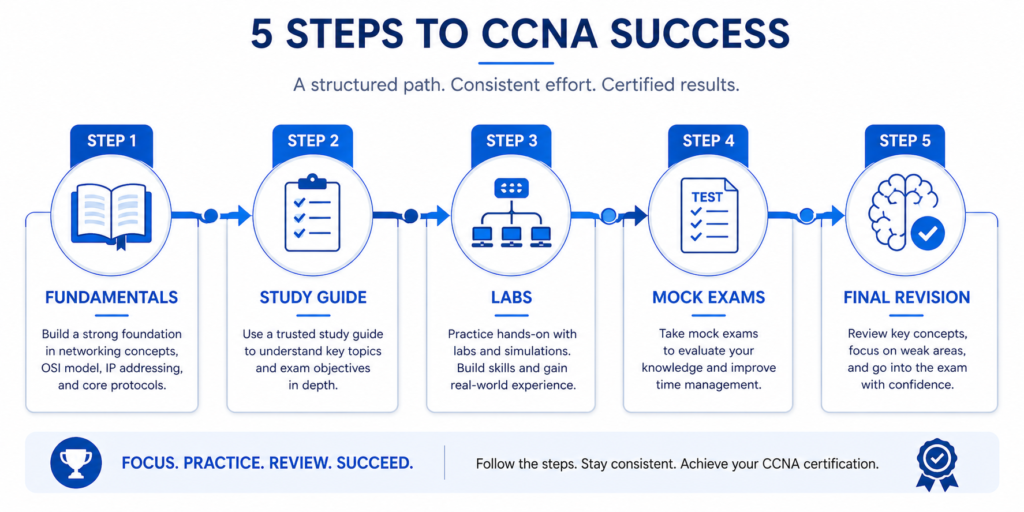
This is the core of this entire guide. Everything above has been building to this — a repeatable, tested framework that I’ve seen work for all experience levels.
Step 1: Build Strong Fundamentals (Networking Basics First)
Before you open the CCNA curriculum, you need solid networking fundamentals. I mean it. If you don’t deeply understand the OSI model, TCP/IP, subnetting, and basic switching concepts, the rest of the CCNA material will feel like reading in a foreign language.
Spend your first one to two weeks exclusively on these basics. Free resources like Cisco NetAcad’s ‘Introduction to Networks’ course or the first few modules of any ccna cisco certified network associate study guide are perfect for this phase. Don’t rush it.
Step 2: Follow a Structured Study Guide
Once your fundamentals are solid, follow a structured ccna cisco certified network associate study guide from beginning to end. The Wendell Odom Official Cert Guide is the gold standard — it follows the exam blueprint exactly and provides review questions at the end of every chapter.
The key here is discipline: work through the material sequentially rather than jumping around. The topics in CCNA build on each other. For example, you need to understand VLANs before you can understand inter-VLAN routing, and inter-VLAN routing before you can properly configure OSPF in a multi-segment topology.
Step 3: Practice with Labs and Simulations
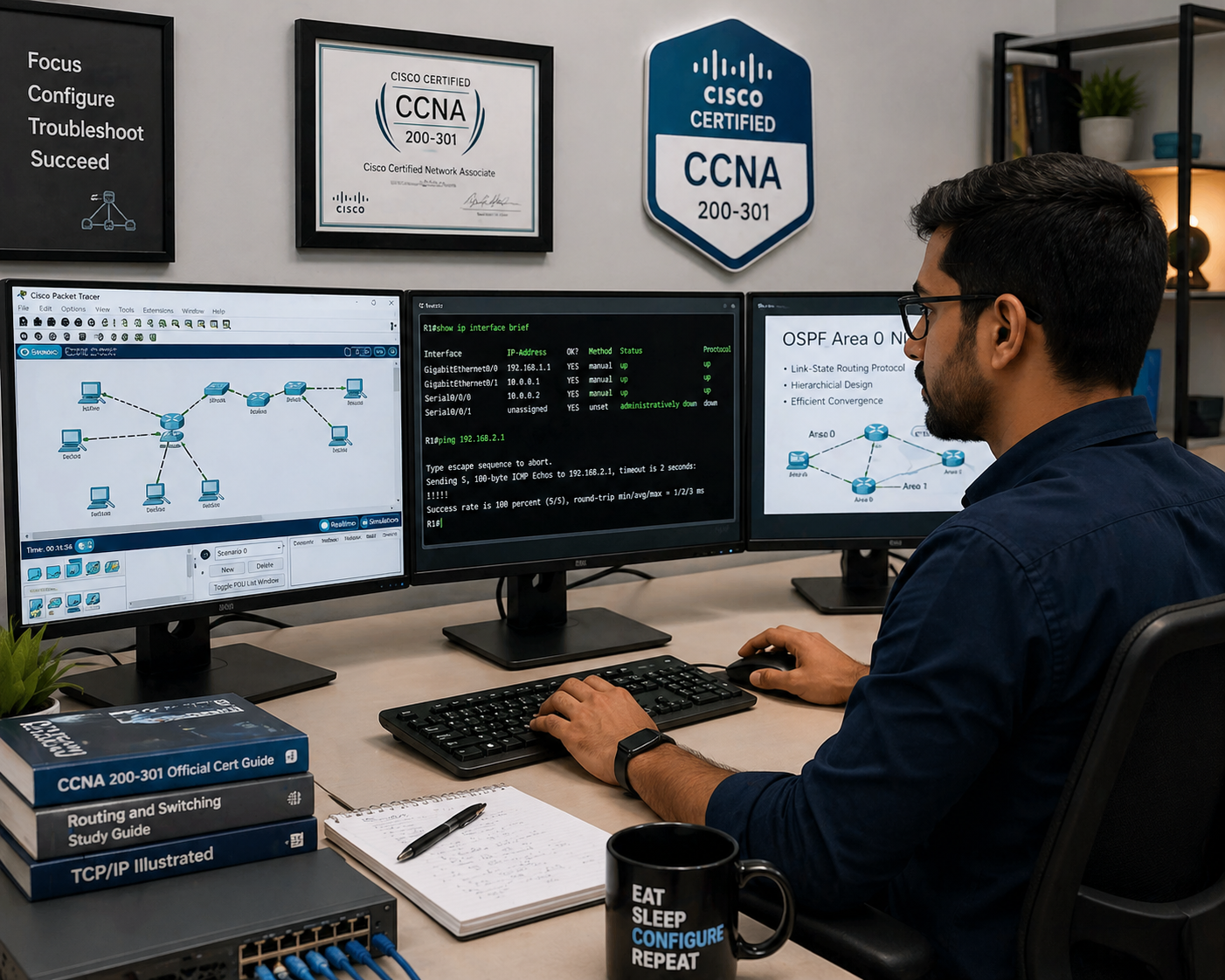
This step is non-negotiable. No amount of video watching or reading substitutes for hands-on CLI practice. Download Cisco Packet Tracer for free and start building networks from day one of your study plan.
For each topic you study — say, OSPF configuration — immediately follow up with a Packet Tracer lab where you configure it yourself. Make mistakes in the simulator. Troubleshoot. Break things intentionally and fix them. This is the muscle memory you’ll need during the exam’s simulation questions.
Step 4: Take Mock Exams Strategically
Don’t wait until two days before the exam to take your first practice test. Start taking practice exams after completing roughly 60% of the material. Why? Because practice exams reveal gaps in your knowledge while you still have time to address them.
Use platforms like Boson ExSim-Max — in my opinion, the closest thing to the real CCNA exam in terms of question style and difficulty. Review every wrong answer thoroughly. Understanding why you got something wrong is more valuable than getting it right by luck.
Step 5: Final Revision Strategy Before Exam
In the final 7–10 days before your exam, shift from learning mode to consolidation mode. Review your notes, redo weak-area labs, take two to three full practice exams under timed conditions, and score consistently above 85% before booking the real thing.
Furthermore, don’t study the day before the exam. Rest. Your brain consolidates memory during sleep, and mental fatigue is a real performance killer on exam day. Trust your preparation.
Real Study Plan Based on Course Duration
Here’s what a realistic cisco certified network associate course duration looks like across three different experience levels. These aren’t optimistic projections — they’re based on what consistently works.
30-Day Crash Plan (For Experienced Learners)
If you already have solid networking experience — perhaps you’ve been working in IT for a few years — a 30-day intensive plan can work. This requires 3–4 hours of focused study daily with no major breaks.
- Days 1–5: Review fundamentals, subnetting, and Layer 2 switching
- Days 6–12: IP connectivity — routing protocols, OSPF, static routing
- Days 13–18: IP services, security fundamentals, ACLs, NAT
- Days 19–22: Automation and programmability domain
- Days 23–28: Full practice exam cycle (3 full exams, review all errors)
- Days 29–30: Final revision, weak areas only
⚠️ Warning: This plan is demanding. If you fall behind in Week 1, extend to 45 days rather than compressing further. Burnout kills more CCNA attempts than difficulty does.
60–90 Day Balanced Plan (Most Effective Path)
This is the path I recommend for most people. It balances depth of learning with a realistic time investment of 8–10 hours per week — achievable for working professionals.
- Weeks 1–2: Networking fundamentals, OSI, TCP/IP, subnetting
- Weeks 3–5: Network access — VLANs, trunking, STP, EtherChannel
- Weeks 6–9: IP connectivity — routing, OSPF, path selection
- Weeks 10–11: IP services, security, automation
- Weeks 12–13: Practice exam phase — Boson or similar platform
- Week 14: Final consolidation and exam booking
This plan produces the highest pass rates in my observation. The 60–90 day window gives you enough time to genuinely understand concepts rather than just memorizing facts.
120-Day Beginner Plan (Zero Experience)
If you’re completely new to networking, 4 months is a realistic and healthy timeline. Don’t rush this — the foundation you build here will serve you for your entire networking career.
- Month 1: Networking fundamentals only — don’t touch CCNA material yet
- Month 2: CCNA curriculum Sections 1–2 (Networking Fundamentals, Network Access)
- Month 3: CCNA curriculum Sections 3–5 (IP Connectivity, Services, Security)
- Month 4: Automation domain + intensive practice exam phase + exam
In addition, during Month 1, I’d strongly recommend pairing your networking fundamentals with a general course on CompTIA Security+ basics — understanding the security landscape early will make the CCNA Security Fundamentals section significantly more intuitive. Our CompTIA Security+ courses guide is a great resource for this.
Common Mistakes That Kill Your CCNA Progress
I’ve watched too many talented people struggle unnecessarily because of avoidable errors. Here are the ones that matter most.
Jumping Into Advanced Topics Too Early
Most beginners get this wrong: they jump straight into OSPF or security topics because those sections sound impressive, while skipping over subnetting, the OSI model, or switching fundamentals. The result is confusion, discouragement, and eventual quitting.
However, CCNA is designed as a building-block curriculum. Every advanced topic assumes you’ve mastered what came before. Therefore, follow the sequence — even if parts feel slow or basic.
Ignoring Hands-On Practice
I cannot stress this enough. Cisco Packet Tracer is free. GNS3 is free. There is no excuse for skipping labs. The CCNA exam includes simulation-based questions that cannot be answered with memorized theory alone — you need real muscle memory from actual configuration practice.
In my experience, candidates who spend at least 40% of their total study time on hands-on labs have dramatically better pass rates than those who study primarily through videos and reading.
Over-Reliance on Theory and Videos
Videos are fantastic for understanding concepts. However, they create a false sense of progress. Watching a brilliant explanation of OSPF makes you feel like you understand it — until you sit in front of a blank router prompt and can’t remember a single command.
Therefore, every time you watch a video or read a chapter, immediately follow up with a lab or practice question on the same topic. Learning → Application → Retention. That sequence is how human memory works.
Skipping Practice Exams Until Too Late
Many candidates treat practice exams as a ‘final check’ rather than a study tool. This is a costly mistake. Practice exams should begin at the midpoint of your study plan, not the end.
Early practice exams identify gaps while you still have time to address them. They also help you calibrate your exam pacing — knowing how long you spend per question is crucial when you have 120 minutes for up to 120 questions.
Beginner vs Advanced Strategy: How Your Approach Should Change
Beginner Learning Path (Zero Networking Background)
If you’re starting from zero, your primary job in the first four weeks is not to learn CCNA — it’s to build the foundation that makes CCNA learnable. Focus exclusively on networking fundamentals: how data travels across networks, what protocols do, and how IP addresses and subnets work.
Use free resources for this phase. Cisco NetAcad’s ‘Introduction to Networks’ course is ideal. Once you can comfortably explain the OSI model, subnet a /24 address space, and describe how a switch differs from a router, you’re ready to begin the formal CCNA curriculum.
Intermediate Strategy (Some IT Knowledge)
If you’ve worked in helpdesk, system administration, or basic network support, you already have a significant advantage. Your strategy should be to quickly audit your existing knowledge against the CCNA 200-301 exam blueprint to identify gaps.
In my experience, intermediate learners typically have solid Layer 1-2 knowledge but gaps in routing protocols, IP services, and especially the automation and programmability domain. Focus your energy there rather than re-studying things you already know well.
Advanced Fast-Track Approach
For experienced network professionals who already configure Cisco devices in their daily work, the fast-track approach is viable. Your focus should be almost entirely on exam-specific knowledge — how Cisco tests topics, what the specific exam objectives cover at each domain level, and areas like automation that may be newer to your daily work.
Therefore, spend the first week doing a full practice exam diagnostic. Your score will tell you exactly where to focus. This approach can realistically get you exam-ready in 3–5 weeks of targeted preparation.
Tools and Resources That Actually Help You Pass
Best Study Guides and Books
The Wendell Odom Official Cisco CCNA 200-301 Cert Guide (two-volume set) remains the definitive study resource. It’s thorough, aligned with the exam blueprint, and includes chapter review questions throughout. If you buy one physical resource, make it this.
For a more concise option, the Cisco CCNA 200-301 Official Cert Guide Library plus Jeremy Cioara’s study materials provide excellent complementary coverage.
Lab Tools and Simulators (Packet Tracer, GNS3)
Cisco Packet Tracer is the starting point for everyone. It’s free, easy to install, and supports all the core CCNA lab scenarios. Download it from Cisco’s NetAcad platform. For more advanced simulation needs, GNS3 allows you to run actual Cisco IOS images, though it requires more setup and hardware resources.
I recommend starting with Packet Tracer for the first two months, then experimenting with GNS3 if you want to explore more complex topologies before your exam.
Practice Exam Platforms
Boson ExSim-Max for CCNA is the gold standard. The questions are exam-accurate, the explanations are detailed, and the platform shows you performance analytics by exam domain. It’s not cheap at around $99, but it’s the single best investment after the course itself.
MeasureUp is a solid alternative, and Pearson Test Prep (included with official study guides) is also useful. Avoid generic ‘dumps’ sites — they’re not only ethically problematic, but the questions are often inaccurate and will give you false confidence.
Community and Peer Learning Resources
The r/ccna subreddit is one of the most active and genuinely helpful communities for CCNA candidates. Cisco Learning Network is Cisco’s official community with study groups and exam discussions. Both are worth bookmarking.
Additionally, Discord communities focused on networking certifications have grown significantly. Finding a study partner or accountability group dramatically improves completion rates — this is backed by general learning science, not just anecdote.
Real-World Use Cases: How CCNA Impacts Your Career

Entry-Level Network Engineer Roles
The most direct path after CCNA is an entry-level network engineer or network administrator role. These positions involve configuring and maintaining routers, switches, and network infrastructure. The cisco certified network associate certification is widely recognized as the benchmark credential for these roles, and many job postings list it as a minimum requirement.
In my experience, CCNA-certified candidates who also bring hands-on lab experience from their studies — even self-built topologies in Packet Tracer — stand out significantly in interviews. Employers know you can actually configure the technology, not just describe it.
Career Transition into Cloud & DevOps
One of the most exciting paths I’ve seen CCNA-certified professionals take is the bridge into cloud networking. As organizations shift workloads to AWS, Azure, and Google Cloud, they need engineers who understand both traditional networking and cloud connectivity.
The cisco certified network associate certification provides the networking foundation; adding an AWS Solutions Architect or Azure Network Engineer certification on top is a powerful combination. Our detailed guide on AWS certification courses walks through exactly how to make that transition strategically.
Furthermore, if you’re interested in the intersection of networking and automation, the Automation & Programmability domain in CCNA is your gateway into DevOps and network engineering roles. Pair it with some Python knowledge and you’ll be a genuinely rare candidate in the market.
Salary and Job Market Insights
The cisco certified network associate certification consistently delivers salary improvements. Here’s a realistic breakdown of what you can expect in 2026:
| Role | Experience Level | Typical Salary Range (USD) |
| Network Administrator | Entry (0–2 yrs) | $55,000 – $75,000 |
| Network Engineer | Mid (2–5 yrs) | $75,000 – $100,000 |
| Senior Network Engineer | Senior (5+ yrs) | $100,000 – $130,000+ |
| Cloud Network Engineer | Mid-Senior | $110,000 – $150,000+ |
These figures reflect US market data and vary by location, employer, and experience. However, globally, the CCNA certification commands salary premiums across virtually every major market.
Checklist: Your CCNA Certification Readiness
Before you book your exam, run through this checklist. If you can’t check most of these items, you need more preparation time — not more money or a different course.
Knowledge Checklist
- I can subnet a given IP address without a calculator
- I understand how STP prevents switching loops and can explain its election process
- I can describe how OSPF builds its link-state database and elects a DR/BDR
- I understand how NAT works and can configure it on a Cisco router
- I can explain the difference between standard and extended ACLs and write basic rules
- I understand the basics of REST APIs and JSON format for the Automation domain
Practical Skills Checklist
- I’ve configured VLANs and inter-VLAN routing in Packet Tracer
- I’ve set up OSPF between multiple routers and verified adjacency
- I’ve configured DHCP on a router and verified client assignment
- I’ve applied basic ACLs and confirmed filtering behavior
- I’ve practiced the show and debug commands used for troubleshooting
Exam Readiness Signals
- I’m consistently scoring 85%+ on full Boson or MeasureUp practice exams
- I can finish a full-length practice exam within the 120-minute time limit
- I’ve reviewed every wrong answer and understand why it was wrong
- I’ve completed at least three full practice exam attempts
⚠️ If you’re scoring below 80% on practice exams, do not book the real exam yet. Extend your preparation by 2–3 weeks and focus on your weakest domain. The $330 retake fee is real.
FAQ: Cisco Certified Network Associate Certification
How much does CCNA certification cost?
The cisco certified network associate cost for the exam itself is approximately $330 USD per attempt. Additional costs include your study course ($15–$2,000+ depending on the platform you choose), practice exam software ($79–$99), and optional study guides ($60–$80). Total investment for a well-prepared candidate typically ranges from $450 to $600, or significantly more if you opt for a bootcamp or university program.
How long does it take to complete a CCNA course?
The cisco certified network associate course duration varies significantly based on your experience and study pace. A complete beginner should plan for 4–5 months of consistent study at 8–10 hours per week. Someone with prior IT experience can expect 60–90 days. Experienced network professionals can sometimes prepare in 3–5 weeks of intensive study.
Can I pass CCNA using only free resources?
Yes — and many people have done it successfully. However, it requires exceptional self-discipline and organization, since free cisco certified network associate course free resources are scattered and unstructured. Cisco NetAcad, Jeremy’s IT Labs on YouTube, and Cisco Packet Tracer can collectively cover the full CCNA curriculum at no cost. For most people though, a low-cost structured course (as little as $15–$25 on Udemy) dramatically improves the experience and pass rate.
Which is the best CCNA online course?
In my assessment, Jeremy’s IT Labs CCNA course on Udemy consistently ranks as one of the best cisco certified network associate online course options for the money. For video-heavy learners, CBT Nuggets is excellent. For those wanting a more formal path, Cisco’s own cisco certified network associate coursera partnerships or the official NetAcad curriculum are solid choices. The ‘best’ course depends on your learning style, budget, and how much structure you need.
Is CCNA still worth it in 2026?
Absolutely. Despite shifts in cloud computing and AI automation, the cisco certified network associate certification remains one of the most recognized and respected entry-level credentials in the IT industry. Network infrastructure isn’t going away — it’s evolving, and companies need engineers who understand both traditional and modern network environments. The cisco certified network associate ccna is your proof that you do.
Final Action Plan: Your Next 30 Days to Start CCNA
Theory is useless without action. Here’s exactly what to do in your first 30 days to begin your CCNA journey on the right foot.
Day 1–3: Set Up Your Learning Environment
Before studying a single concept, set up your tools. Download Cisco Packet Tracer from NetAcad (free). Choose and enroll in your primary study course. Get a dedicated notebook or create a digital notes system. Block out your study schedule in your calendar for the full duration of your plan.
Environment design matters more than people think. Having your tools ready eliminates friction, and eliminating friction is what keeps you consistent over weeks and months.
Week 1–2: Core Networking Concepts
Spend Weeks 1 and 2 exclusively on networking fundamentals. Cover the OSI model, TCP/IP stack, IPv4 addressing and subnetting, basic switching concepts, and the role of networking devices. Do at least one Packet Tracer lab per study session.
Don’t rush this phase. I’ve seen people skip fundamentals, jump into OSPF in Week 2, and spend the next six weeks confused about everything. The first two weeks are your investment in making the rest of the journey smooth.
Week 3–4: Labs + Practice + Mock Tests
By Week 3, you should be extending into VLANs and basic routing. For every concept you cover, build a corresponding Packet Tracer topology. At the end of Week 4, take your first diagnostic practice exam — even if you haven’t finished the curriculum. Your score will reveal your weak areas and shape the next phase of your study plan.
Remember: the goal isn’t a perfect score on your first practice exam. The goal is data. You want to know exactly where to focus your next 60 to 90 days of effort.
How to Stay Consistent Until You Pass
Consistency beats intensity. Three hours of focused study five days a week beats a twelve-hour weekend marathon followed by no studying for six days. Your brain needs repeated exposure over time to consolidate complex networking concepts.
Finally, build accountability into your system. Tell someone about your CCNA goal. Join an online study group. Book your exam date once you’re 70–75% through your study plan — having a real date on the calendar is one of the most powerful motivators for staying on track.
The cisco certified network associate certification has changed thousands of careers. It’s not easy, but it’s absolutely achievable with the right strategy and consistent effort. You have the roadmap now — go use it.
Final Thoughts
I started this guide by saying that the Cisco Certified Network Associate certification still matters in 2026 — and I want to end by reinforcing that point. In an industry being transformed by cloud, AI, and automation, the fundamentals of how networks actually work have never been more important.
The cisco certified network associate ccna isn’t just a resume line item. It’s proof that you understand the infrastructure that everything else runs on. Whether you’re aiming for a network engineer role, pivoting into cloud, or building towards security — CCNA is the right foundation.
Use the framework in this guide. Follow the timeline that fits your experience level. Don’t skip the labs. Start your practice exams early. And when you’re ready, book that exam date and commit to it.
If you’re also building out your broader tech skillset, I’d recommend exploring our guides on cybersecurity skills and Google Cybersecurity Professional Certificate to see how CCNA fits into a larger certification strategy. The combination of networking and security credentials is one of the most powerful combinations in the job market right now.
You’ve got the roadmap. Now go execute.