Introduction
Let me be direct with you: transformational leadership is one of the most overhyped — and simultaneously underutilized — leadership styles in modern organizations. I’ve spent years studying leadership models, coaching executives, and watching teams either thrive or collapse under different approaches. And I’ll tell you this — understanding the real advantages and disadvantages of transformational leadership is the difference between building a culture that scales and burning your team out chasing a vision nobody actually believes in.
The term ‘transformational leader’ gets thrown around in boardrooms, LinkedIn posts, and MBA classrooms like it’s some universal cure for organizational problems. However, the reality is far more nuanced. Yes, transformational leadership can produce extraordinary results. But it also carries specific risks that most leadership guides conveniently forget to mention.
In this guide, I’m going to walk you through everything — what defines a transformational leader, the four components that drive real impact, where this style genuinely works, where it backfires, and how to apply it practically in 2026. Whether you’re a first-time manager or a senior executive navigating digital transformation, this post will give you the clarity and framework you need to make smart decisions.
💡 Key Insight: Transformational leadership isn’t good or bad in isolation — it’s effective or ineffective depending on context. That’s the core insight most leadership content misses.
Quick Answer — When Transformational Leadership Works (and When It Fails)
The Fast Summary Most Leaders Miss
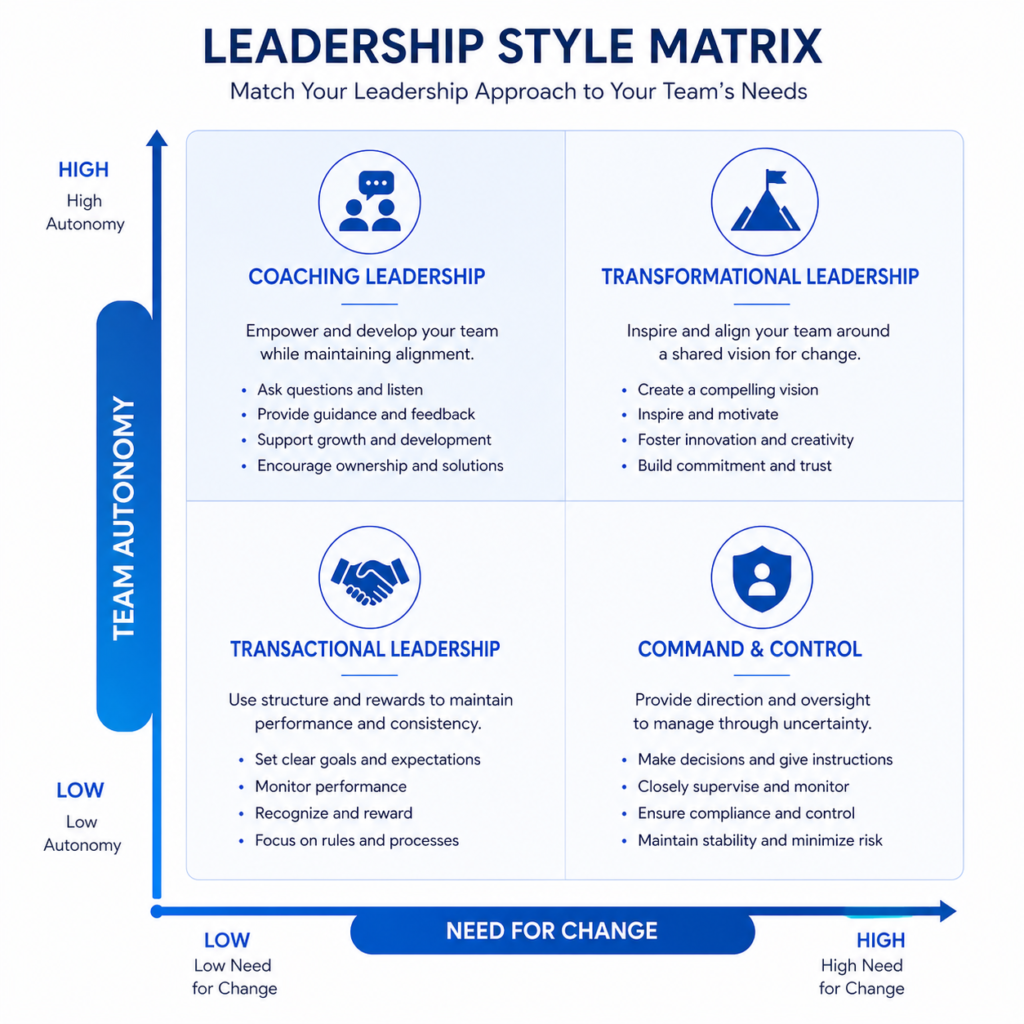
Transformational leadership works exceptionally well when teams need direction, inspiration, and long-term cultural change. It fails — often spectacularly — in environments that require precision, compliance, short-term execution, or crisis response. Therefore, before you adopt this style wholesale, you need to understand where you’re actually operating.
In my experience, most leaders who struggle with transformational approaches aren’t doing it wrong — they’re doing it in the wrong context. A hospital emergency department, for instance, rarely needs a visionary leader mid-crisis. It needs clear protocols and confident execution. However, the same hospital’s leadership board planning a 5-year digital overhaul? That’s exactly where a transformational leader thrives.
Situations Where Transformational Leadership Delivers Results
- High-growth startups scaling from 10 to 100 employees
- Organizations undergoing major structural or cultural change
- Tech companies navigating product pivots or market disruptions
- Healthcare systems reimagining patient care models
- Educational institutions modernizing curriculum and delivery
- Nonprofits driving community-level impact with limited resources
- Teams lacking direction, motivation, or shared purpose
Situations Where It Backfires
- Regulated industries where compliance is non-negotiable (finance, legal, nuclear energy)
- Crisis management scenarios requiring immediate, precise action
- Teams with highly specialized, autonomous experts who resent micro-visioning
- Organizations where metrics and short-term results are the primary KPI
- Leaders who lack authentic credibility with their teams
Who This Guide Is For
Leaders Trying to Scale Teams or Organizations
If you’re managing a team that’s grown faster than your processes, or if you’re trying to unify people around a mission that feels fractured — this guide is directly for you. Transformational leadership theory was built precisely for this scenario: creating alignment and momentum at scale. However, scaling isn’t just about motivation. It’s about building systems that sustain that motivation even when the leader isn’t in the room.
Managers Transitioning from Operational to Strategic Roles
This is one of the most underserved audiences in leadership content. Operational managers — people who built their career on executing well — often struggle when they step into strategic roles. The instinct to micromanage clashes directly with what transformational leadership demands: trust, delegation, and vision-setting. In my experience, this transition is where most mid-career leaders either leap forward or stall completely.
If you’re in this phase, I’d also encourage you to explore structured learning. For example, strong leadership development courses can accelerate this transition significantly — both in mindset and practical frameworks. Here’s a resource on leadership development courses that I’ve personally found helpful for developing strategic leadership thinking.
Professionals in Healthcare, Tech, and Digital Transformation
Transformational leadership in nursing, healthcare administration, and digital transformation contexts has its own unique dynamics. In healthcare, for example, you’re balancing regulatory compliance with the need to inspire frontline staff who face burnout daily. In tech, you’re managing fast-moving environments where the goalposts shift every quarter. This guide addresses the industry-specific nuances that generic leadership content ignores.
What Actually Defines a Transformational Leader in 2026
Core Traits That Separate Real Leaders from Motivational Talkers
Here’s what I’ve observed consistently: the most effective transformational leaders I’ve encountered aren’t necessarily the most charismatic people in the room. They’re the most credible. There’s a massive difference between a transformational leader and a motivational speaker, and confusing the two is one of the most expensive mistakes organizations make.
Real transformational leaders share these core characteristics:
- Authentic vision: They articulate a future that feels genuinely achievable, not a fantasy
- Intellectual honesty: They acknowledge complexity rather than oversimplify
- Consistent integrity: Their actions match their words, quarter after quarter
- Empathetic listening: They actually hear concerns before driving change
- Systemic thinking: They understand how culture, process, and people interconnect
The 4 Components That Drive Real Impact
The transformational leadership model, as developed by James MacGregor Burns and later expanded by Bernard Bass, identifies four core components. These are often called the ‘Four I’s’ — and together, they form the foundation of what makes this leadership style distinct.
| Component | What It Means in Practice | Common Failure Mode |
| 1. Idealized Influence | Leaders become role models through integrity and sacrifice — not just status | Using authority instead of earning respect |
| 2. Inspirational Motivation | Crafting a compelling vision that connects individual work to larger purpose | Vague, feel-good mission statements nobody believes |
| 3. Intellectual Stimulation | Encouraging creative problem-solving and challenging existing assumptions | Leaders who demand innovation but punish failure |
| 4. Individualized Consideration | Treating each team member as a whole person with unique needs and goals | Generic management approaches applied uniformly |
How Transformational Leadership Theory Translates into Practice
Theory is useful. But what I care about — and what you should care about — is how transformational leadership definition and model translate into daily behaviour. Therefore, let me break this down practically. A transformational leader doesn’t just deliver a great town hall speech. They follow up with one-on-ones. They remove obstacles blocking their team. And they connect a junior analyst’s daily spreadsheet to the company’s five-year mission. That’s the practice, not the theory.
Transformational Leadership Advantages That Drive Real Results
How It Increases Team Performance and Ownership
One of the most consistent advantages of transformational leadership is its capacity to increase psychological ownership among team members. When people feel genuinely connected to a vision — and when they see a leader who models the behaviour they preach — performance lifts. I’ve seen this happen not because of bonuses or promotions, but because people simply start caring more.
Research consistently shows that transformational leadership style correlates with higher organizational commitment, lower turnover, and stronger discretionary effort. In other words, people do more than their job description requires — not because they have to, but because they want to.
Why It Works in Innovation and Change-Driven Environments
Innovation requires psychological safety. It requires people to raise unconventional ideas without fear of ridicule. Transformational leaders create that environment by actively rewarding intellectual courage. Therefore, in environments where the market is moving fast — like digital transformation, AI-driven industries, or rapidly scaling startups — this leadership style provides an enormous competitive advantage.
For teams working in AI, technology, or digital-first environments, the intersection of leadership and continuous learning is critical. If you’re building these skills simultaneously, resources like top AI skills for 2026 become directly relevant to how transformational leaders drive digital change.
Long-Term Cultural Impact on Organizations
Perhaps the most underrated advantage of transformational leadership is its compounding cultural effect. When a leader consistently models integrity, pushes for intellectual growth, and develops other leaders, the culture shifts — not just while that leader is there, but after they leave. I’ve seen organizations where a single transformational leader’s influence lasted a decade after their departure, simply because they built people who built people.
This is fundamentally different from transactional approaches, which tend to produce results only as long as the reward-punishment system is actively maintained.
Real Example: High-Impact Transformational Leader Case
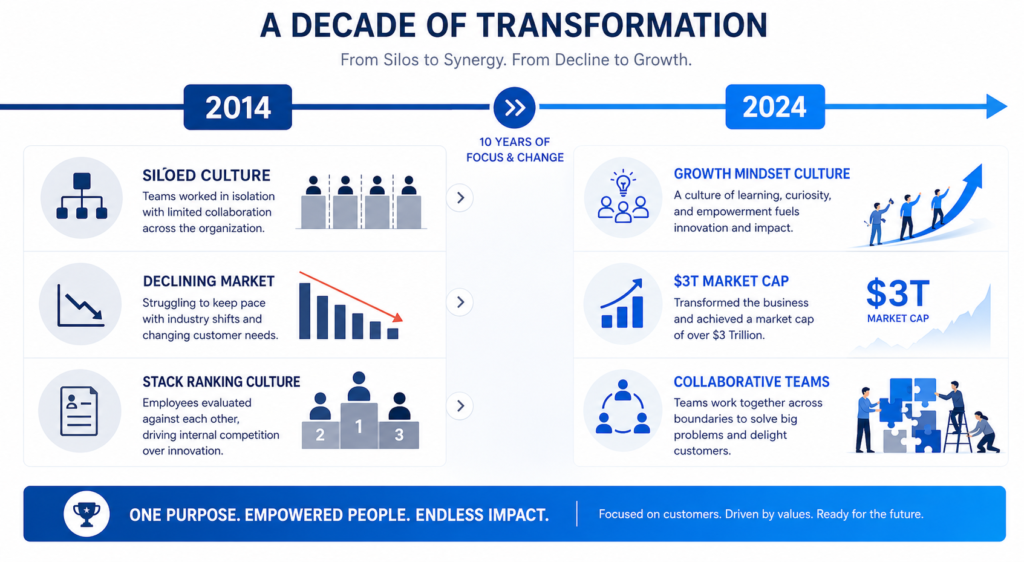
Consider Satya Nadella‘s tenure at Microsoft, widely regarded as one of the most studied transformational leadership examples in corporate history. When Nadella became CEO in 2014, Microsoft was culturally stagnant and organizationally siloed. His approach wasn’t to mandate change — it was to reframe the company’s identity around a growth mindset philosophy (directly borrowing from Carol Dweck’s research). He modelled intellectual humility publicly, eliminated competitive stack-ranking internally, and connected every product team to an overarching mission around empowerment. The result was one of the most dramatic corporate turnarounds in modern business history.
Transformational Leadership Disadvantages Most People Ignore
Burnout Risk and Over-Dependence on Vision
Here’s the uncomfortable truth that most leadership content avoids: transformational leadership can burn people out. When a leader constantly raises the bar, challenges assumptions, and pushes for more — without equally investing in recovery, boundaries, and sustainable pacing — the team exhausts itself chasing a horizon that never arrives.
Additionally, organizations can develop an over-dependence on the transformational leader’s personal vision. When that leader leaves — or loses energy — the entire culture can collapse. I’ve witnessed this in organizations where a founder-CEO was the sole source of inspiration. The moment they stepped back, the team lost direction entirely.
When Inspiration Replaces Execution (And Fails)
This is perhaps the most damaging disadvantage of transformational leadership: the substitution of inspiration for execution. Some leaders are genuinely gifted at crafting a compelling narrative and generating enthusiasm. However, enthusiasm without structure produces chaos. Projects get started but never finished. Processes are ignored in favour of bold pivots. Teams become permanently excited about the next thing while never delivering on the current thing.
In short: vision without operational discipline is just storytelling.
Misalignment with Structured or Compliance-Heavy Industries
Transformational leadership in healthcare, for example, requires careful calibration. The inspirational components work well for building staff engagement and retaining nurses who would otherwise burn out in the system. However, the intellectual stimulation component — encouraging people to challenge assumptions and experiment — can create serious problems when applied to clinical protocols that exist precisely because the stakes of error are catastrophic.
Similarly, in financial services, nuclear energy, or aviation, the model must be adapted significantly. Therefore, the idea that transformational leadership is universally superior is simply incorrect.
Leadership Bias and Blind Spots
Transformational leaders are often characterized by strong convictions. That’s both their greatest strength and their most dangerous blind spot. When a leader’s vision becomes their identity, they stop being open to contradictory evidence. They surround themselves with people who reinforce the vision rather than stress-test it. This creates confirmation bias at scale — which, in organizations, can result in catastrophic strategic errors.
⚠️ Warning: The same charisma that makes a transformational leader inspiring can make them resistant to critical feedback. Always build formal challenge mechanisms into your leadership culture.
Transformational vs Transactional Leadership — What Actually Works
Key Differences That Matter in Real Business Scenarios
The transformational leader vs transactional leader debate is often framed as a binary choice. In reality, it’s a spectrum — and the most effective leaders I’ve worked with operate fluidly across that spectrum depending on what the situation demands.
| Dimension | Transformational Leader | Transactional Leader |
| Primary Driver | Shared vision and intrinsic motivation | Rewards, incentives, and consequence management |
| Focus | Long-term cultural and organizational change | Short-term performance and goal attainment |
| Team Relationship | Mentor-mentee; emotionally connected | Manager-employee; task-focused |
| Best Environment | Innovation, change, growth phases | Stability, compliance, structured execution |
| Risk | Burnout, over-idealism, lack of execution | Low engagement, transactional culture, turnover |
| Famous Example | Satya Nadella, Jacinda Ardern | Jack Welch (early GE years) |
When Transactional Leadership Outperforms Transformational
There are specific scenarios where a transactional approach genuinely outperforms a transformational one — and being honest about this matters. In short-cycle, high-accountability environments (think quarterly sales targets, project deliveries with hard deadlines, or compliance audits), a clear reward-punishment framework drives faster results than vision-setting. People know exactly what’s expected, what they’ll receive for hitting targets, and what happens if they miss them.
Furthermore, research on instrumental leadership — the concept of ‘on instrumental leadership beyond transactions and transformations’ — suggests a third model: leaders who combine both styles situationally, based on what the organization needs at any given moment. That’s the model I find most practical.
Hybrid Leadership: Combining Both for Maximum Results
The real answer to the transformational leader and transactional leader debate is: use both deliberately. Set the vision and inspire through transformation. Execute and measure through transactional clarity. The best frameworks I’ve seen treat these as complementary tools rather than competing philosophies.
If you’re developing a broader management skill set alongside your leadership style work, combining this with strong project management fundamentals — like those covered in a PMP certification course — can significantly accelerate your ability to bridge vision and execution.
The Step-by-Step Framework to Become a Transformational Leader
Step 1: Build Vision That People Actually Believe
The most common mistake I see at this stage is leaders confusing ambition with vision. A vision isn’t a revenue target or a market share goal. It’s a compelling picture of a future state that makes people want to be part of building it. Craft it by asking: ‘What problem does our team exist to solve, and why does that problem matter to the world?’ That’s your starting point. Then test it — share it informally with people at every level of your organization, and watch how they respond.
Step 2: Align Individual Goals with Organizational Purpose
Vision-setting at the organizational level is only the first step. The transformational leader then does the harder work of connecting each person’s individual goals and aspirations to that larger purpose. This requires actual conversations — not annual reviews, but genuine one-on-ones where you understand what drives each person and actively create pathways for their growth within the mission.
Step 3: Create High-Trust Communication Systems
Trust is infrastructure. It’s not something you build with a single town hall or a values workshop — it’s built through hundreds of small, consistent actions over time. High-trust communication systems include regular transparency about organizational challenges, consistent follow-through on commitments, creating formal channels for upward feedback, and publicly acknowledging when you were wrong.
Step 4: Develop and Empower Future Leaders
The true mark of a transformational leader is whether their organization becomes stronger after they leave. Therefore, developing other leaders isn’t optional — it’s your primary legacy as a transformational leader. Invest in coaching, mentorship, and stretch assignments. Give your highest-potential people real decision-making authority before they feel fully ready.
This ties directly into public speaking, influence, and communication development — skills that transform managers into leaders. Resources like the best public speaking course can help aspiring leaders develop the confidence and presence that transformational leadership requires.
Step 5: Measure Impact Beyond Motivation
Here’s where many transformational leaders stumble. They’re great at generating energy and excitement. However, they fail to connect that energy to measurable outcomes. Build a scorecard that tracks both leading indicators (employee engagement scores, internal promotion rates, 360 feedback trends) and lagging indicators (revenue, retention, customer satisfaction). This creates accountability that sustains the transformation beyond the initial inspiration phase.
The 7 Transformations of Leadership (Advanced Framework)
Overview of Rooke and Torbert’s Leadership Stages
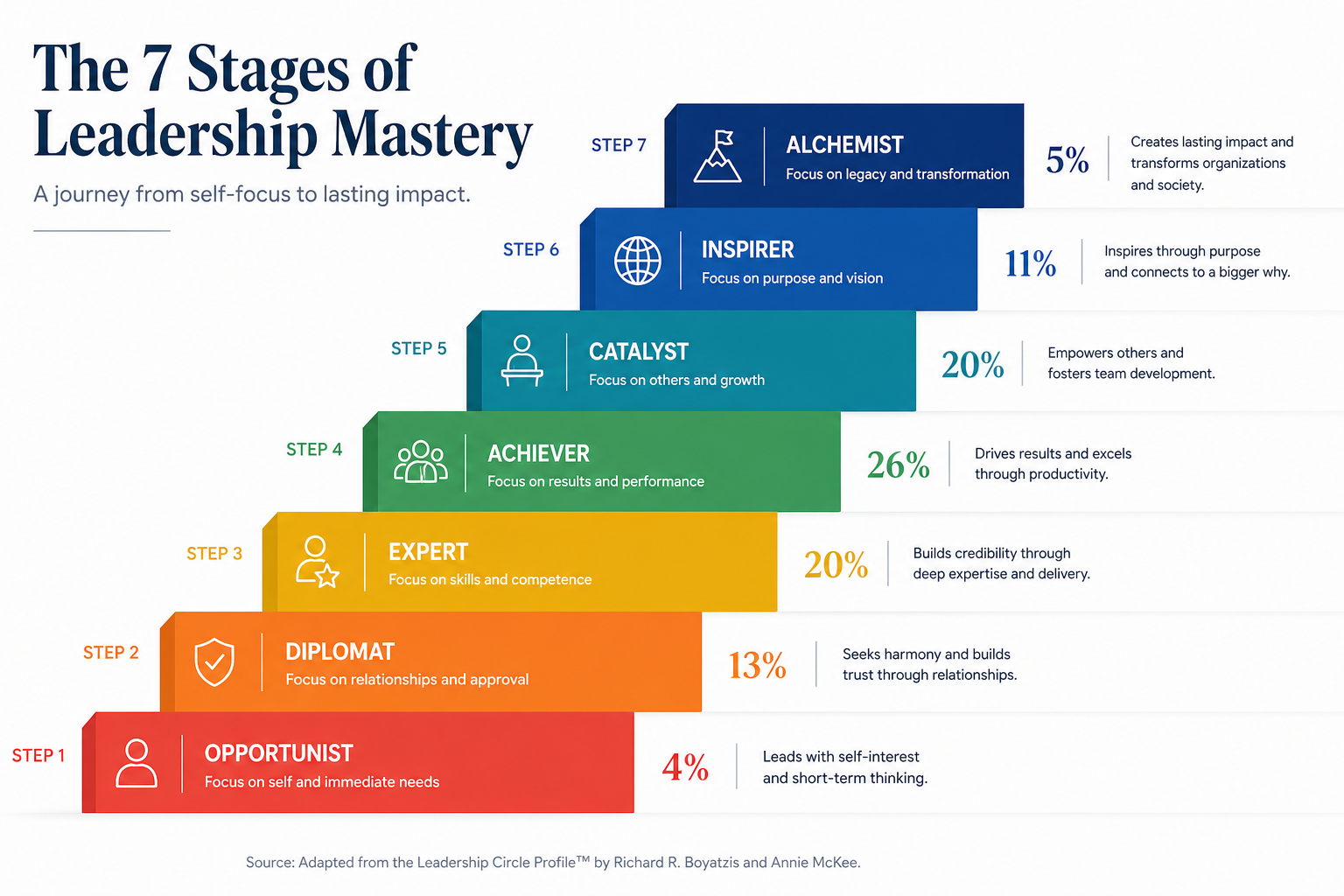
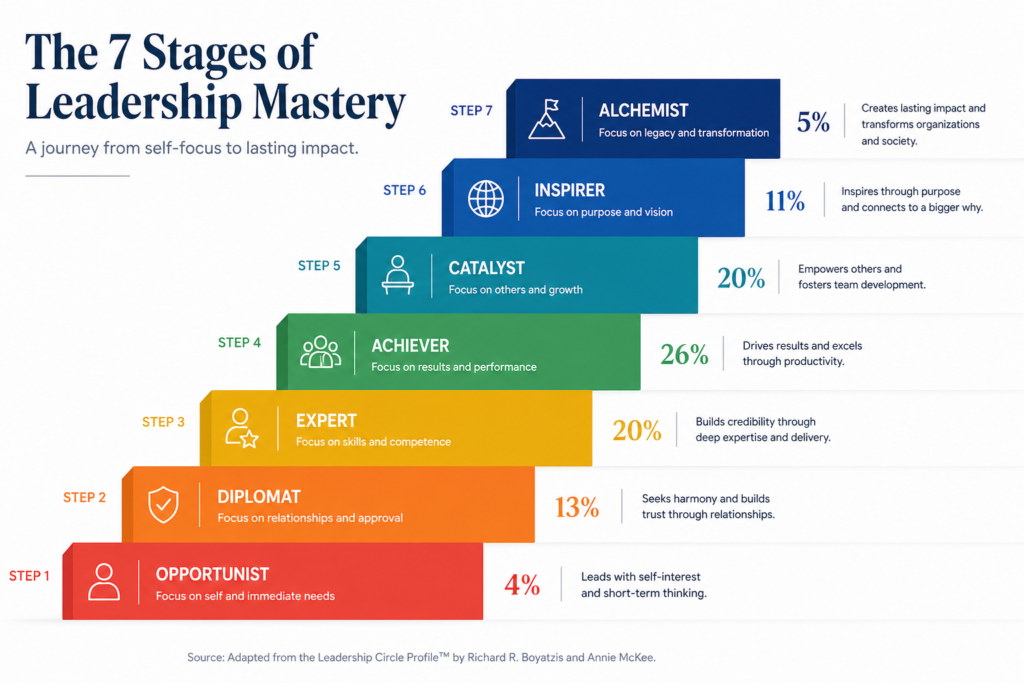
One of the most sophisticated and evidence-based frameworks I’ve encountered is the Rooke and Torbert 7 transformations of leadership, originally published in the Harvard Business Review (HBR seven transformations of leadership). Based on over 25 years of research involving more than 4,000 managers, Rooke and Torbert identified seven distinct ‘action logics’ — essentially, developmental stages through which leaders evolve in how they interpret and respond to the world around them.
The seven transformations of leadership represent a progression from reactive, self-protective leadership to increasingly sophisticated, strategically agile, and organizationally aware leadership. The research showed that most leaders operate from just two or three of these stages throughout their careers — and that advancing to the higher stages is both rare and profoundly impactful.
How Leaders Evolve Across the 7 Transformations
| Stage | Action Logic | Key Characteristic | % of Leaders |
| 1 | Opportunist | Win at all costs; short-term focus; distrustful | 5% |
| 2 | Diplomat | Avoid conflict; seek group approval; rule-follower | 12% |
| 3 | Expert | Deep technical knowledge; logic-driven; perfectionist | 38% |
| 4 | Achiever | Goal-focused; team-oriented; pragmatic problem-solver | 30% |
| 5 | Individualist | Questions systems; self-aware; comfortable with ambiguity | 10% |
| 6 | Strategist | Systems-level thinker; drives transformation; collaborative | 4% |
| 7 | Alchemist | Integrates personal and organizational transformation; rare | 1% |
Notably, the research found that only Strategists and Alchemists (stages 6 and 7) consistently lead successful organizational transformations. This has profound implications for how we think about developing transformational leadership capability — it’s not just a style choice, it’s a developmental journey.
Practical Application in Modern Organizations
Understanding the seven transformations of leadership PDF framework helps organizations make smarter talent decisions. For example, an Expert (Stage 3) might be your best individual contributor but a poor choice to lead organizational change, because their action logic prioritizes technical correctness over systemic influence. Conversely, a Strategist (Stage 6) might feel constrained in a role that only requires execution without transformation opportunity.
In practice, this means leaders and organizations should actively assess where key leaders sit in this progression and invest in developing upward movement — particularly from Expert to Achiever, and from Achiever to Individualist, where the most common developmental plateaus occur.
Self-Assessment: Where You Currently Stand
Rooke and Torbert developed a formal assessment called the Leadership Development Profile (LDP), which is the most rigorous tool for placing leaders within the 7 transformations framework. However, for a practical starting point, ask yourself these reflection questions:
- When I face conflict, do I typically avoid it (Diplomat), fight to win (Opportunist), or engage it as a learning opportunity (Individualist/Strategist)?
- Do I define success by personal achievement or by the systemic change I’ve enabled?
- Can I hold genuinely contradictory viewpoints simultaneously and work productively with that tension?
- How often do I actively challenge my own leadership assumptions — not just in theory, but in real decisions?
If you want a deeper formal self-assessment, search for the ‘7 transformations of leadership quiz’ through the Leadership Development Profile instrument — it’s the gold standard for this framework and worth the investment.
Real-World Applications Across Industries
Transformational Leadership in Healthcare and Nursing
Transformational leadership in nursing is one of the most studied and validated applications of this model. The American Nurses Credentialing Center (ANCC) Magnet Recognition Program — the gold standard for nursing excellence — explicitly requires transformational leadership practices as a core criterion for hospital designation.
In practice, transformational leader in nursing contexts means charge nurses and nursing managers who go beyond scheduling and compliance to actively mentor their teams, advocate for systemic process improvements, and create psychological safety for nurses to raise patient safety concerns without fear of retaliation. The evidence is clear: hospitals with transformational nursing leadership show better patient outcomes, lower nurse turnover, and fewer medical errors.
However — and this is crucial — transformational leadership in healthcare must be balanced with clear operational protocols. The inspirational components work. The ‘challenge all assumptions’ component must be applied selectively.
Digital Leadership in the Age of Transformation
Digital leadership in the context of digitalization and digital transformations presents unique challenges. Leaders in this space must simultaneously inspire teams through ambiguity (a transformational trait) while maintaining technical credibility (more of an Expert-level trait in the Rooke/Torbert framework). The most effective digital transformation leaders I’ve observed bridge both.
Furthermore, digital transformation requires leaders who understand that organizational change is as important as technological change. Rolling out new systems without transforming the human behaviors around them is a recipe for expensive failure. Therefore, transformational leadership isn’t just relevant in digital contexts — it’s arguably essential.
If you’re leading digital transformation and want to strengthen your technical foundation, developing skills in areas like AI and machine learning can significantly increase your credibility with technical teams and strengthen your transformational influence.
Sustainability and Collective Leadership Models
One of the most exciting emerging areas in leadership research involves creating leadership collectives for sustainability transformations. Unlike traditional models that center transformation in a single charismatic leader, collective leadership approaches distribute transformational capacity across networks of leaders who operate with shared accountability and complementary strengths.
This model is particularly relevant in sustainability contexts, where the complexity and scale of systemic change far exceeds what any individual leader can drive. Organizations like Unilever, Patagonia, and Interface have pioneered collective leadership models for sustainability that provide compelling real-world evidence of this approach.
Case Study: Organizational Transformation in Action
A mid-sized regional healthcare network I’m familiar with underwent a comprehensive transformational leadership initiative over 36 months. The starting point: high nurse turnover (34% annually), low patient satisfaction scores (51st percentile nationally), and a leadership culture described by staff as ‘command and control.’
The transformation strategy involved: training 120 nurse managers in transformational leadership principles, establishing a shared governance model that gave frontline staff genuine policy input, creating mentorship cohorts, and developing a clear organizational vision that connected daily clinical work to community health outcomes.
Results after 36 months: nurse turnover dropped to 18%, patient satisfaction climbed to the 78th percentile nationally, and three of the trained nurse managers were promoted to director-level roles. The transformation outlasted the tenure of the initial champion — which is the truest measure of success.
Common Mistakes That Kill Transformational Leadership
Confusing Charisma with Leadership
I’ve seen this destroy organizations. A charismatic person takes the stage, delivers a compelling vision, generates enormous excitement — and then fails completely to build the systems, trust, and accountability that transformation requires. Charisma gets attention. Leadership keeps it. Therefore, evaluate whether your transformational leader is building genuine followership or simply attracting temporary enthusiasm.
Ignoring Systems and Processes
Transformational leaders sometimes treat operational systems as bureaucratic obstacles rather than enablers of scale. This is a critical mistake. Vision without process produces chaos. In fact, the most effective transformational leaders I’ve encountered are obsessive about process design — because they understand that good systems are what allow their vision to scale beyond their own direct influence.
Overpromising Vision Without Execution
Nothing erodes a transformational leader’s credibility faster than a pattern of grand promises and incomplete delivery. People can forgive setbacks. They cannot forgive consistent overpromising. Therefore, discipline your vision-setting with rigorous execution planning. Every ambitious goal needs a realistic roadmap — and that roadmap needs to be visible to the team.
Lack of Accountability and Metrics
Transformation without measurement is just disruption. The best transformational leaders build clear accountability structures and metrics that track progress against the vision. These aren’t punitive — they’re navigational. They tell you whether the transformation is actually happening or whether you’re simply generating inspirational noise.
| Mistake | Warning Sign | Correction |
| Charisma over substance | High energy, low execution; team can’t describe the actual plan | Ground vision in specific, measurable milestones |
| Ignoring systems | Projects start but never complete; chaos during growth | Pair visionary leadership with strong operational management |
| Overpromising | Team cynicism grows over time; ‘this too shall pass’ culture | Under-promise by 20%; over-deliver consistently |
| No accountability | Everyone inspired, no one responsible; blurred ownership | Assign explicit ownership to every transformation initiative |
Beginner vs Advanced Leadership Approach
What Beginners Should Focus on First
If you’re new to intentional leadership development, start here: learn to listen before you lead. Most beginner leaders underestimate the amount of listening required before vision-setting becomes credible. Spend your first 90 days in any new leadership role in deep listening mode — understand the real culture, the real problems, and the real aspirations of your team before you start crafting transformation narratives.
- Master one-on-one conversations before town halls
- Build trust through consistency, not charisma
- Understand your organization’s current reality before prescribing change
- Develop emotional intelligence as a foundational skill
How Advanced Leaders Scale Transformation
Advanced transformational leaders think in systems. They understand that their personal influence has a ceiling, and they actively work to embed transformation into culture, process, and other leaders — so the system transforms itself. and they develop successors deliberately. They build peer networks that extend their influence beyond their organizational boundaries.
Additionally, advanced leaders leverage continuous learning with real discipline. Staying ahead in rapidly evolving fields requires both strategic vision and technical awareness — whether that means understanding AI’s impact on your industry, data analytics, or cybersecurity risks that affect organizational resilience. Pairing leadership development with skills like data analytics gives advanced leaders the evidence base to make better transformation decisions.
Transitioning from Manager to Transformational Leader
This transition is harder than most people realize — and more important. A manager’s job is to optimize what exists. A transformational leader’s job is to build what doesn’t yet exist while keeping the current engine running. The skill sets overlap but are not identical. The shift requires moving from ‘How do I solve this problem?’ to ‘How do I build the conditions where my team solves problems I haven’t even anticipated?’
This transition is also where time management skills become critical. Managing your own time and energy as a leader is the precondition for having the mental space to think strategically. A time management course can be a surprisingly high-leverage investment during this transition phase.
Tools, Models, and Resources to Accelerate Growth
Leadership Assessment Tools and Frameworks
- Leadership Development Profile (LDP) — the Rooke/Torbert instrument for assessing action logics across the seven transformations
- Multifactor Leadership Questionnaire (MLQ) — the most widely used tool for measuring transformational leadership behaviours
- 360-Degree Feedback Systems — essential for capturing blind spots that self-assessment misses
- DiSC Profile — useful for understanding communication and influence style as a complement to transformational frameworks
Top Learning Resources (Books, Podcasts, Platforms)
Books I recommend from direct experience:
- Leadership and Self-Deception — The Arbinger Institute (foundational mindset shift for transformational leaders)
- The Leadership Challenge — Kouzes & Posner (practical framework grounded in 40 years of research)
- Transformational Leadership — Bernard Bass & Ronald Riggio (the academic foundation, worth reading once)
- Seven Transformations of Leadership — Rooke & Torbert, HBR (available as an article; look for the ‘seven transformations of leadership pdf’ version online)
For podcasts, the Leadership Transformations podcast ecosystem — including resources like Selah Leadership Transformations and Leadership Transformations Selah — offers practical, real-world leadership conversations. Organizations like Leadership Transformations Inc also provide structured development programs worth exploring if you’re building enterprise leadership capacity.
Organizations and Communities for Leadership Development
- Harvard Business Review Leadership Section — consistently the best synthesis of research and practice
- Center for Creative Leadership (CCL) — evidence-based leadership development programs
- Leadership Transformations Inc — specialized in organizational leadership transformation programs
- Selah Leadership Transformations — focused on values-based and reflective leadership development
- The Arbinger Institute — particular strength in mindset and cultural transformation
Practical Checklist to Apply Transformational Leadership Today
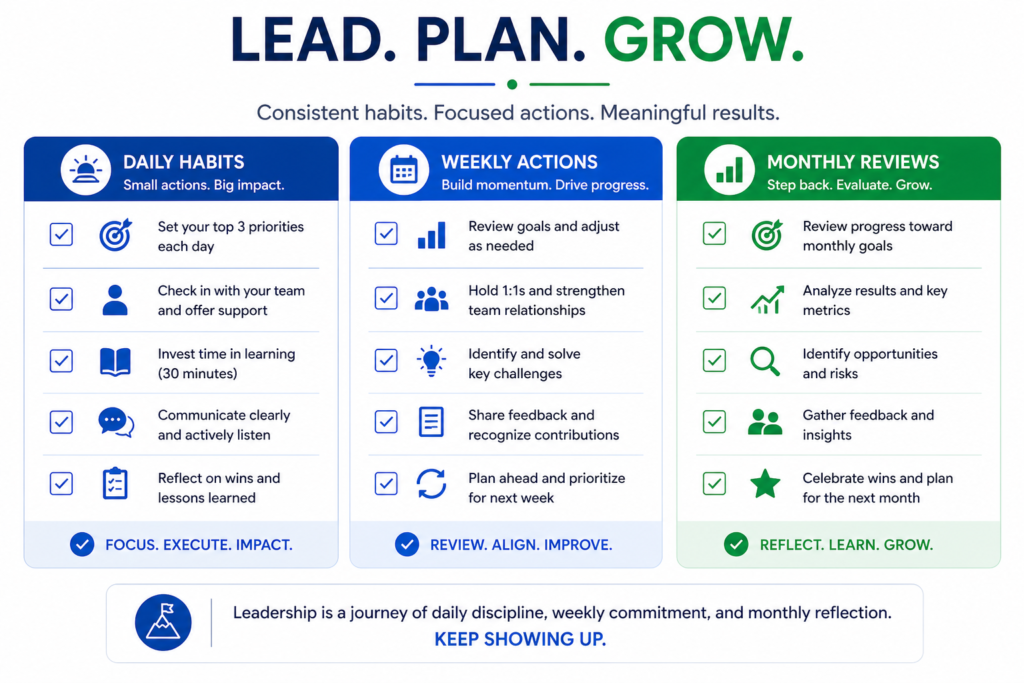
Daily Leadership Habits That Drive Change
- Start each day by connecting your planned actions to the organizational vision
- Have at least one genuine conversation with a team member that goes beyond task status
- Acknowledge one person’s contribution publicly — specifically and authentically
- Identify one assumption you’re currently making that deserves challenge
- Model the behaviour you expect — visibly and consistently
Weekly and Monthly Leadership Actions
- Conduct structured one-on-ones focused on development, not just deliverables
- Review your leadership dashboard — are transformation metrics moving?
- Identify one emerging leader and give them a stretch assignment
- Seek out one piece of critical feedback you haven’t been hearing
- Monthly: revisit your organizational vision — does it still resonate? Does it need refinement?
- Monthly: review your personal development — are you growing or plateauing?
Team-Level Implementation Checklist
- Has every team member articulated how their role connects to the organizational mission?
- Is psychological safety actively measured, not just assumed?
- Do team members have genuine development pathways, not just performance reviews?
- Are intellectual challenges and creative problem-solving rewarded — even when they fail?
- Is transformation progress tracked with specific, agreed-upon metrics?
- Are the next leaders in your team being developed actively?
FAQ — Answering What People Also Ask
What defines a transformational leader?
A transformational leader is someone who inspires and motivates their team to exceed ordinary expectations by connecting individual work to a compelling shared vision. What truly defines a transformational leader — beyond charisma or title — is their consistent ability to develop other leaders, challenge existing assumptions constructively, and create lasting cultural change that outlasts their own tenure. The transformational leader meaning goes deeper than inspiration: it’s about systemic impact.
What are the 4 components of transformational leadership?
The four components of transformational leadership — often called the Four I’s — are: (1) Idealized Influence, where the leader models integrity and earns genuine respect; (2) Inspirational Motivation, where they communicate a vision that creates genuine excitement and purpose; (3) Intellectual Stimulation, where they actively challenge the team to think creatively and question assumptions; and (4) Individualized Consideration, where they treat each team member as a unique individual with distinct development needs. Together, these four components form the complete transformational leadership model.
Who is a famous transformational leader?
Several leaders are frequently cited as transformational leader examples: Satya Nadella (Microsoft), who rebuilt company culture around a growth mindset; Jacinda Ardern (former New Zealand PM), who modelled empathetic and values-driven leadership at national scale; Nelson Mandela, whose transformational leadership transcended political boundaries; and Howard Schultz (Starbucks), who transformed a coffee company into a global culture brand. In 2025, the most discussed transformational leader of the year nominees typically come from healthcare, climate technology, and AI ethics — reflecting where organizational transformation is currently most needed.
What are the 7 transformations of leadership?
The 7 transformations of leadership framework, developed by David Rooke and William Torbert and published in the Harvard Business Review, describes seven sequential leadership ‘action logics’: Opportunist, Diplomat, Expert, Achiever, Individualist, Strategist, and Alchemist. Each stage represents a progressively more sophisticated way of interpreting and responding to the world. Research across 4,000+ managers found that only Strategists and Alchemists — approximately 5% of leaders combined — consistently drive successful organizational transformations. The framework is available in the HBR seven transformations of leadership article, and formal assessment is available through the Leadership Development Profile instrument.
Final Action Plan — How to Apply This Starting Today
30-Day Leadership Transformation Plan
Week 1 — Listen and assess: Conduct five informal conversations with team members focused entirely on understanding their experience. Don’t share your vision yet. Just listen.
Week 2 — Draft your vision: Using what you’ve heard, draft a first version of your organizational vision. Test it with three trusted team members and invite honest critique.
Week 3 — Connect individuals to purpose: Have individual conversations with each direct report to explicitly connect their role and goals to the vision you’ve developed.
Week 4 — Build your accountability system: Design a simple leadership dashboard with three to five metrics that will tell you whether transformation is actually happening over the next quarter.
Key Metrics to Track Success
- Employee engagement scores (bi-annual pulse surveys minimum)
- Internal promotion rate — are you growing leaders from within?
- Voluntary turnover rate — are people choosing to stay?
- 360-degree feedback trends for yourself and your direct leadership team
- Innovation metrics — new ideas submitted, experiments run, improvements implemented
- Team performance KPIs — are results actually improving alongside culture?
Long-Term Growth Strategy for Leadership Excellence
Long-term leadership excellence requires three parallel investments: developing yourself (your mindset, skills, and self-awareness), developing others (your team, your successors, your leadership culture), and developing your organization (your systems, your processes, your purpose). A transformational leader who invests in only one of these three areas will hit a ceiling. The leaders who sustain transformation over decades invest in all three simultaneously — and they do it with the same discipline they bring to their operational goals.
Additionally, continuously expanding your knowledge base across entrepreneurship, strategy, and organizational development is part of the long game. Resources like entrepreneurship courses and small business management courses can help leaders connect organizational transformation to practical business outcomes — bridging vision with viability.
🎯 Final Thought: Transformational leadership isn’t a style you adopt — it’s a capacity you develop over years of intentional practice, honest feedback, and genuine service to the people you lead. Start small, stay consistent, and measure everything.
Conclusion
After everything I’ve shared in this guide, here’s my core message: transformational leadership is one of the most powerful approaches available to modern leaders — and one of the most misunderstood. The advantages are real and well-documented: stronger team performance, higher engagement, better retention, and lasting cultural change. However, the disadvantages are equally real: burnout risk, execution gaps, charisma bias, and misalignment with certain environments.
The transformational leader who thrives in 2026 is not the most inspirational person in the room. They’re the most credible, the most consistent, and the most committed to developing others. They understand when to lead transformationally and when to switch registers. and they use frameworks like the Rooke and Torbert 7 transformations of leadership to understand their own developmental stage and grow deliberately. They measure their impact not by the applause they receive, but by the leaders they produce.
Therefore, use this guide as your starting point — not your destination. The 30-day action plan gives you an immediate structure. The frameworks give you depth. The checklists give you discipline. What only you can bring is the authentic commitment to show up consistently for your team, your organization, and your own growth.
That’s what transformational leadership actually looks like. Not a TED Talk. A Tuesday morning, doing the work.