If you’re searching for how to become an AI engineer and wondering whether a degree is actually required — I’ll save you the confusion upfront. It’s not. I’ve seen people land junior AI engineering roles in under a year coming from backgrounds as varied as marketing, teaching, and basic software development. What got them there wasn’t a diploma. It was a focused roadmap, real projects, and the right skills.
The AI industry is moving faster than universities can update their curricula. Employers in 2026 aren’t scanning for degrees on resumes — they’re scanning for GitHub repos, deployable projects, and proof that you can build things. That shift is exactly why this career path is now genuinely accessible to anyone willing to put in structured effort.
In this guide, I’ll walk you through everything I know about how to become an AI engineer — from absolute beginner all the way to job-ready. Whether you’re a student after 10th or 12th, a career switcher, or a developer looking to transition, this roadmap applies to you.
| ✅ Why You Can Trust This Guide This guide is built from real-world observation of what actually gets people hired in AI roles. I’ve analyzed hundreds of job descriptions, tracked successful self-taught career transitions, and studied what top AI employers are genuinely asking for in 2026. BestCoursesHub.com has helped thousands of learners navigate data and AI careers — the strategies here are grounded in what the job market actually rewards, not theory. |
Quick Answer: What Actually Works in 2026
Most guides bury the answer. I’ll give it to you immediately.
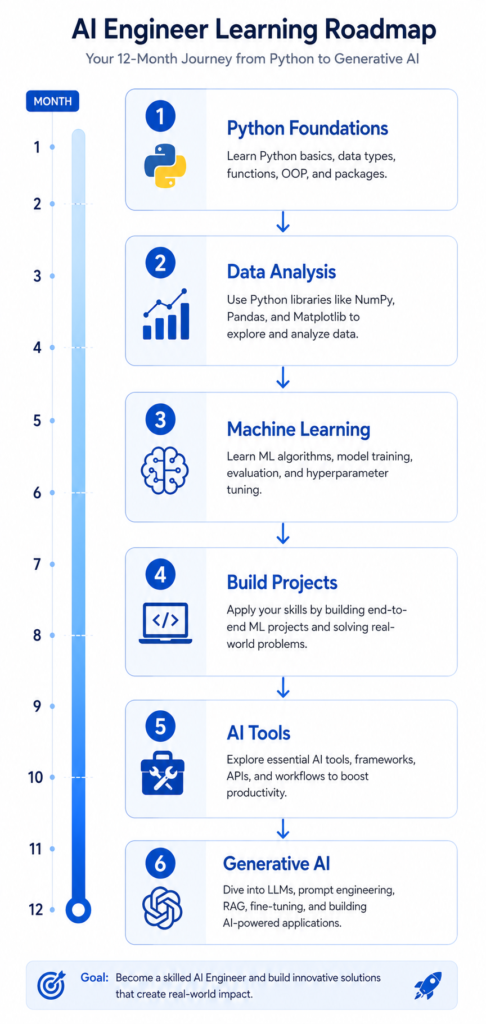
The shortest realistic path to becoming an AI engineer: learn Python → understand data fundamentals → study machine learning → build real projects → learn GenAI tools. No degree required at any step.
Here’s what employers care about most in 2026:
- Python proficiency (non-negotiable)
- SQL and data handling ability
- Practical understanding of ML models
- Familiarity with LLM APIs and generative AI tools
- A GitHub portfolio with real, deployable projects
- Basic cloud deployment knowledge (AWS, GCP, or Azure)
What you should ignore as a beginner:
- Advanced mathematics courses before building anything
- Collecting certificates without projects to back them up
- Learning every ML framework before mastering one
- Waiting until you feel ‘ready’ to start building
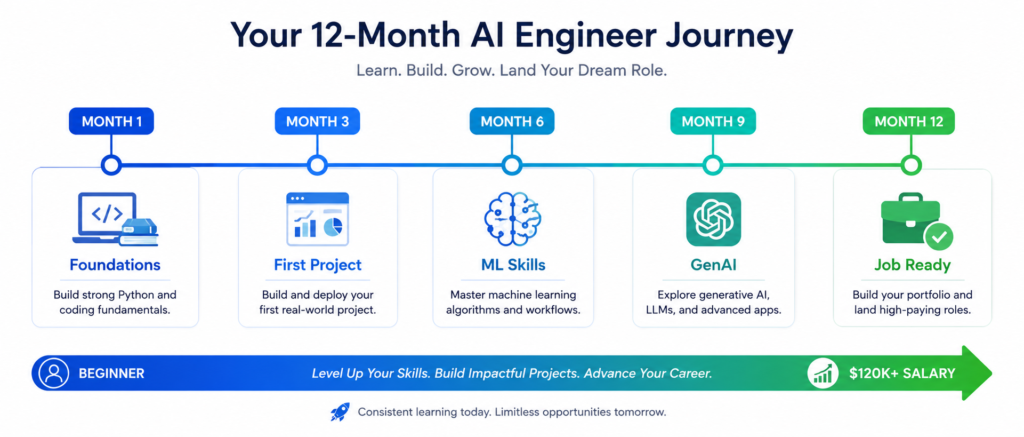
Realistically? With 10–15 focused hours per week, you can become job-ready as a junior AI engineer in 9–12 months. I’ve seen people do it faster — and seen others drag it out for years by following the wrong approach.
| ⚡ Key Takeaway The path to AI engineering is skill-based, not credential-based. Your GitHub portfolio matters more than your transcript. |
Who This Career Path Is Best For
Before you commit, it’s worth being honest about whether this path fits your situation. From my experience, AI engineering suits a specific type of person — and it’s not just about technical interest.
This roadmap works especially well for:
- Students after 10th or 12th who want to build a high-demand career early
- Career switchers without a tech background who are willing to build foundations from scratch
- Software developers who already write code and want to pivot into AI applications
- Data analysts who work with data daily and want to step into machine learning
- Self-taught learners without degrees who learn best through projects and building
If you’re a developer already comfortable with Python, you’re honestly 30–40% of the way there before you even start. If you’re coming from a completely non-technical background, expect the first 2–3 months to feel harder — but it’s absolutely manageable with the right structure.
What AI Engineers Actually Do Day-to-Day
One of the biggest mistakes beginners make is building a romanticized mental image of the job. Let me give you the real picture — because it matters for knowing what to actually learn.
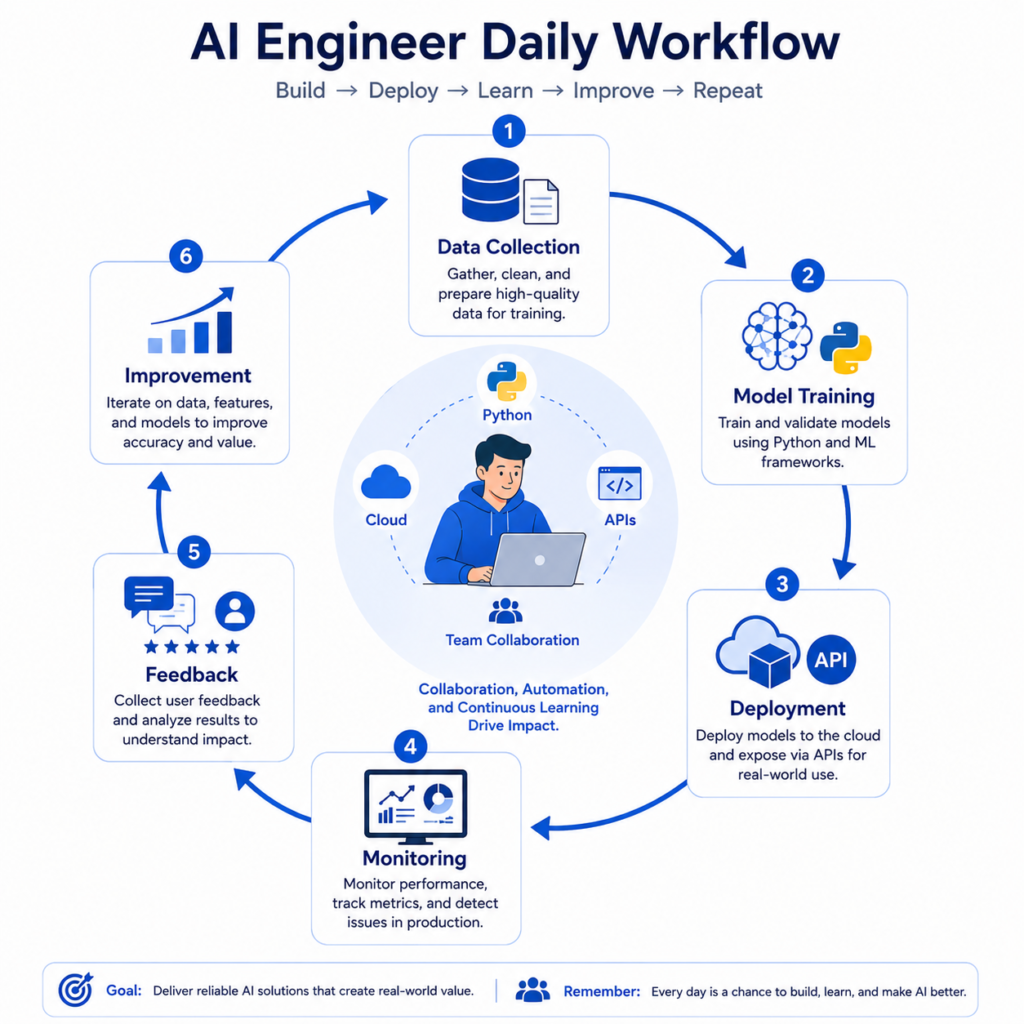
On most days, AI engineers spend their time:
- Building AI-powered features into applications (chatbots, recommendation engines, search tools)
- Writing Python code to train, evaluate, and improve machine learning models
- Working with data pipelines — cleaning inputs, managing data quality, preprocessing features
- Integrating AI APIs (OpenAI, Anthropic, or Hugging Face) into production apps
- Collaborating with product teams to understand what problem actually needs solving
- Debugging model outputs and improving accuracy based on real-world performance
Real examples of AI engineering projects junior engineers actually work on:
- Building a customer support chatbot using LLM APIs
- Creating a document classifier that sorts incoming emails automatically
- Developing a product recommendation engine for an e-commerce platform
- Building a sentiment analysis tool to monitor brand mentions
- Deploying a fine-tuned model to a cloud API endpoint
Notice something? Most of these are software + AI projects — not pure research. The engineering matters as much as the AI knowledge.
AI Engineer vs Machine Learning Engineer vs Data Scientist
This confuses almost every beginner — and for good reason. Job titles in AI overlap constantly. Here’s what actually distinguishes them.
| Criteria | AI Engineer | ML Engineer | Data Scientist |
| Primary Focus | Building AI apps & integrating models | Training & optimizing ML models | Analyzing data & building predictive models |
| Coding Intensity | High (Python, APIs, deployment) | High (Python, frameworks, MLOps) | Medium (Python, R, SQL) |
| Math Required | Moderate | High | High |
| Best Entry Role? | ✅ Yes — most accessible | Moderate entry bar | Harder without stats background |
| Avg US Salary | $130,000 – $175,000 | $135,000 – $180,000 | $110,000 – $155,000 |
| Demand in 2026 | 🔥 Exploding | Very High | High |
From my observation: AI engineer is the most accessible entry point in 2026, especially with the explosion of LLM-powered applications. You don’t need to build models from scratch to get hired — you need to know how to use them intelligently.
If you’re interested in the data side of things, my guide on the data analyst roadmap for career growth is worth reading alongside this one — the paths complement each other well.
| 💡 Pro Tip If you’re a complete beginner, target ‘AI Engineer’ or ‘AI Application Developer’ roles first. They value software skills + AI knowledge, which is achievable without a research background. |
The Step-by-Step AI Engineer Roadmap
This is the section most guides get wrong. They either overload you with every possible technology or give you a vague ‘learn Python and ML’ answer. Here’s the actual sequence that works.
Step 1: Build Strong Foundations First
Everything starts with Python. Not Java, not C++, not JavaScript — Python. It’s the undisputed language of AI and machine learning, and every tool, library, and framework you’ll use is Python-first.
What to learn in Python specifically:
- Data structures: lists, dictionaries, sets, tuples
- Functions, classes, and object-oriented programming basics
- File handling and working with external libraries
- Core libraries: NumPy, Pandas, Matplotlib
On math — here’s something most beginner guides won’t tell you. You don’t need to master calculus or linear algebra before writing your first ML model. You need a working understanding of probability, statistics (mean, median, distributions), and basic algebra. That’s it for getting started.
The math becomes important as you advance — but don’t let it become a reason to delay starting. I’ve seen too many beginners spend three months on Khan Academy math theory before ever writing a line of machine learning code.
| ⚠️ Common Mistake Spending months on math theory before ever touching a dataset. Learn math alongside code — not before it. The context of real problems makes the math stick far better anyway. |
Step 2: Learn Data Analysis Before AI
This step gets skipped constantly, and it’s exactly why so many beginners struggle when they hit real ML work. Machine learning is built on data — if you don’t understand data, your models will be garbage regardless of how sophisticated your algorithms are.
What to focus on:
- SQL fundamentals: SELECT, WHERE, JOIN, GROUP BY, aggregations — these appear constantly in real AI jobs
- Data cleaning: handling missing values, duplicates, outliers
- Data preprocessing: normalization, encoding categorical variables, feature engineering
- Visualization: communicating patterns using Matplotlib, Seaborn, or Plotly
If SQL feels unfamiliar, I recommend starting with my guide on how to learn SQL language — it covers exactly what an aspiring AI engineer needs without going into database administration territory.
And if you want a full structured learning path, check my SQL roadmap, designed specifically for data and AI learners.
Step 3: Learn Machine Learning the Practical Way
Now you’re ready for machine learning. The key word is practical. Don’t spend six weeks on ML theory from a textbook before you’ve trained a single model.
Start with these core concepts:
- Supervised learning: linear regression, logistic regression, decision trees, random forests
- Unsupervised learning: clustering (K-means), dimensionality reduction (PCA)
- Model evaluation: accuracy, precision, recall, F1 score, cross-validation
- Overfitting and underfitting — understanding the bias-variance tradeoff
Common ML mistakes beginners make:
- Jumping to neural networks before understanding simpler models
- Ignoring model evaluation and just checking accuracy
- Using datasets without understanding what the features mean
- Not cleaning data before modeling, then wondering why results are poor
Scikit-learn is your best friend at this stage. It implements almost every classical ML algorithm cleanly and lets you focus on understanding rather than low-level implementation details.
Step 4: Start Building Real AI Projects
This is where most tutorials fail you — they end before the projects begin. Here’s what actually matters for your portfolio.
Beginner projects that impress recruiters:
- Movie or product recommendation system using collaborative filtering
- Spam/ham email classifier using natural language processing
- House price predictor using regression with real estate data
- Customer churn prediction model with a simple Streamlit dashboard
Intermediate AI application ideas (after 4–6 months):
- AI-powered resume analyzer using LLM APIs
- Sentiment analysis tool for social media monitoring
- Document question-answering app using RAG (Retrieval Augmented Generation)
- Image classification app deployed as a live web service
Projects that are mostly useless for getting hired: recreating tutorials exactly as shown, Titanic dataset notebooks without original insight, or anything with no deployment component whatsoever.
| 💡 Pro Tip Every portfolio project should answer one question: ‘What problem does this solve for a real user?’ If you can’t answer that, the project won’t impress recruiters — no matter how technically impressive it seems. |
Step 5: Learn AI Tools Used in Real Jobs
Once you can build models, you need to learn the ecosystem of tools that actual AI engineering teams use every day.
- TensorFlow vs PyTorch: Both are widely used. PyTorch is increasingly dominant in production and preferred for research. Start with PyTorch for deep learning.
- Git and GitHub: Non-negotiable. Version control is how you collaborate and showcase your work. If you don’t have a GitHub profile with active contribution history, fix that immediately.
- Cloud platforms: Learn the basics of AWS SageMaker, Google Vertex AI, or Azure ML. You don’t need to be a cloud architect — you need to know how to deploy a model.
- APIs and deployment: Learn FastAPI or Flask to build simple model-serving APIs. Learn Docker basics for containerization. These skills appear in almost every AI engineering job description.
For understanding the broader data infrastructure, my piece on data analytics tools is a solid complement to this step.
Step 6: Learn Generative AI and LLM Applications
This is the step that didn’t exist in AI roadmaps three years ago — and it’s now arguably the most important for getting hired quickly in 2026.
After ChatGPT changed everything in 2023, AI engineering shifted significantly. A huge portion of new AI engineering jobs involve building on top of large language models, not building the models themselves.
What to learn in GenAI:
- Prompt engineering: writing effective prompts for different use cases, few-shot learning, system prompts
- LLM API integration: OpenAI, Anthropic, Cohere, Mistral — learn to integrate these via Python
- RAG (Retrieval Augmented Generation): how to give LLMs access to your own data using vector databases like Pinecone or ChromaDB
- AI agents: using frameworks like LangChain or LlamaIndex to build multi-step AI workflows
- Evaluation: how to measure and improve LLM output quality systematically
Real-world GenAI use cases that companies are actively hiring for: enterprise chatbots, document processing automation, code generation tools, AI-powered search, and customer intelligence platforms.
How to Become an AI Engineer Without a Degree
Let me be direct: a degree helps, but it is not required. I’ve tracked enough career transitions to say that with confidence. What actually determines hiring in 2026 is a combination of demonstrated skills, portfolio quality, and your ability to communicate technically.
Here’s what employers actually look for when there’s no CS degree on the resume:
- GitHub portfolio with 3–5 quality projects that are deployable, documented, and solve real problems
- Evidence of continuous learning: course completions, blog posts, contributions to open-source
- Technical interview performance — can you solve problems and explain your reasoning clearly?
- Communication clarity — can you talk about your work in a way that non-technical people understand?
Skills vs certifications vs projects — ranked by hiring impact:
- Projects (highest impact — proof you can build)
- Demonstrated skills through technical interviews and code samples
- Recognized certifications (a helpful signal, not a substitute for skills)
- Degree (least differentiating factor for self-taught candidates with strong portfolios)
How self-taught engineers actually get interviews:
- Cold LinkedIn outreach with a project portfolio link — personalized, not templated
- Contributing to open-source AI projects — builds credibility and genuine network connections
- Technical writing and blogging on Medium, Substack, or a personal site
- Participating in Kaggle competitions and showcasing results publicly
- Building in public on LinkedIn or Twitter/X — documenting your learning journey
Mistakes self-taught learners make that kill their chances:
- Applying before building any public portfolio — no evidence means no interviews
- Listing every online course completed without projects to demonstrate those skills
- Underselling themselves due to imposter syndrome — your projects are real work
- Not networking at all and waiting for job applications to work alone
| ⚡ Key Takeaway Your GitHub is your degree. Three strong, documented AI projects open more doors than a certificate from a mid-tier university. Build in public, ship real things. |
How to Become an AI Engineer After 10th or 12th
Best Path After 10th
If you’re coming out of 10th grade with an interest in AI, you’re in the most advantageous position possible — time is on your side. Here’s what I’d recommend starting immediately.
Skills to build right now:
- Basic Python programming (free YouTube resources are genuinely excellent for this)
- Logical thinking through coding puzzles — HackerRank and Codeforces beginner levels
- Understanding what computers actually do: operating systems basics, file systems, terminal usage
Best free learning resources for 10th-grade starters:
- CS50P (Harvard’s free Python course on edX) — the best beginner Python course available anywhere
- Khan Academy for statistics and probability foundations
- YouTube: Sentdex, freeCodeCamp, and Corey Schafer channels for practical Python
Avoid outdated learning paths: stay away from courses teaching Python 2 or focusing purely on academic AI theory. You want applied, hands-on learning from day one.
Best Path After 12th
After 12th, you face a genuine choice: pursue a formal degree or go self-taught. Both can work. Here’s how to think about it clearly.
Choosing the right degree if you go the university route:
- Computer Science is the most directly relevant degree — but not the only option
- Mathematics, Statistics, or Electronics Engineering with AI/ML electives also work well
- Look specifically for programs offering ML/AI specializations or flexible final-year project options
Is computer science mandatory? No. I’ve seen mechanical engineers and commerce graduates become solid AI engineers. What matters more is supplementing your formal education with practical AI skills regardless of your major.
Online learning vs university: University gives you structure, a network, and a credential that still matters in certain corporate environments. Online learning gives you speed, relevance, and lower cost. The best approach for most people in 2026 is a hybrid — pursue a degree if feasible, while layering in practical AI learning via Coursera, fast.ai, or DeepLearning.AI simultaneously.
Internship strategy: Start applying for AI and data internships by your second year, even if you feel under-qualified. Junior internships care far more about enthusiasm and basic Python skills than about theoretical knowledge.
For understanding data analysis roles that often serve as stepping stones into AI engineering, check out my overview of data analyst courses for beginners — it maps cleanly to the early stages of this AI roadmap.
The Skills That Matter Most in 2026
From analyzing hundreds of AI engineering job descriptions in 2026, here’s what appears most consistently — ranked by frequency and actual hiring impact.
| Skill | Hiring Importance | Time to Learn |
| Python | 🔴 Non-negotiable | 2–3 months (functional level) |
| SQL | 🔴 Non-negotiable | 3–6 weeks |
| Machine Learning Fundamentals | 🔴 Non-negotiable | 2–3 months |
| LLM / GenAI Tools | 🟠 Very High | 4–8 weeks |
| Cloud Platforms (AWS/GCP/Azure) | 🟠 Very High | 4–6 weeks (basics) |
| Git & Version Control | 🟠 High | 1–2 weeks |
| Communication & Business Thinking | 🟡 Essential | Ongoing development |
| Problem-Solving Mindset | 🟡 Essential | Ongoing development |
Beginner Mistakes That Kill Progress
These mistakes are the single biggest difference between people who become AI engineers in 12 months and people who are still ‘learning’ five years later.
| Mistake | Why It Kills Progress |
| Tutorial Addiction | You feel productive but build nothing transferable. After 50 tutorials, you still can’t build anything from scratch on your own. |
| Learning Too Many Tools | Spreading across TensorFlow, PyTorch, Keras, and scikit-learn simultaneously means mastering none. Pick one and go deep. |
| Ignoring Projects | No project = no proof. No proof = no interviews. Projects are non-negotiable — they’re your resume. |
| Skipping SQL & Data Fundamentals | Real AI jobs are fundamentally data jobs. Engineers who can’t handle data are a liability to every team they join. |
| Chasing Certificates | Certificates without skills are resume decoration. Skills without certificates still get you hired. |
| Trying Advanced AI Too Early | Starting with neural networks and transformers before understanding linear regression creates gaps that haunt you in every technical interview. |
The Best Resources to Learn AI Engineering
Free Learning Resources
The best free AI learning content available today is genuinely excellent — often better than paid courses. Here’s what I’d actually use.
YouTube channels worth your time:
- 3Blue1Brown — visual explanations of neural networks and core math concepts
- Sentdex — practical Python and ML projects taught by doing
- Andrej Karpathy — deep learning from one of the field’s most respected practitioners
- freeCodeCamp — full-length courses on ML, Python, and data science, free
Free AI courses worth completing:
- fast.ai (Practical Deep Learning) — the best free deep learning course, period
- Google’s Machine Learning Crash Course — solid, practical ML fundamentals
- DeepLearning.AI Short Courses — free GenAI courses including LangChain, RAG, and prompt engineering
- CS50AI (Harvard) — strong conceptual AI foundations for absolute beginners
GitHub repositories and open-source projects:
- Hugging Face Transformers — contribute to the most important open-source AI library in the world
- LangChain — read the source code to understand how production LLM applications are actually built
- Awesome Machine Learning on GitHub — curated, maintained list of learning resources and papers
Paid Resources Worth Considering
Not everything worth paying for is worth it at every price. Here’s my honest assessment.
Best structured courses:
- Andrew Ng’s Machine Learning Specialization (Coursera) — the gold standard for ML fundamentals, worth every penny
- DeepLearning.AI specializations — practical and well-structured for deep learning and GenAI
- fast.ai premium content — highly recommended for advanced practical learners
Certifications that actually signal real competence:
- AWS Certified Machine Learning – Specialty (strong signal for cloud ML roles)
- Google Professional Machine Learning Engineer
- TensorFlow Developer Certificate
For a detailed breakdown of which certifications are worth pursuing, check my guide on data analyst certifications — much of it applies directly to AI engineering paths.
Bootcamps vs self-learning: Bootcamps can accelerate your timeline if you need structure — but they’re expensive. Self-learning is absolutely viable if you’re disciplined. Most successful self-taught AI engineers combine free resources + one or two paid courses + consistent project building.
What a Realistic 6–12 Month Learning Plan Looks Like
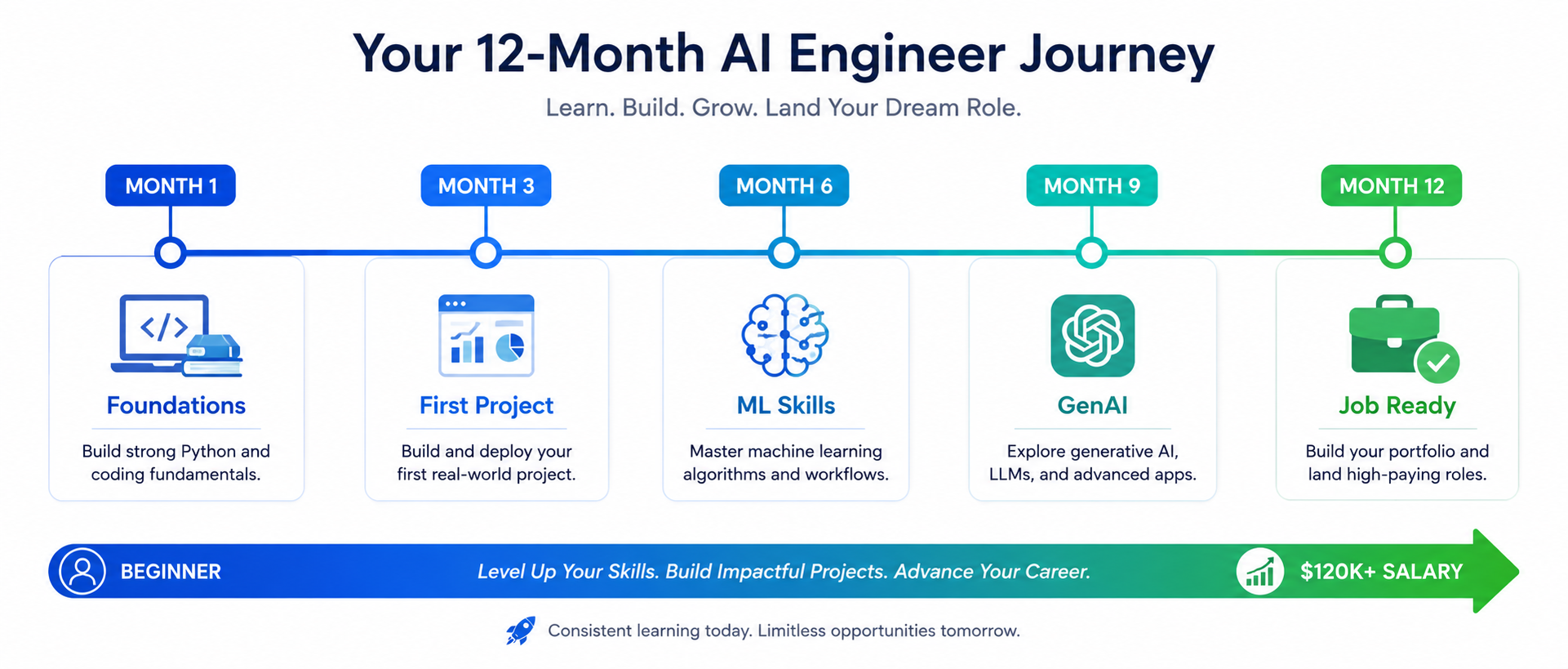
Here’s the exact monthly breakdown I’d follow starting from scratch today with the goal of becoming job-ready as a junior AI engineer.
First 30 Days: Lay the Foundations
- Complete a solid Python beginner course — CS50P or equivalent
- Learn Git basics and create a GitHub profile (your future portfolio home)
- Start SQL fundamentals at 3–4 hours per week
- Build one tiny Python project: calculator, quiz game, simple web scraper — anything that runs end-to-end
| 🎯 30-Day Goal Be comfortable writing Python functions, using loops, working with lists and dictionaries, and pushing code to GitHub. That’s the entire goal — nothing more. |
Months 2–4: Go Deeper on Core Skills
- Complete Andrew Ng’s ML Specialization at 6–8 hours per week minimum
- Practice SQL daily with real datasets on Mode Analytics or SQLZoo
- Learn data analysis with Pandas and Matplotlib — work with real-world datasets
- Build your first real portfolio project: a prediction model with a documented README
- Start reading about model deployment basics (Streamlit is a great first deployment tool)
| 🎯 Month 4 Goal Have 2 portfolio projects on GitHub, SQL skills at intermediate level, and a working understanding of supervised ML models you can explain in plain English. |
Months 5–8: Advanced Projects and GenAI
- Learn PyTorch fundamentals — fast.ai course is ideal for this stage
- Build a GenAI application using an LLM API (OpenAI or Anthropic)
- Deploy at least one project publicly (Hugging Face Spaces, Railway, or Render are all free options)
- Start contributing to one open-source project — even documentation improvements count
- Practice prompt engineering and implement a simple RAG architecture
| 🎯 Month 8 Goal Have 3–4 strong portfolio projects including at least one GenAI application, with at least one deployed publicly with a live URL you can share. |
Months 9–12: Job-Ready Execution
- Optimize your GitHub profile, LinkedIn, and resume for AI engineering roles
- Practice technical interviews: LeetCode easy/medium + ML conceptual questions
- Network actively: connect with 5 AI engineers per week on LinkedIn, engage with their content
- Apply to 5–10 positions per week — include internships, junior roles, and contract work
- Write 2–3 technical blog posts explaining your projects and what you learned
| 🎯 Month 12 Goal Active interview pipeline with 3–5 conversations in progress. Your first offer is close — the momentum you’ve built makes it a matter of time, not luck. |
AI Engineer Salary and Career Growth
Let’s talk money — knowing what this career can pay is important context for the effort you’re about to invest.
| Experience Level | US Salary Range | Global Remote Range |
| Entry-Level (0–2 years) | $95,000 – $135,000 | $45,000 – $90,000 |
| Mid-Level (2–5 years) | $135,000 – $180,000 | $80,000 – $130,000 |
| Senior (5+ years) | $180,000 – $260,000+ | $120,000 – $180,000 |
| Freelance / Contract | $80 – $200 / hour | $40 – $120 / hour |
Industries hiring aggressively for AI engineers in 2026: fintech, healthcare AI, SaaS products, enterprise automation, legal tech, e-commerce, and government AI initiatives. Remote demand is particularly strong — AI engineering is one of the most remote-friendly tech roles available.
Freelancing is also real and growing. Once you have 2–3 strong portfolio projects, platforms like Toptal, Contra, and direct LinkedIn outreach can generate meaningful consulting income while you actively job search.
What Nobody Tells Beginners About AI Careers
A few things I wish more guides said out loud.
- The field changes extremely fast. What was cutting-edge in 2022 is baseline knowledge now. You need to build a habit of continuous learning — following AI releases, reading about new tools, experimenting. This isn’t optional; it’s the job.
- Most AI jobs are software + data jobs with AI layered on top. Companies need engineers who ship production-ready code, not just people who can run Jupyter notebooks. The engineering fundamentals matter enormously.
- Communication matters more than most expect. Technically brilliant candidates lose offers because they can’t explain their work clearly. Your manager needs to understand your decisions. Practice explaining complex things simply — it’s a skill that compounds.
- Consistency beats intelligence. The people who become AI engineers aren’t necessarily the smartest in the room — they’re the ones who showed up every day for 12 months and built things. A mediocre person who codes daily beats a brilliant person who codes occasionally, every single time.
For anyone coming from a business intelligence background, the transition into AI can be surprisingly smooth — I’ve covered complementary skills in detail in my post on business intelligence analytics certification.
Practical Action Plan You Can Start Today
Here’s your immediate next-step framework. No more planning — just action.
What to learn this week:
- Install Python and VS Code today — not tomorrow
- Complete Day 1–7 of CS50P (free on edX, no signup fee)
- Create a GitHub account if you don’t have one
- Bookmark fast.ai and DeepLearning.AI short courses for what comes next
What to build this month:
- One Python project that runs end-to-end — scraper, calculator, simple game, anything
- Push it to GitHub with a proper README explaining what it does and why
- Solve 5 SQL problems on SQLZoo to start building that muscle
What to avoid completely:
- Buying courses before finishing free ones
- Watching AI YouTube videos without writing any actual code
- Comparing your month 1 progress to someone else’s month 18
How to stay motivated long-term: set a 30-day specific goal, not a vague ‘learn AI’ intention. Track your hours weekly. Join one AI Discord or LinkedIn group for accountability. Build in public — even when no one’s watching yet, it creates commitment.
| 🚀 Recommended Resources from BestCoursesHub If you’re building data skills alongside AI, these guides will accelerate your foundation: → Data Analyst Roadmap for Career Growth → Data Analyst Courses for Beginners → SQL Roadmap for Data & AI Learners → Power BI Courses for Beginners |
Frequently Asked Questions
Can I Become an AI Engineer Without Coding?
Short answer: no. Python is fundamental to AI engineering — it’s how you build, train, and deploy AI systems. There are no-code AI tools, but they don’t qualify you for engineering roles. The good news: Python is one of the most beginner-friendly programming languages and can be learned to a functional level in 8–12 weeks with consistent practice.
Do I Need a Computer Science Degree?
No. Employers in 2026 prioritize demonstrated skills and portfolio quality over academic credentials. A CS degree can help with certain corporate hiring pipelines, but self-taught candidates with strong projects consistently get hired. Compensate with better projects, an active GitHub, and consistent networking.
Is AI Engineering Hard for Beginners?
It’s challenging but absolutely learnable. The hardest part for most beginners isn’t the concepts — it’s the sustained consistency required over months. The math can feel intimidating but is manageable if you learn it alongside practical work. Most people who struggle do so because of inconsistency, not lack of ability.
How Long Does It Take to Become Job-Ready?
With 10–15 focused hours per week: 9–12 months to junior AI engineer level. With 20+ hours per week and prior coding experience: 6–8 months is realistic. The range exists because it depends entirely on your prior experience, learning efficiency, and the quality of your portfolio projects.
Can I Become an AI Engineer After 12th?
Absolutely — thousands of people have done exactly this. After 12th, you have two paths: pursue a CS degree while learning AI on the side, or go fully self-taught. Both work. The degree adds structure and a credential; the self-taught path can be faster to first income. Many successful AI engineers combine both approaches.
Is AI Engineering Still Worth It in 2026?
Yes — and the case is stronger than ever. AI adoption is accelerating across every industry, and the demand for engineers who can build AI-powered applications far exceeds supply. Entry-level salaries are strong, remote opportunities are abundant, and the field rewards continuous learners who keep up with rapid change.
What Is the Difference Between AI and Machine Learning?
AI (artificial intelligence) is the broad field of creating systems that perform tasks normally requiring human intelligence. Machine learning is a subset of AI where systems learn from data rather than being explicitly programmed. Deep learning is a further subset using neural networks. As an AI engineer, you’ll work across all three — but ML and deep learning are where most practical engineering work happens.
How Does AI Become Sentient?
This is a philosophical and scientific question without a settled answer. Current AI systems, including large language models, are not sentient — they process and generate patterns from training data without consciousness, self-awareness, or genuine understanding. Whether AI can ever become truly sentient remains one of the most contested debates in science and philosophy. From an engineering perspective, we’re building systems that are remarkably capable but fundamentally different from biological consciousness.
Which Programming Language Should I Learn First?
Python, without question. It’s the de facto language of AI, machine learning, data science, and almost every AI tool ecosystem. After Python, SQL is the second most valuable language for AI engineers. JavaScript is useful once you want to build full-stack AI applications, but it comes much later.
What Projects Should Beginners Build First?
Start with a spam email classifier, house price predictor, or movie recommendation system. These cover core ML concepts, are achievable in a few weeks, and give you something concrete to discuss in interviews. After those, build a simple chatbot using an LLM API — this immediately demonstrates GenAI skills that are in high demand across the industry.
Final Thoughts
If you’ve read this far, you now have a clearer picture of how to become an AI engineer than 95% of people who’ve ever searched that phrase. Most of them got a vague list and closed the tab. You have a complete roadmap.
The smartest way to enter AI in 2026 is to start immediately, stay narrow in focus, and build obsessively. Don’t try to learn everything at once. Learn what you need for the next step, build something with it, and repeat that loop.
Why action matters more than perfect planning: I’ve seen people plan their AI learning path for six months without writing a single line of code. The plan itself became a substitute for progress. Don’t fall into that trap. The best version of this roadmap is the imperfect one you actually execute.
The compounding advantage of starting early is very real. Someone who starts today and builds consistently for 12 months will be in a position that feels almost unreachable to someone starting next year. Skills compound. Portfolio compounds. Network compounds. The best time to start was yesterday. The second-best time is right now.
| 🚀 Your Next Step Starts Right Now Open VS Code. Install Python. Write your first line of code today. The AI engineering career you want is built one day at a time. → Explore more career guides at BestCoursesHub.com |