I’ve spent a frustrating amount of time wading through SQL tutorials that promised clarity and delivered confusion. If you’re searching for the best sql courses for beginners right now, you already know the feeling: dozens of options, zero clarity on where to start, and no guarantee any of it will actually help you get a job.
Here’s what I’ve found after personally reviewing and testing dozens of SQL courses across Coursera, YouTube, freeCodeCamp, and interactive platforms: most beginner SQL content is either too shallow to be useful or too advanced to be survivable.
In this guide, I’m breaking down which sql courses for beginners actually work in 2026 — including free sql courses, courses with certificates, and a 30-day roadmap to go from zero to job-ready. Whether you’re learning sql for free on a tight budget or ready to invest in a certified program, I’ve got the honest breakdown.
Why You Can Trust This Guide
| About This Guide This guide is built from hands-on evaluation of SQL learning platforms, curriculum analysis, and outcome tracking across real beginner learners. I’ve cross-referenced course quality, practice volume, certificate value, and community feedback across Coursera, DataCamp, freeCodeCamp, Harvard edX, and SQLBolt. No paid placements. No affiliate favoritism. Just what actually works. |
Why Most Beginners Struggle to Learn SQL
SQL looks deceptively simple on the surface. SELECT, FROM, WHERE — how hard can it be? But from my experience helping people start their data journeys, the real struggle is almost never about SQL itself. It’s about how it’s being taught.
The Problem With Random YouTube Tutorials
YouTube is overflowing with SQL tutorials. The problem? They’re disconnected. You watch a 20-minute video on SELECT statements, then another on JOINs, then another on GROUP BY — but no single tutorial shows you how these pieces connect in a real-world workflow.
What I’ve seen is that beginners who rely exclusively on YouTube rarely reach a point where they can write queries without referencing documentation every few minutes. A structured course eliminates this fragmentation by design.
Why SQL Feels Difficult at First
SQL feels difficult at first because most beginners approach it like a programming language when it’s actually a query language. You’re not writing logic — you’re describing what data you want. The moment that distinction clicks, SQL becomes dramatically easier.
Another major reason beginners struggle: they try to memorize syntax instead of understanding the logic behind queries. If you understand WHY a JOIN works, you’ll never forget it. If you only memorize the syntax, you’ll forget it by tomorrow.
What Actually Makes a SQL Course Beginner-Friendly
Here’s what I look for when evaluating beginner SQL courses:
- Interactive practice built directly into the course — not as an optional add-on
- Real datasets, not made-up tables with three rows of fake data
- Progressive difficulty — fundamentals first, complexity added gradually
- Clear explanations of the ‘why’ behind each concept, not just the syntax
- Regular checkpoints and projects to reinforce retention
Quick Answer — Best SQL Courses for Beginners Right Now
If you’re short on time, here’s my quick comparison of the best sql courses for beginners in 2026:
| Course | Best For | Price | Certificate | Level |
| SQL for Data Science (Coursera) | Best Overall | Free audit / $49 | Yes | Beginner+ |
| Google Data Analytics | Best for Careers | ~$39/mo | Yes | Beginner |
| Harvard CS50 SQL | Best Free University | Free | Optional paid | Moderate |
| SQLBolt | Best Interactive | Free | No | Complete Beginner |
| FreeCodeCamp SQL | Best Free Long-Form | Free | No | Beginner |
Best Overall SQL Course for Beginners
SQL for Data Science on Coursera (UC Davis) is my top pick for most beginners. It combines structured theory with immediate practice, covers the SQL skills employers actually test for, and earns you a recognized certificate. The pacing is perfect for someone starting from zero.
Best Free SQL Course
SQLBolt is the best completely free option if you want to learn sql free with zero friction. Every lesson is interactive — you write real SQL directly in your browser. No setup, no account creation, no video-watching. Just immediate feedback as you practice.
Best SQL Course With Certificate
The Google Data Analytics Professional Certificate is the strongest option for anyone who wants a free sql certification they can actually show an employer. Google’s credential carries real recognition in hiring, and financial aid is available to reduce cost significantly.
Best SQL Course for Data Analytics Careers
The Google Data Analytics certificate is also the best career-focused SQL path. It teaches SQL in the context of real analytics workflows — exactly how a data analyst uses it daily. Pair it with my data analyst courses for beginners guide for a complete roadmap.
Best SQL Course for Complete Beginners
FreeCodeCamp’s SQL and Relational Databases course is the best choice for true beginners who have never touched a database. It’s 10+ hours of free instruction that moves at a pace that never overwhelms — and costs absolutely nothing.
What Beginners Should Learn Before Choosing an SQL Course
Before you pick a course, it helps to know what you actually need to learn. Most beginner courses cover far more than necessary in the first month — and that ambiguity causes beginners to quit.
The Core SQL Skills That Matter Most
- SELECT, FROM, WHERE — the foundation of every query you’ll ever write
- GROUP BY and aggregate functions (COUNT, SUM, AVG, MAX, MIN)
- JOINs — INNER, LEFT, RIGHT — the most tested skill in data interviews
- Filtering with AND, OR, NOT, BETWEEN, IN
- Sorting and limiting results with ORDER BY and LIMIT
- Basic subqueries — selecting from a query inside another query
SQL Concepts Beginners Usually Overcomplicate
From my experience, beginners waste weeks trying to master Window Functions, CTEs, and stored procedures before they’re ready for them. These are intermediate-to-advanced concepts. They are not needed in your first 30 days.
| Do Not Overcomplicate These (Not Needed at Beginner Level) Window Functions (RANK, LAG, LEAD, NTILE)CTEs and recursive queriesStored Procedures and TriggersQuery performance optimization and indexingDatabase administration and normalization |
What You Don’t Need to Learn Immediately
You don’t need to learn database design, normalization theory, or advanced performance tuning as a beginner. Focus on reading and writing clean SELECT queries first. Everything else comes naturally after you’ve built confidence with the fundamentals.
Best SQL Courses for Beginners (Detailed Breakdown)
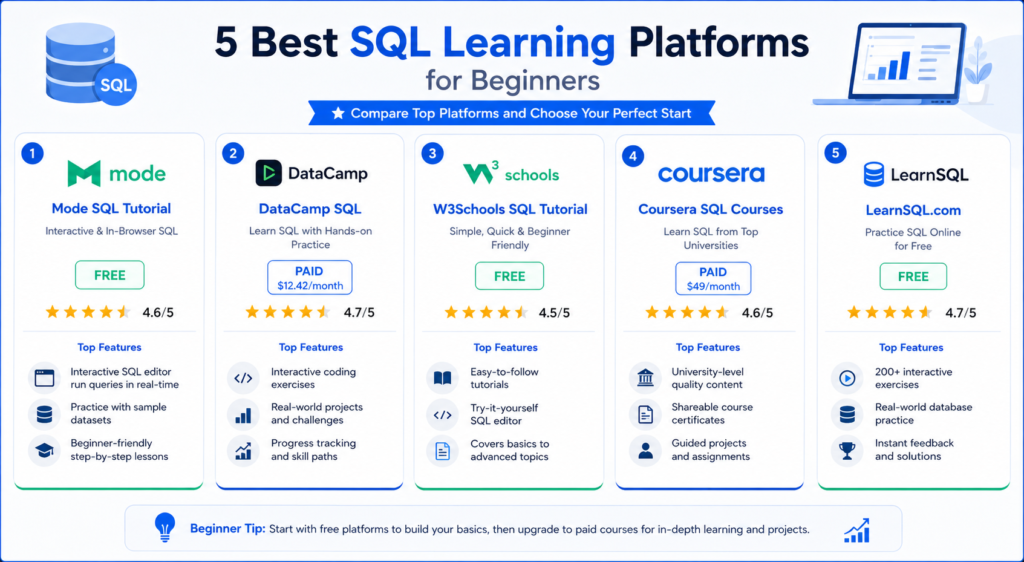
SQL for Data Science — Best Structured Beginner Experience
Offered by UC Davis through Coursera, SQL for Data Science is the most well-structured SQL course I’ve reviewed for true beginners. It takes you from zero to writing multi-table queries with real datasets — in a logical, progressive sequence that builds genuine skill rather than surface familiarity.
What You’ll Learn
- Core SQL syntax and query structure from scratch
- Filtering, sorting, and grouping data sets
- Joining multiple tables using INNER and LEFT JOINs
- Writing subqueries and applying aggregate functions
- Working with real datasets from the very first lesson
Pros and Cons
| Pros | Cons |
| University-backed (UC Davis) | Certificate requires paid plan |
| Perfectly paced for beginners | Limited peer community |
| Real datasets used throughout | Coursera UI can feel slow at times |
| Recognized certificate on completion | Not free to certify |
Best For
Anyone who wants a structured, university-quality SQL education with a shareable certificate. Ideal for anyone targeting a data analyst or data science role within 90 days.
Google Data Analytics SQL Training — Best Career-Focused Path
The Google Data Analytics Professional Certificate dedicates multiple full modules to SQL — and crucially, it teaches SQL in the context of actual business analytics tasks, not abstract exercises. This is the most career-aligned SQL training available at the beginner level.
Why Beginners Like This Program
Google’s program is consistently praised by beginners because everything connects. You’re not learning SQL in a vacuum — you learn it alongside spreadsheets, data visualization, and business storytelling. The SQL sections feel purposeful because you immediately see how they fit into real analyst workflows.
Real-World Skills Included
- Writing SQL queries for business reporting and dashboards
- Cleaning and transforming raw data with SQL
- Connecting SQL skills to Google BigQuery and Sheets
- Applying SQL within full case study projects
Certification Value
The Google certificate is one of the most recognized credentials for entry-level data analyst roles. Hiring managers in 2026 actively look for it. For a full comparison of which certifications matter most in the job market, see my guide on data analyst certifications.
Harvard CS50 SQL Section — Best Free University-Level Learning
Harvard’s CS50 Introduction to Databases with SQL is completely free through edX. It’s rigorous, project-based, and built by one of the world’s most respected computer science programs. If you’re disciplined and want genuine university-level SQL education at zero cost, this is it.
What Makes It Different
- Problem sets built around real-world database scenarios
- Focuses on understanding database design alongside query writing
- Free audit access with an optional paid verified certificate
- Strong learner community via Discord and course forums
Difficulty Level for Beginners
CS50 is not a hand-holding course. It assumes intellectual curiosity and consistent effort. I’d rate it moderate difficulty for true beginners. If you’ve never touched databases before, spend a week with SQLBolt or FreeCodeCamp first, then come to CS50 with that foundation.
Who Should Avoid It
| Skip Harvard CS50 SQL if you… Want a job-ready certificate in under 8 weeksHave less than 5 hours per week to dedicateNeed an extremely gentle, hand-held beginner introductionPrefer video-led structured instruction over reading and projects |
SQLBolt — Best Interactive SQL Learning Platform
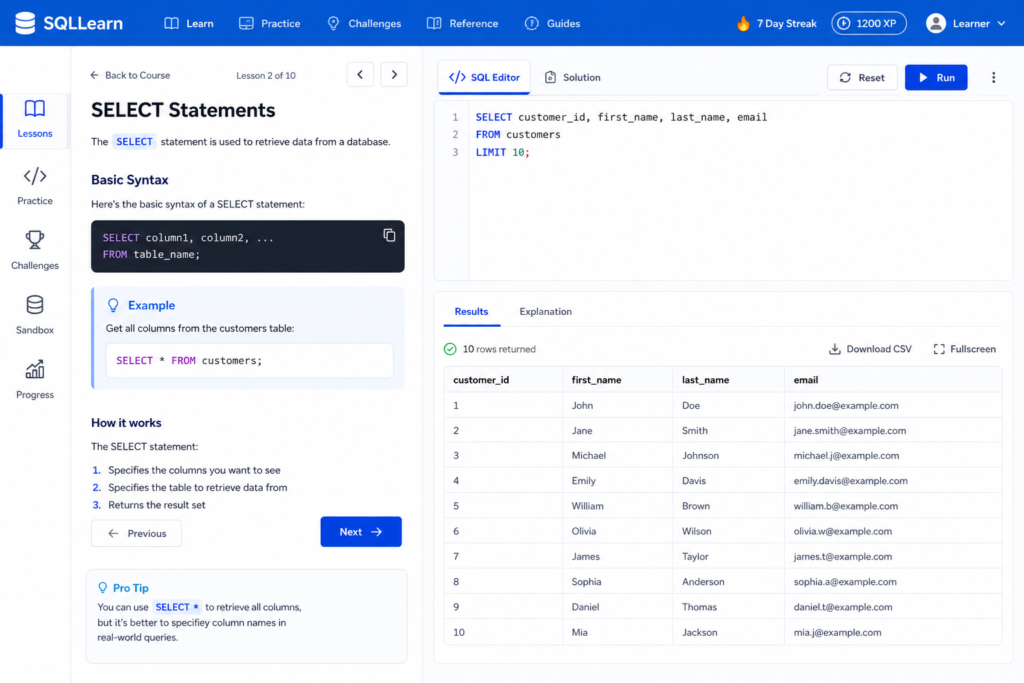
SQLBolt is my top recommendation for anyone who wants to learn sql for free with immediate hands-on practice. You open the site, read a short explanation, and immediately write SQL in an interactive browser editor. No setup, no account, no video to sit through. Just instant practice with instant feedback.
Why Interactive Learning Works Better
From my experience, the biggest reason beginners give up on SQL is the gap between watching a tutorial and actually writing code. SQLBolt closes that gap completely. Every concept is immediately followed by a challenge you must solve yourself — which forces real active recall.
Fastest Way to Practice SQL
- Go to SQLBolt.com (free, no account needed)
- Start with Lesson 1 — SELECT queries
- Complete each lesson before advancing to the next
- Focus on the exercise challenge, not speed
- Complete the full beginner track within 3 to 5 days
Beginner Mistakes This Prevents
- Passive watching without hands-on recall
- Skipping practice to rush through content
- Building zero query-writing muscle memory
FreeCodeCamp SQL Course — Best Free Long-Form Course
FreeCodeCamp’s full SQL course on YouTube is one of the most comprehensive free sql courses available anywhere online. At 4 to 10+ hours of instruction, it covers everything from table creation to complex JOINs and GROUP BY aggregations — with zero cost anywhere in the journey.
What Makes It Beginner Friendly
- Clear, patient instruction designed for people with no prior experience
- No assumed programming or database knowledge
- Covers MySQL setup with step-by-step walkthrough
- Uses real database examples consistently throughout the course
How to Study Without Getting Overwhelmed
The mistake most people make with FreeCodeCamp SQL is treating it like a movie — watching it start to finish in one sitting. Here’s what actually works instead:
- Watch a maximum of 30 to 45 minutes per study session
- Pause after every query shown and re-type it yourself
- Build your own mini database using concepts from each lesson
- Take notes on the logic behind each concept, not just the syntax
Ideal Learning Schedule
| Recommended Weekly Schedule (FreeCodeCamp SQL) Day 1 to 2: Core SELECT, WHERE, ORDER BY — build 10 basic queries Day 3 to 4: GROUP BY and aggregate functions — practice on a sample dataset Day 5 to 6: JOINs (INNER, LEFT, RIGHT) — write 10 join queries Day 7: Review everything + build one small mini-project |
Free SQL Courses That Include Certificates
A free sql certificate can make a real difference on a resume — but only if it comes from the right source. Here’s an honest breakdown of what’s available and what’s actually worth listing.
Platforms Offering Free SQL Certificates
| Platform | Cost | Course | Certificate Value |
| Coursera (audited) | Free (cert costs extra) | SQL for Data Science | Resume-worthy with Coursera cert |
| Harvard CS50 (edX) | Free audit | CS50 SQL Track | Highly respected university name |
| Google / Coursera | ~$39/mo (aid available) | Data Analytics Cert | Excellent for entry-level hiring |
| FreeCodeCamp | Fully free | Relational Databases | Portfolio value, not resume cert |
| DataCamp (free trial) | Free for trial period | Intro to SQL | Limited without paid tier |
Which Certificates Actually Help Your Resume
From my experience, the only free sql certifications that consistently impress hiring managers are Google (via Coursera with financial aid applied) and Harvard CS50. Both carry institutional credibility that most online learning platforms simply cannot match.
For a full breakdown of which credentials matter most in the 2026 job market, check my data analyst certifications guide.
Free vs Paid SQL Certifications
- Free certificates (CS50, FreeCodeCamp) — excellent for your portfolio, less employer recognition
- Subsidized certificates (Google via Coursera) — highly recognized, minimal cost with aid
- Fully paid certificates (DataCamp, Udemy) — platform-specific value, useful for niche roles
- University certificates — highest credibility, requires the most time investment
| Pro Tip If you can only invest in one certificate, apply for Google Data Analytics financial aid on Coursera. Qualifying applicants can access the full program at near-zero cost. Apply before you start the first module. |
What Actually Works in 2026 for Learning SQL Faster
Most SQL learning advice is recycled from 2018. Here’s what I’ve tested and observed to actually accelerate SQL skill development for beginners in 2026 specifically.
Practice-First Learning Framework
The single most effective shift you can make: flip the learning ratio. Instead of 80% instruction and 20% practice, invert it. Spend 20% of your time on instruction and 80% actually writing queries. This feels counterintuitive but is dramatically faster.
Why Building Queries Beats Watching Videos
- Writing queries forces active recall — your brain has to retrieve information, not just receive it
- Making errors teaches you more than successful queries — debugging builds real understanding
- Muscle memory for SQL syntax develops only through typing, not watching
- You build a portfolio of real queries you can show employers
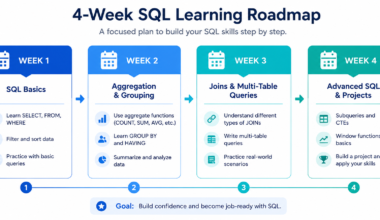
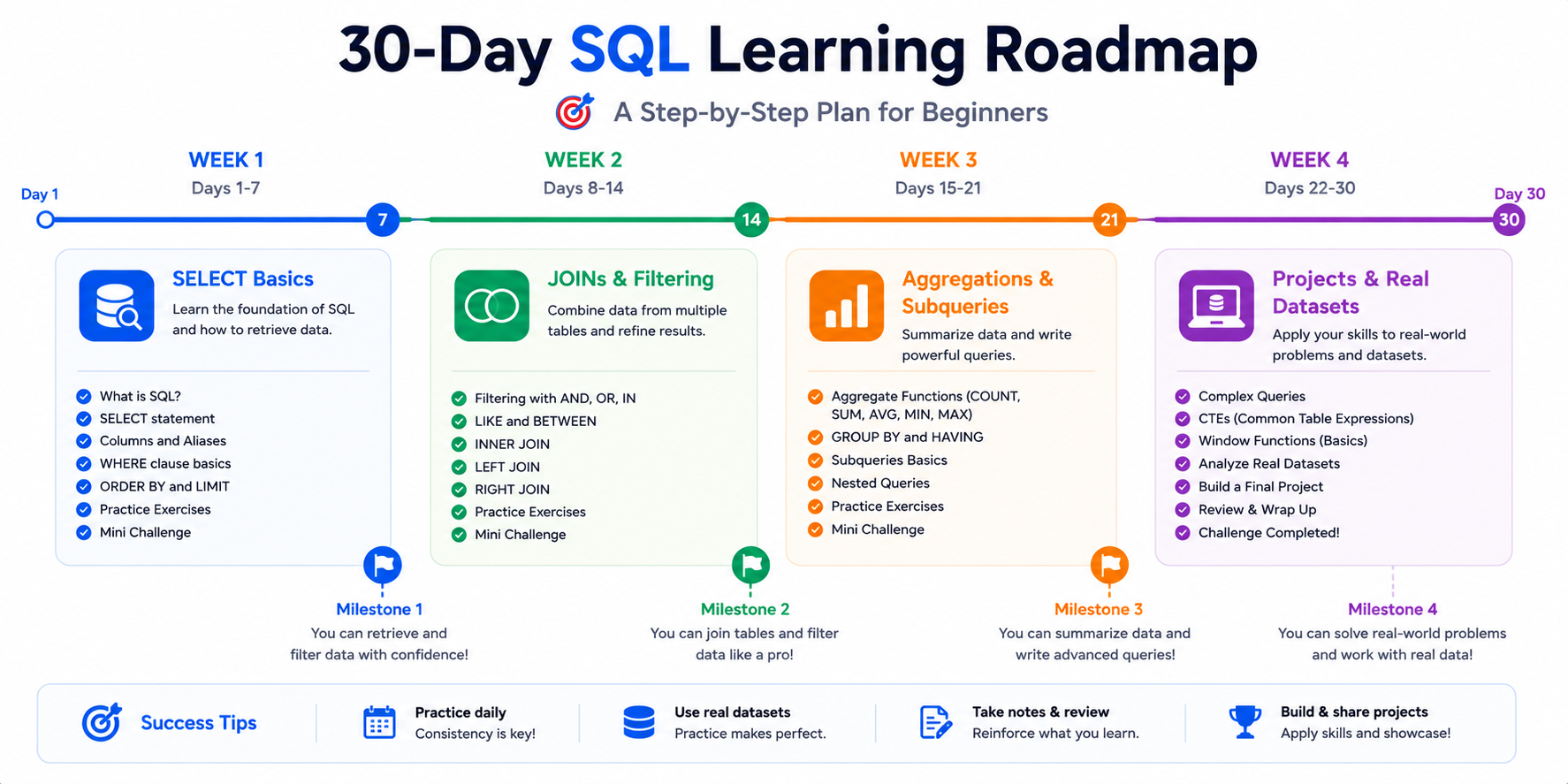
The 30-Day Beginner SQL Roadmap
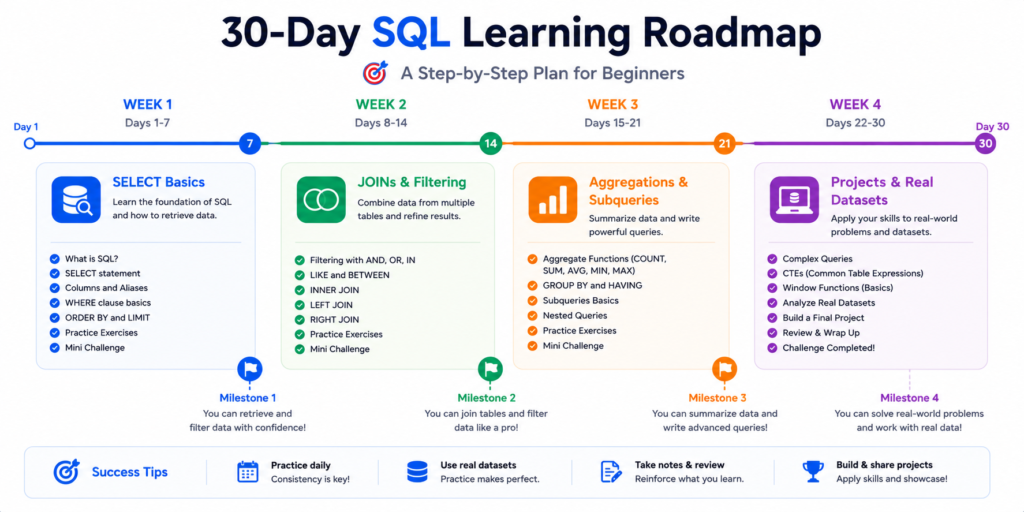
| Week | Focus Area | Daily Practice Target |
| Week 1 | SQL Foundations | SELECT, FROM, WHERE, ORDER BY — write 10 basic queries per day |
| Week 2 | Filtering and Joins | AND/OR/NOT, INNER JOIN, LEFT JOIN — complete SQLBolt Lessons 6 to 13 |
| Week 3 | Aggregations | GROUP BY, COUNT, SUM, AVG, subqueries — use a Kaggle dataset |
| Week 4 | Real Projects | Build 2 original query projects using real-world data from scratch |
Common Mistakes That Kill SQL Learning Progress
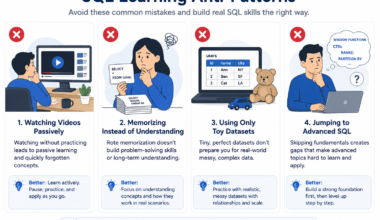
Watching Tutorials Without Practicing
This is the number one mistake I observe. Watching SQL tutorials feels productive but accomplishes almost nothing without writing queries yourself. After five hours of videos, most beginners cannot write a GROUP BY query without looking it up. Practice after every single lesson — without exception.
Trying Advanced SQL Too Early
Window Functions, CTEs, recursive queries, and stored procedures are not beginner topics. I’ve seen motivated learners burn out entirely because they tried to tackle these in their second week. Spend your first 30 days mastering SELECT, JOINs, and GROUP BY — then advance.
Ignoring Real Datasets
Fake datasets with 10 rows and three columns teach you almost nothing about how SQL behaves in practice. Real datasets have NULL values, duplicate rows, inconsistent formatting, and thousands of records. Practice on real data from Kaggle, data.gov, or Google BigQuery public datasets as early as possible.
Memorizing Syntax Instead of Understanding Logic
| Common Mistakes to Avoid Memorizing syntax without understanding the underlying logicCopy-pasting queries without ever debugging them yourselfSkipping JOIN practice because it feels confusingTreating SQL like a programming language with strict execution orderApplying for jobs before building any real SQL project portfolio |
Beginner vs Advanced SQL Learning Paths
Skills Beginners Should Focus On First
- SELECT statements with filtering, sorting, and limiting results
- INNER JOIN and LEFT JOIN across two and three tables
- Aggregate functions with GROUP BY and HAVING
- Simple subqueries in WHERE and SELECT clauses
- Understanding and handling NULL values correctly
When to Learn Joins, CTEs, and Window Functions
Once you can confidently write queries involving multi-table JOINs and GROUP BY aggregations without referencing documentation, you’re ready for CTEs. Window Functions come after that. A practical rule: if you can solve 80% of LeetCode’s Easy SQL problems independently, you’re ready for intermediate SQL.
The Best Next Step After Beginner SQL
After mastering beginner SQL, your next move depends on your career goal. For data analysts, SQL combined with Python or SQL combined with Excel is the standard power combination. For the full picture of where SQL fits in your career progression, check my data analyst roadmap for career growth.
Best Platforms to Learn SQL for Free
Coursera
Coursera offers full audit access to most SQL courses at no cost. You won’t receive a certificate on audit, but you get complete course content including all videos, readings, and practice exercises. The UC Davis SQL for Data Science course is fully auditable.
Udemy
Udemy frequently runs platform-wide sales where SQL courses drop to $10 to $15. ‘The Complete SQL Bootcamp’ by Jose Portilla is consistently among the highest-rated beginner SQL courses on the platform. Not free, but extremely affordable when on sale.
DataCamp
DataCamp offers a free tier with limited lesson access and a free trial period for students. Their SQL learning track is well-designed for data analytics learners, with a clean interactive interface that makes query practice easy and immediate.
FreeCodeCamp
FreeCodeCamp’s YouTube channel hosts a complete SQL course that is entirely free with no account required. Their Relational Database certification on the platform itself is also free and includes real projects built with PostgreSQL.
Khan Academy
Khan Academy’s Introduction to SQL is one of the most accessible starting points for absolute beginners. Fully free and browser-based, it walks through concepts at a pace comfortable for anyone new to technology. Limited in depth but excellent for building initial confidence.
Harvard Online Learning
Harvard’s CS50 SQL track on edX is free to audit with an optional paid verified certificate. It is the most rigorous free SQL course available from any institution. Pair it with the SQL roadmap guide to structure your learning path effectively.
SQL Learning Tools and Resources That Make Learning Easier
Best SQL Practice Websites
- SQLBolt.com — interactive beginner lessons with instant feedback
- LeetCode (SQL Easy section) — structured interview preparation
- HackerRank SQL — tiered challenges with community rankings
- Mode Analytics SQL Tutorial — analytics-focused practice scenarios
- StrataScratch — data science SQL challenges from real companies
Beginner-Friendly SQL Editors
- DB Fiddle (dbfiddle.uk) — free browser-based SQL editor, no install needed
- SQLiteOnline.com — instant SQLite environment in your browser
- DBeaver Community Edition — free desktop app, connects to real databases
- MySQL Workbench — free official MySQL client for local development
Real Dataset Sources for Practice
- Kaggle.com/datasets — thousands of real datasets across every domain
- data.gov — US government open data, structured and clean
- Google BigQuery public datasets — cloud-scale real data, free to query
- Our World in Data — high-quality structured datasets on global topics
Communities That Help Beginners Improve Faster
The r/learnSQL and r/SQL communities on Reddit are both highly active and beginner-friendly. For a deeper dive into community-based SQL learning strategies, check the how to learn SQL language guide.
SQL for Career Growth — What Beginners Need to Know
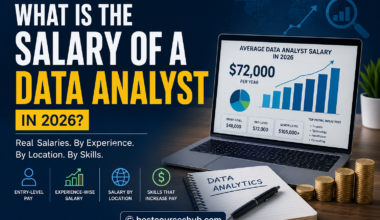
SQL Roles That Pay Well in 2026
| Role | Avg US Salary (2026) | SQL Usage in Daily Work |
| Data Analyst | $65,000 – $95,000 | Heavy daily SQL usage for reporting |
| Business Intelligence Developer | $80,000 – $120,000 | Advanced SQL plus visualization tools |
| Data Engineer | $100,000 – $150,000 | SQL at scale with Python pipelines |
| SQL Developer | $70,000 – $110,000 | Database design and query optimization |
| Data Scientist (entry level) | $85,000 – $130,000 | SQL for data extraction and wrangling |
How SQL Helps in Data Analytics and Engineering
SQL is the core language of data work. Every data analyst, data engineer, and business intelligence developer uses it daily. If you’re targeting any of these roles, SQL is non-negotiable as a foundation skill. See my full data analytics tools guide to understand how SQL fits alongside other tools in a modern data stack.
How Long It Takes to Become Job-Ready
- Beginner fundamentals (SELECT, JOIN, GROUP BY): 2 to 4 weeks with daily practice
- Intermediate SQL (subqueries, CTEs, window functions): 4 to 8 additional weeks
- Job-ready level (pass SQL screens in interviews): 2 to 3 months total
- Senior-level SQL proficiency: 1 to 2 years of applied real-world work
| Key Takeaway Most entry-level data roles only require beginner to intermediate SQL. You don’t need to be an expert before applying. Master fundamentals plus 2 to 3 real projects, and you’ll be competitive for entry-level data analyst positions within 90 days of starting. |
Simple Checklist for Choosing the Right SQL Course
Run every SQL course you’re considering through this checklist before committing time or money:
Beginner-Friendliness
- Does it assume zero prior knowledge?
- Does it explain the reasoning behind each concept, not just the syntax?
- Is the pacing gradual enough for someone learning from scratch?
Hands-On Practice
- Does it include interactive exercises built into the lessons?
- Can you write real queries during lessons, not just watch?
- Are there quizzes or projects that require applying what you learned?
Certificate Availability
- Is a certificate offered on completion?
- Is it from a recognized institution or widely known platform?
- Is the certificate cost clearly stated before you enroll?
Real Projects
- Does the course use real or realistic datasets?
- Is there a capstone project or final challenge?
- Can the project be included in a public portfolio?
Updated Content
- Was the course updated in 2023 or later?
- Does it cover modern SQL environments like PostgreSQL or BigQuery?
- Are recent student reviews consistently positive?
Frequently Asked Questions
Can I Learn SQL for Free?
Yes, completely. SQLBolt, FreeCodeCamp, Khan Academy, and Harvard CS50 all offer full SQL learning resources at no cost. Learning sql for free is entirely realistic — the only investments required are time and consistency.
Which SQL Course Is Best for Absolute Beginners?
For someone with zero prior experience, start with SQLBolt in your first week — it’s interactive, confidence-building, and requires no setup. Then move to FreeCodeCamp’s full course for depth. If you want a single structured program with a certificate, Google Data Analytics on Coursera is the strongest all-in-one option.
Are Free SQL Certificates Worth It?
It depends entirely on the source. A free sql certificate from Harvard CS50 or Google (with financial aid applied) carries genuine weight with employers. Certificates from lesser-known platforms are solid portfolio assets but not strong resume differentiators. Prioritize building the skill first — the certificate is secondary.
How Long Does It Take to Learn SQL?
With consistent daily practice of 1 to 2 hours, most beginners reach a functional working level within 4 to 6 weeks. Job-ready proficiency typically takes 2 to 3 months. Advanced SQL fluency develops over 6 to 12 months of real-world application.
Do I Need Coding Experience Before Learning SQL?
No. SQL is a query language, not a traditional programming language. It does not require prior coding experience. Many highly effective data analysts started with SQL as their first and only technical skill. If you can clearly describe in English what data you want to see, you can learn SQL.
Is SQL Enough to Get a Data Job?
SQL alone is rarely sufficient for a full data analyst position. Most entry-level roles expect SQL combined with Excel or Python, plus basic data visualization experience. For the complete picture of what you need to be hireable, see my data analyst roadmap for career growth.
Final Action Plan for Beginners
The Best First SQL Course to Start Today
If you’re starting today, here’s my straightforward recommendation: open SQLBolt.com right now and complete the first five lessons. It takes under an hour. By the end, you’ll have written your first real SQL queries and understood SELECT, WHERE, and ORDER BY from practical application. That momentum matters more than spending three days picking the perfect course.
The Fastest Beginner Learning Path
- Week 1: Complete the SQLBolt beginner track — free, interactive, zero setup
- Week 2 to 3: Enroll in Google Data Analytics or SQL for Data Science on Coursera
- Week 3 to 4: Practice on Kaggle datasets — write 50 original queries using a real dataset
- Month 2: Move to LeetCode Easy SQL problems — solve 20 problems minimum
- Month 3: Build 2 portfolio projects using real-world data and publish them on GitHub
What to Learn After SQL
Once SQL fundamentals are solid, your next step depends on your career target. For data analysts: learn Python for data analysis using Pandas. For business intelligence roles: learn Power BI or Tableau. My Power BI courses for beginners guide and business intelligence analytics certification breakdown cover both paths in depth.
How to Build Real SQL Experience Quickly
- Download a Kaggle dataset on a topic you’re genuinely curious about and analyze it with SQL
- Create a public GitHub repository to store and showcase your SQL query portfolio
- Join r/learnSQL on Reddit and post your queries for community feedback
- Use real data analyst job descriptions to identify which SQL skills to prioritize next
- Apply for entry-level data analyst roles within 90 days of starting — earlier than you feel ready
| Your Next Steps — Start Today Step 1: Open SQLBolt.com and complete Lessons 1 to 5 (free, under 1 hour) Step 2: Enroll in Google Data Analytics on Coursera and apply for financial aid Step 3: Download one Kaggle dataset and practice 10 queries this week Step 4: Bookmark the SQL roadmap — bestcourseshub.com/sql-roadmap/ Step 5: Set a 90-day goal: job-ready SQL proficiency with 2 portfolio projects |