Introduction
Let me be brutally honest with you. The number one reason most people fail at building an online store isn’t a lack of money, the wrong niche, or even bad products. It’s that they jump in without a structured learning foundation — and then spend months making expensive, easily avoidable mistakes. I’ve seen this pattern repeat itself over and over again in the e-commerce space.
The good news? The right e-commerce courses can completely change that equation. When you follow a structured, experience-backed learning path, you dramatically cut down the time it takes to go from zero to a live, revenue-generating store. I’ve personally gone through dozens of these courses — free ones, paid ones, certification programs — and in this guide, I’m going to give you a complete, no-fluff breakdown of exactly what to learn, in what order, and where to learn it.
Whether you’re an absolute beginner who doesn’t know where to start, a side hustler looking to launch fast, or a professional wanting to upgrade your skills with an e-commerce certification course, this guide was built for you. By the time you finish reading, you’ll have a clear, actionable roadmap — not just a list of course names.
Here’s what this guide covers:
- How to choose the right e-commerce course (and avoid the traps)
- The exact learning path I recommend for 2026
- The best free and paid ecommerce courses available right now
- Real examples of people who went from student to store owner
- A 7-day action plan to start your store today
Who This Guide Is For (And How to Use It)
Before we dive in, I want to make sure you’re in the right place. This isn’t a generic overview that tells you “just Google some courses.” This is a guide built around specific e-commerce learning needs — and it serves three very different types of readers.
Absolute Beginners Starting from Zero
If you’ve never built an online store before, you’re exactly who this guide is designed for. I remember what it felt like to stare at Shopify for the first time without knowing what a product variant was or why my checkout page looked broken. The truth is, you don’t need technical skills to start — you need the right e-commerce online course that walks you through each step without assuming prior knowledge.
In my experience, beginners benefit most from structured courses that cover store setup, product sourcing, and basic digital marketing in a single curriculum. Jumping straight into advanced paid advertising or SEO before mastering the fundamentals is one of the biggest beginner mistakes I see — and I’ll cover that in detail later.
💡 Pro Tip: Start with a free ecommerce course to validate your interest, then invest in a paid program once you’re committed. Don’t spend $500 before you’ve even listed your first product.
Side Hustlers Wanting to Launch Fast
If you already have some business instincts but want to launch an online store alongside your main income, your needs are different. You don’t have time for 40-hour course marathons. You need the fastest path from learning to launching — and that means prioritizing execution over theory. Therefore, I’ll point you specifically to the frameworks in the Step-by-Step section and the 7-day action plan at the end of this guide.
Side hustlers should look for e-commerce courses online that are modular, self-paced, and project-based. You want to learn, apply, and move on — not watch lecture after lecture without building anything.
Professionals Looking for Certification or Skill Upgrade
If you’re a marketing professional, a business owner, or even an agency consultant looking to add e-commerce strategy to your toolkit, you’ll want to explore certification-level programs. An e-commerce certification course free or paid can genuinely add weight to your resume and client pitch decks — but only if you choose the right one.
For this group, I’ll highlight platforms that offer verifiable credentials, real-world case studies, and advanced modules on topics like conversion rate optimization, data analytics, and omnichannel strategy. These are the ecommerce courses that actually move the needle at the professional level.
Quick Answer: Best Way to Learn E-commerce in 2026
I know some of you just want the short version. So here it is — the distilled answer — before we go deep.
Fastest Path from Learning to Launching a Store
The fastest path to launching a store in 2026 follows this sequence:
- Take a free beginner e-commerce course (Shopify Academy or Coursera) to understand the fundamentals — store setup, product listing, basic payment setup.
- Pick a niche and validate your product idea before spending a dollar on inventory or ads.
- Learn traffic generation basics — specifically SEO content marketing or paid Meta/Google ads — through a focused e-commerce marketing course.
- Launch a minimal viable store with 3–5 products.
- Analyze your data, iterate, and then scale.
Most people try to skip steps 2 and 3 and go straight from “I have a product” to “why aren’t people buying?” — and that’s where months get wasted. However, by following this sequence, I’ve seen complete beginners go live in under 30 days with their first sale within the first week.
Free vs Paid Course Decision in Under 2 Minutes
Here’s my simple decision framework. Ask yourself two questions:
- Do I have a clear business idea and $0 to invest in learning? → Start with a free e-commerce course.
- Am I serious, have some budget, and want a structured mentorship-style program? → Invest in a paid ecommerce course.
That’s really it. Free courses are not inferior — in fact, some of the best e-commerce courses online are completely free. The difference is structure, depth, and community support. Paid programs tend to offer better mentorship, updated content, and job-placement-level resources.
What Actually Matters More Than Courses
Here’s the uncomfortable truth I wish someone had told me early: the course is 20% of the equation. The other 80% is your execution speed, your willingness to test and fail fast, and your discipline to actually apply what you learn — not just consume it.
I’ve met people who completed every top-rated ecommerce course on Udemy and still haven’t launched a store. I’ve also met people who watched 6 hours of YouTube and had $3,000 in sales within their first month. Action beats information every single time.
💡 Pro Tip: Block 30 minutes every day exclusively for executing — not learning — what you learned the previous day. That habit will separate you from 90% of people who take e-commerce courses.
What Actually Works in 2026 (Modern E-commerce Learning Path)
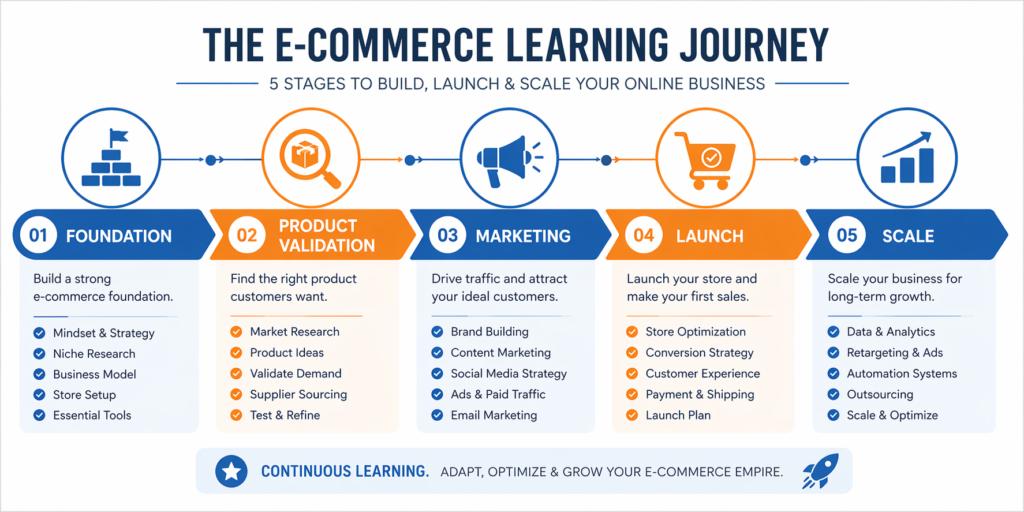
The e-commerce landscape has shifted significantly over the last two years. Between AI-powered product discovery, social commerce on TikTok and Instagram, and the rise of headless commerce, the skills you needed in 2020 are no longer enough. Here’s what’s actually working in 2026.
Core Skills Every E-commerce Course Must Cover
Not all e-commerce courses are created equal. However, the best ones — whether free or paid — should cover these core areas:
- Store setup and platform selection (Shopify, WooCommerce, or BigCommerce)
- Product research and validation frameworks
- Conversion rate optimization — turning visitors into buyers
- Email marketing and customer retention strategies
- Basic understanding of paid advertising (Meta Ads, Google Shopping)
- Search engine optimization for product pages and categories
- Analytics interpretation — understanding what your data is telling you
If a course skips any of these fundamentals, it’s incomplete. In my experience, the biggest gap in most beginner ecommerce courses is the analytics piece — they teach you how to drive traffic but not how to figure out why that traffic isn’t converting. That gap is expensive.
The 7 Pillars of E-commerce You Must Master
When people ask me “what are the 7 pillars of e-commerce?”, I give them this framework — because it maps directly to the skills you need to build a sustainable online business, not just a quick-sale store:
| Pillar | What It Means for Your Store |
| 1. Product | Sourcing, quality control, and product-market fit |
| 2. Storefront | UX design, mobile responsiveness, and brand trust signals |
| 3. Traffic | SEO, paid ads, social media, and influencer marketing |
| 4. Conversion | Pricing strategy, copywriting, and checkout optimization |
| 5. Retention | Email flows, loyalty programs, and repeat purchase funnels |
| 6. Operations | Inventory, shipping, customer service, and returns management |
| 7. Data & Analytics | Using metrics to make smarter product and marketing decisions |
Mastering all 7 pillars is the difference between a store that makes occasional sales and a store that generates consistent monthly revenue. Any quality e-commerce course online should touch on at least 5 of these 7 areas.
Types of E-commerce Models You Should Choose From
Before investing time in any e-commerce training, it’s critical to choose the business model that aligns with your goals, budget, and available time. Here are the main models in 2026:
- Dropshipping — Low startup cost, no inventory; however, lower margins and high competition.
- Private Label — Source generic products, brand them as your own; higher upfront cost but better margins.
- Print-on-Demand — Great for creative entrepreneurs; no inventory, fully automated fulfillment.
- Wholesale / Retail Arbitrage — Buy low, sell higher on platforms like Amazon or eBay.
- Digital Products — E-books, courses, templates; 100% margin, no shipping, infinitely scalable.
- Subscription Boxes — Recurring revenue model; requires strong retention and logistics skills.
For example, if you choose dropshipping, your e-commerce course needs to emphasize supplier research and ad management heavily. If you go digital products, you need to focus on content marketing and email list building. The model shapes the curriculum you need — and that’s a detail most generic e-commerce courses completely ignore.
Step-by-Step Framework to Learn and Launch
Step 1: Choosing the Right E-commerce Course
This is where most beginners spend too much time — and paradoxically, it becomes their first form of procrastination. Therefore, I want to give you a clear decision structure so you can choose and move forward within 24 hours.
Ask yourself these three questions before enrolling in any ecommerce course online:
- Does this course match my business model (dropshipping, private label, digital products)?
- Does it include hands-on projects or just video lectures?
- Is the instructor someone with real, verifiable e-commerce revenue — not just a course creator?
If the answer to any of these is “no” or “I can’t verify,” keep looking. The e-commerce course fees you pay should directly correspond to the depth and real-world applicability of what you’re getting. I’ve seen $2,000 courses that were pure recycled content, and $97 courses that genuinely transformed people’s businesses.
⚠️ Mistake to Avoid: Don’t choose a course based on hype or Instagram screenshots of student results. Look for instructors who show real Shopify dashboards, ad spend data, and ROAS numbers — not just revenue screenshots that could be inflated.
Step 2: Learning Store Setup and Product Validation
Once you’ve selected a course, the first thing you should implement — not just watch — is store setup. Your goal at this stage isn’t a perfect store. It’s a functional store with at least one validated product. Here’s how I approach validation:
- Research trends using Google Trends, TikTok hashtags, and Amazon Best Sellers
- Check competitor stores using tools like SimilarWeb or Semrush to gauge traffic volume
- Run a pre-launch ad for $5/day for 5 days to test demand before building inventory
- Validate supplier quality by ordering samples before listing any product
Product validation is the most skipped step in e-commerce education. However, it’s the single most valuable thing I teach because it saves people from investing weeks into a store that sells a product nobody actually wants to buy online.
Step 3: Marketing and Traffic Generation Fundamentals
Here’s the truth about e-commerce marketing: you don’t need to master every channel. You need to master one traffic channel deeply before adding a second. In my experience, the best starting point depends on your budget:
- $0 budget → SEO content + organic social media (Instagram Reels, TikTok, Pinterest)
- $10–$50/day → Meta Ads or Google Shopping — start with one, not both
- $100+/day → Add retargeting campaigns and email automation alongside paid ads
A quality e-commerce marketing course will walk you through ad structure, creative testing, audience segmentation, and attribution — not just how to click buttons in Ads Manager. If you want to go deeper on digital marketing strategy, I highly recommend also checking out our guide on digital marketing courses for business owners which covers platform-specific strategies in detail. Additionally, if social commerce is your focus, our breakdown of social media marketing courses covers exactly how to turn organic followers into buyers.
Step 4: Scaling with Automation and Analytics
Scaling is the stage most beginners dream about but few actually reach — usually because they skip the data literacy piece. Therefore, once your store is generating consistent sales (even $500–$1,000/month), it’s time to introduce two layers:
- Automation — Email flows (welcome series, abandoned cart, post-purchase), chatbot support, inventory alerts
- Analytics — Weekly review of conversion rate, average order value, customer acquisition cost, and return on ad spend
At this stage, AI tools are genuinely changing the game. If you’re curious how artificial intelligence is reshaping e-commerce operations and learning, I’d recommend reading our in-depth piece on AI in education and machine learning — it has direct implications for how smart store owners are using AI today.
Best E-commerce Courses Online (Free and Paid)
Best Free E-commerce Courses to Start Today
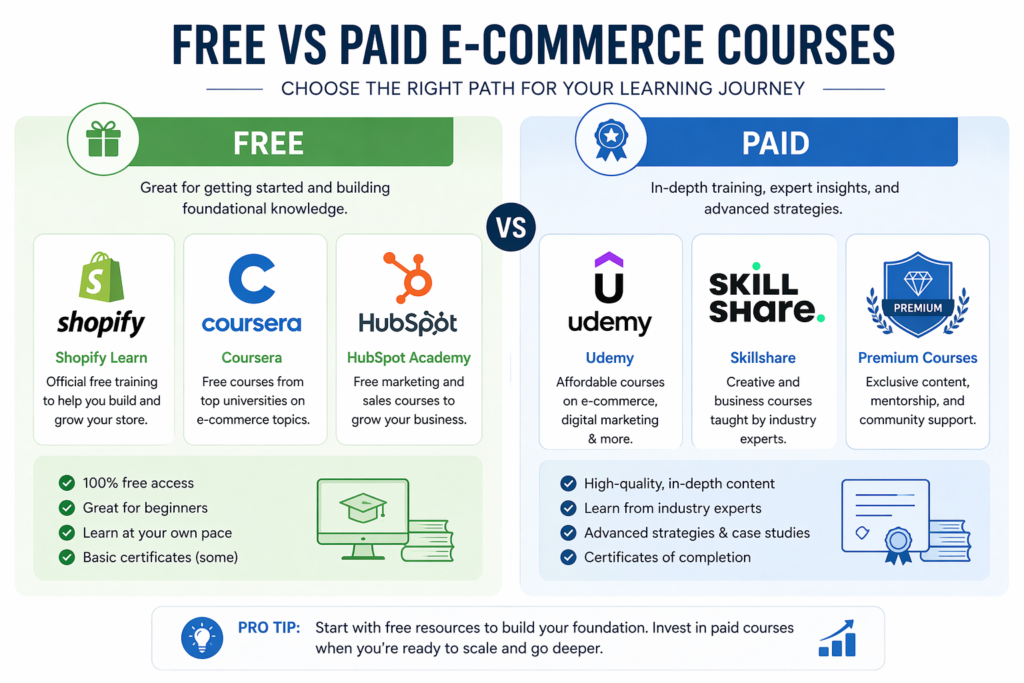
Free doesn’t mean low quality. Some of the best ecommerce courses I’ve ever taken were completely free — and they’re built by the platforms that have the most to gain from your success: the store builders themselves.
| Course / Platform | Best For | What You’ll Learn |
| Shopify Academy | Complete beginners | Store setup, product sourcing, dropshipping basics |
| Google Digital Garage | Marketing foundations | SEO, analytics, paid ads, email marketing |
| HubSpot Academy | Inbound marketing | Content strategy, email flows, CRM for e-commerce |
| Coursera (audit mode) | Structured academic learning | E-commerce strategy, business models, consumer behavior |
| Meta Blueprint | Facebook & Instagram ads | Ad creation, audience targeting, campaign optimization |
In my experience, Shopify Academy and Google Digital Garage together cover about 70% of what you need to launch your first store. Start there, and you’ll have a solid foundation without spending a single dollar on e-commerce course fees.
High-Value Paid Courses Worth Investing In
Paid ecommerce courses make sense when you want a structured curriculum, ongoing mentorship, a real community, and content that’s actively updated. Here are the ones I’ve personally evaluated and would recommend:
- Udemy — ‘The Complete Shopify Dropshipping Masterclass‘ (under $20 on sale): Excellent for absolute beginners who want a comprehensive, project-based walkthrough of store setup and ad basics.
- Foundr — ‘Start & Scale’ by Gretta van Riel: One of the most respected e-commerce courses for building a branded product business from scratch. Real case studies, real numbers.
- Ecom Elites (Franklin Hatchett): A community-based dropshipping course with regular updates — particularly strong on Facebook Ads strategy and product research.
- Skillshare — Various e-commerce modules: Good for creative entrepreneurs who want to blend product development with content marketing.
When evaluating paid programs, always check the last update date. A paid ecommerce course online that hasn’t been updated since 2022 is selling you outdated tactics — especially in paid advertising, where platform algorithms change every few months.
Certification Courses That Actually Add Career Value
If you’re building a resume or pitching clients, certifications matter — but only the right ones. Here are the programs that carry real professional weight:
- Google Analytics Certification (free) — Essential for any e-commerce professional working with data.
- HubSpot Inbound Marketing Certification (free) — Highly recognized in the marketing and e-commerce industry.
- Shopify Partner Program Certification — Valuable if you’re building and managing stores for clients.
- Meta Certified Digital Marketing Associate — Increasingly recognized by e-commerce brands hiring marketing managers.
For context, I’d also recommend pairing any e-commerce certification course with broader business skills. Our guide on entrepreneurship courses for founders is a great complement, especially if you’re building a brand — not just a store.
Free vs Paid E-commerce Courses (What You Should Choose)
When Free Courses Are Enough
Free e-commerce courses are genuinely enough in several situations that most people underestimate. In my experience, if you’re at any of the following stages, you should start — or stay — with free content:
- You haven’t validated your business idea yet
- You’re testing whether e-commerce is the right path for you
- You have strong self-discipline and don’t need structured accountability
- Your primary goal is learning the platform mechanics (Shopify, WooCommerce)
- You want to build foundational marketing knowledge before investing
For example, I spent my first three months exclusively on free e-commerce courses before I paid for anything. By the time I did invest in a paid program, I already knew enough to evaluate it critically and extract maximum value from it. That’s the smart approach.
When Paid Courses Give Better ROI
However, there are specific situations where the investment in a paid e-commerce course pays for itself many times over:
- You want direct access to a successful instructor or private community
- You’re launching a serious business and need mentorship-level guidance
- You need advanced training on topics like conversion rate optimization, international scaling, or multi-channel commerce
- The course includes done-for-you templates, supplier lists, or proprietary tools
The ROI calculation is simple: if a $300 course helps you avoid even one costly mistake — say, investing $1,000 in the wrong inventory — it’s already paid for itself three times over. That’s the lens I use when evaluating e-commerce course fees.
Hidden Costs and Expectations Beginners Ignore
Whether you go free or paid, there are real costs that most course descriptions don’t mention upfront. Therefore, I want to flag these before you enroll in anything:
- Shopify/platform subscription fees ($29–$79/month to start)
- Domain name and professional email ($15–$25/year)
- App and plugin costs (often $30–$100/month for essential tools)
- Initial ad budget ($100–$500 to test your first campaigns)
- Product samples and photography if you’re selling physical products
⚠️ Mistake to Avoid: Never factor in only the e-commerce course fees when budgeting. The real cost of launching a store typically runs $300–$800 in the first 90 days — and knowing that upfront saves you a lot of stress.
E-commerce Marketing Courses That Drive Real Sales
What Top E-commerce Marketing Courses Teach
I want to be specific here because “e-commerce marketing” is a phrase that gets thrown around loosely. The best e-commerce marketing courses I’ve taken — and taught from — focus on a specific customer journey framework:
- Awareness — How to get discovered (SEO, social content, influencer partnerships)
- Consideration — How to build trust (product photography, reviews, social proof)
- Conversion — How to close the sale (copywriting, urgency, checkout optimization)
- Retention — How to bring them back (email sequences, loyalty rewards, SMS)
Any e-commerce marketing course that doesn’t teach all four stages of this funnel is giving you an incomplete picture. You can drive millions of visitors to a store and still make zero sales if your conversion layer is broken.
Skills That Directly Impact Revenue (Ads, SEO, Funnels)
In terms of revenue impact, here are the marketing skills that move the needle fastest — ranked from highest immediate impact to longer-term compounding:
- Paid Ads (Meta & Google Shopping) — Fastest path to traffic; however, requires budget and testing discipline.
- Email Marketing — Highest ROI of any digital channel; every $1 spent returns an average of $36.
- SEO for E-commerce — Slower to build but generates free, compounding organic traffic over time.
- Conversion Rate Optimization — Often overlooked; doubling your conversion rate doubles your revenue without more traffic.
- Social Commerce — TikTok Shop and Instagram Shopping are driving explosive direct sales for product brands in 2026.
For deep dives into these specific marketing channels, I’d strongly suggest checking our comprehensive guide on social media marketing courses as well as our overview of the best digital marketing courses for business owners — both pair directly with any e-commerce marketing curriculum.
How to Combine Marketing Learning with Execution
This is the piece most people miss. Learning marketing theory and executing marketing campaigns are two completely different cognitive tasks — and trying to do both simultaneously often leads to paralysis.
My recommendation is a “learn one, execute one” rhythm:
- Week 1: Learn Meta Ads fundamentals (spend 5 hours on the course module)
- Week 2: Run your first $50 test campaign (no learning — just execution and observation)
- Week 3: Analyze results, identify gaps, go back to the course for specific answers
This rhythm prevents the “infinite learning loop” where you keep taking ecommerce training courses without ever launching a campaign. In my experience, people who execute alongside learning see results 3x faster than those who try to “finish” the course before taking action.
Online vs Local Classes (Which Learning Style Wins)
Benefits of Online E-commerce Courses
The overwhelming majority of e-commerce education happens online — and for good reason. Here’s why online e-commerce courses online win for most learners:
- Self-paced learning fits around full-time jobs and family commitments
- Access to instructors who are currently running 7 or 8-figure stores
- Content is regularly updated to reflect platform changes and algorithm shifts
- Community forums and Slack groups provide peer learning at scale
- Price point is significantly lower than in-person programs
Furthermore, online courses often come with lifetime access — meaning you can revisit modules as your store grows and your questions become more advanced. That’s something a one-time e-commerce class can’t match.
When Local Classes Make Sense
That said, I don’t want to dismiss in-person learning entirely. If you’re searching for “e-commerce courses near me,” there are genuine scenarios where local options make sense:
- You’re a hands-on learner who needs in-person accountability
- Your local community college or business incubator offers a subsidized or free e-commerce class
- You want to network with other local entrepreneurs and potential collaborators
- You’re looking for one-on-one mentorship that online programs rarely provide
Local chambers of commerce, SCORE chapters, and Small Business Development Centers (SBDCs) often run free or low-cost e-commerce workshops that are genuinely worth attending — especially for networking.
Hybrid Learning Strategy for Faster Results
In my experience, the most successful e-commerce students use a hybrid approach. They take a structured online course for the core curriculum, but they also actively participate in live events, mastermind groups, and local meetups for real-time feedback and accountability.
For example, one approach that works extremely well is:
- Primary curriculum: Online e-commerce course (Shopify Academy + one paid platform)
- Weekly accountability: A local business meetup or online mastermind group
- Ongoing learning: YouTube channels, podcasts, and industry newsletters
💡 Pro Tip: Join at least one active e-commerce community (Facebook Group, Discord, Reddit’s r/ecommerce) alongside your formal course. Real-time peer feedback on your store is worth more than any lecture.
Real Examples: From Course to Live Store
Beginner Launching First Shopify Store
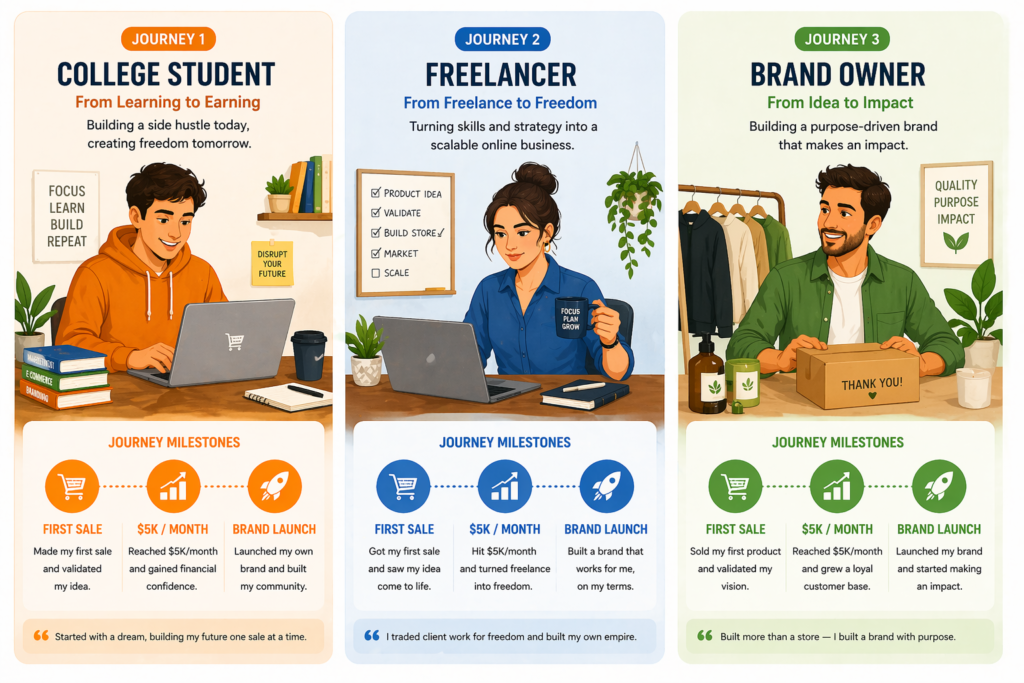
Let me share the story of someone I coached (shared with permission) — a 24-year-old with no business background who decided to build a Shopify store selling sustainable kitchen products after taking a free e-commerce course on Shopify Academy.
Here’s how his journey unfolded:
- Week 1–2: Completed the Shopify Academy beginner track (free). Set up his store, chose his niche.
- Week 3: Validated his hero product using Google Trends and Reddit research — confirmed demand before ordering samples.
- Week 4: Store went live with 4 products, basic email capture, and a simple Instagram profile.
- Month 2: First $500 in sales using organic Instagram content — no ad spend.
- Month 4: Scaled to $3,200/month after adding a $30/day Meta Ads campaign.
The key takeaway? He launched before he felt “ready.” He launched with a messy store, imperfect product photos, and a modest following. However, he launched — and that single decision separated him from the dozens of people in the same course who never published their store.
Freelancer Turning Skills into Income
Another example is a graphic designer who had zero e-commerce experience but used her existing design skills to build a print-on-demand store selling custom wall art. She combined a free e-commerce course online with HubSpot’s free content marketing certification and built a business that generates $2,800/month in passive income alongside her freelance work.
What’s important here is that she didn’t follow a generic template. She mapped her existing skills — design, visual communication — directly to a business model that rewarded those strengths. That’s the strategic layer that most ecommerce courses miss entirely: aligning your model with your natural advantages.
Scaling from Small Store to Brand
Finally, consider the trajectory of a small store that started selling handmade candles on Etsy and eventually scaled to a full Shopify storefront doing $25,000/month. The owner credits three specific investments:
- A paid e-commerce marketing course focused on email sequences and customer retention (LTV doubled within 6 months)
- A wholesale sourcing course that reduced her cost per unit by 40%
- Our guide on small business management courses — her words — helped her structure operations as she scaled beyond solo work You can find that resource here: Small Business Management Courses.
Common Mistakes That Kill Results
Taking Too Many Courses Without Execution
This is the number one mistake I see — and I call it “course hopping syndrome.” It happens when learners collect courses the way some people collect gym memberships: the act of enrolling feels productive, but without actual execution, nothing changes.
Therefore, here’s my strict rule: never start a new e-commerce course until you’ve implemented at least 80% of what you learned from the previous one. One fully executed course beats ten half-watched ones every single time.
⚠️ Mistake to Avoid: If you’ve taken more than three e-commerce courses without launching a store, stop enrolling. Set a hard launch deadline — 30 days — and use only free resources until you hit it.
Choosing Courses Without Real-World Application
The second major mistake is choosing ecommerce courses that are entirely theory-based — no live projects, no store reviews, no actual ad campaigns run during the course. In my experience, courses that ask you to build something while you learn produce 5x better outcomes than purely lecture-based content.
Look for courses that include assignments like: “By the end of this module, you will have your Shopify store set up with 3 products listed and live.” That accountability structure is what turns learners into store owners.
Ignoring Marketing and Focusing Only on Setup
The third mistake — and this one is particularly common among technically-inclined learners — is spending 80% of course time on store setup and only 20% on marketing. Here’s the reality: a beautiful, perfectly designed store with zero traffic earns zero dollars.
Marketing is the engine. Store setup is just the vehicle. Therefore, I recommend spending at minimum 50% of your total learning time on traffic generation, conversion optimization, and customer retention. If your e-commerce course doesn’t emphasize this balance, supplement it with a dedicated e-commerce marketing course.
Beginner vs Advanced Learning Path
What Beginners Should Focus On First
If you’re just starting out, your goal for the first 60 days is simple: launch a functional store with at least one validated product and generate your first sale. Everything else — branding, advanced funnels, international shipping — comes later.
Beginner priority list:
- Platform basics (Shopify, WooCommerce) — how to set up, customize, and publish
- Product research — how to find what’s selling and why
- Basic store trust signals — professional photos, about page, clear returns policy
- One traffic channel — choose organic social OR one paid platform, not both
- Email capture — at minimum, collect emails from day one
Intermediate Skills to Scale Revenue
Once you’re generating $1,000–$5,000/month consistently, it’s time to add intermediate-level skills:
- Email marketing automation — abandoned cart sequences, post-purchase flows, re-engagement campaigns
- Paid ad scaling — how to increase budget without losing profitable ROAS
- Conversion rate optimization — split testing headlines, product images, and checkout flows
- Customer segmentation — targeting different messages to new vs returning buyers
- Influencer and UGC marketing — leveraging authentic content to build brand trust
Advanced Strategies (Automation, AI, Data-Driven Growth)
At the advanced level — stores doing $10,000+/month — the game changes entirely. You’re no longer the operator; you’re the strategist. This is where AI tools, automation, and data literacy become genuinely transformative.
Advanced e-commerce operators in 2026 are using:
- AI-powered product description and ad copy generation (saving 10+ hours/week)
- Predictive analytics for inventory management and seasonal demand forecasting
- Automated customer service with AI chatbots trained on your product catalog
- Dynamic pricing tools that adjust based on competitor prices and demand signals
For a deeper look at how AI is reshaping business skills, I recommend reading our guide on top AI skills for 2026 — several of those skills translate directly into e-commerce operational efficiency.
Prompt engineering skills are also becoming a genuine e-commerce superpower — helping operators write better product copy, ad scripts, and customer emails in a fraction of the time.
Tools and Resources to Complement Your Learning
Platforms for Store Building
Your e-commerce course will likely recommend one or two platforms, but here’s a quick comparison of the most widely used options in 2026:
- Shopify — Best all-in-one platform for beginners; excellent app ecosystem; $29–$79/month
- WooCommerce — Best for WordPress users; highly customizable but requires more technical setup
- BigCommerce — Strong for mid-market and B2B; better out-of-the-box SEO than Shopify
- Etsy — Best starting point for handmade, vintage, or niche product sellers
- Amazon FBA — Massive built-in audience; however, high competition and complex fee structure
Tools for Product Research and Validation
These tools are what separate guessing from strategy in product selection. I personally use most of these tools actively:
- Google Trends — Free; shows search interest over time by geography
- Jungle Scout / Helium 10 — Essential for Amazon product research ($49–$97/month)
- Semrush — For keyword research and competitor analysis ($119+/month; free trial available)
- Exploding Topics — Identifies trending products and niches before they peak
- TikTok Creative Center — Free; shows viral products and ad formats in real-time
Marketing and Analytics Tools
Your marketing tools will determine how efficiently you can grow. These are the ones I consider non-negotiable at different stages:
- Klaviyo — Industry-standard email and SMS marketing for Shopify stores
- Google Analytics 4 — Free; essential for understanding traffic sources and behavior
- Meta Ads Manager — Your primary interface for Facebook and Instagram campaigns
- Hotjar or Microsoft Clarity — Free heatmap tools that show how users interact with your store
- Triple Whale — Advanced e-commerce analytics for stores doing $10K+/month
If data analytics is an area you want to develop seriously, our in-depth review of the Google Data Analytics Certificate is a valuable complement to any e-commerce curriculum — the skills transfer directly.
Checklist: How to Choose the Right E-commerce Course
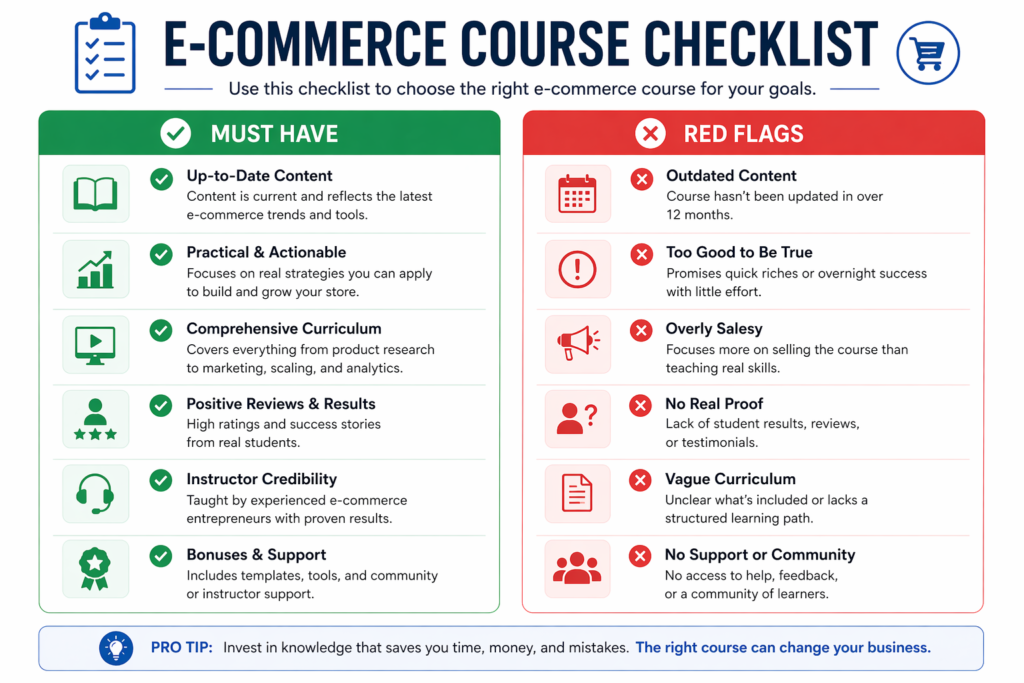
Must-Have Features Before Enrolling
Use this checklist before committing to any e-commerce course — free or paid:
- ✅ Instructor has verifiable, current e-commerce revenue or client results
- ✅ Course was updated within the last 12 months
- ✅ Curriculum covers your specific business model
- ✅ Includes hands-on projects or store-building exercises
- ✅ Has an active student community (forum, Slack, Facebook Group)
- ✅ Covers marketing and traffic generation — not just store setup
- ✅ Offers a refund window (minimum 14 days) for paid courses
Red Flags to Avoid
Equally important is knowing what to walk away from. These are the warning signs I’ve learned to recognize after evaluating dozens of programs:
- 🚩 Last updated in 2021 or earlier
- 🚩 Promises specific income claims (“Make $10K/month guaranteed”)
- 🚩 No verifiable instructor background or business examples
- 🚩 No hands-on component — purely lecture-based videos
- 🚩 Overly focused on one traffic channel with no broader strategy
- 🚩 No refund policy or money-back guarantee
- 🚩 Course primarily sold through hype-based Instagram or YouTube ads
Quick Decision Checklist
If you’re in decision mode right now, run through this 60-second filter:
- Does the instructor show real store dashboards or client results? (Yes → proceed; No → skip)
- Is this course updated for 2025 or 2026? (Yes → proceed; No → skip)
- Does it match my business model? (Yes → proceed; No → skip)
- Can I get a refund if it’s not right? (Yes → enroll; No → proceed with caution)
If you cleared all four, enroll immediately and start the first module the same day. Momentum is everything — the longer you wait after enrolling, the less likely you are to complete the course.
FAQ: Your Real Questions Answered
Is E-commerce a Course or a Career Path?
It’s both — and the distinction matters. E-commerce as a course is a structured curriculum that teaches you the mechanics of building and running an online store. E-commerce as a career path is an entire professional ecosystem that includes roles like e-commerce manager, digital marketing strategist, supply chain analyst, and brand director.
However, the most relevant answer for most readers is this: e-commerce is primarily a business skill set that you can learn through structured courses and apply immediately. Whether it becomes a career, a side income, or a full-time business depends entirely on how you apply what you learn. So yes — is e-commerce a course? Absolutely. But it’s also one of the most scalable business skill sets available in 2026.
What Are the 7 Major Types of E-commerce?
The 7 major types of e-commerce, classified by the parties involved in the transaction, are:
- B2C (Business-to-Consumer) — The most common model; brands sell directly to individual customers (e.g., Amazon, Nike’s website)
- B2B (Business-to-Business) — Companies sell products or services to other businesses (e.g., Alibaba, Salesforce)
- C2C (Consumer-to-Consumer) — Individuals sell to other individuals through a platform (e.g., eBay, Etsy, Facebook Marketplace)
- C2B (Consumer-to-Business) — Individuals offer services to businesses (e.g., Fiverr, Upwork, influencer marketing)
- B2G (Business-to-Government) — Companies provide goods or services to government agencies through procurement portals
- D2C (Direct-to-Consumer) — Manufacturers or brands sell directly to consumers without intermediaries
- Social Commerce — Transactions completed entirely within social media platforms (e.g., TikTok Shop, Instagram Shopping)
For most readers of this guide, B2C, D2C, and social commerce are the most relevant models to understand and build toward in 2026.
What Are the 7 Pillars of E-commerce?
I covered this in depth earlier in this guide, but as a quick reference, the 7 pillars of e-commerce that every store owner must master are: Product, Storefront, Traffic, Conversion, Retention, Operations, and Data & Analytics. These pillars function as an interconnected system — weakness in any one area creates a ceiling on your growth. A strong e-commerce course will touch on all seven, though different programs naturally emphasize different pillars based on their focus.
Will AI Replace E-commerce or Transform It?
This is one of the most common — and most misunderstood — questions I get asked. The short answer is: AI will not replace e-commerce. It will transform the execution of e-commerce in profound ways, but human judgment, brand creativity, customer relationship management, and strategic decision-making remain deeply human skills.
What AI is already doing — and will accelerate — includes:
- Automated product description writing and SEO optimization
- Personalized product recommendations at scale
- AI-powered chatbot customer service (24/7, instant response)
- Predictive inventory management and demand forecasting
- Dynamic ad creative generation and A/B testing automation
Therefore, the smarter question isn’t “will AI replace e-commerce?” — it’s “how do I use AI to outcompete everyone who isn’t using it?” The operators who embrace AI tools in 2026 will have a significant structural advantage over those who don’t. Our guide on free AI tools for students and professionals covers the exact tools e-commerce operators are already using to automate and scale faster.
Final Action Plan to Launch Your Store
7-Day Learning and Execution Plan
Here’s the exact 7-day plan I give to every new e-commerce student I work with. This isn’t a passive learning plan — it’s a build-while-you-learn framework designed to have you live within one week:
| Day | Focus | Action |
| Day 1 | Niche & Model | Choose your business model + validate niche with Google Trends & Reddit |
| Day 2 | Platform Setup | Set up Shopify free trial. Install a theme. Configure payment and shipping. |
| Day 3 | Product Research | Identify 3–5 hero products. Order samples or set up POD/dropshipping supplier. |
| Day 4 | Store Build | Write product descriptions, upload photos, create About and Policy pages. |
| Day 5 | Marketing Prep | Set up email capture. Create social profiles. Draft first 3 content posts. |
| Day 6 | Pre-Launch Review | Test checkout on mobile. Check page speed. Get 3 people to review your store. |
| Day 7 | LAUNCH | Go live. Publish first social post. Send to your personal network. Make your first sale. |
First Revenue Goal Strategy
Your first goal is not $10,000/month. Your first goal is $1 — your very first sale. That milestone matters more psychologically than any income projection, because it proves to you that the system works and that people will actually buy from you.
Therefore, your first 30-day revenue strategy should be brutally simple:
- One product — your validated hero product
- One traffic channel — organic social or a very small paid test budget
- One email capture mechanism — a simple pop-up with a 10% discount offer
- One revenue target — enough to cover your monthly platform fees
Once you hit that first sale, you have proof of concept. Then — and only then — should you start thinking about scaling, adding products, or expanding to new marketing channels.
💡 Pro Tip: Celebrate your first sale. Seriously. Screenshot it, share it in your course community, tell someone. That moment of validation is what keeps you going through the harder months ahead.
Long-Term Growth Roadmap
For those who want the 12-month horizon, here’s how I map sustainable e-commerce growth:
- Months 1–2: Launch, validate one product, hit first $500 in revenue
- Months 3–4: Optimize conversion rate, introduce email marketing, reach $1,500–$3,000/month
- Months 5–6: Scale best-performing ad campaigns, add 2–3 complementary products
- Months 7–9: Build brand identity, launch loyalty program, target $5,000–$8,000/month
- Months 10–12: Introduce automation, explore wholesale or B2B, or launch second brand
This isn’t a guarantee — e-commerce results vary widely based on niche, model, marketing execution, and product quality. However, this roadmap is what I’ve seen work consistently for motivated, execution-focused learners who treat their store as a real business, not a passive income fantasy.
If you’re building a team or developing leadership skills alongside your store, our guide on small business management courses and our resource onentrepreneurship courses for founders are both worth bookmarking for that growth phase.
Conclusion
Here’s what I want you to take away from this guide: the right e-commerce courses are not a silver bullet. They are a catalyst — a structure that dramatically accelerates your learning, reduces your mistakes, and gives you the confidence to actually launch and sell.
The best free e-commerce course in the world is worth exactly nothing if you don’t execute on what you learn. And the most expensive paid ecommerce course is a waste of money if you’re not genuinely committed to building something real.
So here’s my challenge to you: pick one course from this guide — free or paid — enroll today, and commit to the 7-day launch plan. Don’t wait until you “feel ready.” Don’t wait for perfect conditions. The e-commerce operators winning in 2026 are the ones who started before they were ready and learned by doing.
You now have everything you need. The next move is yours.
💡 Pro Tip: Bookmark this guide. Return to it as you progress through each stage. And when you make your first sale, come back and remember: it started with the decision to learn.