Introduction
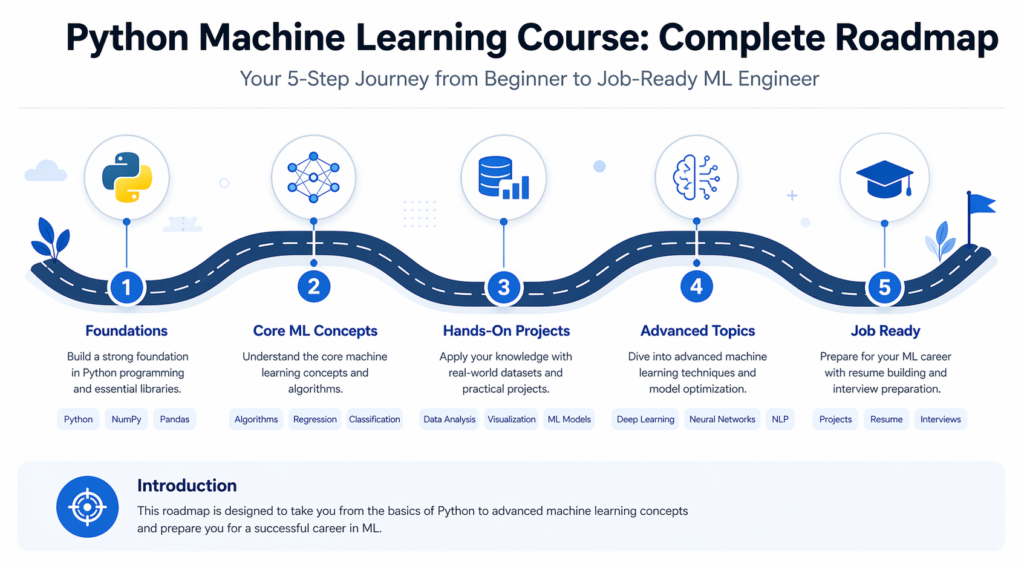
Let me be honest with you — when I first started looking for machine learning courses online, I was completely overwhelmed. There were hundreds of options. Coursera, Udemy, edX, YouTube tutorials, free PDFs, paid bootcamps. I didn’t know where to begin, and I wasted months jumping between courses without making any real progress.
Sound familiar? You’re not alone. Most people who fail to learn ML don’t fail because they’re not smart enough. They fail because they have no structure. They pick a random course, get lost in theory, skip the hard parts, and eventually quit.
That’s exactly why I wrote this guide. After years of studying, building real models, and helping others navigate the same confusion, I’ve put together a complete, battle-tested roadmap for machine learning courses online — from absolute beginner all the way through to advanced specialization and job readiness.
In 2026, ‘mastery’ doesn’t mean memorizing algorithms. It means building things. Deploying models. Solving real problems with real data. This guide will show you how to get there — step by step, without wasting time on the wrong things.
Whether you’re a complete beginner, a developer transitioning into AI, or a professional chasing a certification, this roadmap is built for you.
Who This Machine Learning Roadmap Is For
Before diving in, let me be clear about who will benefit most from following this roadmap. Machine learning is a broad field — however, this guide is structured to serve multiple types of learners at different stages.
Beginners Starting From Zero
If you’ve never written a line of Python or never heard the term ‘supervised learning,’ don’t worry. This roadmap starts with the basics and builds up progressively. In my experience, the biggest mistake beginners make is jumping straight into deep learning without understanding the fundamentals. We fix that here.
Therefore, if you’re brand new, the foundation stage is your starting point — and I’ll tell you exactly which machine learning course for beginners to take first.
Developers Transitioning Into AI/ML
If you already know how to code — Python, JavaScript, Java — you’re ahead of the curve. In fact, transitioning into ML as a developer is one of the smartest career moves in 2026. Your coding foundation means you can skip some of the early Python basics and go straight into core machine learning concepts.
I’d also recommend checking out this guide on top AI skills for 2026 — it pairs perfectly with the roadmap I’ve laid out here.
Data Analysts Moving Toward ML Roles
If you’re already working in data analytics, you have a significant head start. You understand data structures, querying, and visualization. The next step is learning how to move from describing data to predicting outcomes — and that’s where machine learning online courses come in.
The core ML concepts section of this roadmap is where you’ll get the most value, particularly around supervised learning and feature engineering.
Professionals Seeking Certification & Career Growth
Maybe you’re already in tech — maybe even in project management, cloud computing, or cybersecurity — and you want to add ML to your resume. In that case, this guide covers both the best machine learning courses with certificates and how to use those certifications strategically.
For professionals looking to expand credentials broadly, I’ve seen strong overlap with learners who also pursue AWS certification courses alongside ML training — a powerful combination in 2026.
Quick Answer: Best Way to Start Machine Learning in 2026
I know some of you want the bottom line first. Fair enough — here it is.
The 3-Stage Learning Path (Foundation → Practice → Specialization)
| ✅ Stage 1 — Foundation: Math basics, Python, and data handling (4–6 weeks) ✅ Stage 2 — Practice: Core ML algorithms + hands-on project work (6–10 weeks) ✅ Stage 3 — Specialization: Deep learning, NLP, or deployment (8–12 weeks) |
That’s the framework. Everything else in this guide fills in the details. However, the key insight here is that most people spend 80% of their time in Stage 1 and never actually build anything. Don’t do that.
Fastest Route vs Deep Learning Route (Which One You Should Choose)
| Factor | Fastest Route | Deep Learning Route |
| Goal | ML job / switch careers fast | Research / AI engineering |
| Timeline | 3–4 months | 6–12 months |
| Tools | Scikit-learn, Pandas | TensorFlow, PyTorch |
| Best For | Business analysts, developers | CS grads, researchers |
| Starting Course | Andrew Ng ML Specialization | Deep Learning Specialization |
What Actually Works in 2026 (Project-Based Learning Over Theory)
Here’s what I’ve learned after watching hundreds of learners go through this: theory without projects is useless. You can watch 200 hours of lecture videos and still not know how to train a model on real data.
What works is building projects as you learn. For every concept you study, you should immediately apply it to a small project. Therefore, the roadmap I’ve designed is built around this principle — not just course recommendations, but a progression of practical work.
Step-by-Step Machine Learning Course Roadmap
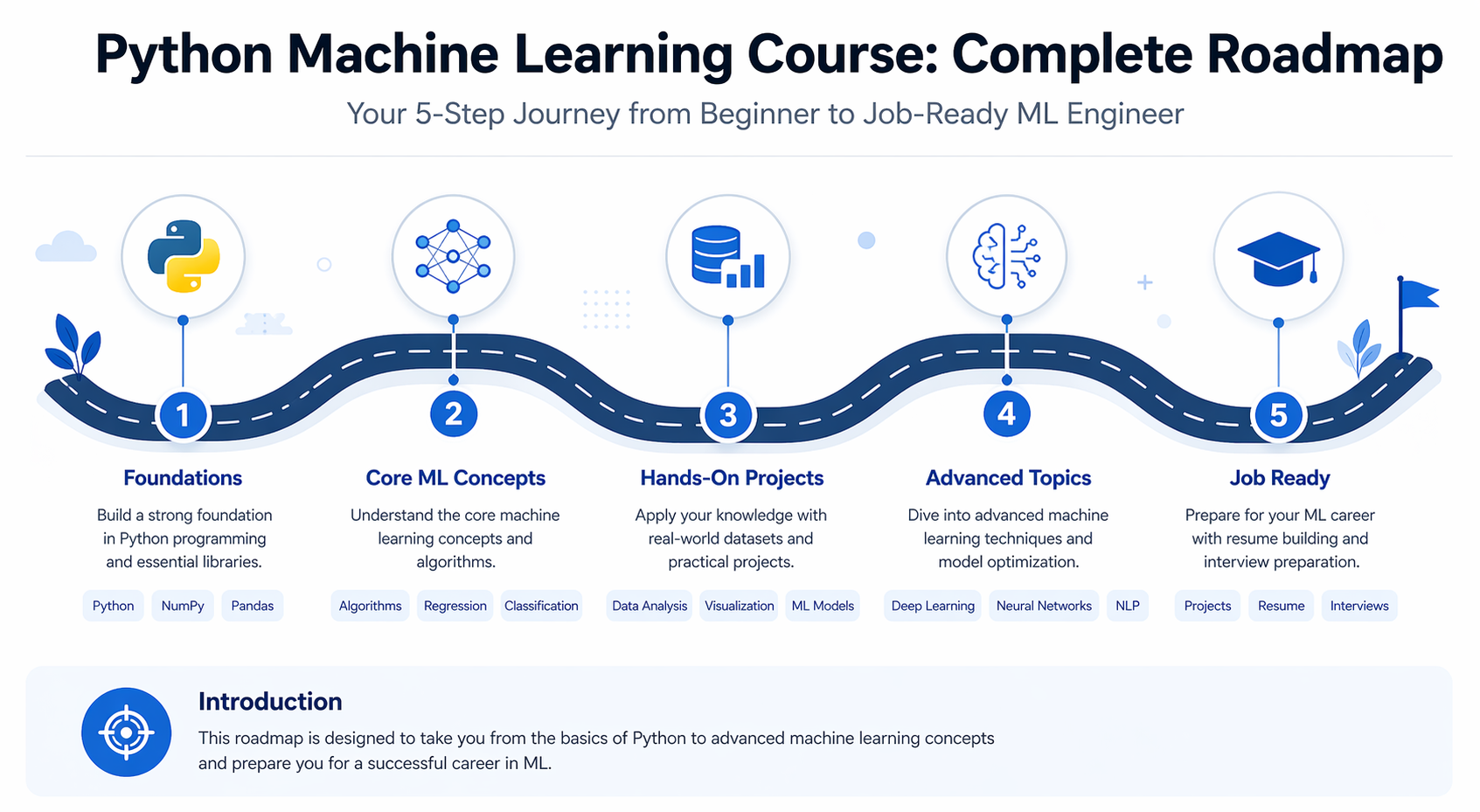
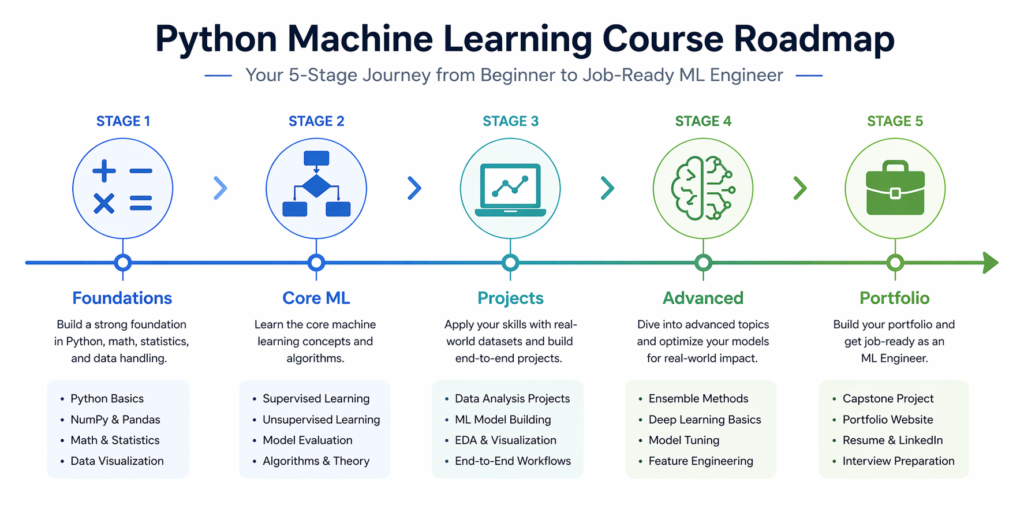
Now let’s get into the actual roadmap. I’ve broken this down into five progressive stages. Each stage builds on the last — so don’t skip ahead.
Stage 1 – Foundations That Actually Matter
Most beginners overthink this stage. You do NOT need a PhD in mathematics to do machine learning. However, you do need a working understanding of a few core areas:
- Linear algebra basics (vectors, matrices — Khan Academy covers this in a weekend)
- Statistics & probability (distributions, mean, variance, Bayes theorem)
- Python fundamentals (loops, functions, libraries like NumPy and Pandas)
- Data handling basics (CSV files, data cleaning, exploratory analysis)
In my experience, 3–4 weeks of focused study here is enough to move forward. Don’t get stuck perfecting your math. You learn the rest by doing.
If Python is completely new to you, start with this best Python course guide for 2026 before touching ML — it’ll make everything click faster.
Stage 2 – Core Machine Learning Concepts That Drive Results
This is where machine learning actually begins. Stage 2 focuses on the algorithms and concepts that form the backbone of 90% of real-world ML applications:
- Supervised learning: linear regression, logistic regression, decision trees, SVMs
- Unsupervised learning: K-means clustering, PCA, anomaly detection
- Model evaluation: accuracy, precision, recall, F1 score, cross-validation
- Feature engineering: handling missing data, encoding, normalization
I’ve tested this myself — understanding supervised vs unsupervised learning deeply is more valuable than skimming through 10 advanced topics. Therefore, spend real time here. Build small models. Break things. Fix them.
Stage 3 – Hands-On Projects That Build Real Skills
This stage is where most learners separate themselves from the crowd. Instead of watching more lectures, you need to build:
- A house price prediction model using regression
- A spam classifier using Naive Bayes or logistic regression
- A customer segmentation project using clustering
- An end-to-end ML pipeline with data cleaning, training, and evaluation
Use Kaggle datasets for this. Start with beginner competitions like Titanic survival prediction. The goal isn’t to win — it’s to practice the full workflow. In addition, document your code on GitHub as you go.
Stage 4 – Advanced Topics for Career Growth
Once you’ve completed real projects, you’re ready for advanced territory. This is where you can specialize based on your goals:
- Deep learning fundamentals (neural networks, backpropagation, CNNs, RNNs)
- Natural Language Processing (NLP) — text classification, transformers, LLMs
- Computer vision basics (image classification, object detection)
- Model deployment (Flask APIs, FastAPI, Docker, cloud hosting)
For context on how AI is changing broader fields, this piece on AI in education and machine learning is worth a read — it gives you a sense of where ML is being applied in the real world.
Stage 5 – Portfolio & Job-Ready Skills
A portfolio beats a certificate every single time. By Stage 5, your goal is to have 3–5 solid projects on GitHub, a clean LinkedIn profile, and at least one deployed ML model that someone can actually use.
- 3–5 ML projects on GitHub with clean READMEs
- One deployed model (Streamlit, Hugging Face Spaces, or AWS)
- A write-up or blog post explaining one project in depth
- Kaggle profile with at least 2–3 completed competitions
This portfolio is your proof of work — and in 2026, employers care far more about what you’ve built than which course certificate you hold.
Best Machine Learning Courses Online (2026 Picks)
I’ve gone through dozens of machine learning courses online over the years — some of them excellent, many of them disappointing. Here are my honest picks for 2026, organized by level.
Best Beginner Courses That Build Strong Foundations
| Course | Platform | Duration | Best For |
| ML Specialization – Andrew Ng | Coursera | ~3 months | Beginners & career switchers |
| Intro to ML – Google | Google ML Crash Course | 15 hours | Quick overview |
| Python for ML – Jose Portilla | Udemy | 25 hours | Developers new to ML |
| Machine Learning A-Z | Udemy | 44 hours | Hands-on project learners |
New to the AI/ML world entirely? Start with this beginner-friendly guide on AI courses for beginners — it’ll help you pick your first course with confidence.
Intermediate Courses That Focus on Real Projects
Once you’ve completed a beginner course, the next step is applied learning. These intermediate-level machine learning online courses are where things get practical:
- Fast.ai — Practical Deep Learning for Coders: Hands down the best project-first ML course online. Free. Extremely practical.
- Applied Machine Learning (Udemy, various instructors): Great for working through real datasets.
- Kaggle’s free ML micro-courses: Bite-sized, practical, and completely free — ideal for reinforcing concepts with real data.
At this stage, the key isn’t finding the ‘perfect’ course — it’s combining structured learning with daily project practice. Therefore, spend at least 50% of your learning time actually coding.
Advanced Courses for Specialization (AI, Deep Learning)
- Deep Learning Specialization – Andrew Ng (Coursera): The gold standard for learning neural networks, CNNs, RNNs, and transformers.
- Full Stack Deep Learning (Berkeley): Covers MLOps, deployment, and production systems.
- CS231n – Stanford Computer Vision: If you want to specialize in image/vision AI, this is world-class.
- Hugging Face NLP Course (free): The best resource for natural language processing in 2026.
Best Structured Learning Paths vs Random Course Selection
Here’s a mistake I see constantly — people buy 6 courses from different platforms, watch 20% of each, and wonder why they aren’t making progress. Structured learning paths work. Random course selection doesn’t.
My recommendation: pick ONE platform, follow ONE structured path from start to finish, and only switch if you’ve genuinely exhausted what it offers. Consistency always beats variety.
Coursera Machine Learning Courses – Are They Still Worth It?
This is one of the most common questions I get — and the honest answer is: yes, but it depends on how you use them. Let me break it down.
Andrew Ng Machine Learning Course Breakdown (What You Really Learn)
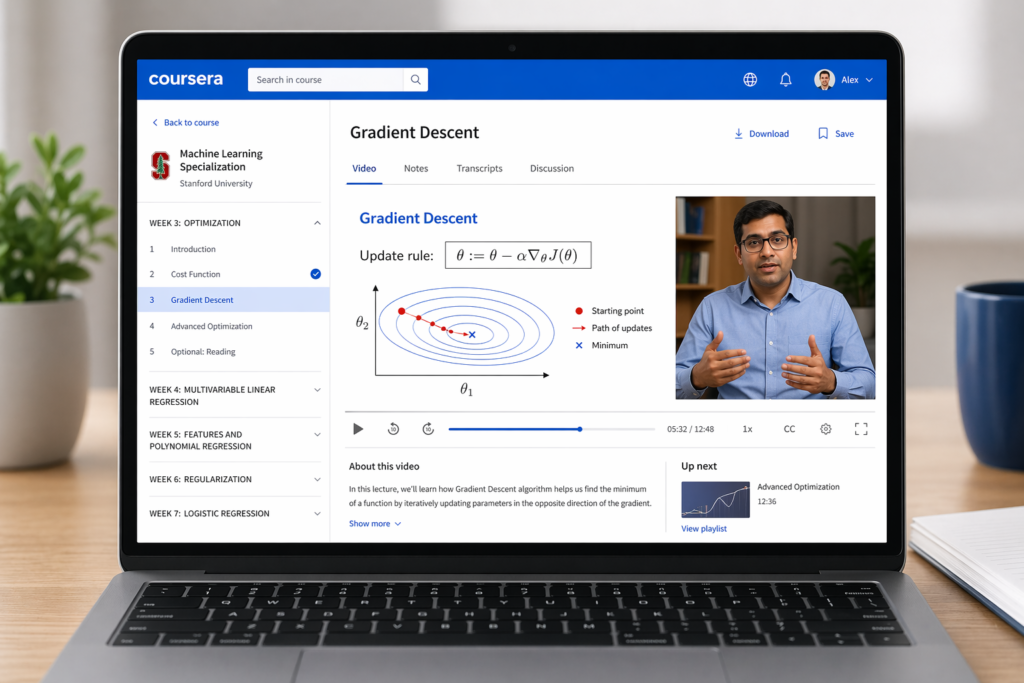
The Machine Learning Specialization by Andrew Ng on Coursera is arguably the most influential ML course ever created. I’ve completed it — and I’ll tell you exactly what you get:
- Week-by-week progression from linear regression to neural networks
- Intuitive explanations of math without overwhelming jargon
- Python-based labs using NumPy and TensorFlow
- Real-world framing of every concept
What I appreciate most is how the course machine learning content is taught with clarity and patience. Andrew Ng genuinely makes hard concepts accessible. However, the course is more theoretical than project-heavy — so you’ll want to supplement with Kaggle practice.
Coursera ML Courses vs Other Platforms (Udemy, edX, etc.)
| Platform | Best For | Price Range | Certificate? |
| Coursera | Structured, career-focused | $49–$79/month | Yes (verified) |
| Udemy | Practical, project-heavy | $10–$20 (sale) | Yes (completion) |
| edX | Academic depth, university courses | Free audit / $150+ | Yes (paid) |
| Fast.ai | Hands-on, project-first | Free | No |
| Kaggle Learn | Micro-skills, practical | Free | Yes (free) |
Pros and Limitations of Coursera in 2026
Pros:
- University-backed courses with strong brand recognition
- Verified certificates that carry weight with employers
- Well-structured, progressive curriculum
- Financial aid available for those who qualify
Limitations:
- Can be expensive without financial aid
- Lighter on real-world project work compared to Fast.ai or Kaggle
- Certificate alone won’t get you hired — you still need a portfolio
Who Should Choose Coursera (and Who Should Not)
Choose Coursera if: you want a structured path, you value recognized certificates, you’re new to ML, or your employer may sponsor the cost.
Skip Coursera if: budget is very tight (free alternatives are nearly as good), you learn better by doing than watching, or you’re already past the intermediate stage.
Free vs Paid Machine Learning Courses – What Actually Works
The free vs paid debate in online learning is one I’ve thought about a lot. Here’s the honest truth: free courses have gotten dramatically better. However, paid courses still offer advantages in structure and accountability.
Free Courses That Deliver Real Value (Not Just Theory)
- Google’s Machine Learning Crash Course — Practical and fast. Perfect for developers.
- Fast.ai — Arguably the best hands-on ML course in the world. Completely free.
- Kaggle Learn — Short, focused modules with immediate practice on real data.
- Stanford CS229 (YouTube) — The academic deep-dive. Lecture recordings are free.
- Hugging Face NLP Course — Essential for anyone interested in language models.
I’ve recommended these free machine learning courses online to dozens of people — and many of them landed jobs without spending a dime on paid courses. Therefore, don’t let anyone tell you that free means inferior.
Paid Courses That Are Worth the Investment
- Andrew Ng’s ML Specialization on Coursera (~$49/month): Worth every penny for structure.
- Deep Learning Specialization on Coursera: Best deep learning curriculum available.
- Udemy ML A-Z (~$15 on sale): Extremely practical, regular price drops make it affordable.
- DataCamp ML Track: Great for data-focused learners, interactive coding environment.
Free vs Paid: ROI Comparison for Career Growth
| Factor | Free Courses | Paid Courses |
| Cost | $0 | $10–$200+ |
| Structure | Variable (self-directed) | High (guided path) |
| Certificate Value | Limited (Kaggle, Google) | Higher (Coursera verified) |
| Project Focus | High (Kaggle) | Medium to high |
| Best ROI Move | Free courses + portfolio | Paid cert + portfolio |
When Free Courses Are Enough (And When They Are Not)
Free courses are enough when: you’re self-disciplined, you supplement with Kaggle projects, and you focus on building a portfolio over collecting certificates.
Free courses are NOT enough when: you need the accountability of a paid structure, your career requires recognized certificates, or you’re applying to employers who specifically list certain credentials.
Certifications That Actually Matter in Machine Learning
Let me be upfront here — certifications are useful, but they’re not the hiring factor most people think they are. Here’s how they actually work in the real world.
Do Certificates Help You Get a Job in 2026?
In my experience: yes, but only when paired with a strong portfolio. A certificate without projects is like a food critic who’s never eaten at a restaurant. It signals effort, but not capability.
That said, certifications do open doors — particularly in larger companies with formal HR screening, corporate training programs, or roles that explicitly list credential requirements.
Best Machine Learning Courses with Certificates
- Machine Learning Specialization — Coursera / DeepLearning.AI (most recognized)
- IBM Machine Learning Professional Certificate — Coursera (great for enterprise roles)
- Google Professional Machine Learning Engineer — GCP (highly valued in cloud-ML roles)
- Kaggle Certificates (free) — Widely respected in data science communities
- Microsoft Azure AI Engineer Associate — Strong for Azure-integrated ML roles
For those pursuing cloud-based ML work, pairing your ML certificate with an AWS certification is a combination I’ve seen lead to strong salary outcomes in 2026.
How to Use Certificates to Boost Your Resume
Don’t just list the certificate — show what you did with it. For example, instead of ‘Completed ML Specialization on Coursera,’ write ‘Completed ML Specialization and applied knowledge to build a predictive model for customer churn reduction, deployed as a REST API.’
That one sentence tells a recruiter three things: you learned, you applied, and you shipped something real.
Common Misconceptions About Certifications
- Misconception: A certificate = a job offer. Reality: It’s a signal, not a guarantee.
- Misconception: More certificates = more employable. Reality: One strong certificate + 3 portfolio projects beats 5 certificates with no portfolio.
- Misconception: You need a degree to get a certificate. Reality: All major ML certificates are degree-free.
- Misconception: Free certificates have no value. Reality: Kaggle and Google free certificates are respected across the industry.
Tools & Platforms You Need Alongside Courses
Taking machine learning courses online without using the right tools is like studying cooking without ever touching a knife. Here’s what your learning stack should look like.
Essential Tools (Python, Jupyter, TensorFlow, Scikit-learn)
- Python 3.10+: The language of ML. Non-negotiable.
- Jupyter Notebooks: Your daily workspace for experimentation.
- NumPy & Pandas: For data manipulation and analysis.
- Scikit-learn: The go-to library for classical ML algorithms.
- TensorFlow & Keras: For deep learning models and neural networks.
- PyTorch: Gaining ground fast — preferred in research and modern deep learning.
- Matplotlib & Seaborn: For data visualization.
Platforms for Practice (Kaggle, GitHub, Colab)
- Kaggle: The best platform for ML practice, datasets, and competitions. Also offers free GPU.
- Google Colab: Free cloud notebook environment with GPU support. No installation needed.
- GitHub: Where your portfolio lives. Every project you build should be here.
- Hugging Face: Essential for NLP projects and model sharing.
- Weights & Biases: Experiment tracking for serious ML work.
You might also find value in these free AI tools for students and professionals — several of them integrate well with an active ML learning workflow.
How to Combine Courses with Hands-On Practice
Here’s the framework I use: For every concept I learn in a course, I immediately apply it in a Colab notebook. Then I push the notebook to GitHub. Then I find a related Kaggle dataset and try to apply the same technique there.
It sounds simple — and it is. However, most learners skip the application step and wonder why knowledge doesn’t stick. Practice is where learning happens.
Learning Stack Setup for Beginners
| Week 1: Install Python, set up VS Code, create a GitHub account Week 1: Create a Kaggle account, complete the ‘Python’ micro-course Week 2: Start Google Colab — run your first notebook Week 2: Install NumPy, Pandas, and Matplotlib — follow along with your ML course Week 3+: One Kaggle dataset per week, one GitHub push per week |
Common Mistakes That Kill Your Machine Learning Progress
I’ve seen the same mistakes over and over — from beginners and intermediate learners alike. Learning from these will save you months of frustration.
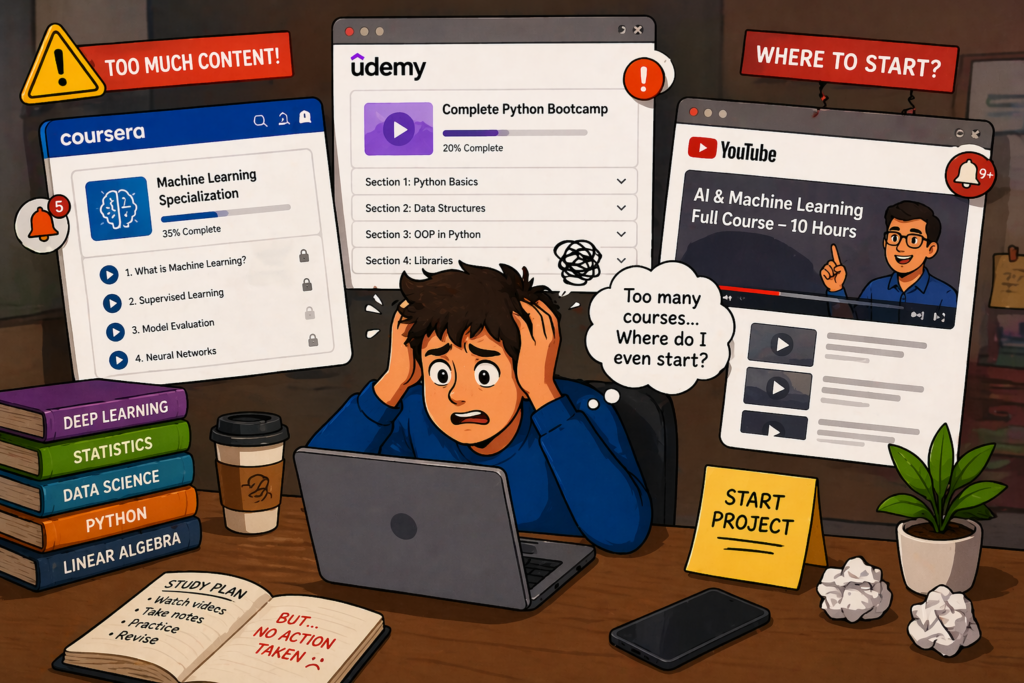
Taking Too Many Courses Without Practice
I call this ‘tutorial hell.’ You feel productive because you’re watching lectures, taking notes, and completing quizzes. But you’re not actually coding. You’re not solving real problems. As a result, nothing sticks.
The fix: For every hour of video content, spend at least one hour writing code. No exceptions.
Ignoring Projects and Real-World Data
Textbook datasets like Iris flowers or MNIST digits are fine for learning concepts. However, they don’t prepare you for real work — where data is messy, incomplete, and unpredictable.
Start using real-world datasets from Kaggle, UCI Machine Learning Repository, or government open data portals as soon as possible. The earlier you face real data problems, the better.
Chasing Certificates Instead of Skills
A certificate signals that you completed a course. It doesn’t signal that you can actually do the job. I’ve interviewed people with four ML certificates who couldn’t build a basic logistic regression from scratch.
In 2026, employers increasingly use take-home projects and coding assessments — not certificate screening — to evaluate ML candidates. Skills first. Certificates second.
Skipping Fundamentals and Getting Stuck Later
This is the classic beginner trap: jumping straight into deep learning because it sounds impressive, then getting completely lost when you encounter backpropagation or gradient descent.
Build your foundation first. Understand supervised learning deeply. Understand what a loss function is and why it matters. Then move to advanced topics. I promise — the advanced content makes so much more sense when the foundation is solid.
Beginner vs Advanced Learning Strategy
The right strategy depends entirely on where you are right now. Here’s how I’d approach each level.
Beginner Path (Structured + Guided Learning)
As a beginner, your enemy is confusion. Therefore, your strategy should prioritize structure above everything else. Pick one course, follow it completely, and resist the urge to jump around.
Recommended path: Google ML Crash Course → Andrew Ng ML Specialization → 2 Kaggle beginner competitions.
Timeline: 8–12 weeks of consistent daily study (1–2 hours per day minimum).
Intermediate Path (Projects + Case Studies)
At the intermediate level, you understand the basics but you’re not yet confident applying them to new problems. The strategy here is exposure — seeing as many different use cases and datasets as possible.
Focus on: Kaggle competitions, real-world case studies, reading ML papers (start with Google Scholar), and contributing to open-source projects on GitHub. At this stage, your learning is more self-directed and problem-driven.
Advanced Path (Specialization + Deployment)
Advanced learners need to stop breadth-skimming and go deep into one specialization — whether that’s NLP, computer vision, reinforcement learning, or MLOps. In addition, the ability to deploy models is becoming a mandatory skill in 2026. Focus on: Docker, FastAPI or Flask, cloud platforms (AWS SageMaker, GCP Vertex AI), and production-level model monitoring. If you’re pursuing MLOps or deployment skills, our guide on top AI skills for 2026 including MLOps and Generative AI covers exactly what employers are looking for right now.
How to Transition Between Levels Efficiently
The sign that you’re ready to move from beginner to intermediate: you can train a basic model on a new dataset without looking up every step. You’ve done it at least 5 times.
The sign you’re ready for advanced work: you’ve completed 3+ Kaggle competitions and you can explain your modeling decisions clearly. At that point, specialization is your next move.
Practical Checklist to Start Machine Learning Today
Enough planning — let’s get specific. Here’s exactly what to do starting today.
Step-by-Step Action Plan (Day 1 → 90 Days)
- Day 1–7: Set up Python, Jupyter, GitHub account. Complete Kaggle Python micro-course.
- Day 8–21: Start Google ML Crash Course. Build your first linear regression in Colab.
- Day 22–45: Begin Andrew Ng ML Specialization (Coursera). Complete first 2 modules.
- Day 46–60: Enter your first Kaggle beginner competition (Titanic). Submit predictions.
- Day 61–75: Complete ML Specialization. Build a classification project on a real dataset.
- Day 76–90: Polish GitHub, document 2 projects with READMEs. Update LinkedIn.
| Day | Activity | Goal |
| Mon–Tue | Course lecture + notes | Learn new concept |
| Wed | Implement concept in Colab | Code it yourself |
| Thu | Kaggle dataset practice | Apply to real data |
| Fri | GitHub commit + document | Build portfolio habit |
| Sat | Review + optional lecture | Reinforce learning |
| Sun | Rest or light reading | Avoid burnout |
Course Selection Checklist (Avoid Wrong Choices)
- ✅ Does the course include hands-on coding exercises?
- ✅ Is it updated for 2025/2026 content and tools?
- ✅ Does it use Python (not R or pseudocode)?
- ✅ Are there real datasets used — not just toy examples?
- ✅ Is the instructor credible with real-world ML experience?
- ❌ Avoid: courses with no coding, no projects, or last updated pre-2022.
- ❌ Avoid: courses that promise ‘ML mastery in 3 days’ — they’re marketing, not learning.
Project Milestones to Track Progress
- Milestone 1 — First Model: Train a linear regression on any dataset. Evaluate with RMSE.
- Milestone 2 — Classification Project: Build a spam classifier or churn predictor.
- Milestone 3 — Kaggle Submission: Make your first competition submission (any score).
- Milestone 4 — End-to-End Pipeline: Data → Training → Evaluation → Prediction output.
- Milestone 5 — Deployment: Serve a model as an API or deploy to Hugging Face Spaces.
FAQ – Machine Learning Courses Online
Which machine learning course is best for beginners?
In my experience, the Machine Learning Specialization by Andrew Ng on Coursera is the best structured starting point. If budget is a concern, the Google Machine Learning Crash Course is an excellent free alternative. Both are beginner-friendly and well-paced.
Are free machine learning courses enough to get a job?
Yes — if you pair them with a strong project portfolio. I’ve seen learners land ML engineer roles using only free courses (Fast.ai, Kaggle Learn, Google MLCC) combined with 3–4 solid GitHub projects. The portfolio is the deciding factor, not the payment method.
Is Coursera machine learning worth it in 2026?
For most learners — yes. The Andrew Ng ML Specialization on Coursera remains one of the clearest, most comprehensive machine learning courses available anywhere. The verified certificate holds real weight in hiring, and the financial aid option makes it accessible. However, supplement it with Kaggle practice for hands-on reinforcement.
Can I learn machine learning without a degree?
Absolutely — and thousands of people do it every year. In 2026, ML hiring is increasingly portfolio and skills-based, not degree-based. Many ML engineers working at top tech companies are self-taught or bootcamp-trained. What matters is what you can build and demonstrate.
This is also true in adjacent fields — see how self-learners are advancing with Google Data Analytics certifications as a real-world example of credential-based career switching.
How long does it take to complete machine learning courses?
It depends on your starting point and how much time you invest daily. As a general guideline: beginners with 1–2 hours per day can complete a foundational ML course in 8–12 weeks. Reaching job-readiness — with a solid portfolio — typically takes 4–6 months of consistent effort.
Final Action Plan to Master Machine Learning
This is where everything comes together. Whether you have 30 days or 6 months, here’s the exact path forward.
30-Day Quick Start Plan
Goal: Get from zero to building your first ML model with Python.
- Week 1: Python basics + NumPy + Pandas (Kaggle Python micro-course)
- Week 2: Google ML Crash Course — complete it fully
- Week 3: Andrew Ng ML Specialization — Module 1 (regression, cost functions)
- Week 4: Build and document a linear regression project. Push to GitHub.
90-Day Skill-Building Strategy
Goal: Complete a full ML course and build 2 portfolio projects.
- Month 1: Foundation + Andrew Ng ML Specialization Modules 1–2
- Month 2: Classification, clustering + Kaggle beginner competition entry
- Month 3: End-to-end project pipeline + GitHub portfolio polish + LinkedIn update
6-Month Job-Ready Roadmap
Goal: Be ready to apply for entry-level ML / data science roles.
- Months 1–2: Full foundation + ML Specialization completion
- Months 3–4: 2 Kaggle competitions + intermediate course (Fast.ai or Udemy)
- Month 5: Deep Learning Specialization (first 2 courses) + deployed project
- Month 6: Portfolio finalization, resume building, interview preparation
As you approach job readiness, don’t overlook soft skills — a strong resume writing course can dramatically improve how your ML experience is presented to hiring managers.
Long-Term Growth Strategy in AI/ML
Machine learning is not a destination — it’s a discipline that evolves constantly. The learners who thrive long-term are those who stay curious, keep building, and stay connected to the community.
Long-term habits to build:
- Follow ML research through arXiv, Papers With Code, and Google Scholar
- Contribute to open-source ML projects on GitHub
- Write about what you’re building (blog posts, LinkedIn articles)
- Attend ML conferences virtually — NeurIPS, ICML, ICLR recordings are free online
- Stay updated on prompt engineering and generative AI developments
For the generative AI side of your learning, this ChatGPT prompt engineering guide and our dedicated prompt engineering course guide are excellent companions to your ML journey.
Conclusion
Let me leave you with this: the best machine learning course online is the one you actually finish and apply. It doesn’t matter whether it’s free or paid, Coursera or Kaggle, beginner or advanced — what matters is that you build something real with what you learn.
The roadmap I’ve shared here is the one I wish I had when I started. Five progressive stages, honest course recommendations, a practical checklist, and a clear action plan. Everything you need to go from confusion to competence.
Machine learning isn’t magic — it’s a skill. And like any skill, it responds to consistent, focused practice. Start today. Build something this week. Push it to GitHub. Then move to the next stage.
You’ve got everything you need. The only thing left is to begin.