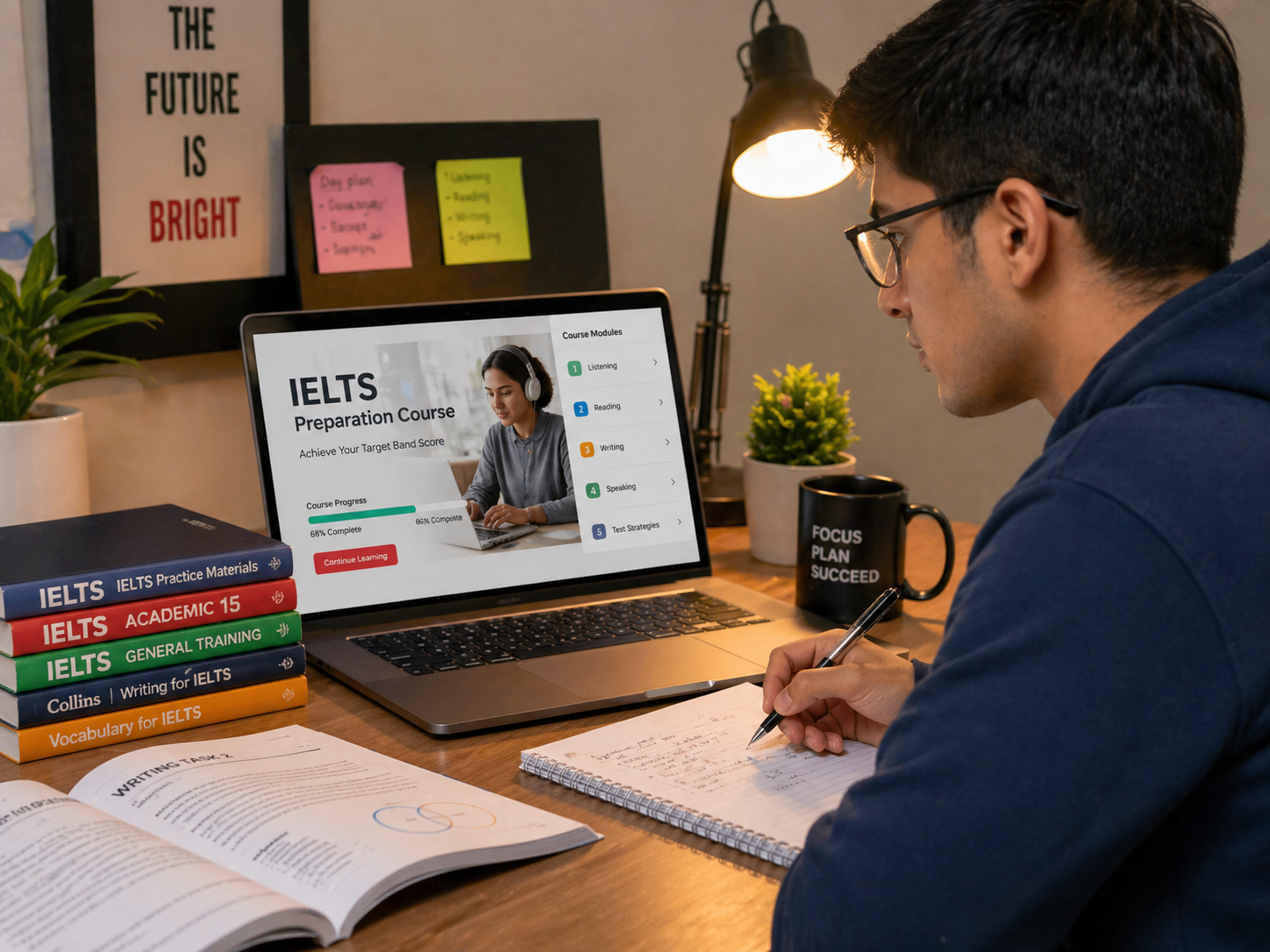
Here is a hard truth most test prep guides won’t tell you: the reason most IELTS candidates fail to hit their target band score has nothing to do with their English level. I have seen this pattern repeat itself countless times — motivated students, hours of study, and still stuck at band 5.5 or 6. The real problem is lack of structure, not lack of effort.
| ⚡ QUICK TAKE: If you have been studying for IELTS without a clear plan, a focused course, and targeted practice — you are leaving band score points on the table. This guide changes that. |
In this complete IELTS preparation guide, I am going to walk you through everything that actually moves the needle: the best online IELTS preparation courses (free and paid), the exact study plan framework that pushes you toward band 7 and above, and the most common mistakes I watch test-takers make — so you can avoid every single one of them.
Whether you are a complete beginner, stuck somewhere in the band 5–6 range, or a professional with limited time, there is a clear path forward. Let me show you what it looks like.
Quick Answer — What Actually Works in IELTS Preparation (2026)
If you are here for the fastest possible answer before diving deeper, here it is: the candidates who consistently improve their band scores are the ones who combine a structured IELTS preparation course with deliberate daily practice and honest self-assessment. That combination — not cramming, not passive watching — is what delivers results.
The 80/20 Strategy Most Test-Takers Miss
After years of watching IELTS candidates succeed and fail, I keep coming back to the same observation: 80% of your score improvement comes from about 20% of your preparation activities. Those high-leverage activities are timed mock tests, skill-specific drills with feedback, and understanding the IELTS band descriptors inside out.
Most people do the opposite. They re-watch video lessons. They highlight notes. They do practice reading passages without timing themselves. That is passive learning — and it does not transfer to exam performance. The moment you start treating every practice session like the real exam, everything changes.
But here is the problem most IELTS courses will not address: knowing what to study is different from knowing how to practice. A great IELTS online course gives you both — and I will tell you exactly which ones do that below.
Best Type of IELTS Course Based on Your Level
Not every IELTS preparation course is built for the same person. Here is a quick map before we go deeper:
- Band 4–5: You need a foundational course with grammar support and listening basics
- Band 5–6: You need a structured IELTS online course with task-specific strategies
- Band 6–7+: You need expert feedback on writing and speaking, plus timed full mocks
Now here is what actually works — matching your course type to your actual level, not what you wish your level was. Being honest about where you are starting from is the single most important decision you will make in your IELTS preparation journey.
Free vs Paid Courses — What’s Worth It?
The free vs paid question comes up every time. Here is my honest take after going through both: free IELTS preparation courses are genuinely useful for understanding the exam format, building vocabulary, and getting familiar with question types. However, if you need expert feedback on your writing, structured progression, and accountability, a paid IELTS prep course fills that gap in ways free resources simply cannot.
Most people actually need a combination of both — and I will break that down in detail in the course comparison section later in this guide.
Who This IELTS Preparation Guide Is For
Before we go further, I want to be clear about who this guide was written for. Because the right IELTS preparation strategy is very different depending on where you are starting from.
Beginners Starting From Scratch
If you have never taken IELTS before and you do not know what to expect from the exam, this guide will give you a full orientation. You will learn what the four skills test, what free IELTS preparation materials to start with, and how to build a realistic timeline before your exam date.
One thing I always tell beginners: do not let the exam format intimidate you. IELTS is a test of practical English — and with the right IELTS online course and consistent practice, most motivated beginners see significant progress within eight to twelve weeks.
Students Stuck at Band 5–6
This is honestly the most common situation I encounter. You are not a beginner — you understand English well enough — but your band score is stuck. This plateau happens for a specific reason: you are practicing, but not the right things. You are studying, but without targeted feedback.
Most people stuck at band 5–6 need to stop taking more mock tests and start deeply analyzing why they are losing marks. The sections below on IELTS exam practice mistakes will be particularly important for you.
Working Professionals With Limited Time
IELTS preparation with a full-time job is genuinely difficult — but far from impossible. The key is efficiency. You do not need three hours a day. You need thirty to forty-five focused minutes, a clear weekly plan, and the right IELTS online classes or self-study tools that respect your schedule.
I will cover time-efficient IELTS training options and apps that let you practice on the go. Even fifteen minutes of smart listening practice on your commute compounds into serious improvement over twelve weeks.
Top Online IELTS Preparation Courses (Free & Paid)
Let me be direct: there are hundreds of IELTS preparation courses online, and most of them are mediocre. What follows is what I actually recommend based on quality, structure, and real score impact.
Best Free IELTS Preparation Courses (With Certificate Options)
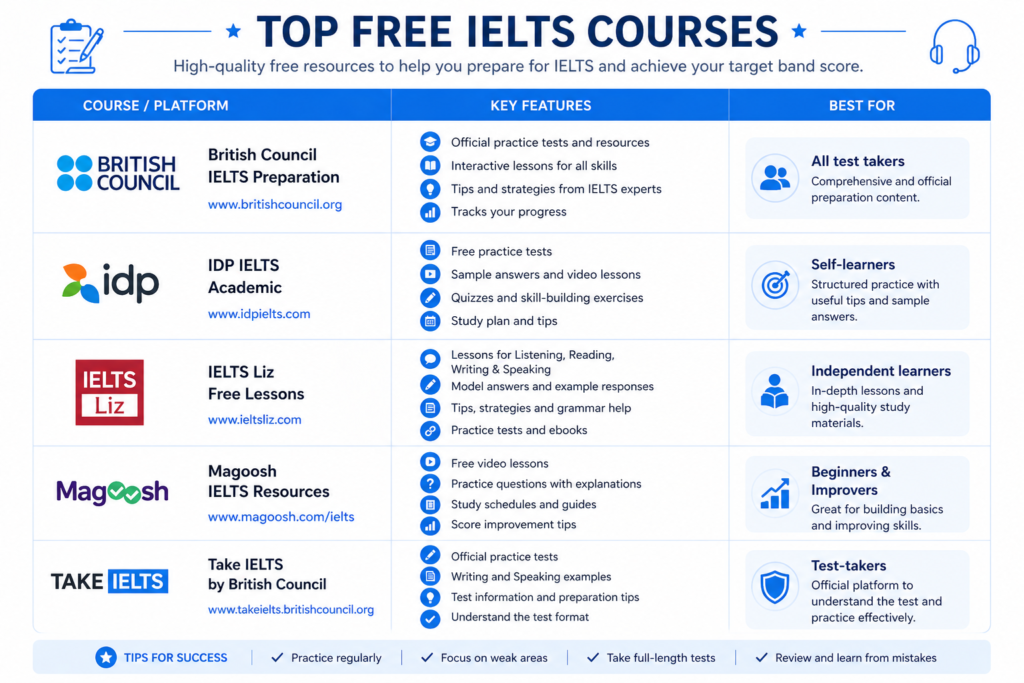
British Council — IELTS Online Practice: The British Council offers a free IELTS preparation course through FutureLearn. This is one of the most credible free options available — built by the same organisation that administers the IELTS exam itself. The course covers all four skills, includes sample answers, and provides a certificate of completion. The British Council IELTS course free tier gives you solid exam familiarity, though the premium certificate version carries a small fee.
IELTS.org Official Practice Materials: The official IELTS website provides free sample test questions, listening audio, and writing task samples directly from the exam bodies. This is non-negotiable as a starting point for any IELTS preparation. These are the real question formats — use them.
Coursera — IELTS Preparation (University of California, Irvine): Available to audit for free, this course is structured, university-backed, and covers test strategy for all four sections. The IELTS preparation course online free audit option gives you access to most content without paying. For a certificate, there is a fee — but the learning content itself is accessible at no cost.
E2 IELTS on YouTube: One of the most popular free IELTS training channels online. The speaking and writing strategy videos are particularly strong. While it is not a formal IELTS preparation course online free with certificate, the quality of the teaching rivals many paid programmes.
IELTS Liz: A free website packed with lessons, tips, model answers, and free IELTS preparation material. IELTS Liz is especially useful for writing and speaking strategies. The site’s simplicity is a feature — everything is straightforward and actionable.
Best Paid IELTS Courses That Deliver Results
Magoosh IELTS: One of the most popular paid IELTS prep courses globally. Magoosh offers video lessons, practice questions, full-length mock tests, and email support from tutors. The structured progression — from concept lessons to timed practice — makes it particularly effective for candidates targeting band 6.5 to 7.5. Pricing is competitive for the content volume provided.
IELTS Advantage: Built by experienced IELTS examiners, IELTS Advantage focuses heavily on academic writing and speaking. If your writing is your weakest point — which it is for the majority of test-takers — this is among the best IELTS preparation courses available. The examiner-written model answers and detailed marking feedback are genuinely excellent.
British Council Premium (via FutureLearn): Upgrading to the paid tier of the British Council IELTS preparation course gives you graded assignments, examiner feedback, and a recognised certificate. For those weighing the British Council IELTS preparation course fee, the upgrade is worth it if you need a certificate for visa or academic applications.
Udemy — IELTS Band 7+ (Ryan Higgins): A highly rated IELTS online course available at a low one-time cost, especially during Udemy’s frequent sales. Covers all four skills with practical strategies and sample answers. Good value for self-directed learners who want a comprehensive paid resource without a subscription commitment.
IELTS.org — Official Practice Tests Plus: Official paid practice tests from the exam body itself. These are the closest simulation to the real exam you will find. If your focus is timed exam practice with authentic question sets, this is essential for your final four weeks of preparation.
Which Course Should YOU Choose? (Decision Framework)
Here is my straightforward decision framework. Ask yourself three questions:
- Do you have a budget? If not, start with British Council free + IELTS Liz + E2 IELTS on YouTube.
- What is your biggest weakness? Writing and speaking need feedback — invest in a paid course for those. Listening and reading can be improved significantly with free IELTS preparation material and timed practice.
- How much time do you have? Less than 8 weeks to exam? Invest in a structured paid course. More than 12 weeks? Build with free resources and only pay for mock test packages and writing feedback.
Free IELTS Preparation Resources That Actually Help
Even if you choose a paid IELTS prep course, these free resources will significantly amplify your results. Think of them as the tools you use alongside your main course — not instead of it.
Best IELTS Preparation Books (Beginner to Advanced)
Books remain among the most reliable IELTS preparation materials, because they contain authentic question formats and structured exercises you can work through methodically.
- Cambridge IELTS Series (Books 1–18): The gold standard. These are official practice tests published by Cambridge — the same organisation that writes the real exam. Work through at least four to six books under timed conditions.
- The Official Cambridge Guide to IELTS: Ideal for beginners. Covers all four skills, includes full practice tests, and explains band descriptors clearly.
- Barron’s IELTS Superpack: Strong for vocabulary building and grammar reinforcement. Good supplementary IELTS preparation material for candidates at band 5–6.
- Collins English for IELTS Series: Skill-specific books for reading, writing, listening, and speaking. Useful when you want to isolate and drill one particular area.
Free IELTS Preparation Materials and PDFs
Alongside books, there is a wealth of IELTS preparation course PDF material available freely online. Be selective — quality varies enormously. These sources I trust:
- IELTS.org sample questions and audio (official, free)
- British Council IELTS preparation PDF worksheets (available through their website)
- IELTS Liz free PDF downloads (writing task 2 essay structures, speaking cue cards)
- Road to IELTS free tier (British Council’s digital platform with interactive lessons)
Most people spend too much time collecting IELTS preparation course PDF files and too little time actually working through them. Download two or three focused PDFs and use them completely before reaching for more.
Practice Platforms for Real Exam Simulation
The best IELTS exam practice happens under real conditions — timed, without pausing, with a proper answer sheet. These platforms simulate the experience well:
- IELTS.org Official Practice Tests — the most authentic simulation available
- British Council Road to IELTS — interactive practice with instant scoring for reading and listening
- Exam English (examenglish.com) — free practice tests across all four skills
- IELTS Mock Test (ieltsmocktest.com) — free full-length practice tests with instant scoring
Step-by-Step IELTS Preparation Plan (Band 7+ Framework)
This is the section most IELTS guides skip because building a real study plan requires specificity — and specificity requires taking a position. Here is the framework I have seen produce consistent band 7+ results when followed with genuine discipline.
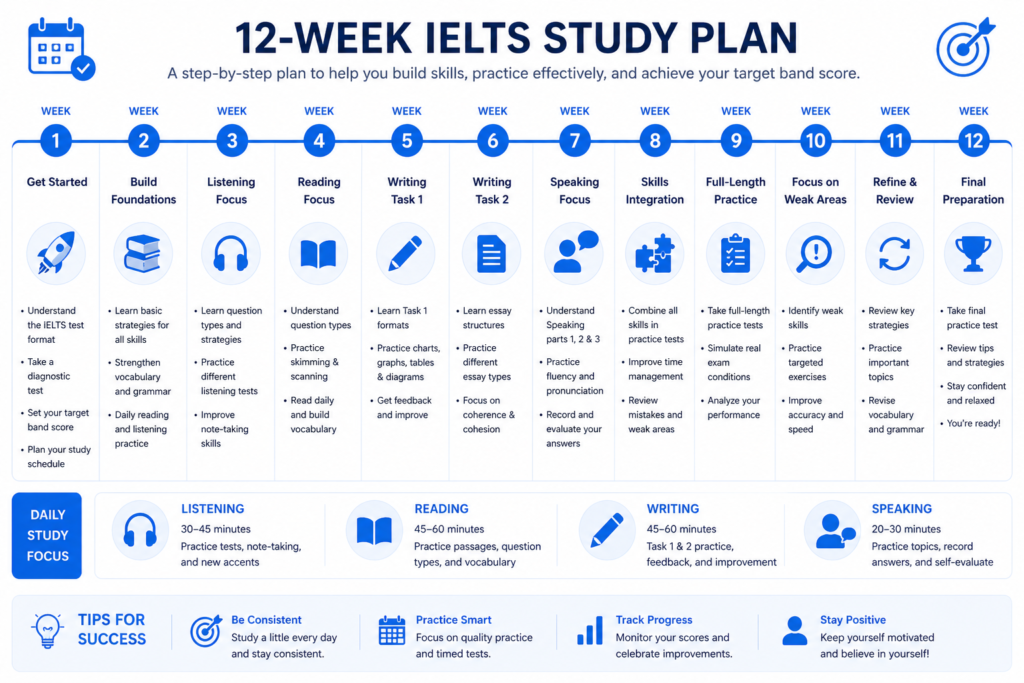
Week-by-Week Study Plan
The plan below assumes you have 12 weeks before your exam date and roughly 45–60 minutes of focused study daily. Adjust the weeks based on your actual timeline.
| Week | Focus | Activity |
| Week 1–2 | Diagnostic + Listening | Take mock test, identify weak spots, start listening daily |
| Week 3–4 | Reading Skills | Skim & scan drills, timed reading passages, vocab building |
| Week 5–6 | Writing Tasks 1 & 2 | Practice both task types, get feedback, review band descriptors |
| Week 7–8 | Speaking Fluency | Record yourself, practice with partner or AI, review cue cards |
| Week 9–10 | Full Mock Tests | Weekly full test, review errors, refine weak areas |
| Week 11–12 | Final Review | Mini mock tests daily, timing drills, confidence building |
| ⚡ Most people skip the diagnostic test in Week 1. Do not do this. Without knowing exactly where you are losing marks, your preparation will be generalised — and generalised preparation produces generalised results. |
Daily Routine That Improves All 4 Skills
Rather than dedicating entire days to one skill, a mixed daily approach builds all four skills in parallel — which is important because IELTS tests them on the same day.
Here is an effective daily structure for a 60-minute session:
- 10 minutes — Listening: One section of a practice test, review answers, note vocabulary
- 15 minutes — Reading: One passage with timing, review mistakes in detail
- 20 minutes — Writing: One task (alternate Task 1 and Task 2 daily), self-assess against band descriptors
- 15 minutes — Speaking: Record yourself answering one cue card prompt, replay and critique
Yes, this means you are not finishing a full test every day — and that is fine. Isolated skill practice with immediate self-review builds stronger foundations than churning through complete mock tests without reflection.
How to Combine Course + Practice + Revision
The formula that works is this: course content teaches you what and why, deliberate practice applies it, and revision shows you whether it stuck.
- Watch or read one course concept (strategy for academic writing Task 1, for example)
- Immediately apply it with a timed practice question
- Compare your output against a model answer or band descriptor
- Note the gap and adjust your approach in the next session
This active learning loop — learn, apply, compare, adjust — is what separates candidates who improve from those who plateau. If your current IELTS online course does not build this feedback loop in, create it yourself using the free resources I listed above.
IELTS Exam Practice — What Most People Do Wrong
After watching this pattern repeat across hundreds of IELTS candidates, I am convinced that how you practice matters more than how much you practice. The following mistakes are the primary reasons intelligent, hard-working test-takers underperform on exam day.
Practicing Without Feedback (Biggest Mistake)
This is, without question, the most costly mistake in IELTS exam practice. You write a Task 2 essay. You read it back. It seems fine. You move on. But ‘seems fine’ is not a band score — and self-assessment without a reference point is largely guesswork.
Every piece of writing and speaking practice needs to be evaluated against the IELTS band descriptors: task achievement, coherence and cohesion, lexical resource, and grammatical range and accuracy. These are not abstract concepts — they are the exact criteria your examiner uses. Until you internalise them, you are practicing in the dark.
But here is the problem: most free IELTS online courses do not offer real human feedback. This is where investing in even occasional paid feedback sessions — from a qualified IELTS examiner or tutor — pays enormous dividends.
Ignoring Weak Sections
Almost everyone has a preferred skill. Candidates who are strong readers tend to over-practice reading. Strong speakers avoid the writing section. This feels productive but it is actually the opposite.
IELTS overall band score is the average of all four sections rounded to the nearest 0.5. Neglecting your weakest section puts a ceiling on your overall score regardless of how strong you are elsewhere. Most people stuck at band 6 overall would break through by dedicating 60% of their IELTS preparation time to their two weakest skills.
Over-Reliance on Passive Learning
Watching IELTS YouTube videos is useful. Reading strategy guides is useful. But passive consumption cannot substitute for active production. Speaking fluency does not improve by watching speaking videos. Writing accuracy does not improve by reading model essays.
For every hour of passive content you consume, you should be spending at least one hour actively practicing under real conditions. That ratio is the single most actionable change you can make to your IELTS training today.
Beginner vs Advanced IELTS Preparation Strategy
Your strategy should match your starting band score. Here is what that looks like in practice:
Beginner Strategy (Band 4–5 to 6)
At this level, the priority is building core English foundations alongside exam-specific strategies. Spend the first three to four weeks understanding the exam format completely — question types, timing, what each section tests — before touching strategy.
Recommended free resources at this level: British Council free IELTS course, IELTS Liz basics, and Cambridge IELTS books 12–14. Your daily focus should be vocabulary building, basic grammar, and listening comprehension through authentic English media. Keep exam practice limited initially — format familiarisation comes first.
Intermediate Strategy (Band 6 to 7+)
This is where most of my readers sit — and it is also where the most nuanced guidance is needed. Getting from band 6 to 7 is not about studying harder. It is about plugging specific gaps.
At band 6, your grammar is broadly functional but contains frequent errors. Your writing lacks the cohesive flow and lexical sophistication that the band 7 descriptor requires. Your speaking is understandable but not natural.
The highest-leverage activities at this stage: writing one Task 2 essay daily with examiner-level feedback, replacing simpler vocabulary with academic alternatives systematically, and practicing speaking with a native or proficient partner who will correct your errors. An investment in a mid-tier paid IELTS preparation course with writing feedback is strongly recommended here.
Advanced Strategy (Band 7 to 8+)
Reaching band 8 is a different game entirely. At this level, grammatical accuracy needs to be close to perfect, and your vocabulary needs not just range but precision and naturalness. Examiners can tell the difference between a memorised phrase and genuine fluency — and the band 8–9 descriptors explicitly test for this.
At this level, I recommend working with a qualified IELTS examiner directly — not a general English tutor. The margin between band 7.5 and 8.0 often comes down to nuances in task achievement and coherence that only an experienced examiner’s eye will catch. Official IELTS practice tests under strict timed conditions should be your weekly benchmark.
Tools and Platforms That Boost IELTS Preparation
The right tools can meaningfully compress your preparation timeline. Here are the ones worth your attention in 2026:
Best Apps for IELTS Practice
- IELTS Prep App (British Council) — Practice tests, vocabulary, and speaking exercises on mobile. Free with premium upgrade options.
- Magoosh IELTS — Full mobile access to their course and practice questions.
- ELSA Speak — AI-powered pronunciation feedback. Particularly useful for speaking preparation.
- Anki — Flashcard system for systematic vocabulary building. Use it with a pre-built IELTS vocabulary deck.
- BBC Learning English — Not IELTS-specific, but excellent for listening skills and natural English exposure.
Online Classes vs Self-Study Tools
IELTS online classes — live sessions with a tutor or examiner — provide accountability and immediate feedback that self-study cannot replicate. However, they are significantly more expensive per hour than course platforms.
My recommendation: use self-study tools and IELTS online courses as your primary preparation structure, and invest in four to six live sessions with a qualified tutor specifically for writing and speaking feedback. That combination delivers the benefits of both approaches at a manageable cost.
AI Tools for Writing and Speaking Practice
In 2026, AI tools have become a genuinely useful addition to IELTS preparation — particularly for writing feedback and speaking fluency practice. Tools like ChatGPT can evaluate your Task 2 essays against band descriptors if you prompt them correctly, and speaking practice apps powered by AI can give you immediate pronunciation and fluency feedback.
However, use AI feedback as a supplement, not a replacement for human examiner feedback. AI tools do not yet match the nuance of an experienced IELTS examiner, particularly for task achievement and cohesion assessment. For a deeper understanding of how AI is transforming education and online learning, see my guide on
For a broader view on how AI tools are reshaping self-directed learning, check out AI in Education and Machine Learning — it is directly relevant to how you structure your self-study.
Course Comparison — Free vs Paid IELTS Preparation
Here is the clearest way I know to visualise the free vs paid decision. This comparison covers the factors that actually matter for score improvement.
| Feature | Free Courses | Paid Courses | Best For |
| Cost | Free | $30–$300+ | Budget-conscious |
| Certificate | Some (British Council) | Yes (most) | Career & visa docs |
| Structure | Moderate | High | Structured learners |
| Feedback | Minimal | Expert feedback | Weak skill improvement |
| Flexibility | High | Medium–High | Busy professionals |
| Score Impact | Moderate | High | Band 7+ targets |
Cost vs Value Breakdown
Free courses cost nothing financially but demand more from you in terms of self-discipline and self-assessment. Paid courses provide structure, accountability, and feedback — but only deliver value if you actually complete them. I have seen candidates pay for premium IELTS prep courses and finish less than 30% of the content.
When Free Courses Are Enough
Free IELTS preparation courses are genuinely sufficient if: you are a self-directed learner with strong discipline, your target band is 6.5 or below, you have 12 or more weeks before the exam, and your listening and reading are your primary weak areas (both can be significantly improved through free practice).
When You Should Invest in Paid Training
Invest in a paid IELTS preparation course if: writing or speaking are your weakest skills and you need structured feedback, you have a tight timeline (under eight weeks), your target band is 7.0 or higher, or you have previously struggled with self-discipline on free platforms. The return on investment from a well-chosen paid IELTS online course is genuinely significant when the alternative is retaking the exam.
Common IELTS Preparation Mistakes That Kill Your Score
These are not theoretical mistakes — I have watched real test-takers make every single one of them. Identify which ones apply to you and address them directly.
No Structured Plan
Studying without a written plan is the most common mistake across all certification exams — not just IELTS. Without a plan, you default to studying what is comfortable rather than what needs work. You lose track of which skills you have not practiced this week. You waste time deciding what to do instead of doing it.
Before your next study session, write down exactly what you will practice, for how long, and how you will assess whether you succeeded. That single habit change produces measurable results within two weeks.
Practicing Wrong Materials
There is an enormous amount of unofficial IELTS preparation material online — and a significant portion of it uses outdated question formats, inaccurate band descriptors, or simply teaches the wrong strategies. This is particularly true for certain IELTS preparation course PDF files shared on social media.
Stick to official Cambridge materials, British Council resources, and reputable course platforms. IELTS preparation books from the Cambridge series are the safest bet — they are written by the exam body and reflect the actual current question format precisely.
Ignoring Time Management
Every IELTS section has a strict time limit — and many candidates who know the content still underperform because they have not practiced completing tasks within those limits. The reading section is particularly brutal in this regard: three long passages, forty questions, sixty minutes.
From week three of your preparation onwards, every reading and listening practice session should be timed with no pausing, no rewinding, no extra minutes. Treat the time limit as non-negotiable, because on exam day, it will be.
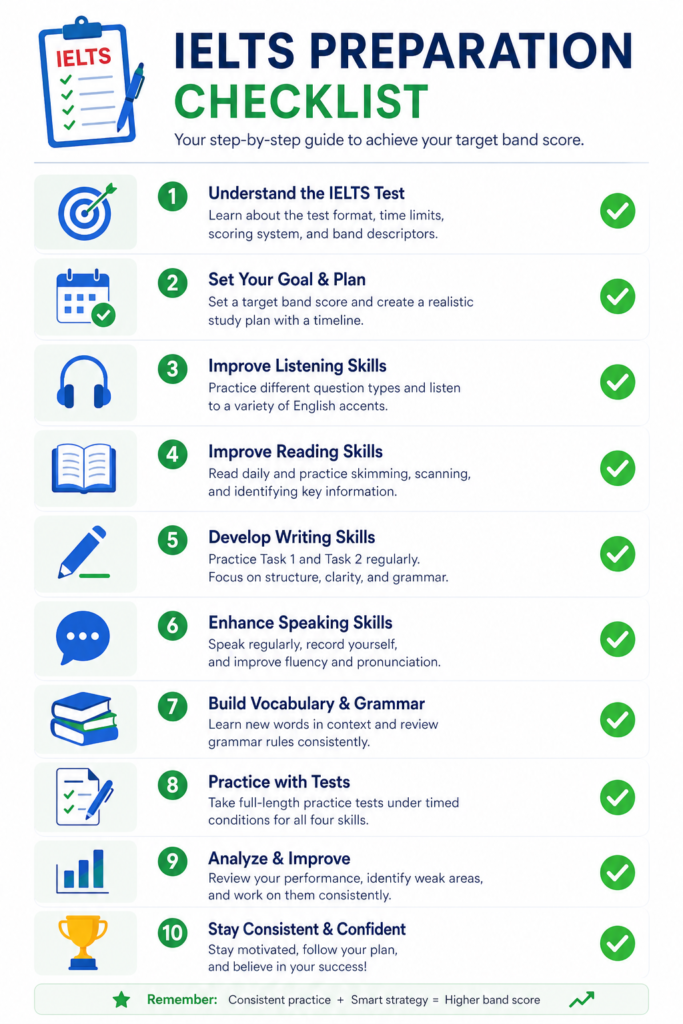
IELTS Preparation Checklist (Before Exam Day)
Use this checklist in the final two weeks before your exam to confirm you are ready — and to identify anything that still needs attention.
Skills Readiness Checklist
- Listening: Can you score consistently above your target band on timed full listening tests?
- Reading: Are you completing all 40 questions within 60 minutes on realistic practice sets?
- Writing: Have you received external feedback on at least five Task 2 essays and five Task 1 responses?
- Speaking: Have you recorded and reviewed at least ten mock speaking tests across all three parts?
Practice Test Benchmarks
- Completed at least four full timed mock tests under real exam conditions
- Overall mock test band score is within 0.5 of your target band consistently
- All four skill scores reviewed and weak areas addressed
- Familiar with the format, timing, and instructions for every section
Final Week Strategy
The final week should not involve learning new strategies or concepts. If a technique has not been practiced and internalised by this point, introducing it now will create confusion rather than improvement.
Your final week should be: one short (two-section) mock test per day, thirty minutes of targeted review on your weakest question type, vocabulary consolidation (review — not new learning), and mental preparation, including sleep, exam logistics, and test-day routines.
| 📌 Final Week Rule: No new strategies. No new materials. Trust the preparation you have done and focus on sharpening what you already know. |
FAQs — IELTS Preparation Questions Answered
What is the best IELTS preparation course?
The best IELTS preparation course depends on your budget, timeline, and weakest skill. For free options, the British Council course via FutureLearn and IELTS Liz are excellent starting points. For paid options, Magoosh IELTS and IELTS Advantage consistently deliver strong results. If writing is your weakest skill, prioritise any course that includes examiner-written feedback.
Can I prepare for IELTS online for free?
Yes — and genuinely effectively, especially for listening and reading. The British Council free IELTS course, IELTS.org official practice materials, E2 IELTS on YouTube, and IELTS Liz together constitute a strong free IELTS preparation course online. For writing and speaking, free resources are helpful but you will progress faster with at least some feedback from a qualified examiner.
How long does IELTS preparation take?
IELTS preparation time depends on your starting band score and target. As a general guide: from band 4–5, expect 12–16 weeks of consistent study to reach band 6–6.5. From band 6, targeting 7+ typically requires eight to twelve weeks of structured daily practice. Working professionals with limited time should add four to six weeks to these estimates.
Which IELTS books are best for preparation?
The Cambridge IELTS practice test series (books 1 through 18) is the gold standard for IELTS preparation books because they contain authentic exam questions. The Official Cambridge Guide to IELTS is the best all-in-one resource for beginners. The Collins English for IELTS skill books are excellent for targeted skill-specific drilling.
Is the British Council IELTS course free?
Yes — partially. The British Council IELTS preparation course on FutureLearn is available free to audit, which gives you access to most lessons and content. The certificate version, which includes graded assignments and examiner feedback, carries a fee. For most candidates, the free audit tier provides excellent value as a starting resource, particularly when combined with free IELTS preparation materials from IELTS.org.
What is the best IELTS preparation material for self-study?
For self-study, the most effective combination is: Cambridge IELTS books (12–18) for authentic practice tests, IELTS Liz for writing and speaking strategies, official IELTS.org sample materials for format familiarisation, and a structured IELTS online course (free or paid) to provide sequence and guidance. Free IELTS preparation course PDF resources from trusted sources add supplementary practice.
Final Action Plan — Start Your IELTS Preparation Today
You now have everything you need to build a serious, structured, and effective IELTS preparation plan. But information without action does not move your band score. Here is your exact next move.
Step 1: Choose Your Course
Based on your budget and level, select one primary IELTS online course or free resource cluster to anchor your preparation. Do not start three different courses simultaneously — pick one and commit to it completely. If you are unsure, start with the British Council free course and IELTS Liz, and add paid resources once you have assessed your specific weaknesses.
Step 2: Follow the Study Plan
Use the twelve-week framework I laid out above and adapt it to your timeline. Write your study plan for this week before you close this tab. Seriously — do it now. The candidates who plan their preparation in writing are significantly more likely to follow through. If time management is a consistent challenge for you, my guide on
If time management is a challenge during your preparation, the strategies in my Time Management Course Online guide apply directly to structured exam study.
Step 3: Practice Smart and Track Progress
From day one, keep a simple error log: every time you get a question wrong, note which skill, which question type, and what the mistake was. Review it weekly. Within four weeks, a clear pattern will emerge — and that pattern tells you exactly where to focus your remaining preparation.
Track your mock test scores weekly. If you are not seeing progressive improvement, something in your practice method needs to change — either the quality of your feedback, the balance of your study time, or the level of authentic pressure in your practice sessions.
| 🎯 YOUR NEXT MOVE: Take one full timed IELTS mock test this week using official Cambridge materials. Review every mistake in detail. That diagnostic is the foundation everything else builds on. |
And if you want to see how broader digital and online learning skills can support your long-term career goals — whether you are preparing IELTS for study abroad, immigration, or professional development — explore our guides on:
Best Public Speaking Course: Build Confidence
Resume Writing Course — Stand Out in the Job Market
Free AI Tools: Top 10 Picks for Students and Pros in 2026
Leadership Development Courses