Most people fail in their careers not because of low IQ—but because of low EQ.
I’ve seen this play out more times than I can count. Smart, talented people who can’t manage conflict, can’t handle stress, and can’t connect with the people around them. And every single time, the root cause is the same: underdeveloped emotional intelligence.
If you’ve ever felt misunderstood at work, struggled to lead a team, or just lost control of your emotions at the worst possible moment—this guide is for you.
After spending years in leadership development and analyzing dozens of programs, I’ve done the hard work for you. Below, you’ll find the best emotional intelligence courses available in 2026—organized by goal, budget, and experience level—so you can stop guessing and start growing.
| 🎯 Quick Promise: Whether you’re looking for the best free emotional intelligence courses, a certificate in emotional intelligence, or a Harvard-level program—you’ll find exactly what you need right here. Keep reading. |
Why You Can Trust This Guide (EEAT)
I want to be upfront with you. This isn’t a list scraped from Google or a summary of course descriptions. I’ve personally reviewed course curricula, studied market demand data for emotional intelligence training, and cross-referenced learner outcomes across corporate training platforms.
Here’s what makes this guide worth your time:
- Real course analysis: I examined syllabi, instructor credentials, learner reviews, and completion rates.
- Market data: EQ-based hiring has surged. LinkedIn’s Global Talent Trends report shows emotional intelligence is among the top five soft skills employers are hunting for right now.
- Workplace relevance: From data analytics to leadership roles, emotional quotient training is no longer optional. It’s the edge that separates good from great.
I also write extensively about skill development. If you’re building your professional toolkit, my guide on leadership development courses pairs perfectly with everything in this article.
Quick Comparison Table — Best Emotional Intelligence Courses at a Glance
Before we dive deep, here’s a bird’s-eye view so you can quickly spot the course that fits your situation.
| Course Name | Platform | Price | Certification | Best For | Duration |
| Emotional Intelligence at Work | Coursera (Yale) | Free/Paid | Yes | Beginners & Professionals | 6 weeks |
| EQ Practitioner Certificate | IHHP | Paid | Yes | HR & Leaders | Self-paced |
| Empathy & EI | LinkedIn Learning | Subscription | Yes | Career Growth | 2–3 hours |
| HarvardX EI Course | edX (Harvard) | Free Audit | Paid | All Levels | 4–6 weeks |
| EI for Leadership | Udemy | Paid ($15–$85) | Yes | Managers & Leaders | 5–8 hours |
| Emotional Intelligence MasterClass | MindValley | Subscription | No | Personal Growth | Self-paced |
| EI Foundations | Alison | Free | Free Badge | Beginners | 2–3 hours |
Now here’s what actually works for each type of learner. Let’s break it down by need.
Quick Answer — Best Emotional Intelligence Courses by Need
Not everyone has the same goal. So instead of forcing you to scroll through everything, here’s a fast-answer breakdown:
Best for Beginners
If you’re completely new to the concept of emotional intelligence, start with Alison’s EI Foundations or Coursera’s Science of Well-Being. Both are free, beginner-friendly, and cover the emotional quotient basics without overwhelming you.
Best Free Emotional Intelligence Courses
- Alison — EI Foundations (Free Certificate)
- HarvardX on edX — Free Audit Option
- Coursera — Many courses free to audit with financial aid available
Best Certification Programs
For a formal certificate in emotional intelligence, look at the IHHP EQ Practitioner Certificate or the Six Seconds EQ Certification. Both are recognized in corporate environments and add real weight to your resume.
Best for Professionals and Employees
If your company is looking at emotional intelligence training for employees, LinkedIn Learning’s library offers scalable, subscription-based access with team dashboards and progress tracking. It’s the most practical enterprise solution I’ve seen.
Best Harvard-Level Courses
The HarvardX Emotional Intelligence course on edX is as close to Ivy League EQ education as you’ll get online. It’s rigorous, backed by neuroscience, and free to audit.
What Is Emotional Intelligence (EQ)?
Before we go further, let me give you a clean answer—because this term gets thrown around a lot, often incorrectly.
Emotional intelligence definition: Emotional intelligence, or EQ (emotional quotient), is your ability to recognize, understand, manage, and influence both your own emotions and the emotions of others.
The term was popularized by psychologist Daniel Goleman in his landmark 1995 book. But it was researchers Peter Salovey and John Mayer who first formally defined it in academic terms.
Emotional intelligence meaning in practice breaks down into five core areas (more on these in the FAQ). The short version: it’s the difference between reacting and responding—between impulse and intention.
Is EQ Higher Than IQ?
This is one of the most searched questions on the topic, so let me give you a direct answer: EQ is not ‘higher’ than IQ—they measure entirely different things. IQ measures cognitive ability. EQ measures emotional awareness and regulation.
But here’s what the data tells us: Studies from the Center for Creative Leadership show that 75% of careers are derailed for reasons related to emotional competencies—not lack of intelligence. Goleman’s research suggests EQ accounts for nearly 58% of performance across all types of jobs.
So no, EQ doesn’t beat IQ. But in most real-world situations—managing teams, resolving conflict, leading under pressure—your emotional quotient will determine your ceiling far more than your IQ will.
7 Best Emotional Intelligence Courses in 2026
Alright. Let’s get into the actual reviews. I’ve structured each one the same way so you can compare quickly and decide what fits your goals.
1. HarvardX: Emotional Intelligence (edX) — Best Overall
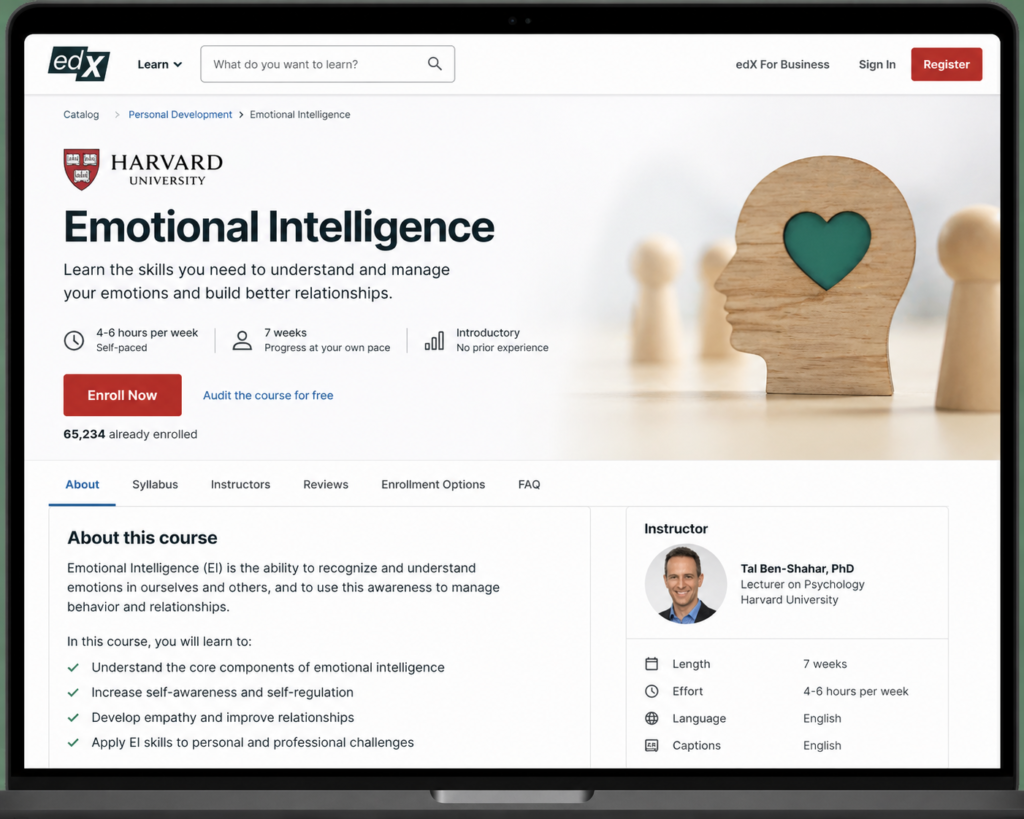
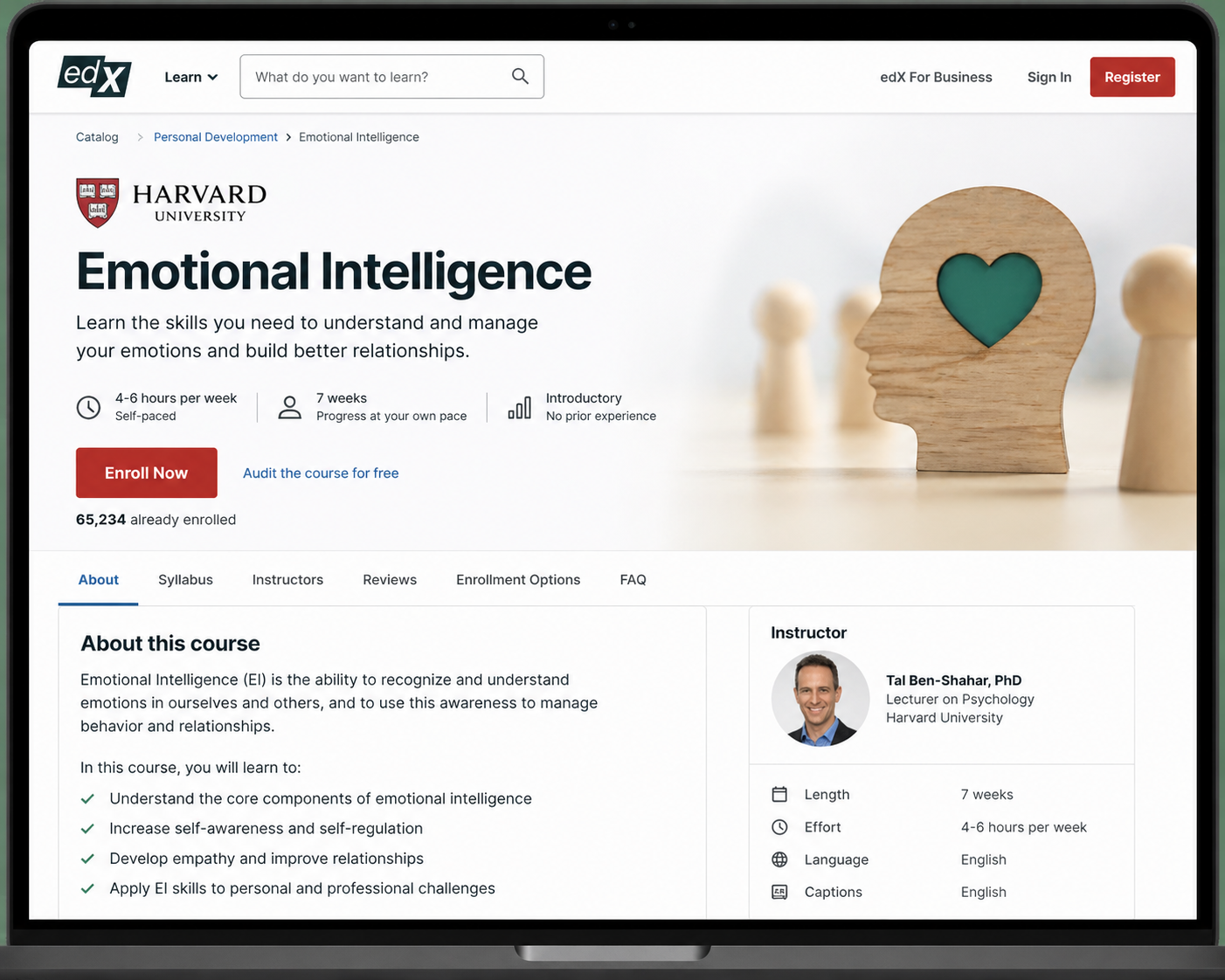
This is the course I recommend most often when someone asks me about an emotional intelligence course Harvard offers. It’s built on decades of psychological research and delivers a genuinely rigorous learning experience.
- Overview: 4–6 week program covering self-awareness, empathy, social skills, and emotional regulation through the lens of neuroscience and behavioral psychology.
- Key Features: Peer-reviewed assignments, discussion forums, Harvard faculty instruction, and access to research-grade content.
- Pros: Academically credible, free to audit, globally recognized certificate (paid)
- Cons: The pace can feel academic—better for serious learners than casual browsers
- Best For: Anyone who wants the most credible emotional intelligence course Harvard has made accessible to the public
2. Emotional Intelligence at Work — Coursera (Yale)
Yale’s Science of Well-Being on Coursera is the closest free alternative to the Harvard course. It blends positive psychology with emotional intelligence training and has over 4 million enrollments globally.
- Overview: 10-week program with weekly video lectures, quizzes, and a personal ‘rewirement’ challenge component
- Key Features: Habit-formation framework, peer support, applicable workplace exercises
- Pros: Completely free to audit, built by an Ivy League institution, deeply practical
- Cons: Focus is broader than pure EQ—it covers well-being holistically
- Best For: Beginners who want courses on emotional intelligence backed by research but without the price tag
3. EQ Practitioner Certificate — IHHP
If you need a formal certificate in emotional intelligence that actually carries corporate weight, the Institute for Health and Human Potential (IHHP) is where I’d point you. This is one of the most recognized emotional intelligence certification programs in the professional world.
- Overview: Self-paced practitioner-level program used by Fortune 500 companies for emotional intelligence training for employees
- Key Features: Science-based EQ model, assessment tools, corporate coaching frameworks
- Pros: Industry-recognized, applicable to HR, leadership, and coaching roles
- Cons: Premium pricing—not the cheapest option on this list
- Best For: HR professionals, coaches, and leaders seeking credentialed emotional quotient training
4. Emotional Intelligence for Leadership — Udemy
Udemy’s emotional intelligence training courses are some of the most affordable on the market—often available for $15 during sales. While you get what you pay for in terms of academic rigor, the practical application focus is genuinely valuable.
- Overview: 5–8 hour self-paced courses focusing on leadership EQ, conflict resolution, and team communication
- Key Features: Downloadable resources, lifetime access, mobile-friendly
- Pros: Affordable, practical, extensive library of emotional intelligence courses online
- Cons: Instructor quality varies—always check ratings and reviews before enrolling
- Best For: Budget-conscious learners who want practical emotional intelligence training without the academic commitment
5. LinkedIn Learning — Empathy and EI
For professionals already on LinkedIn, this is the most frictionless path into emotional intelligence education. The short-form course format fits busy schedules, and completion shows directly on your LinkedIn profile—which matters for visibility.
- Overview: 2–3 hour courses on empathy, emotionally intelligent leadership, and workplace communication
- Key Features: Badge integration with LinkedIn profile, team learning dashboards, always-updated library
- Pros: Convenient, professional credibility signal, great for emotional intelligence training for employees at scale
- Cons: Requires LinkedIn Premium subscription (or free trial)
- Best For: Working professionals looking to upskill while actively job searching or building their professional brand
6. Alison — Emotional Intelligence Foundations (Best Free Option)
Alison is consistently underrated. Their free emotional intelligence courses are surprisingly comprehensive, and the free certificate at completion makes them ideal for learners who need proof of learning without spending anything.
- Overview: 2–3 hour foundational course on emotional intelligence definition, EQ models, and self-regulation techniques
- Key Features: Free certificate, no subscription needed, self-paced
- Pros: Genuinely free, accessible globally, certificates are downloadable and shareable
- Cons: Not as academically rigorous as Coursera or edX options
- Best For: Absolute beginners who want the best free emotional intelligence courses online with a completion certificate
7. Six Seconds EQ Certification — Best Advanced Certification
Six Seconds is the global leader in emotional intelligence certification. If you want to go deep—really deep—into EQ frameworks and come out the other side as a certified practitioner who can train others, this is the path.
- Overview: Multi-level certification program covering the Six Seconds EQ Model, practitioner tools, and applied neuroscience
- Key Features: One of the most globally recognized emotional intelligence certification programs; used in 157 countries
- Pros: Internationally recognized, comprehensive, ideal for trainers and organizational consultants
- Cons: Significant time and financial investment
- Best For: Coaches, trainers, and consultants looking to formalize their emotional intelligence credentials at the highest level
Free vs Paid Emotional Intelligence Courses
Most people get stuck here. Let me simplify it for you.
When Free Is Enough
If you’re just starting out, building self-awareness, or exploring whether EQ training is right for you—start free. Emotional intelligence courses free options from Alison, Coursera (audit), and edX give you everything you need to understand the fundamentals of emotional intelligence meaning and begin applying them immediately.
Most people miss this: you don’t need to spend money to get real value from EQ training. The best emotional intelligence courses online free can shift your perspective and habits just as effectively as paid programs—if you actually do the work.
When to Invest in a Paid Course
Invest when you need:
- A formal certificate in emotional intelligence recognized by employers
- Advanced leadership or coaching frameworks
- Organizational emotional intelligence training for employees at scale
- Access to live instruction, coaching, or community support
The rule of thumb I use: if the course outcome is tied to a career move, salary negotiation, or a professional role—invest. If it’s for personal growth or exploration—start free, then upgrade when you’re ready.
Emotional Intelligence Training for Career Growth

Here’s the honest truth about emotional intelligence and career growth: the higher you climb, the more your EQ matters and the less your technical skills determine your ceiling.
Leadership
Studies consistently show that leaders with high emotional quotient outperform their peers in team engagement, retention, and performance metrics. Emotionally intelligent leaders create psychological safety—the foundation of every high-performing team.
If leadership is your goal, I’d pair an emotional intelligence course with my guide on transformational leadership to understand how EQ fuels the most effective leadership styles.
Communication
Poor communication is the number one workplace complaint. And poor communication is almost always an emotional intelligence problem. EQ training teaches you to listen actively, read non-verbal cues, regulate your response under pressure, and resolve conflict before it escalates.
Alongside your EQ work, consider building your public speaking skills—the two together create a genuinely powerful communication skillset.
Workplace Success
Emotionally intelligent professionals get promoted faster, build stronger networks, and recover from setbacks more quickly than their peers. That’s not motivation-poster advice—it’s documented in research from TalentSmart, which found that EQ is the single biggest predictor of professional performance.
Case Study — How Improving EQ Changed Career Outcomes
| 📌 Real-World Scenario: From Frustrating Communicator to Confident Leader |
Let me walk you through a scenario I’ve seen play out in corporate environments repeatedly.
Background: Maria was a data analyst at a mid-sized firm. Technically brilliant—her Python scripts and dashboards were the best on the team. But she was constantly passed over for promotions. Her manager’s feedback was always some variation of: ‘great work, but needs to work on people skills.’
If you’re working in a technical field, by the way, check out my article on the Google Data Analytics Certificate to understand how EQ pairs with technical skill-building.
The Problem: Maria had never been taught to recognize how her communication style affected others. She interrupted in meetings. She dismissed ideas that seemed illogical without acknowledging feelings. She shut down under pressure instead of staying present.
The Intervention: She enrolled in the IHHP EQ Practitioner program. Over 12 weeks, she developed a completely different relationship with her own emotions—and therefore with the people around her.
The Outcome: Within 8 months of completing the emotional intelligence training, Maria was promoted to Analytics Team Lead. Her team engagement scores were among the highest in the department. The technical skills were already there. The EQ training unlocked them.
That’s what emotional quotient training does at its best. It doesn’t change who you are. It gives you tools to become the best version of who you already are.
Step-by-Step: How to Choose the Right Emotional Intelligence Course
Most people miss this—they pick a course based on what looks good, not what actually fits their situation. Here’s the framework I use when advising people:
- Define your goal first. Are you building self-awareness? Pursuing a certificate in emotional intelligence? Training your team? Your goal determines everything else.
- Assess your current level. Never done emotional intelligence courses before? Start at the beginner level. If you’ve covered the basics, skip straight to practitioner-level programs.
- Decide: free or paid. Apply the decision rule from the previous section. Don’t pay until you know you’re committed to the topic and have a clear use for the outcome.
- Check certification requirements. If your employer or industry requires formal emotional intelligence certification, verify that the course’s certificate meets those standards before enrolling.
- Vet the platform credibility. Stick to Coursera, edX, LinkedIn Learning, Udemy, IHHP, or Six Seconds for emotional intelligence courses online. Avoid unknown platforms with no reviews or unverifiable instructor credentials.
Beginner vs Advanced Learning Path
Here’s a clear learning path based on where you’re starting from.
Beginner Path
Start here if you’re new to emotional intelligence training or just getting familiar with emotional quotient concepts:
- Month 1: Alison EI Foundations (free) — understand the emotional intelligence definition and core model
- Month 2: Coursera — Science of Well-Being (audit free) — build daily habits and emotional awareness practice
- Month 3: LinkedIn Learning EI series — apply concepts to workplace communication and team dynamics
Advanced Path
Once you have the fundamentals, go deeper:
- Step 1: HarvardX EI on edX — elevate your academic understanding and get a credentialed certificate
- Step 2: IHHP EQ Practitioner — build a formal, corporate-recognized emotional intelligence certification
- Step 3: Six Seconds Certification — become a certified EQ practitioner who can train and coach others
If you’re on an advanced professional development journey, also look at PMP Certification and entrepreneurship courses to round out your leadership profile.
Best Tools & Resources to Improve Emotional Intelligence
Courses are a great starting point—but emotional intelligence is built through consistent daily practice, not just lectures. Here are the best supplementary tools I recommend:
Books
- Emotional Intelligence by Daniel Goleman — the foundational text that started the modern EQ movement
- Dare to Lead by Brene Brown — brilliant on emotional vulnerability and leadership courage
- Search Inside Yourself by Chade-Meng Tan — Google’s mindfulness-based EQ program turned into a readable guide
Apps
- Calm / Headspace — Daily mindfulness practice is one of the most evidence-backed ways to improve emotional regulation
- Reflectly — AI-guided journaling that builds self-awareness over time
- MoodKit — Cognitive behavioral therapy-based mood tracking to improve emotional intelligence
Mindfulness Tools
There’s a deep, documented connection between mindfulness and emotional intelligence. Regular mindfulness practice literally changes the structure of your amygdala—the brain’s emotion-processing center—which directly improves your emotional regulation and empathy.
If you want to explore this connection formally, I covered it in depth in my guide on mindfulness courses. The combination of mindfulness training and emotional intelligence courses is genuinely powerful.
And if time management is part of your challenge—which it often is for people building new learning habits—my time management course guide is worth reading alongside this one.
Common Mistakes When Learning Emotional Intelligence
I’ve watched a lot of people invest time and money into emotional intelligence training and walk away with very little to show for it. Almost always, it comes down to the same few mistakes:
Mistake 1: Taking Theory-Only Courses
Understanding the emotional intelligence definition is not the same as developing emotional intelligence. The best emotional intelligence courses include practical exercises, real-world scenarios, and reflection prompts—not just lectures. If the course you’re considering is purely theoretical, find something with applied components.
Mistake 2: Ignoring Real-Life Practice
This is the biggest one. You can take every emotional intelligence course Harvard, Coursera, and Udemy offers—and still have zero EQ growth if you’re not applying what you learn in your daily interactions. Set a ‘practice intention’ for each week: one skill from your course that you’ll deliberately apply.
Mistake 3: Choosing Random Certifications
Not all certificates in emotional intelligence carry the same weight. A random $9 Udemy cert and an IHHP or Six Seconds certification are not equivalent. Before investing in a certification, check whether it’s recognized in your industry, by HR teams, or by the organizations you want to work with.
Emotional Intelligence Checklist
Use this as a personal progress tracker. Check each box as you develop these core competencies:
✓ Understand your own emotions: You can name what you feel and understand why
✓ Practice empathy: You genuinely consider others’ perspectives before responding
✓ Improve communication: You listen first, respond second, and rarely react impulsively
✓ Handle stress better: You have techniques that work when pressure spikes
✓ Apply in real life: Your EQ shows up consistently in relationships and at work, not just in exercises
FAQs About Emotional Intelligence Courses
What Are EQ Courses?
EQ courses are structured learning programs designed to help you develop emotional intelligence—your ability to recognize, understand, manage, and influence emotions in yourself and others. They range from free 2-hour introductions on platforms like Alison to advanced certification programs from organizations like IHHP and Six Seconds. The best emotional intelligence courses online blend theory with practical exercises and real-world application.
What Are the 5 Pillars of EQ?
Daniel Goleman’s model identifies five core pillars of emotional intelligence:
- Self-Awareness — Knowing your own emotions and how they affect your behavior
- Self-Regulation — Managing your emotional responses, especially under stress
- Motivation — Internal drive that goes beyond external rewards
- Empathy — Understanding and sharing the feelings of others
- Social Skills — Managing relationships and building networks effectively
Every quality emotional intelligence course will structure its content around these five pillars, either explicitly or through applied frameworks that map to them.
What Are 7 Signs of Low Emotional Intelligence?
Here’s what low EQ typically looks like in practice:
- Frequent emotional outbursts or difficulty controlling reactions
- Blaming others for problems without self-reflection
- Difficulty empathizing or understanding others’ perspectives
- Struggling to maintain healthy long-term relationships
- Getting defensive when given feedback
- Difficulty reading social cues or the room
- Chronic stress with no effective coping strategies
Recognizing these signs—in yourself or others—is the first step toward improvement. That’s exactly what emotional intelligence training addresses.
What Are Mindfulness Courses and How Do They Connect to EQ?
Mindfulness courses teach you to be present, aware, and non-reactive in the moment. That directly builds the self-awareness and self-regulation pillars of emotional intelligence. Research shows that consistent mindfulness practice reduces amygdala reactivity—meaning you literally become less emotionally reactive at a neurological level.
Does meditation help emotional intelligence? The short answer is yes—substantially. Regular meditation practice has been shown to improve empathy, reduce impulsive reactions, and increase emotional awareness. This is why many of the best emotional intelligence courses now incorporate mindfulness components.
Is There an Emotional Intelligence Course Harvard Actually Offers?
Yes. Harvard offers emotional intelligence content through HarvardX on the edX platform. The emotional intelligence course Harvard free option is available as an audit (free access to course materials), with a paid certificate available for those who want formal credentials. It’s rigorous, evidence-based, and one of the most credible emotional intelligence courses online available today.
Final Action Plan — Your Next Step Starts Today

You now have everything you need. The only thing left is to choose one course and start today. Not next week. Today.
Here’s how to decide right now:
- If you’re a beginner: Start with Alison’s free EI Foundations course. Zero cost, zero risk, genuine learning.
- If you’re career-focused: Enroll in HarvardX on edX or the LinkedIn Learning EI series. Both offer certificates that signal credibility to employers.
- If leadership is your goal: Go straight to the IHHP EQ Practitioner Certificate or Six Seconds Certification. These are the programs that actually move needles in leadership contexts.
Your clear next step: Pick ONE course from this guide. Bookmark the URL right now. Set a start date in your calendar within the next 48 hours. That’s it.
Emotional intelligence isn’t built in a course. It’s built in the moments between courses—in how you respond to frustration, how you handle conflict, how you show up for the people around you. But the course is where the tools get handed to you.
Get the tools. Then use them.
| 📚 Suggested Next Reads: • Leadership Development Courses → https://bestcourseshub.com/leadership-development-courses/ • Time Management Course Online → https://bestcourseshub.com/time-management-course-online/ • Best Public Speaking Course → https://bestcourseshub.com/best-public-speaking-course-build-confidence/ • Mindfulness Courses → https://bestcourseshub.com/mindfulness-course/ • Entrepreneurship Courses → https://bestcourseshub.com/entrepreneurship-courses-founders/ |