Most people rank public speaking above death on their list of fears. That is not an exaggeration. Studies show that glossophobia — the fear of speaking in public — affects up to 75% of the population. Yet the people who learn to speak well tend to earn more, lead more, and grow faster in their careers.
Here is the good news: public speaking is a skill. Not a talent. Not a gift you are either born with or not. It is something you can learn, practice, and genuinely improve — often faster than you expect.
The right public speaking course can cut years off your learning curve. Whether you want to stop freezing up during meetings, nail your next job interview, confidently pitch your business, or simply feel calm when all eyes are on you, this guide covers everything you need.
Below, you will find honest reviews of the best public speaking courses available online, a clear comparison of free vs paid options, practical tips that actually work, a 30-day improvement plan, and answers to the most common questions beginners ask.
If you are also developing other career skills alongside public speaking, you may find our guide on entrepreneurship courses for founders useful as a companion resource.
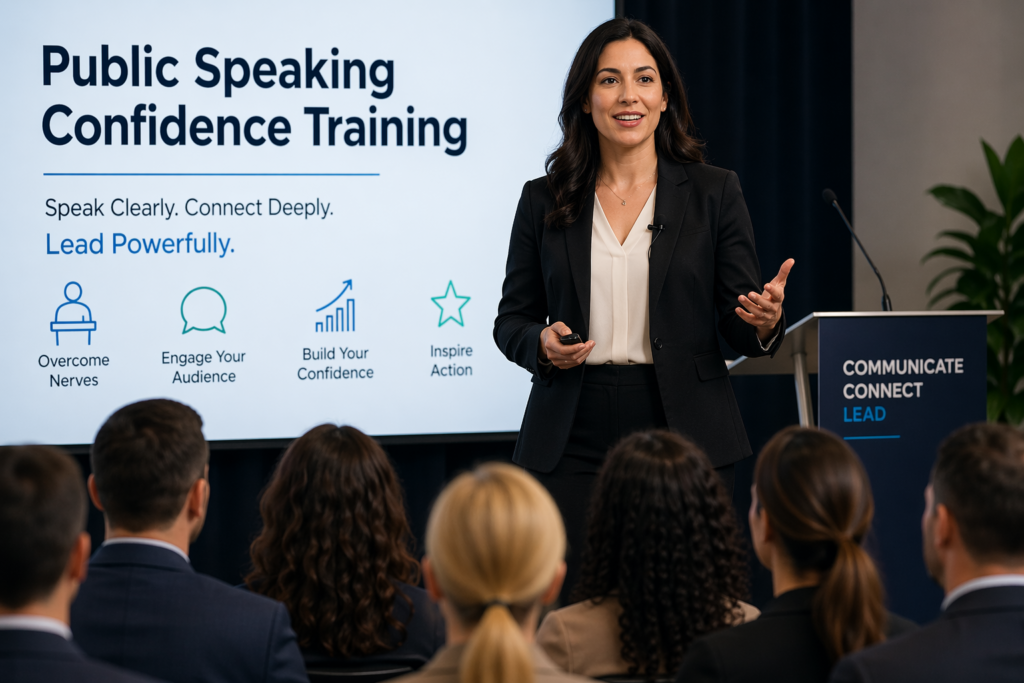
Quick Answer: Which Public Speaking Course Is Best?
Not sure which course to pick? Here is a fast summary based on your goal:
● Best free option: Coursera audit of the University of Washington’s Dynamic Public Speaking Specialization
● Best paid option: Coursera Dynamic Public Speaking Specialization (full certificate track)
● Best for beginners: Udemy – The Complete Public Speaking Bootcamp (affordable, beginner-friendly)
● Best for professionals: LinkedIn Learning – Public Speaking Foundations
● Best public speaking online course overall: Coursera’s Dynamic Public Speaking Specialization (University of Washington)
● Best university-backed option: edX – Effective Communication from the University of Rochester
The best choice always depends on your budget, experience level, and whether you need a certificate. Read on for the full breakdown.
Why More People Are Investing in Public Speaking Skills in 2026
The world has changed. Remote work, video calls, virtual presentations, and online networking have made communication more visible than ever. You are no longer just speaking to a room of colleagues. You are on camera, recorded, and often presenting across time zones.
In 2026, public speaking is no longer a soft skill — it is a career skill. Here is why more people are taking public speaking training seriously:
● Career growth: Professionals who communicate clearly are promoted faster. Leaders who speak with confidence are trusted more.
● Business pitching: Entrepreneurs and freelancers who can pitch well win more clients. A confident pitch can be the difference between a yes and a no.
● Leadership opportunities: Most leadership roles require regular presentations, team updates, and stakeholder communication.
● Networking: Speaking confidently in social and professional settings opens doors that an impressive resume alone cannot.
● Job interviews: Interview performance often decides the outcome more than qualifications. Nervousness reads as a lack of confidence.
The ability to speak in public with clarity and confidence is one of the highest-ROI skills you can develop. And unlike many technical skills, it transfers to every part of your life.
Many professionals who take public speaking courses combine it with leadership and management training for a complete communication skill set.
Who This Guide Is For
This guide was written for a wide range of readers. You will find it useful if you are:
● A beginner who feels anxious or nervous every time you have to speak in front of others
● A student preparing for class presentations or academic speeches
● A job seeker who wants to perform better in interviews and group discussions
● A professional who gives team presentations, client calls, or reports
● An entrepreneur or freelancer who pitches clients or presents ideas regularly
● A manager or team lead who wants to communicate with more authority
● A remote worker who wants to show up more confidently on video calls
● Anyone who wants to find the best public speaking online course and is unsure where to start
No matter your starting point, this guide will help you find the right course, build the right habits, and make real progress.
Signs You Need a Public Speaking Course
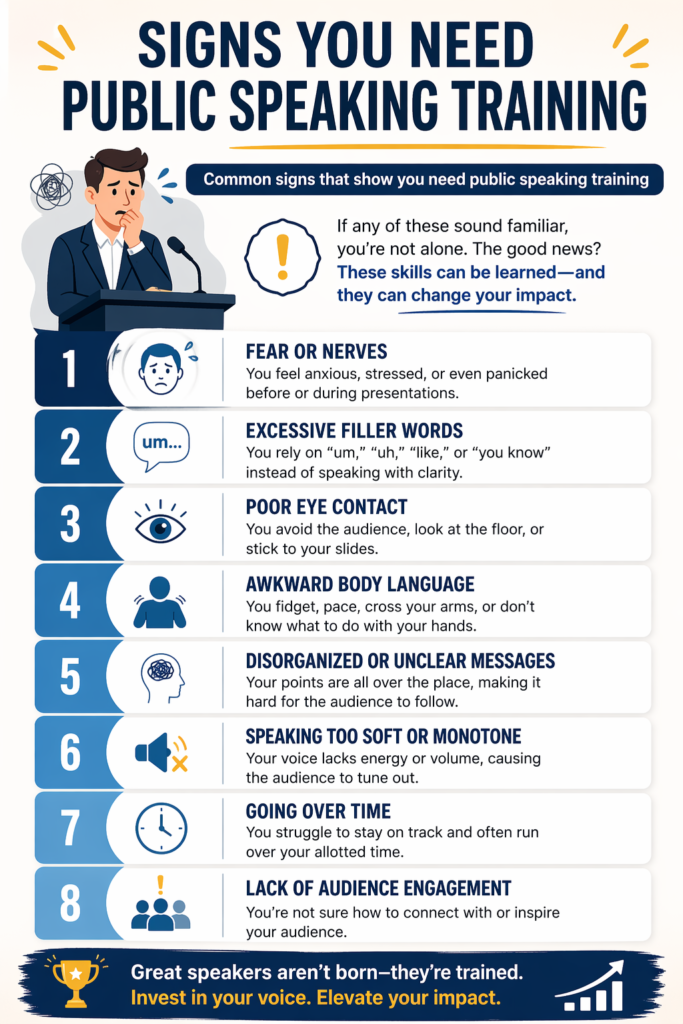
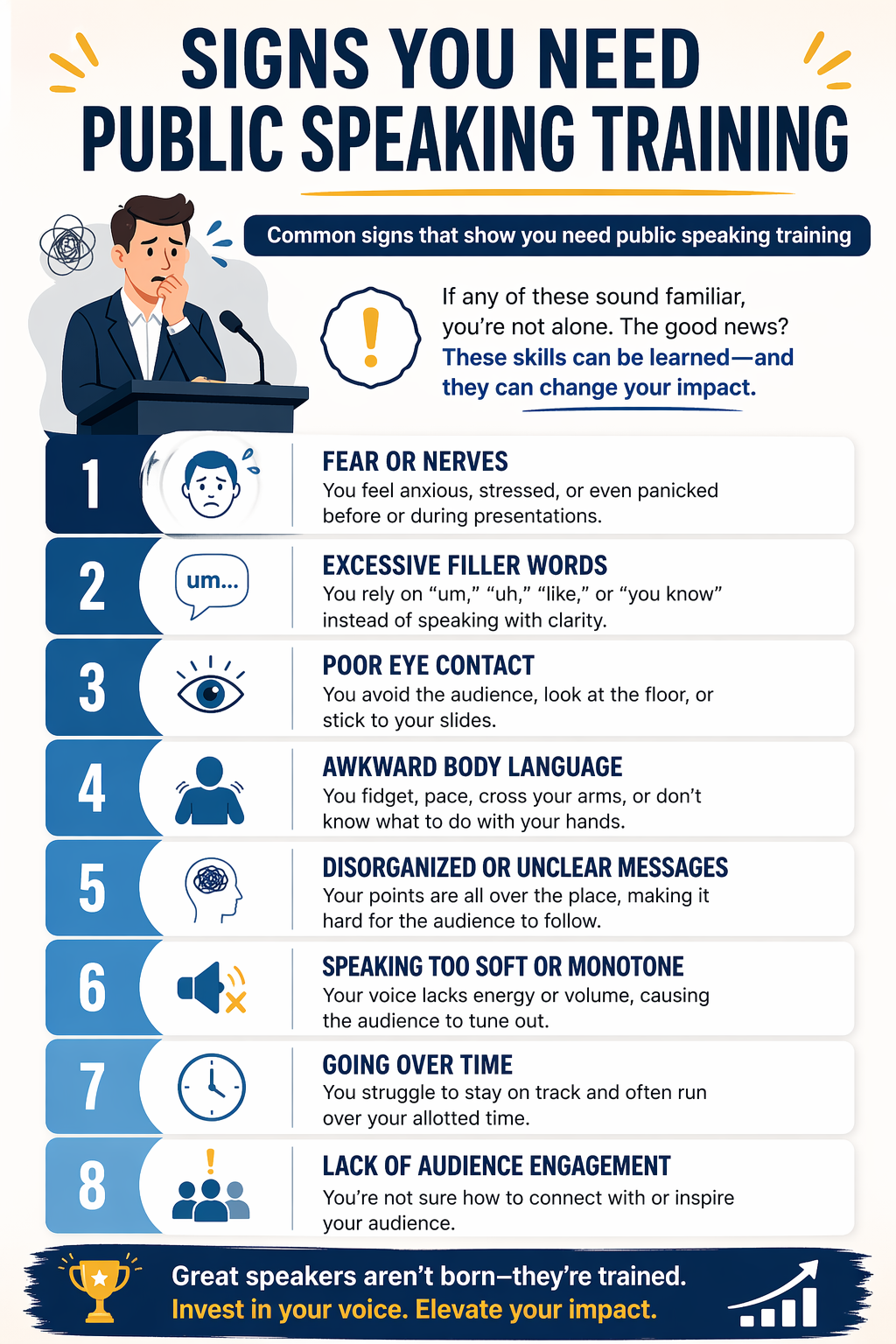
Before choosing a course, it helps to know exactly where you struggle. Here are the most common signs that a structured public speaking course could help you:
● You feel intense fear before presentations: Racing heart, shaky hands, or a blank mind when you know you have to speak
● You go quiet in meetings: You have good ideas but struggle to speak up when others are in the room
● You use too many filler words: “Um,” “uh,” “like,” and “you know” appear far too often in your speech
● You avoid eye contact: You look at your slides, the floor, or your notes instead of the audience
● You speak too fast: Nervousness causes you to rush through content, making it harder for people to follow
● Your message feels disorganized: You struggle to structure your thoughts clearly before and during speaking
● You avoid speaking opportunities: You decline chances to present, speak at events, or lead discussions because fear wins
● You read slides word for word: You rely on slides as a script instead of a support tool
If you recognize three or more of these in yourself, a good public speaking course is not just helpful — it is one of the most productive investments you can make right now.
Different Types of Public Speaking Courses Explained
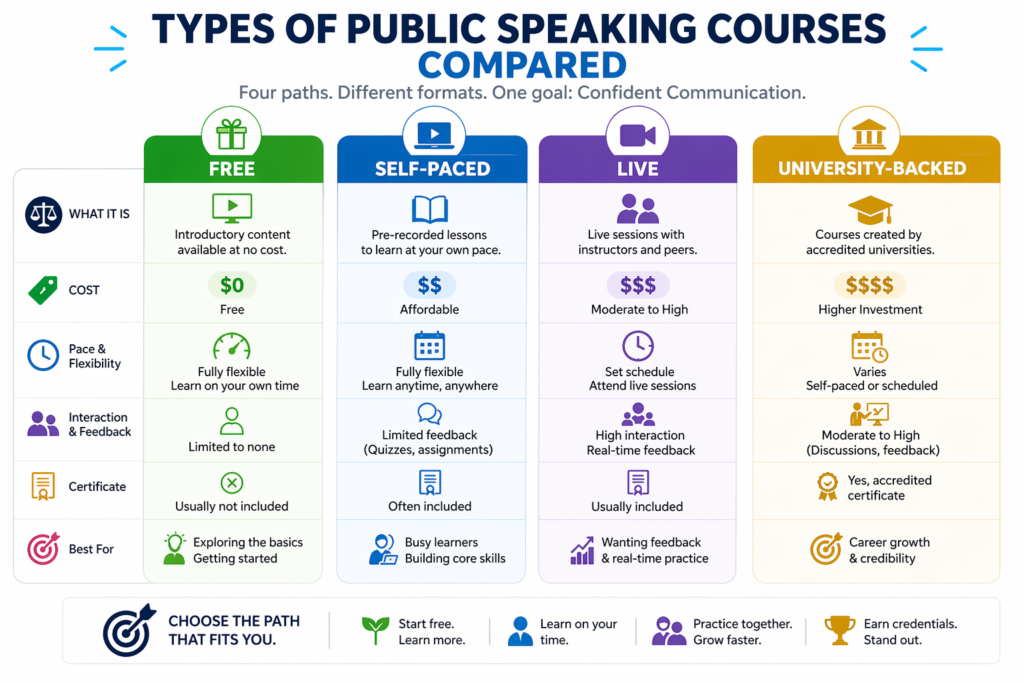
Not every public speaking course is built the same. Understanding the format options will help you choose something that actually fits your schedule, learning style, and budget.
Self-Paced Online Public Speaking Courses
These courses let you learn at your own speed. You watch video lessons, complete exercises, and practice speaking at times that suit you. Most platforms like Udemy, Coursera, and LinkedIn Learning offer this format.
● Best for: flexible learners, busy professionals, and beginners
● Typically affordable — often $15–$50 per course
● Great for building foundational knowledge before live practice
● Weakness: no real-time feedback from an instructor
Live Public Speaking Training Programs
Live programs include instructor-led classes, group workshops, or coaching sessions. You get direct feedback on your delivery, which accelerates improvement.
● Best for: professionals who need fast, measurable progress
● Includes real-time feedback and role-play exercises
● More accountability — you cannot skip sessions easily
● Usually more expensive than self-paced options
University-Backed Public Speaking Courses
These come from academic institutions and carry strong credibility. Platforms like Coursera, edX, and FutureLearn host courses from universities like the University of Washington, Rochester, and Harvard.
● Offer structured, research-backed content
● Often include verified certificates recognized by employers
● Good option if you want to add the credential to your resume or LinkedIn
● Example: University of Washington’s Dynamic Public Speaking Specialization on Coursera
Free Public Speaking Courses
Free options exist on YouTube, Coursera (audit mode), and various open education platforms. They are a smart way to test your interest before committing money.
● Good for: total beginners or people unsure which direction to take
● Usually no certificate included
● Less structured than paid courses
● Best used as a starting point before moving to a paid program
Best Public Speaking Courses to Build Confidence
Here is a curated breakdown of the top public speaking courses available in 2026, based on course quality, student feedback, value for money, and learning outcomes.
Best Overall Public Speaking Course
Coursera — Dynamic Public Speaking Specialization (University of Washington)
This is the most comprehensive public speaking online course you will find from a reputable institution. It covers four courses in one specialization: introductory speaking, speaking to inform, speaking to persuade, and speaking to inspire. Each module includes video assignments where you record and submit speeches for peer review — which means you get real feedback on real performances.
● Price: ~$49/month (free audit available)
● Certificate: Yes — a verified Coursera certificate from the University of Washington
● Duration: Approximately 4 months at a flexible pace
● Best for: Beginners who want a structured, thorough approach
● Standout feature: Video submission and peer review for actual speaking practice
| Expert Tip: Auditing this course for free gives you access to most content. Only pay when you need the certificate. |
Best Free Public Speaking Course
Coursera Audit Mode + YouTube Channels
If you are on a tight budget, auditing the University of Washington course gives you access to video lessons without paying. You can also build strong fundamentals using YouTube channels from TED Talks, Toastmasters International, and coaches like Vinh Giang.
The honest truth: free courses lack feedback and accountability. They are best for building awareness and motivation. Once you have clarity on your weak spots, a paid course becomes a smarter investment.
Best Public Speaking Course Online for Beginners
Udemy — The Complete Public Speaking Bootcamp
This is one of the most popular beginner-friendly courses on Udemy. It walks you through overcoming fear, structuring speeches, improving delivery, and building confidence through short, manageable lessons.
● Price: $15–$25 (Udemy runs frequent discounts)
● Certificate: Yes — a Udemy completion certificate
● Duration: ~10 hours of video content
● Best for: Absolute beginners who want affordable, practical training
● Standout feature: Clear, step-by-step lessons that do not overwhelm new learners
Best Public Speech Classes for Professionals
LinkedIn Learning — Public Speaking Foundations
Professionals who already have basic communication skills benefit most from LinkedIn Learning’s focused program. It is short, practical, and directly applicable to workplace communication including presentations, meetings, and client-facing speaking.
The added benefit: completing LinkedIn Learning courses automatically adds the credential to your LinkedIn profile, which is visible to recruiters and managers.
● Price: Included in LinkedIn Premium (~$39.99/month)
● Certificate: Yes — displays on LinkedIn profile
● Duration: ~2 hours
● Best for: Busy professionals who want fast, career-applicable skills
Best University-Backed Public Speaking Courses
For those who value academic credibility, here are the strongest options:
● University of Washington (via Coursera): Dynamic Public Speaking Specialization — highly structured and comprehensive
● University of Rochester (via edX): Effective Communication — strong focus on clarity, confidence, and persuasion
● Yale University (via Coursera): Various communication and leadership courses with strong credibility signals
Best Speaking in Public Courses With Certificates
If a certificate matters to you — for a job application, LinkedIn profile, or personal milestone — look for these platforms that offer verified credentials:
● Coursera (university-issued certificates)
● edX (verified certificates from accredited universities)
● LinkedIn Learning (certificate displayed directly on your profile)
● Udemy (completion certificates accepted by many employers)
Note: not all certificates carry equal weight. A certificate from the University of Washington or Rochester on Coursera carries more professional credibility than a basic Udemy certificate — though both have real value for demonstrating initiative.
Best Public Speaking Courses — Comparison Table
| Course / Platform | Best For | Price | Certificate | Type | Duration | Skill Level |
| Coursera – Public Speaking (UW) | Beginners & professionals | $49/mo | Yes | Online self-paced | ~16 hrs | Beginner–Intermediate |
| edX – Effective Communication (Rochester) | Career growth | $149 | Yes | Online self-paced | ~12 hrs | Intermediate |
| Udemy – The Complete Public Speaking Bootcamp | Budget learners | $15–$25 | Yes | Self-paced video | ~10 hrs | Beginner |
| Toastmasters International | Live practice & feedback | $45 bi-annually | No | Live / In-person | Ongoing | All levels |
| LinkedIn Learning – Public Speaking Foundations | Professionals | $39.99/mo | Yes | Self-paced video | ~2 hrs | Beginner |
| Harvard – Science of Everyday Thinking (edX) | Analytical thinkers | Free audit | Paid cert | Online | ~8 wks | Intermediate |
| YouTube / TED Talk channels | Total beginners | Free | No | Video lessons | Flexible | Beginner |
| Coursera – Dynamic Public Speaking (UW Spec.) | Comprehensive learners | $49/mo | Yes | Specialization | ~4 months | Beginner–Advanced |
Free vs Paid Public Speaking Courses: Which One Is Worth It?
When a Free Public Speaking Course Is Enough
Free courses make complete sense in these situations:
● You are a total beginner who is not sure if you need structured training yet
● You want to test different teaching styles before spending money
● You need basic tips to get through an upcoming presentation
● You are improving public speaking as a casual personal goal, not a career requirement
In these cases, auditing a Coursera course or watching a quality YouTube series is a smart, risk-free starting point.
When a Paid Public Speaking Course Makes More Sense
Paid courses deliver better results when the stakes are higher:
● You are preparing for an important job interview or promotion
● You give presentations, pitches, or client calls regularly as part of your work
● You need a certificate to add to your professional profile
● You want structured, progressive learning — not scattered tips
● You need feedback on your actual speaking performance
● You are building a business and need strong pitching skills (see also: best digital marketing courses for business owners)
What You Usually Get in Paid Public Speaking Training
● A structured curriculum that builds skills progressively
● Speaking exercises and recorded practice assignments
● Peer or instructor feedback on your delivery
● A certificate of completion
● Access to a student community for accountability
● Supplementary materials like templates, scripts, and worksheets
Free vs Paid Public Speaking Courses — Comparison
| Feature | Free Courses | Paid Courses |
| Cost | Free | $15–$200+ |
| Certificate | Rarely included | Usually included |
| Structured curriculum | Basic or partial | Full and progressive |
| Instructor feedback | None | Often included |
| Live sessions | Rarely | Available in premium |
| Practice exercises | Limited | Regular assignments |
| Community access | Rarely | Often included |
| Best for | Beginners testing interest | Career growth and credentials |
How to Choose the Right Public Speaking Course
With so many options available, narrowing down the best fit comes down to asking the right questions before you buy.
Questions to Ask Before Choosing a Course
1. Is the course built for my skill level? (Beginner, intermediate, or advanced?)
2. Numbers continue with next ref
1. Is the course built for my skill level? (Beginner, intermediate, or advanced?)
2. Does it include actual speaking exercises, not just theory?
3. Does it offer a verified certificate that has value in my field?
4. Is there live feedback from an instructor or peers?
5. Is the format self-paced or does it have fixed deadlines?
6. What do real student reviews say about results?
7. Is the price within my budget, and is there a refund option?
Best Course by Goal
● For job interviews: LinkedIn Learning or Udemy’s Bootcamp
● For presentations: University of Washington Specialization on Coursera
● For confidence building: Toastmasters International or Udemy Bootcamp
● For leadership speaking: LinkedIn Learning + edX Effective Communication
● For students: Free Coursera audit — strong content, zero cost
● For entrepreneurs: Toastmasters + a Udemy or LinkedIn Learning course for pitching skills
How to Choose a Public Speaking Course — Checklist
| Feature to Check | Why It Matters | Must-Have or Optional |
| Beginner-friendly structure | Avoids overwhelming new learners | Must-Have |
| Speaking exercises & practice tasks | Real improvement needs real practice | Must-Have |
| Verified certificate | Useful for job applications and LinkedIn | Optional (career-dependent) |
| Live instructor or peer feedback | Feedback accelerates improvement | Highly Recommended |
| Self-paced option | Flexibility around your schedule | Optional (lifestyle-dependent) |
| Positive reviews from real students | Proof of course quality | Must-Have |
| Clear curriculum and lesson plan | Signals a professional course | Must-Have |
| Community or discussion forum | Keeps you accountable | Optional |
| Refund or free trial | Reduces financial risk | Recommended |
| Practical examples and templates | Makes learning actionable | Must-Have |
Public Speaking Tips That Actually Work
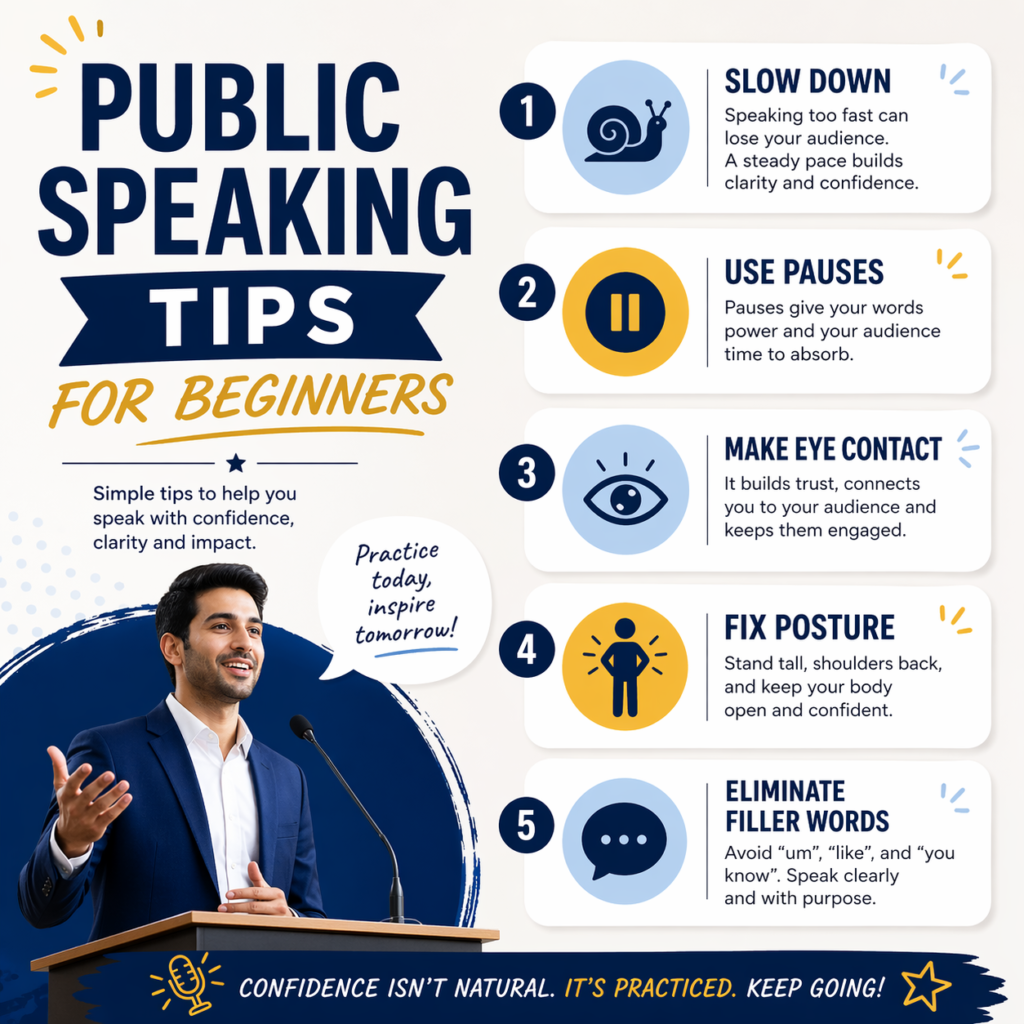
Courses give you structure. But these practical public speaking tips are what make the difference in real-world situations. These are the habits that confident speakers develop over time — and you can start building them today.
How to Reduce Fear Before Speaking
Stage fright is real, but it is manageable. Here is what actually helps:
● Breathe deeply before you start: Slow diaphragmatic breathing (4 counts in, hold for 4, out for 6) calms your nervous system within minutes
● Visualize success: Before walking into the room or joining the call, spend two minutes imagining yourself speaking clearly and the audience responding well
● Prepare more than you think you need to: Confidence is directly linked to preparation. Uncertainty about your material is one of the leading causes of speaking anxiety
● Reframe nervousness as energy: The physical sensations of nervousness and excitement are identical. Telling yourself ‘I am excited’ rather than ‘I am nervous’ has been shown in research to improve performance
● Arrive early: Getting comfortable in the physical space — or joining a Zoom call before others — reduces the novelty effect that triggers anxiety
Simple Tricks to Speak More Confidently
● Slow down: Most nervous speakers talk too fast. Consciously slowing your pace makes you sound more authoritative and gives the audience time to follow you
● Use pauses strategically: A deliberate pause after a key point is one of the most powerful speaking tools there is. It creates emphasis and shows confidence
● Make eye contact: Look at one person for a full sentence, then shift to someone else. This creates connection and signals confidence
● Fix your posture: Stand tall, shoulders back, feet shoulder-width apart. Your body language signals confidence to the audience — and to yourself
● Eliminate filler words: Replace ‘um’ and ‘uh’ with silence. It feels uncomfortable to you, but to the audience it sounds deliberate and composed
Public Speaking Advice for Absolute Beginners
● Start small — practice speaking in front of one or two people before moving to groups
● Record yourself on your phone and review the playback — you will spot habits you did not realize you had
● Join a local Toastmasters club for safe, structured practice with supportive feedback
● Use short bullet-point notes rather than memorizing a script — memorization breaks under pressure
● Celebrate small wins. Speaking up once in a meeting counts. Progress is progress.
Beginner vs Advanced Public Speaking Strategy
| The biggest mistake learners make is trying to use advanced techniques before mastering the basics. Here is a clear breakdown of what to focus on at each stage. |
Beginner Focus Areas
● Confidence: Simply speaking without shutting down is a win. Start there.
● Voice control: Volume, pace, and clarity are the foundation of effective delivery
● Structure: Learn to organize your message using simple frameworks like ‘situation, problem, solution, call to action’
Advanced Focus Areas
● Storytelling: Great speakers use stories to make data memorable and create emotional connection
● Persuasion: Learning how to build an argument, handle objections, and move an audience to action
● Audience engagement: Reading the room, adapting your pace, using questions and humor
● Executive presence: The combination of authority, composure, and authenticity that makes senior leaders compelling to listen to
Common Mistakes People Make When Learning Public Speaking
Improving your speaking skills is straightforward — if you avoid the traps that slow most people down. Here are the mistakes to watch for:
● Memorizing everything word-for-word: This causes the dreaded blank-mind moment when one word escapes you. Use key points instead of scripts
● Speaking too quickly: Speed is a symptom of nervousness. If people are not following you, pace is usually the first thing to fix
● Avoiding all eye contact: Looking at a screen, a wall, or your slides disconnects you from the room
● Ignoring body language: Research consistently shows that non-verbal signals carry more weight than words in how audiences perceive speakers
● Reading slides directly: If the audience can read the slide, you are not adding value. Use slides as visual anchors, not scripts
● Taking many courses without practice: Watching ten courses will not make you a better speaker. Practicing ten speeches will. Courses provide the map; you have to walk the road
● Skipping the recording exercise: Most people avoid watching themselves because it feels uncomfortable. That discomfort is exactly where your growth lives
Best Public Speaking Books to Improve Faster
Courses give you structure. Books give you depth. These five speaking books are consistently recommended by communication coaches and experienced presenters:
| Book | Best For | Main Strength | Skill Level |
| Talk Like TED – Carmine Gallo | Anyone wanting inspiration | Storytelling & emotional connection | Beginner–Intermediate |
| The Quick and Easy Way to Effective Speaking – Dale Carnegie | Beginners | Classic confidence-building framework | Beginner |
| Steal the Show – Michael Port | Performers & business people | Stage presence and authenticity | Intermediate |
| Confessions of a Public Speaker – Scott Berkun | Anyone who presents regularly | Honest, funny, highly practical | All levels |
| Simply Speaking – Peggy Noonan | Writers and speech crafters | Word choice and clarity | Intermediate |
● Talk Like TED (Carmine Gallo): Analyses the best TED Talks in history and breaks down the exact techniques behind their impact. Excellent for understanding storytelling, passion, and memorable delivery.
● The Quick and Easy Way to Effective Speaking (Dale Carnegie): A timeless classic. Practical, accessible, and full of exercises. The go-to recommendation for nervous beginners.
● Steal the Show (Michael Port): Approaches speaking as a performance art. Ideal for professionals who want to add personality, authenticity, and stage presence to their delivery.
● Confessions of a Public Speaker (Scott Berkun): Funny, honest, and genuinely useful. Berkun shares real stories from his own career in a way that makes the book feel like a conversation, not a textbook.
● Simply Speaking (Peggy Noonan): Written by a former speechwriter for US presidents, this is the best guide to word choice, rhythm, and clarity in speech writing and delivery.
Sample 30-Day Public Speaking Improvement Plan
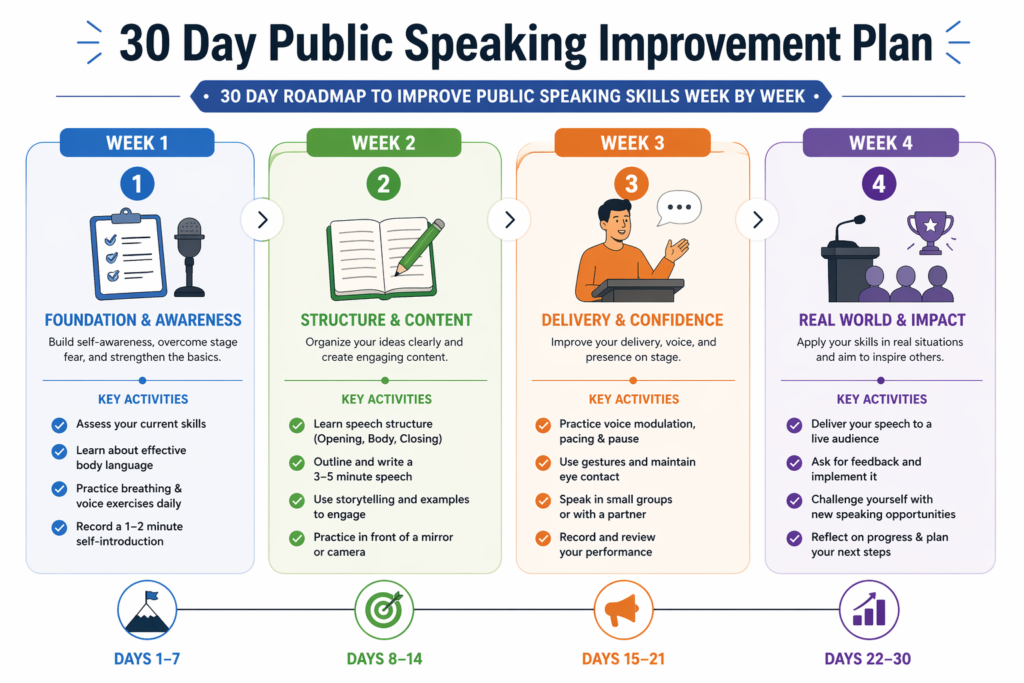
Courses and books are great. But consistent daily practice is what actually changes the way you speak. Here is a practical four-week roadmap designed for beginners:
Week 1: Build Basic Confidence
● Day 1–2: Introduce yourself out loud for 60 seconds, record it, and review
● Day 3–4: Read an article aloud — focus only on pace and clarity
● Day 5–7: Practice speaking for 2 minutes on a topic you know well. No preparation allowed — just talk
Week 2: Improve Your Delivery
● Practice using pauses — speak a sentence, pause for two full seconds, continue
● Work on eye contact by practicing with a trusted friend or family member
● Count your filler words during one recording session and set a goal to cut them in half by the end of the week
● Stand in front of a mirror and practice your posture for five minutes daily
Week 3: Practice Real Speaking Situations
● Join one group discussion or team meeting and make at least one clear, deliberate contribution
● Give a 5-minute informal presentation to a friend or colleague
● Practice speaking from bullet-point notes only — no written scripts
● Record a longer 3-minute talk and evaluate it against this criteria: pace, eye contact, filler words, clarity
Week 4: Build Advanced Skills
● Craft a short story that supports a point or opinion — practice telling it naturally
● Give a 5-minute presentation and include at least one question for your audience
● Handle a surprise question on camera — ask a friend to interrupt your practice speech with a question
● Watch one TED Talk and identify three techniques the speaker uses that you want to adopt
| Action Tip: Pair this 30-day plan with your chosen public speaking course for maximum results. The plan gives you daily reps. The course gives you the framework. |
Frequently Asked Questions
What is the best public speaking course for beginners?
For most beginners, the Udemy Complete Public Speaking Bootcamp offers the best combination of affordability, accessibility, and practical content. If you want a university-backed option, auditing the University of Washington’s Dynamic Public Speaking Specialization on Coursera for free is an excellent starting point.
Are free public speaking courses worth it?
Yes — for beginners who are just starting out or testing the waters. Free courses help you build basic awareness and motivation. However, if you have a specific professional goal (job interview, leadership role, regular presentations), a structured paid course with feedback and a certificate will deliver stronger results.
Can I improve public speaking skills online?
Absolutely. Online public speaking courses have improved significantly and now include video practice assignments, peer feedback, and live coaching options. The key is to choose a course that makes you actually speak — not just watch videos. Pair online learning with in-person practice (even with friends) for the best results.
Which public speaking course offers a certificate?
Several strong options offer verified certificates:
● Coursera (University of Washington Specialization) — university-verified certificate
● edX (University of Rochester) — verified certificate option
● LinkedIn Learning — certificate displayed on your LinkedIn profile
● Udemy — completion certificate accepted by many employers
How long does it take to become confident in public speaking?
For most people, consistent practice over 60–90 days creates a noticeable, lasting improvement in confidence. You will see early progress within the first two to four weeks of daily practice. Full comfort with speaking publicly — especially in high-stakes situations — typically takes six months to a year of regular practice.
What are the best public speaking books?
The most consistently recommended books are Talk Like TED by Carmine Gallo, The Quick and Easy Way to Effective Speaking by Dale Carnegie, Confessions of a Public Speaker by Scott Berkun, and Steal the Show by Michael Port. Carnegie’s book is the best starting point for absolute beginners.
Is a speech class better than self-study?
Both approaches have value. A speech class (especially a live one) gives you accountability, real feedback, and practice with an audience. Self-study is more flexible and affordable. The ideal approach is to combine both: use a structured course or book for learning, and then get live practice through Toastmasters or a speaking group.
Are university public speaking courses worth it?
Yes — particularly if you want credibility and structure. Courses from the University of Washington and University of Rochester are well-designed and their certificates carry genuine recognition. They are also more demanding than casual Udemy courses, which means more growth if you commit.
How do I stop being nervous when speaking publicly?
Start with thorough preparation — most nervousness comes from uncertainty. Practice deep breathing before speaking. Reframe anxiety as excitement. Start practicing in low-pressure environments (small groups, friendly audiences) and build from there. The nervousness never fully disappears for most speakers, but it becomes manageable and, over time, actually useful.
Which public speaking online course is best for professionals?
LinkedIn Learning’s Public Speaking Foundations is the best quick-win option for working professionals. For deeper development, the University of Washington’s Dynamic Public Speaking Specialization on Coursera is the strongest choice. Toastmasters International remains the best live, ongoing training community for professionals who want regular practice.
If you are a professional also looking to advance your career with other skills, check our guides on PMP certification courses andtime management courses online.
Final Action Plan: Where to Start Today
Reading about public speaking is a start. Taking action is where the real growth happens. Here is a simple roadmap to get moving today:
1. Identify your goal: Interview prep? Client presentations? Leadership communication? Your goal determines your best course.
2. Choose your starting course: Beginner on a budget → Udemy. Want a certificate → Coursera. Professional in a hurry → LinkedIn Learning. Want live practice → Toastmasters.
3. Start the 30-day practice plan: Begin this week — even five minutes of daily speaking practice adds up faster than you expect.
4. Record yourself once per week: Review your recordings honestly and track your own progress. This is the single most effective self-improvement tool available to any speaker.
5. Join a speaking community: Toastmasters, a local group, or even an online speaking challenge. Accountability from a community multiplies your results.
| Remember: Every great speaker was once a nervous beginner. The only difference between them and everyone else is that they kept practicing. Your next great speech starts with your very next conversation. |
If you found this guide useful, you might also enjoy reading about social media marketing courses and the best graphic design courses online — two skill areas that pair well with strong communication skills.