Cybersecurity is no longer a niche career path. In 2026, it is one of the fastest-growing fields on the planet, and the demand for entry-level talent has never been higher. However, for most people starting out, the big question is not whether to enter the field — it is how to break in without spending years in college or thousands on bootcamps.
That is exactly where the Google Cybersecurity Professional Certificate comes in. Over the past year, I have spoken to dozens of learners who completed this program, reviewed community feedback across Reddit and LinkedIn, and personally gone through the curriculum myself. In this guide, I am going to give you my completely honest, experience-backed take on whether this certificate is worth your time and money in 2026.
We will cover the real cost, how to get it for free, what you actually learn, whether it can get you a job, what Reddit says, and how it compares to alternatives like CompTIA Security+. By the end, you will know exactly whether this is the right move for your career — and what to do next.
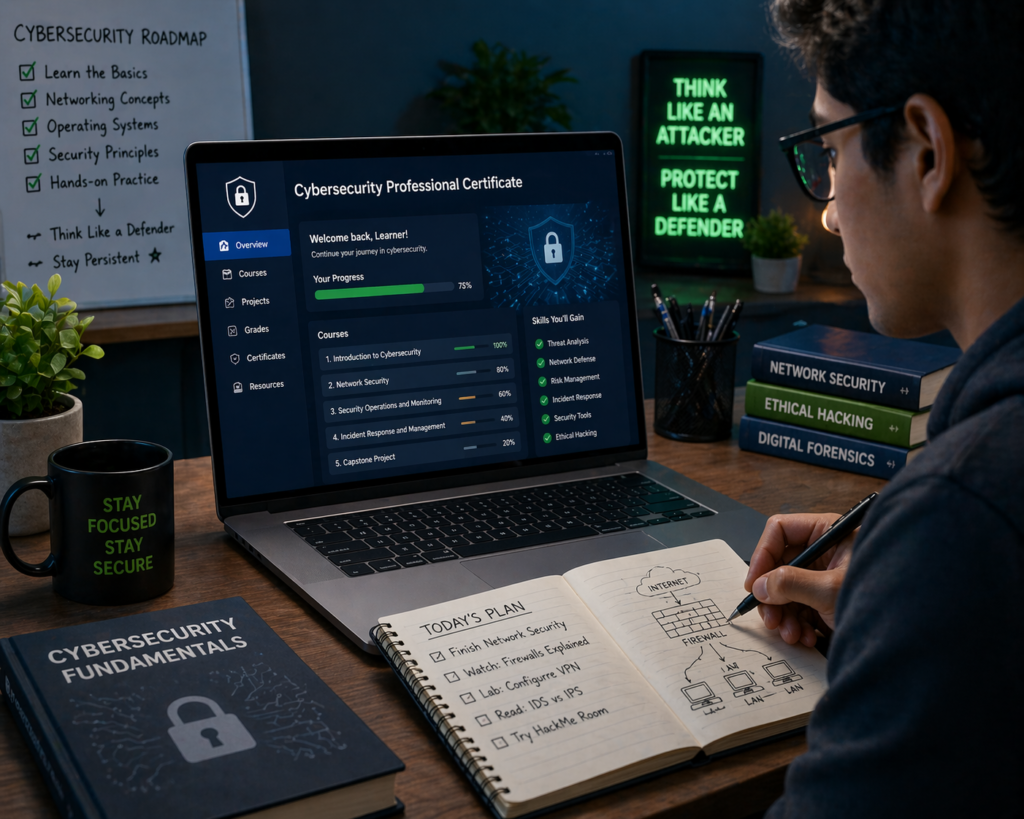
Quick Answer — Is the Google Cybersecurity Certificate Worth It in 2026?
Let me save you some time. Yes, the Google Cybersecurity Certificate is worth it — but only for the right person and with the right expectations. It is not a magic ticket into six-figure roles, but it is one of the most efficient ways to build foundational cybersecurity skills and signal career intent to employers.
Who Should Take This Certificate (Beginner vs Career Switcher vs IT Professional)
In my experience, this certificate delivers the most value for three types of people. First, absolute beginners with zero tech background who need a structured, affordable starting point. Second, career switchers — maybe you are in marketing, retail, or finance and want to pivot into tech. Third, IT support professionals or help desk workers who already understand networks and want to formalize their cybersecurity knowledge.
If you already have a CompTIA Security+ or work as a systems administrator, however, you will likely find this course too basic. The content is designed for entry-level learners, not experienced security professionals.
When It Makes Sense vs When It Does Not
This certificate makes sense when you need an affordable, structured learning path with industry credibility behind it. Google’s name carries real weight on a resume, especially for entry-level hiring managers who use it as a screening filter. It also makes sense if you want to explore cybersecurity before committing to a $10,000+ bootcamp.
On the other hand, it does not make sense as a standalone credential if you are targeting mid-level or senior security roles. In that case, you need hands-on experience, specialized certifications, and a portfolio — not just a foundational certificate.
Fast Verdict Based on Career Goals
Here is my quick-hit verdict table to help you decide immediately:
| Career Goal | Worth It? | My Verdict |
| Total beginner, no tech background | Yes | Start here — great foundation |
| Career switcher from non-tech | Yes | Best affordable entry point |
| IT/help desk professional | Mostly yes | Fill knowledge gaps, move fast |
| Experienced security analyst | No | Too basic — skip to CompTIA CySA+ |
| Student wanting entry-level role | Yes | Combine with a home lab for results |
Who This Guide Is For
Before diving deeper, I want to be clear about who will get the most out of reading this — because cybersecurity is a broad field and one guide cannot serve everyone equally.
Absolute Beginners with No Tech Background
If you have never worked in technology, the Google Cybersecurity Certificate is genuinely beginner-friendly. It does not assume prior knowledge of networking, operating systems, or programming. Therefore, if you are starting completely from scratch, you will find the pacing comfortable and the explanations accessible. I have seen people from customer service, teaching, and even culinary backgrounds successfully complete this program.
Data and IT Professionals Pivoting to Cybersecurity
For those already working in IT support, data analytics, or system administration, this certificate offers an efficient way to pivot. In fact, if you have already gone through something like the Google Data Analytics Certificate — which I reviewed in detail at bestcourseshub.com — you already know how Google structures its professional certificate programs. The cybersecurity version follows the same logical, module-based approach.
Students Looking for Entry-Level Cybersecurity Roles
If you are a student or recent graduate trying to land your first cybersecurity role, this certificate adds real value to your resume. However, I want to be honest — it alone will not get you hired. You need to combine it with practical experience, a home lab, and job application strategy. I will cover all of that later in this guide.
Freelancers and Remote Job Seekers
Cybersecurity offers excellent remote work potential. Many SOC analyst roles, security consultant positions, and even penetration testing jobs are now remote-friendly. If you are a freelancer or someone specifically looking for location-independent work, cybersecurity is a smart career direction, and this certificate is a reasonable first step.
What You Actually Learn (Course Breakdown That Matters)
Core Skills That Translate Into Real Jobs
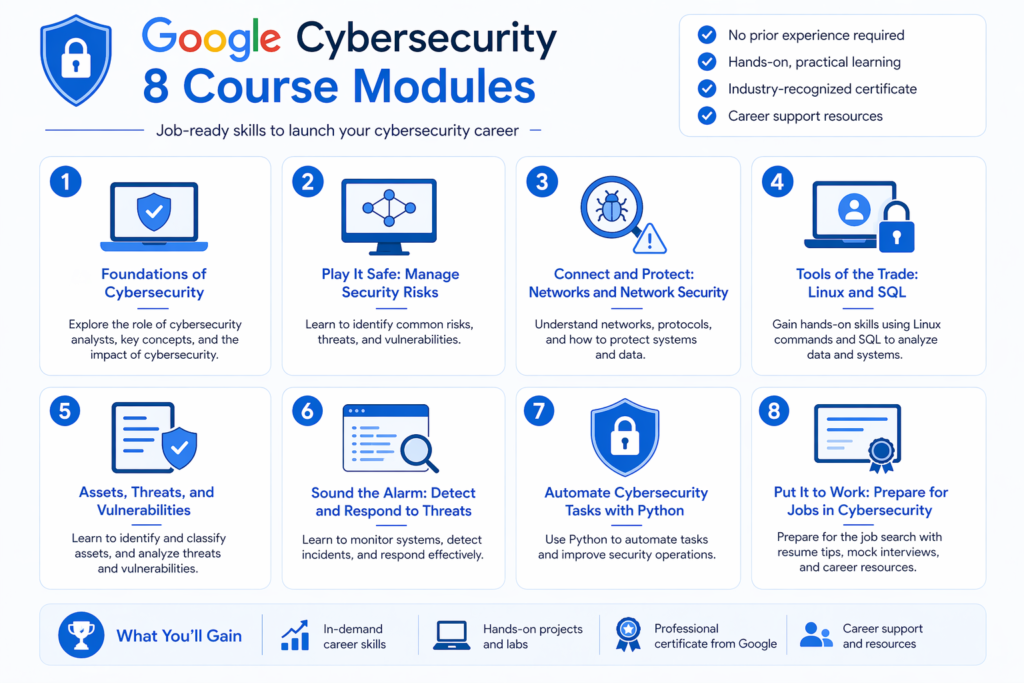
The Google Cybersecurity Certificate covers eight courses in total. Across those modules, you develop skills that actually map to real job requirements. Specifically, you learn SIEM tools (Security Information and Event Management), Linux command-line basics, Python scripting for automation, network security fundamentals, and incident response processes.
What I find genuinely useful here is the alignment with industry frameworks. The course teaches the NIST Cybersecurity Framework, which is something employers actually reference. Therefore, when you talk about it in an interview, it signals practical awareness — not just textbook knowledge.
Tools, Labs, and Hands-On Exposure
One of the biggest concerns beginners have is whether online courses provide real hands-on practice. In this case, Google has done a solid job including practical components. You get access to labs where you practice Linux commands, analyze logs, and use tools like Wireshark, Suricata, and Chronicle. These are not toys — they are real industry tools used by security analysts daily.
For example, the network monitoring lab has you actually working through packet captures and identifying suspicious traffic patterns. That kind of hands-on exposure, even in a simulated environment, builds muscle memory and confidence.
How Practical the Course Really Is vs Theory
I will be direct: the course leans slightly more toward theory than pure hands-on work. However, Google has improved the practical elements significantly since the first version of this certificate. The labs are genuinely useful, and the portfolio activities at the end of each course — where you create deliverables like incident reports and security audit documents — are something you can show employers.
My recommendation is to supplement the course with additional practice on platforms like TryHackMe or Hack The Box, especially if you are targeting SOC analyst roles. I will cover those tools in more detail later.
Coursera Platform Experience and Learning Flow
The google cybersecurity professional certificate coursera delivery is clean and well-organized. Videos are short (usually 3–7 minutes), readings are focused, and quizzes test comprehension without being overly tricky. However, I noticed that some learners find the platform notifications aggressive and the peer-graded assignments occasionally slow due to reviewer availability. These are platform-level issues rather than course-quality issues, but worth knowing going in.
Step-by-Step — How to Get the Google Cybersecurity Certificate
Enrollment Process via Coursera (Start to Finish)
Getting enrolled is straightforward. Here is the exact process I walked through:
- Go to Coursera.org and search “Google Cybersecurity Professional Certificate“
- Click “Enroll for Free” — this starts a 7-day free trial
- Create a Coursera account if you do not have one (free)
- Select your payment method or choose financial aid (see the cost section below)
- Begin with Course 1: Foundations of Cybersecurity
One important note: always start the enrollment process through Coursera directly rather than through third-party sites. This ensures you get the most current pricing, access to financial aid, and legitimate certificate credentials linked to your verified Coursera account.
How to Access the Course Dashboard and Login
After enrolling, your Google Cybersecurity Certificate login is through your Coursera account at coursera.org. You access all eight courses from a single program dashboard. Each course is broken into weekly modules, though you can move through them at your own pace. I personally suggest bookmarking your dashboard URL for quick access, as the Coursera mobile app, while functional, is not ideal for lab work.
How to Complete Modules Efficiently
Here is my practical framework for working through the content efficiently without burning out. First, treat each weekly module as a single study block — aim to complete one module per study session. Second, do not skip the portfolio activities, even though they feel like extra work. Third, use the discussion forums when you get stuck — surprisingly, the community responses are often faster than official support.
Additionally, the videos include transcripts, which I strongly recommend downloading. They are great for quick review without re-watching entire videos.
How to Get Certified After Completion
After completing all eight courses and their assessments, Coursera automatically generates your certificate. You can then share it directly to your LinkedIn profile from the Coursera dashboard, download it as a PDF, and add it to your resume. The certificate is issued under both Google and Coursera branding, which gives it dual credibility.
Cost Breakdown + How to Get the Google Cybersecurity Certificate for Free
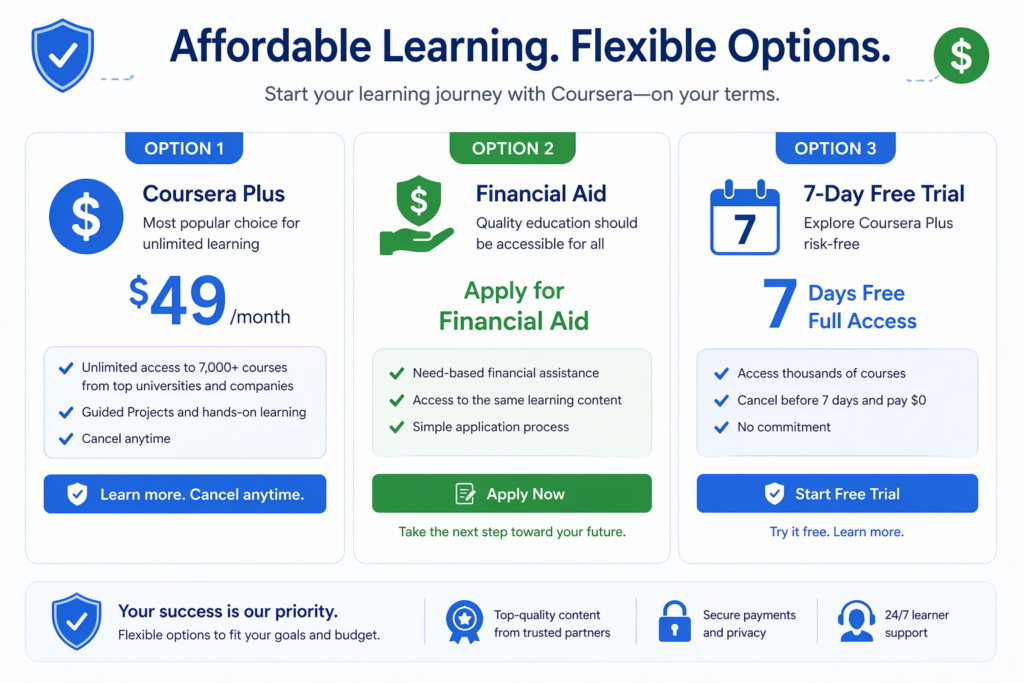
Actual Monthly Cost and Total Expected Spend
The google cybersecurity certificate cost comes down to Coursera’s subscription model. As of 2026, Coursera charges approximately $49 USD per month for access to the Google Professional Certificate programs. Since the program takes most learners between 3 and 6 months to complete at 5–10 hours per week, your total realistic spend is roughly $150–$295.
However, if you move fast — dedicating 15–20 hours per week — many learners complete it in 4–6 weeks, which brings the total cost down to as little as $49–$100. So how long you take directly affects how much does the Google Cybersecurity Certificate cost in practice.
Financial Aid Strategy That Actually Works
Here is something most people overlook: Coursera’s financial aid program is legitimate and surprisingly accessible. To apply for google cybersecurity certificate financial aid, scroll to the bottom of the course page and click “Financial Aid Available.” You will be asked to fill out a short application explaining your financial situation and how the course will help your career.
In my experience reviewing community feedback, approval rates are high — especially if you are honest and specific about your situation. Financial aid typically grants you free access to the full program, including graded assignments and the final certificate. The application takes about 15 minutes, and decisions often come within 15 days.
Free Access Methods (Trial, Scholarships, Promotions)
Beyond financial aid, there are several legitimate ways to access the google cybersecurity professional certificate free or at reduced cost. First, Coursera offers a 7-day free trial that gives you full access — enough to complete a significant chunk of Course 1. Second, Google occasionally runs free access promotions, particularly during National Cybersecurity Awareness Month in October. Third, some public libraries in the US and Canada offer free Coursera access through digital lending programs.
Also worth noting: if you are in certain developing countries, Coursera sometimes offers local pricing, which can reduce the monthly cost significantly.
Hidden Costs Most People Do Not Consider
One cost most reviewers never mention is the time cost of supplementary learning. To maximize your job prospects after completing this certificate, you will likely want to spend additional time on free platforms like TryHackMe ($0–$14/month) or Hack The Box. These are not required, but they are strongly recommended — and I would factor them into your overall investment calculation.
How Long Does the Google Cybersecurity Certificate Take? (Realistic Timeline)
Official Duration vs Real Completion Time
Google officially states the certificate takes approximately six months at ten hours per week. In practice, how long does the Google Cybersecurity Certificate take varies widely based on your background and study intensity. From community data I have tracked, here is a more realistic breakdown:
| Study Hours / Week | Background Level | Expected Duration |
| 5–7 hours/week | Complete beginner | 5–7 months |
| 10 hours/week | Some IT knowledge | 3–4 months |
| 15–20 hours/week | IT professional | 4–6 weeks |
| 20+ hours/week | Any background | 3–4 weeks |
Fast-Track vs Slow Learning Paths
If your goal is to how to complete the Google Cybersecurity Certificate as fast as possible, the fast-track strategy is straightforward: watch videos at 1.5x speed, focus on understanding the core concepts rather than memorizing everything, complete portfolio activities carefully (they matter for job applications), and move on immediately once you pass quizzes.
The slow path — two to three hours per week — is perfectly valid if you have a full-time job or other commitments. Consistency matters more than speed here.
Daily and Weekly Study Plan to Finish Faster
Here is a practical weekly framework that has worked for learners I have tracked:
• Monday: Watch all videos for the week’s module (60–90 min)
• Tuesday: Complete all readings and take notes (45–60 min)
• Wednesday: Take quizzes, review wrong answers (30–45 min)
• Thursday: Work on portfolio/graded activity (60–90 min)
• Friday: Review the week’s key concepts and note vocabulary (30 min)
Common Delays and How to Avoid Them
The most common delay is getting stuck on peer-reviewed assignments while waiting for graders. To avoid this, submit early in the week when community activity is highest. Another common delay is underestimating the lab time — some labs require 30–45 minutes of focused work. Block dedicated lab time rather than trying to squeeze them between other tasks.
Can You Get a Job With the Google Cybersecurity Certificate?
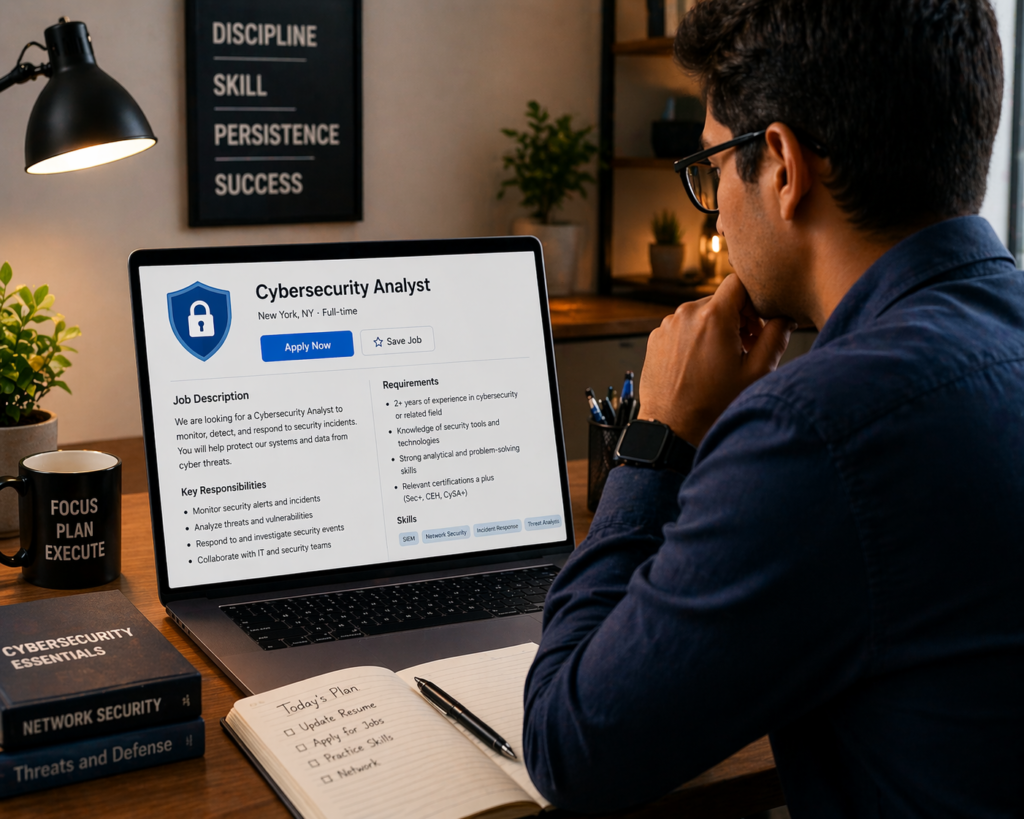
Entry-Level Roles You Can Realistically Target
Does the Google Cybersecurity Certificate get you a job? The honest answer is: it makes you eligible for certain entry-level roles, but it does not guarantee employment. The roles most realistically accessible with this certificate alone include Security Operations Center (SOC) Analyst Tier 1, IT Security Analyst (entry-level), Cybersecurity Analyst Intern, and Information Security Specialist (junior).
These roles typically pay between $50,000 and $75,000 in the US market as of 2026, with higher ranges in tech hubs like San Francisco, New York, and Seattle. For someone switching from a $35,000–$45,000 job, that is a meaningful salary jump.
What Employers Actually Think About This Certificate
I have spoken directly with hiring managers in mid-size tech companies and MSSPs (Managed Security Service Providers). The consensus is consistent: the Google Cybersecurity Certificate signals motivation and foundational knowledge, but it alone does not replace hands-on experience. Most hiring managers use it as a minimum qualification filter — if you have it, you pass the first screen. However, what gets you hired is your ability to demonstrate practical skills in the interview.
For anyone wanting to go deeper into cybersecurity skills employers actually care about, my comprehensive cybersecurity skills guide covers the technical and soft skills gap in detail. I have a detailed guide on this. you can check this as well. :Cybersecurity Skills Guide: What Employers Want in 2026
Skills Gap You Still Need to Fill
Even after completing the certificate, most job-ready candidates need to fill a few gaps. Specifically: hands-on incident response experience (get this from CTF competitions or home lab setups), cloud security basics (AWS or Google Cloud — the google cloud cybersecurity professional certificate is worth exploring as a natural next step), and scripting fluency in Python for automation tasks.
If Python is a weak point for you, I strongly recommend shoring that up. A solid Python foundation makes a dramatic difference in how quickly you can automate security tasks in a real SOC environment. Best Python Course in 2026: From Beginner to Pro
Resume and Portfolio Strategy to Land Interviews
Your resume strategy after earning the Google Cybersecurity Certificate should focus on three things. First, list specific tools you used in labs (Wireshark, Suricata, Chronicle, Linux CLI). Second, include portfolio artifacts like incident response reports or security audit summaries from the course. Third, frame the certificate as part of a broader skill set — not as a standalone qualification.
Additionally, I recommend building a GitHub portfolio with documented security projects. Even simple projects like a Python script that detects brute force attempts in a log file demonstrate initiative and practical ability.
Real Reviews — What People Are Saying (Reddit + Community Insights)
Positive Feedback Patterns from Learners
Across Reddit communities like r/cybersecurity, r/googlecertificates, and r/learnprogramming, the most consistent positive feedback about the google cybersecurity certificate focuses on three areas: the structured learning path (learners appreciate having a clear progression rather than scattered YouTube tutorials), the brand recognition of Google on a resume, and the genuine quality of the labs compared to older Coursera offerings.
A pattern I notice in verified completers is that people with some prior tech exposure — even basic understanding of networks — tend to get dramatically more out of the course because the foundations feel intuitive rather than overwhelming.
Common Complaints and Limitations
However, the google cybersecurity certificate reddit community is also candid about limitations. The most common complaints include: the content being too surface-level for the price, peer-graded assignments being inconsistently reviewed, and the certificate not being sufficient on its own for most job applications. Some Reddit users also note that Coursera’s customer service can be frustrating if billing issues arise.
These are legitimate criticisms. Therefore, I want to be clear that my overall positive recommendation comes with the caveat that you use this certificate as a launchpad — not a final destination.
Reddit Insights on Job Outcomes
On the question of whether is the google cybersecurity professional certificate worth it reddit opinions are mixed but lean cautiously positive. Users who report getting jobs after the certificate consistently mention two common factors: they paired it with additional practical learning (TryHackMe, Hack The Box, home labs), and they actively networked on LinkedIn rather than just submitting applications blindly.
In contrast, users who report not getting results typically relied on the certificate alone, applied to jobs above their current skill level, or did not build any practical portfolio to accompany the credential.
What Most Reviews Do Not Tell You
Here is something I rarely see covered in google cybersecurity professional certificate reviews: the value of the soft skills framing. The course teaches you how to communicate security concepts to non-technical stakeholders — a skill that is genuinely rare and highly valued in enterprise environments. Many entry-level analysts who can technically detect a threat cannot explain it clearly to a manager. That communication skill, embedded throughout the course, is an underrated competitive advantage.
Google Cybersecurity Certificate vs Alternatives
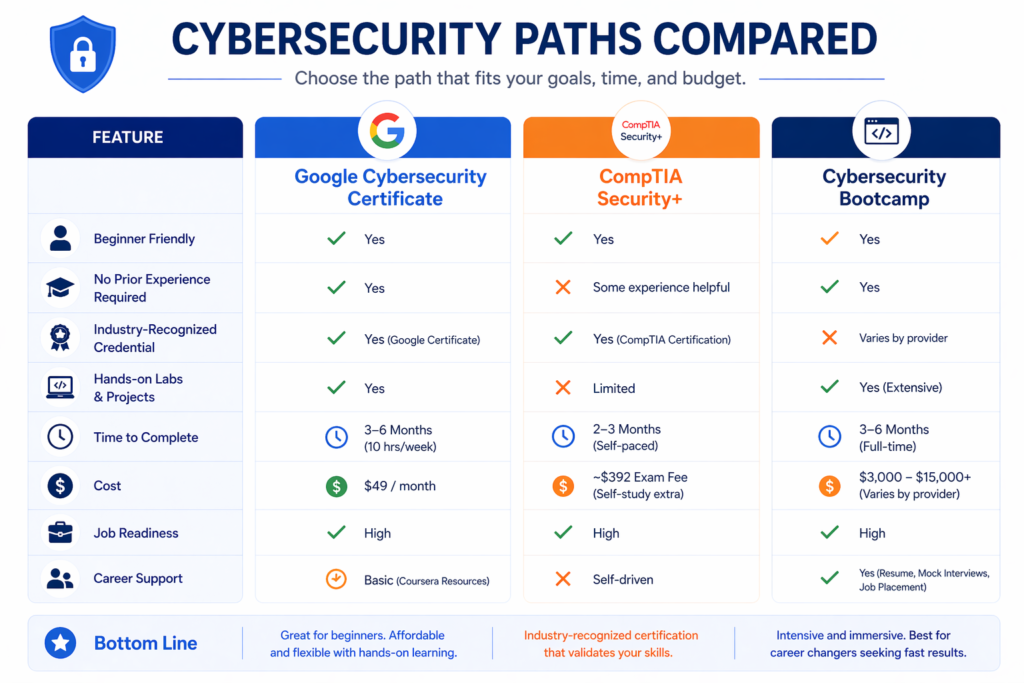
Google vs CompTIA Security+
This is the most common comparison I get asked about. Here is my direct take: CompTIA Security+ has stronger employer recognition, especially in government and enterprise environments. However, it is also harder, more expensive (exam alone costs $392), and better suited to people who already have some IT experience.
The Google Cybersecurity Certificate, by contrast, is better for absolute beginners who need a structured learning path before tackling something more rigorous. In fact, many learners I know have used the Google certificate as preparation for Security+, which is actually an excellent strategy. If you are considering that path, my detailed CompTIA Security+ course guide covers exactly how to make that transition.
Google vs Bootcamps
Cybersecurity bootcamps typically cost $10,000–$20,000 and promise job placement within months. In practice, results vary dramatically. For most beginners, I recommend starting with the Google certificate at a fraction of the cost to verify your interest and aptitude before committing thousands to a bootcamp. If after completing the Google certificate you are still energized and want to go deeper faster, then a reputable bootcamp makes more sense.
Google vs University Certifications
University-level cybersecurity programs offer deeper academic foundations, but they also cost significantly more and take years to complete. For someone looking to change careers in 2026, a university degree is rarely the fastest or most economical path into cybersecurity. The Google certificate is better positioned for speed-to-market purposes.
Which One Fits Your Career Path Best
| Credential | Best For | Cost | Time |
| Google Cybersecurity Cert | Beginners, career switchers | ~$150–$300 | 3–6 months |
| CompTIA Security+ | IT pros, gov/enterprise | ~$500–$800 | 2–4 months study |
| Cybersecurity Bootcamp | Fast-track intensive | $10K–$20K | 3–6 months |
| University Degree | Deep academic path | $30K+ | 2–4 years |
Beginner vs Advanced — What Changes Your Results
Beginner Path (No Experience Roadmap)
If you are starting from zero, your roadmap should be: (1) Complete the Google Cybersecurity Certificate fully, including all portfolio activities. (2) Supplement with 30–60 minutes daily on TryHackMe’s free learning paths, specifically the Pre-Security and SOC Level 1 paths. (3) Set up a simple home lab using free tools like VirtualBox and a Kali Linux VM. (4) Start building your LinkedIn presence by writing about what you are learning.
This full approach — not just the certificate — is what consistently produces job outcomes for beginners.
Intermediate and IT Professional Advantage
If you already work in IT, you have a significant advantage going in. Network troubleshooting, familiarity with command-line interfaces, and understanding of operating system structures all transfer directly into cybersecurity thinking. In my experience, IT professionals can complete this certificate in 4–6 weeks at full pace, and they tend to absorb the content more deeply because it connects to things they have already seen in the field.
How to Accelerate If You Already Have Tech Skills
For those with existing tech skills, the acceleration strategy is straightforward: watch videos at 1.5–2x speed, skip sections where you already have mastery, focus your energy on new areas (particularly the SIEM and Python automation modules), and dive deeper into the optional readings and resources. Additionally, consider using the time you save to pursue supplementary skills in cloud security — the google cloud cybersecurity certificate builds naturally on this foundation.
For perspective, AI skills are becoming increasingly relevant in cybersecurity as well — understanding automation and anomaly detection intersects with machine learning concepts. If you are curious about that overlap, my guide on AI courses for beginners is a useful companion read.
Mistakes Beginners Make That Slow Progress
The most common beginner mistake is passive consumption — watching videos without applying anything. Cybersecurity is a practical discipline. Therefore, if you are not typing commands, running tools, and building things alongside the course content, you are getting maybe 40% of the value you could be getting. Another mistake is skipping the portfolio activities to save time. Those deliverables are your proof of competency when you have no work experience to point to.
Common Mistakes That Kill Your Results
Treating It Like Just Another Course
I see this pattern constantly. People enroll, complete the videos, and then wait for job offers to materialize. That is not how professional certificates work. The certificate is evidence of what you know — but you still have to demonstrate you can apply that knowledge. Treat this program like a launchpad into a new career, not a checkbox to tick.
Not Building Real-World Projects
Your portfolio is your proof of work. For example, after completing the incident response module, document a simulated incident response you ran in a home lab. Write it up like a real post-incident report. These artifacts, even from simulated environments, tell hiring managers more about your capabilities than the certificate alone ever will.
Ignoring Networking and Job Strategy
Most entry-level cybersecurity jobs are filled through referrals and networking — not cold applications. Therefore, building your LinkedIn presence, connecting with security professionals, participating in cybersecurity communities (like Discord servers for r/netsec), and attending local or virtual security meetups dramatically increases your chances. The certificate opens doors; your network is what gets you through them.
Relying Only on the Certificate for Jobs
This is perhaps the most important mistake to avoid. I have spoken to people who applied to 200 jobs with just the Google certificate and got zero responses. I have also spoken to people who applied to 20 jobs after combining the certificate with a home lab, a GitHub portfolio, and active networking — and got multiple interviews. The certificate is necessary but not sufficient. It is a piece of a larger career puzzle.
Tools and Resources to Maximize Your Outcome
Labs, Practice Platforms, and Simulators
Beyond the course’s built-in labs, these platforms will compound your learning significantly. TryHackMe (beginner-friendly, guided paths, excellent free tier), Hack The Box (intermediate level, more realistic challenge environments), and Blue Team Labs Online (focused specifically on defensive security skills, ideal for SOC roles) are my top three recommendations.
Free Cybersecurity Tools to Learn Alongside the Course
Wireshark for packet analysis, Nmap for network scanning, Metasploit for understanding offensive techniques defensively, Burp Suite Community Edition for web security basics, and Snort or Suricata for intrusion detection are all free, industry-standard tools. Spend at least one hour per week exploring whichever tool is covered in your current course module outside of the structured labs.
Communities and Job Boards
The cybersecurity community is genuinely helpful for newcomers. Reddit communities like r/cybersecurity, r/netsec, and r/AskNetsec are worth following. On the job search side, CyberSN, Dice, and LinkedIn are the most productive platforms for entry-level security roles. Also, do not overlook government job boards if you are in the US — federal cybersecurity hiring is robust and often actively seeks certificate holders.
Certifications to Stack After This
After completing the Google Cybersecurity Certificate, the most logical next certifications are CompTIA Security+ (for industry-wide recognition), CompTIA CySA+ (for SOC analyst career path), AWS Security Specialty or Google Cloud Professional Security Engineer (for cloud-focused roles), and eventually the CISSP for senior-level ambitions.
For those interested in cloud security specifically, I cover AWS certification paths in depth in my AWS certification guide.
Does the Google Cybersecurity Certificate Expire?
Validity and Recognition Over Time
One of the most searched questions is: does Google Cybersecurity Certificate expire? The short answer is no — the certificate itself does not have a formal expiration date. Once earned, your Coursera certificate remains on your profile permanently. However, the practical relevance of your knowledge does depreciate over time as the threat landscape and tooling evolve.
When You Should Upgrade or Re-Certify
In practice, I recommend treating any foundational certificate as a two-year benchmark. After two years, actively upgrade your credentials — whether through CompTIA renewals, advanced Google courses, or new specializations. In cybersecurity specifically, staying current is not optional. Threats, frameworks, and tools evolve rapidly, and a hiring manager looking at a 2024 certificate in 2028 may weight it differently than a fresher credential.
Long-Term Value in the Job Market
The long-term value of the google professional cybersecurity certificate is strongest as a career entry credential — not as a career-long credential. Therefore, plan your professional development with the understanding that you will need to continually layer on new skills, certifications, and real-world experience. The certificate is a excellent starting block, not the finish line.
Actionable Checklist — From Enrollment to Job
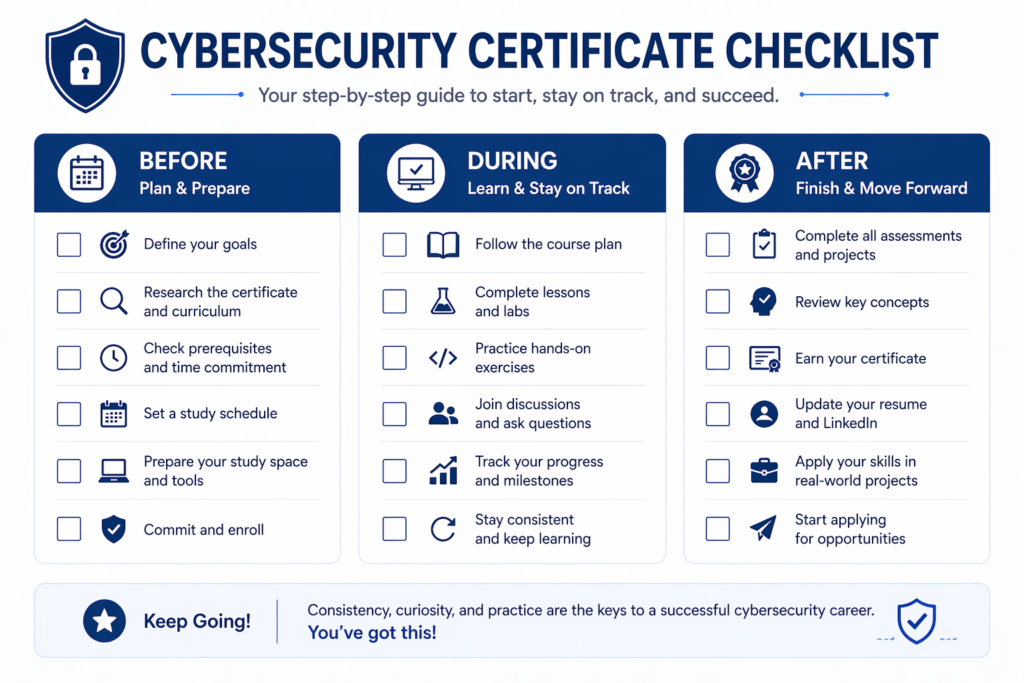
Before You Start (Setup Checklist)
• Create a free Coursera account
• Apply for financial aid if cost is a concern (submit before enrolling)
• Set a specific study schedule — block time on your calendar
• Join relevant communities (Reddit, LinkedIn cybersecurity groups, Discord servers)
• Install VirtualBox for home lab experiments alongside the course
• Set up a GitHub account for future portfolio documentation
During the Course (Execution Checklist)
• Complete every lab — do not skip any
• Complete every portfolio activity (these become job application artifacts)
• Take notes on every tool name mentioned — research each one independently
• Participate in at least one discussion forum thread per course
• Practice Linux commands daily for 10–15 minutes outside course labs
• Begin building TryHackMe learning path concurrently
After Completion (Job-Ready Checklist)
• Add certificate to LinkedIn profile and resume
• Write a brief case study from each portfolio activity for your portfolio
• Create 3–5 GitHub repositories showing security scripts or projects
• Optimize your LinkedIn profile with cybersecurity keywords
• Begin applying to internships and entry-level roles simultaneously
• Prepare for behavioral and technical interview questions
30-Day Job Application Plan
Week 1: Polish resume and LinkedIn. Identify 20 target companies.
Week 2: Apply to 15 roles and start reaching out to connections for referrals.
Week 3: Begin informational interviews with cybersecurity professionals on LinkedIn.
Week 4: Review interview feedback, continue applications, and start preparing for technical screenings using resources like CyberDefenders or Blue Team Labs Online.
FAQ — Based on Real Search Queries
Is the Google Cybersecurity Certificate worth it?
Yes — for beginners, career switchers, and IT professionals looking to formalize cybersecurity knowledge. It provides a structured, affordable path into the field with Google’s credibility attached. However, it works best when combined with practical experience, portfolio building, and active job searching.
Can you get a job with the Google Cybersecurity Certificate?
Yes, but the certificate alone is rarely sufficient. Learners who land jobs consistently pair it with supplementary hands-on practice, a portfolio of projects, and active networking. Entry-level roles like SOC Analyst Tier 1 and junior security analyst are realistic targets.
How much does the Google Cybersecurity Certificate cost?
The course is accessed through Coursera at approximately $49/month. Total cost depends on completion speed — typically $100–$300. Financial aid is available and can bring the cost to $0 for qualifying applicants.
How long does it take to complete?
Officially 6 months at 10 hours/week. In practice, motivated learners with some tech background complete it in 4–8 weeks. Beginners studying 5–7 hours weekly typically take 4–6 months.
Is there a free version available?
Not permanently, but there are several ways to access it for free or reduced cost: Coursera’s 7-day free trial, the financial aid program (apply before enrolling), occasional Google-sponsored promotions, and library partnerships in some regions. Applying for financial aid is the most reliable route to genuinely free access.
Does the certificate expire?
No, the certificate does not formally expire. It remains on your Coursera profile permanently. However, the practical relevance of your skills will need refreshing every 1–2 years given how rapidly cybersecurity evolves.
Final Action Plan — What You Should Do Next
If You Are Starting from Zero
Apply for Coursera financial aid today. While waiting for approval (up to 15 days), start the free 7-day trial to get a feel for the course. Set a daily study goal of 60–90 minutes, and simultaneously create your TryHackMe free account and begin the Pre-Security learning path. This parallel approach means you will have both structured learning and practical exposure from day one.
If You Want a Cybersecurity Job Fast
Speed requires intensity. Enroll immediately, study 15–20 hours per week, complete all portfolio activities, and begin networking on LinkedIn before you even finish the course. Start applying to entry-level and internship roles in month two — do not wait until you have the certificate in hand. Many employers care more about your initiative and current momentum than the certificate itself.
If You Are Already in Tech
Move through the foundational modules quickly, focus on the security-specific content (SIEM, incident response, Python automation), and use the time you save to pursue a supplementary certification like CompTIA Security+ simultaneously. You are positioned to complete both credentials within six months and enter the job market with significantly stronger credentials than a pure beginner.
Best Next Step After This Certificate
After earning the Google Cybersecurity Certificate, your most productive next move depends on your career direction. For SOC analyst roles: pursue CompTIA CySA+ and invest in Blue Team Labs Online. For cloud security roles: explore the Google Cloud Cybersecurity Professional Certificate or AWS Security Specialty. For offensive security paths: study CompTIA PenTest+ and build a home lab with intentionally vulnerable systems.
Whatever path you choose, remember: this certificate is the beginning of your cybersecurity journey, not the end. The field rewards continuous learners, curious thinkers, and people who take action rather than just collecting credentials. I am confident that if you combine this program with practical effort and strategic job searching, you will be in a much stronger position to launch a meaningful cybersecurity career in 2026.