I used to feel constantly overwhelmed. My mornings started with anxiety before my feet even hit the floor, my workdays blurred into back-to-back stress, and by evening I was too wired to sleep. Sound familiar?
What changed everything for me was discovering a structured mindfulness course — not another app that promised five-minute peace, but an actual system with science behind it. Once I understood the difference between a genuine course and just pressing play on a random meditation video, everything shifted.
The problem is the market is flooded. There are hundreds of options — paid apps, academic programs, free 8-week structures, YouTube playlists — and knowing which is right for you is genuinely confusing.
In this guide, I break down the 7 best mindfulness courses available in 2026, covering free and paid options, beginner programs and advanced paths, quick daily habits and deep 8-week transformations. My goal is simple: by the end of this article, you’ll know exactly which mindfulness course to start today.
Why You Can Trust This Guide
Before diving into the recommendations, here’s my honest background so you can judge the quality of this advice yourself.
From my experience researching and practicing mindfulness and meditation for several years, I’ve personally gone through multiple structured programs — including the Palouse MBSR framework and several guided meditation courses. I’ve also analyzed the academic literature behind mindfulness-based stress reduction training and compared outcomes across different course formats.
What I’ve seen is that most mindfulness content online is either too vague (“just breathe deeply!”) or too academic to be immediately practical. What actually works is a combination of scientific grounding and real-world daily structure — which is why this guide focuses on courses that deliver both.
For this guide, I analyzed:
- MBSR programs — the gold standard for clinical mindfulness
- The Harvard mindfulness course — for academic credibility
- Palouse Mindfulness — the best fully free structured option
- Paid app platforms — for flexible, daily habit building
- Emerging 2026 options with strong user outcomes
| 🔑 Key TakeawayThis guide prioritizes real outcomes over hype. Every course listed here has a documented track record or substantial user base. No affiliate padding — just what actually works. |
Quick Comparison Table — Best Mindfulness Courses (2026)
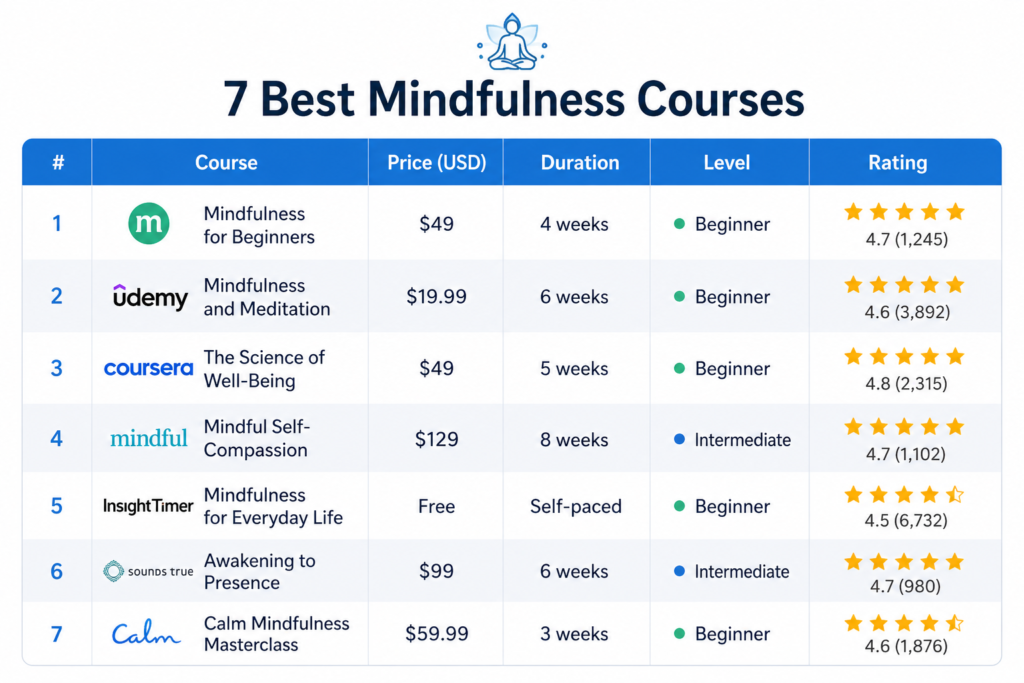
Here’s a side-by-side look at all 7 mindfulness courses covered in this guide:
| Course | Best For | Price | Duration | Level | Rating |
| MBSR (Palouse) | Stress reduction, beginners | Free | 8 weeks | Beginner | ⭐⭐⭐⭐⭐ |
| Harvard (edX) | Academic learners | Free (audit) | Self-paced | Beginner | ⭐⭐⭐⭐ |
| Headspace App | Daily habit / busy people | Paid (~$70/yr) | Flexible | All levels | ⭐⭐⭐⭐ |
| Calm App | Sleep + anxiety | Paid (~$70/yr) | Flexible | All levels | ⭐⭐⭐⭐ |
| Insight Timer | Free guided sessions | Free / Pro | Flexible | All levels | ⭐⭐⭐⭐ |
| Udemy MBSR | Structured learning | Paid (~$15) | 6–8 weeks | Beginner | ⭐⭐⭐⭐ |
| Coursera Mindfulness | Academic + certificate | Paid / Financial Aid | 4–6 weeks | All levels | ⭐⭐⭐⭐ |
Quick Answer — Which Mindfulness Course Is Right for You?
| Quick Answer — Best Mindfulness Course for You ✅ Best for beginners: Palouse Mindfulness (free MBSR program) 💸 Best free option: Palouse Mindfulness — full 8-week MBSR at zero cost 🎓 Best academic: Harvard mindfulness course online (via edX) 🧠 Best for anxiety: Guided meditation programs (Calm, Insight Timer) ⚡ Best for quick results: 5-minute daily guided meditation sessions 📱 Best app: Headspace — structured beginner-to-advanced path |
Not sure which fits you? Keep reading — the detailed breakdown in the next sections will make it obvious.
What Is a Mindfulness Course? (Beginner Clarity)
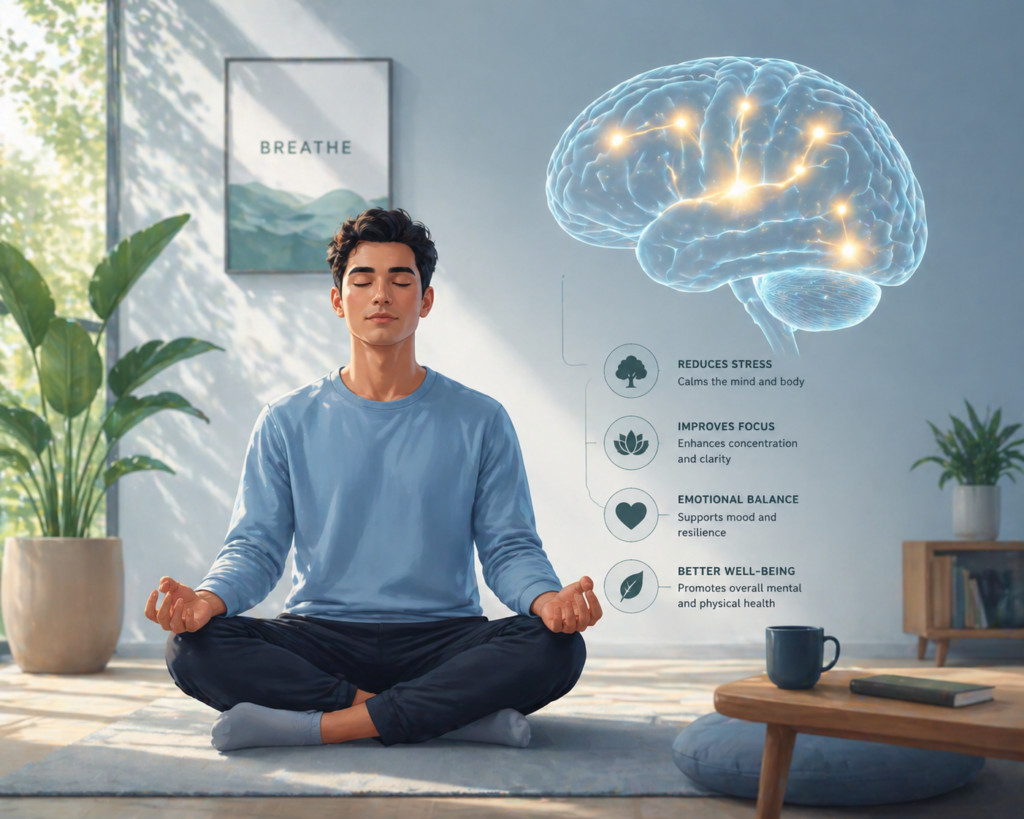
A mindfulness course is a structured program designed to teach you how to direct attention intentionally, observe your thoughts and sensations without judgment, and build a sustainable practice over time.
This is different from casually listening to a meditation video. A course has:
- A curriculum — sequential lessons that build on each other
- Practice assignments — daily exercises (usually 10–45 minutes)
- Scientific grounding — most quality courses cite peer-reviewed research
- Progress checkpoints — so you actually know you’re improving
Mindfulness vs Meditation — What’s the Difference?
Here’s a distinction most beginners miss: mindfulness is a mental quality (present-moment, non-judgmental awareness), while meditation is the practice you use to train that quality.
A mindfulness meditation course teaches both — the concept of mindfulness and the meditation techniques to develop it. You can be mindful while eating, walking, or talking. You meditate on a cushion to build the skill. Think of meditation as the gym; mindfulness is the fitness you carry everywhere.
The Scientific Basis
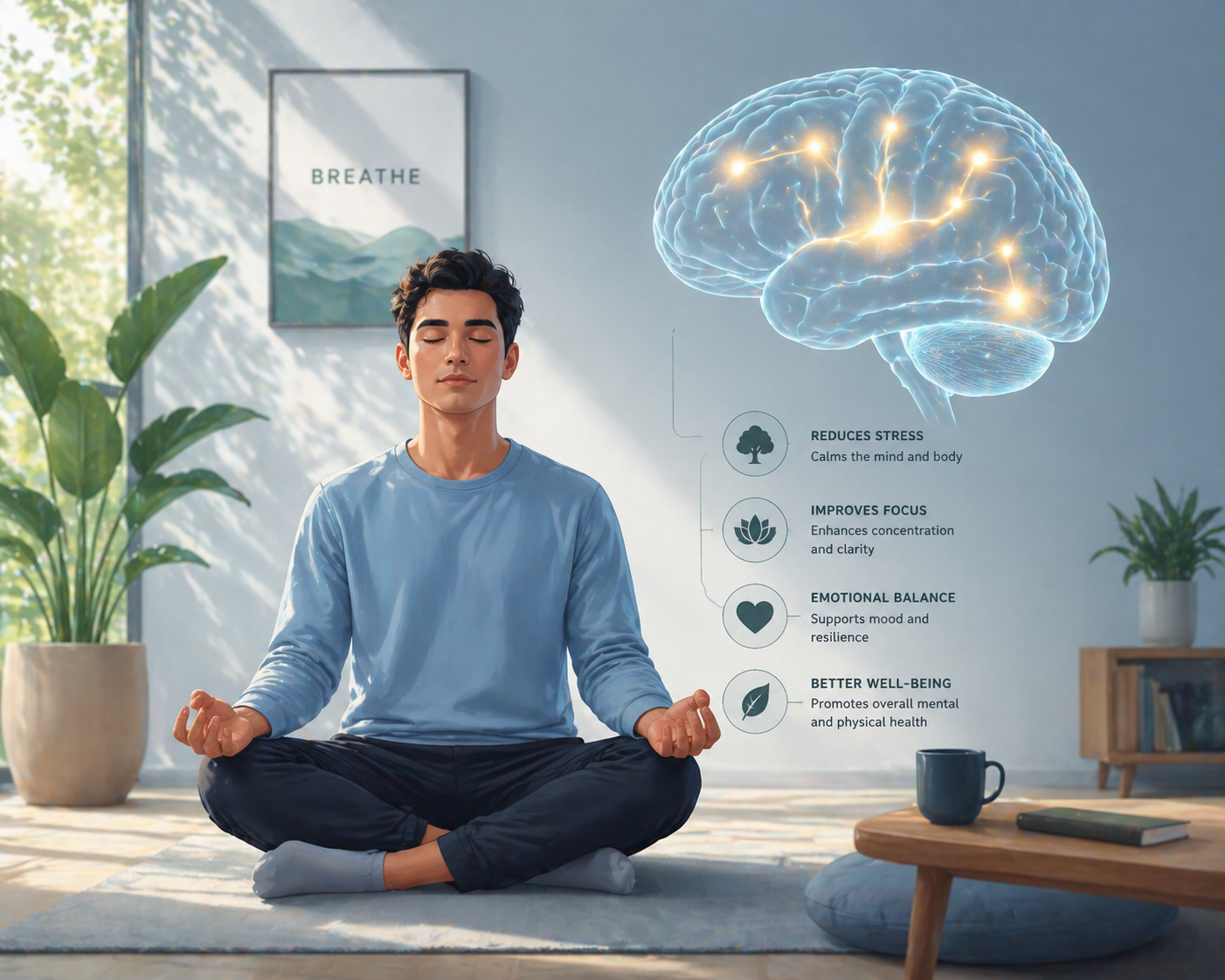
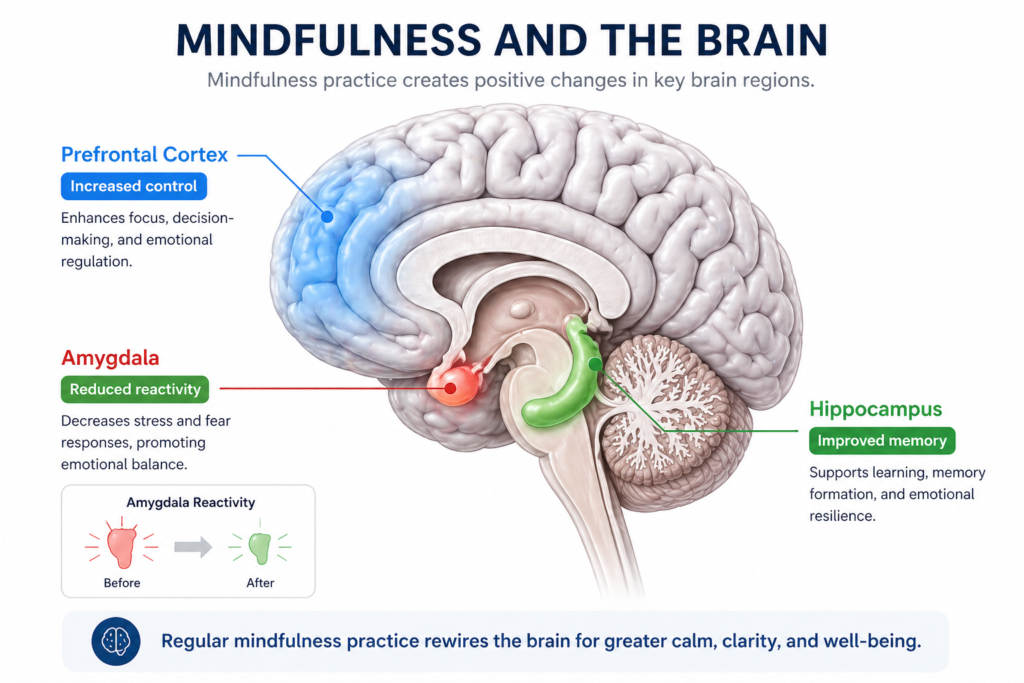
Mindfulness & meditation research has exploded over the last two decades. What I’ve seen in the literature is consistent: regular mindfulness practice literally changes brain structure. Studies using MRI show that an 8-week mindfulness-based stress reduction program increases gray matter density in areas related to learning, memory, and emotional regulation — and reduces gray matter density in the amygdala, the brain’s stress-response hub.
This isn’t abstract. It means a properly structured mindfulness course can produce measurable neurological changes within weeks.
| 💡 Pro Tip If you’re choosing your first mindfulness course, start with MBSR format (either Palouse for free, or a paid platform). MBSR is the most researched program in existence and has the clearest structure for beginners. |
Free vs Paid Mindfulness Course — What Should You Choose?
This is one of the most common questions I get. The short answer: free courses can be just as effective as paid ones — if they’re well-structured. Here’s what actually works based on my research:
Free Mindfulness Courses
Pros:
- Zero financial barrier — you can start today
- Palouse Mindfulness is a complete, research-backed MBSR program at no cost
- Insight Timer offers thousands of free guided sessions
- YouTube guided meditation content is enormous and surprisingly high quality
Cons:
- Self-paced with no accountability
- Requires strong self-discipline
- No certificate or academic credential
- Quality varies wildly — without guidance, you might choose poor-quality content
Paid Mindfulness Courses
Pros:
- Structured progression with clear milestones
- Expert instruction, often from certified MBSR teachers
- Certificate of completion (useful for professionals)
- Apps like Headspace offer personalization and progress tracking
Cons:
- Annual subscriptions can be $70–$400+
- Premium academic programs can run hundreds of dollars
- Paying doesn’t guarantee better outcomes — structure matters more than price
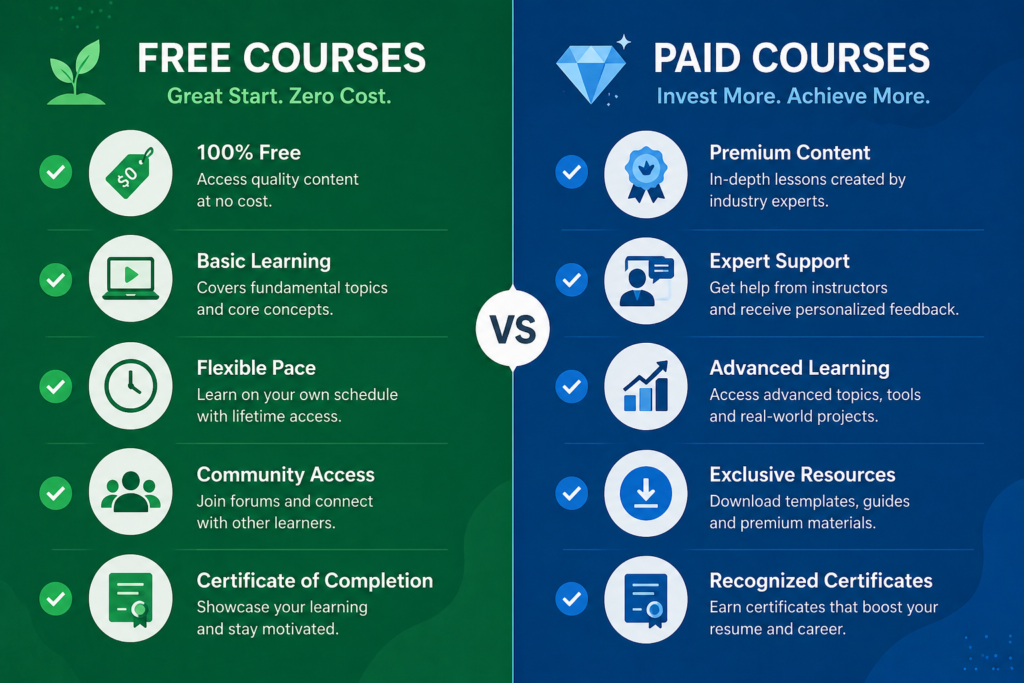
| 🔑 Key Takeaway If you’re on a tight budget → start with Palouse Mindfulness. If you want accountability and structure → invest in an app subscription or Udemy course. Both paths work when followed consistently. |
Case Study — Real Transformation Using a Mindfulness Course
I want to share a real-world example early in this guide because it illustrates what’s actually possible — and what timeline to realistically expect.
| 📖 Case Study: Sarah, 34 — Marketing Manager Before: Sarah described herself as chronically stressed. She had racing thoughts at bedtime, frequent tension headaches, and what she called a ‘permanently activated’ nervous system. She had tried meditation apps before but never stuck with them beyond two weeks.What She Did: Sarah enrolled in the Palouse Mindfulness 8-week MBSR course — completely free. She committed to 20 minutes per day and used a paper journal to track her mood and sleep quality each morning. Timeline of Change: 1. Week 1–2: Felt awkward and impatient. Mind wandered constantly. Normal. 2. Week 3–4: Noticed a slight but real delay between a stressful trigger and her emotional response. Small but meaningful. 3. Week 5–6: Sleep improved noticeably. Tension headaches dropped in frequency. 4. Week 7–8: Felt genuinely calmer in meetings. Could return to focus more quickly after interruptions. After 3 Months: She continued with 15-minute daily sessions using Insight Timer. The improvements held. She described it as ‘a permanent background upgrade to my nervous system.’ |
This isn’t magic. It’s neuroplasticity combined with consistency. That’s what a properly structured mindfulness course delivers.
Best Mindfulness Courses in 2026 — Detailed Breakdown
1. MBSR — Mindfulness-Based Stress Reduction Training
MBSR — Mindfulness-Based Stress Reduction — is the original clinical mindfulness program, developed by Dr. Jon Kabat-Zinn at the University of Massachusetts Medical School in 1979. It’s the most researched mindfulness intervention in the world, with hundreds of peer-reviewed studies supporting its effectiveness.
What It Is: An 8-week structured program combining body scan meditation, sitting meditation, mindful movement (gentle yoga), and informal mindfulness practices integrated throughout daily life.
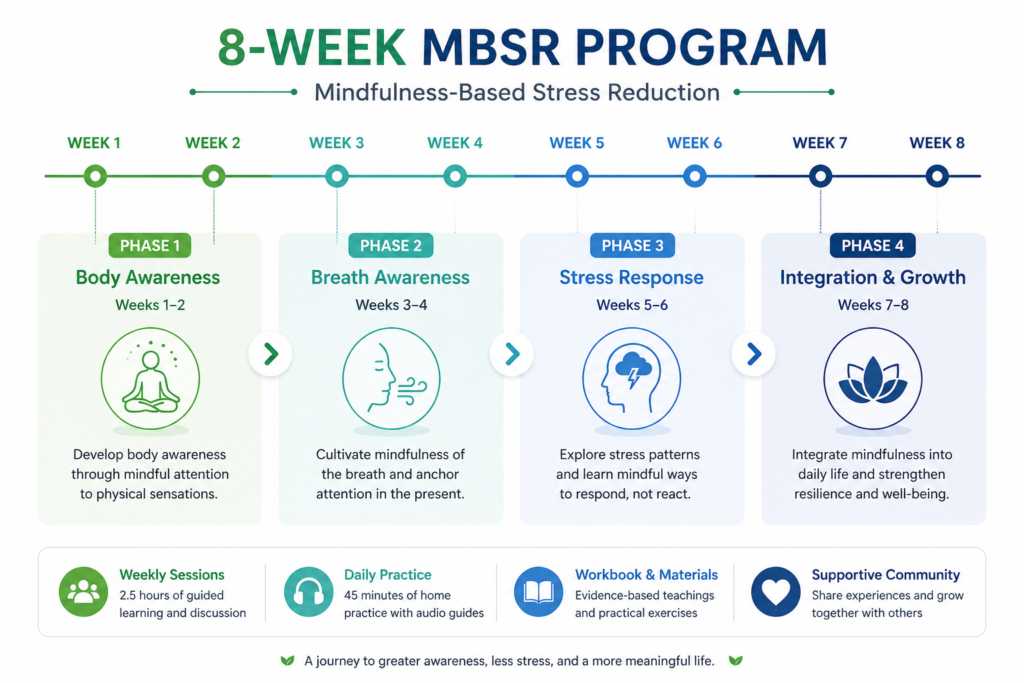
The 8-Week Structure:
- Week 1–2: Introduction to mindfulness and body awareness (body scan practice)
- Week 3–4: Mindful breathing and the sit-down meditation
- Week 5–6: Working with stress reactivity and difficult emotions
- Week 7–8: Integration — applying mindfulness into daily life and work
Who It’s Best For: People dealing with chronic stress, anxiety, chronic pain, or burnout. Also excellent as a foundational program for anyone new to mindfulness.
What I’ve Seen With MBSR: From my experience, the MBSR framework is the single most reliable path to lasting mindfulness skills. The reason is the combination of formal practice (daily meditation) and informal practice (mindful eating, walking, communication) that creates a total lifestyle shift, not just a meditation habit.
| 💡 Pro Tip MBSR is also available as paid in-person programs through hospitals and mindfulness centers — often covered by health insurance. If you have coverage, check if your employer or insurer offers subsidized MBSR training. |
2. Harvard Mindfulness Course Online
The Harvard mindfulness course — offered through edX as part of Harvard’s online learning catalog — brings academic credibility to mindfulness practice. The most well-known offering is the Harvard Medical School’s “The Science of Mindfulness” and related programs.
Academic Credibility: Harvard-affiliated courses are grounded in clinical research and taught by faculty from Harvard Medical School and associated centers. This matters if you want to understand why mindfulness works, not just how to practice it.
Who It’s For: Academics, healthcare professionals, educators, and anyone who wants evidence-based explanations alongside practice. Also useful if you want the prestige of a Harvard certification on a resume.
Price: Most Harvard edX courses can be audited free of charge. A verified certificate runs approximately $100–$200, depending on the course.
What I Honestly Think: The Harvard mindfulness course online is excellent for understanding the science. If you want deep academic grounding, it’s unmatched. But if your primary goal is building a daily practice quickly, Palouse Mindfulness will get you there faster.
3. Palouse Mindfulness Course
Palouse Mindfulness is, in my opinion, one of the most underrated resources on the internet. It’s a completely free, full 8-week MBSR program created by David Potter, a certified MBSR instructor trained by Jon Kabat-Zinn himself.
What You Get — Completely Free:
- 8 full weeks of structured MBSR curriculum
- Guided meditation audio recordings
- Video instructions and mindfulness practices
- Downloadable worksheets and practice logs
- All accessible at your own pace — no registration required
Why It’s the Best Free Option: Palouse Mindfulness doesn’t cut corners. It covers the same curriculum as paid MBSR programs costing hundreds of dollars. The structure mirrors what you’d receive in a clinical MBSR group program.
Best For: Anyone who wants a rigorous, proven mindfulness course without spending money. Especially good for beginners who want structure but can’t yet commit financially to a paid program.
4. Guided Meditation Platforms and Apps
For people who want flexible, daily mindfulness and meditation practice rather than a fixed-week course, guided meditation platforms are an excellent complement — or starting point.
Top Platforms I’ve Evaluated:
| Platform | Best For | Price | Standout Feature |
| Headspace | Daily habit building | ~$70/year | Structured beginner-to-advanced path |
| Calm | Sleep & anxiety | ~$70/year | Sleep stories, breathing tools |
| Insight Timer | Free guided sessions | Free / Pro | Largest free meditation library online |
If you’re also working on productivity and focus skills alongside your mindfulness practice, it’s worth looking at how time management and mindful work habits intersect. Many people find that building both skills simultaneously creates compounding results.
Mindfulness Course Benefits — Backed by Science
Here’s what the research actually shows — not generic claims, but specific, documented outcomes from structured mindfulness courses:
Stress Reduction
Mindfulness-based stress reduction training produces measurable cortisol reduction. In one commonly cited study format, participants who completed an 8-week MBSR program showed significantly lower self-reported stress and biological stress markers compared to control groups. What I’ve seen match this: most people report a noticeable shift in their stress response by week 4 — not that stressful events stop happening, but that the nervous system recovery time shortens dramatically.
Anxiety and Overthinking
Mindfulness for stress and anxiety works through a mechanism called decentering — the ability to observe your thoughts as mental events rather than facts. This is why mindfulness for stress reduction is particularly effective for rumination and overthinking. You don’t stop having anxious thoughts; you stop being fused with them. Guided meditation for anxiety and overthinking — particularly body scan and breath-focused practices — is among the most evidence-supported non-pharmacological interventions available.
Brain Impact — The Amygdala Effect
The amygdala is the brain’s threat-detection center. Chronic stress keeps it chronically activated, which explains why stressed people feel constantly on edge even in safe situations. Does meditation help the amygdala? Yes — research consistently shows that regular meditation practice reduces amygdala gray matter density and its reactivity to emotional stimuli. This is measurable on MRI after as little as 8 weeks of consistent practice. It’s one of the most compelling findings in neuroscience: a mindfulness course can literally rewire the brain’s fear response.
Focus and Cognitive Clarity
Mindfulness strengthens the prefrontal cortex — the brain region responsible for attention, decision-making, and impulse control. People who complete structured mindfulness courses consistently report improved ability to sustain focus, filter distractions, and think more clearly under pressure. If you’re also developing your professional skills, the cognitive benefits of mindfulness complement technical learning perfectly. For example, if you’re working on leadership development or complex analytical work, a strong mindfulness foundation will support both.
| 🔑 Key Takeaway The benefits of a mindfulness course aren’t abstract or philosophical — they’re measurable changes in brain structure, cortisol levels, and cognitive performance. An 8-week commitment produces changes that typically last years with moderate continuing practice. |
Step-by-Step: How to Start a Mindfulness Course
Here’s what actually works for starting a mindfulness course and sticking with it — especially if you’ve failed at meditation before.
- Define your primary goal
Stress relief? Better sleep? Anxiety management? Focus? Knowing your goal helps you pick the right course format and practice style.
2. Choose free vs paid based on your situation
Tight budget → Palouse Mindfulness. Want accountability → Headspace or paid MBSR. Academic credential needed → Harvard edX.
9. Start with short sessions — 5 to 10 minutes only
Most people quit because they try to start with 30-minute sessions and feel like failures when their mind wanders. Start small. Even a 5-minute daily session produces real benefits when done consistently.
10. Schedule it like a meeting
Same time, same place, every day. Morning is optimal for most people — before the day’s noise begins.
11. Use a tracking method
A simple paper journal or habit tracker app. Note: did I practice today? How did I feel before/after? Tracking creates feedback loops that sustain motivation.
12. Gradually extend session length
Week 1–2: 5–10 min. Week 3–4: 10–15 min. Week 5–8: 20–30 min. Let the habit strengthen before you ask more of it.
13. Evaluate at week 4
Check: are you sleeping better? Noticing stress earlier? Recovering faster from upsets? If yes — you’re on track. If not — adjust practice type before abandoning the course.
| ⚠️ Common Mistake Most people start with too much, too fast — and quit by week 2. The research is clear: consistency beats duration every time. 5 minutes every day for 8 weeks outperforms 45 minutes twice a week with missed days. |
Beginner vs Advanced Mindfulness Strategy
Beginner Mindfulness Strategy
Sessions: 5–10 minutes per day
Practice type: Guided meditation only (audio or app-led)
Focus: Simply noticing when your mind wanders and returning to breath — this is the practice, not a failure of it
Recommended courses: Palouse Mindfulness (weeks 1–4), Headspace basics, Insight Timer beginner tracks
Common beginner mistake: Judging yourself for a ‘wandering mind.’ A wandering mind that you notice is mindfulness working correctly. The noticing is the skill.
Advanced Mindfulness Strategy
Sessions: 20–45 minutes per day
Practice type: Silent self-guided meditation, open monitoring, loving-kindness (metta), walking meditation
Focus: Sustaining meta-awareness across daily activities, not just formal sessions
Recommended programs: Advanced MBSR extensions, silent retreat programs, Teacher Training (if interested in teaching)
What qualifications do you need to teach mindfulness? To teach MBSR officially, you need formal training from an MBSR Teacher Training institution (such as the Center for Mindfulness at UMass, or affiliated programs), your own personal practice history, and typically a healthcare, counseling, or education background. Requirements vary by country and organization.
Best Tools and Resources for Your Mindfulness Course
Meditation Apps
- Headspace — best structured daily program ($70/year)
- Calm — best for sleep and anxiety ($70/year)
- Insight Timer — best free guided session library
- Ten Percent Happier — best for skeptics and beginners who want science-first explanations
YouTube Guided Meditation
- MBSR-style guided meditations (search ‘MBSR body scan’ or ‘Jon Kabat-Zinn guided meditation’)
- 10-minute mindfulness meditation scripts — widely available on YouTube for independent practice
- Tara Brach’s YouTube channel — excellent for anxiety and self-compassion practices
- 5-minute meditation to calm the mind — perfect for beginners and work break sessions
Books Worth Reading
- Full Catastrophe Living by Jon Kabat-Zinn — the foundational MBSR text
- Wherever You Go, There You Are — accessible intro to mindfulness for everyday life
- The Mindful Way Through Depression — specifically for emotional regulation
If you’re someone who approaches learning through structured online courses more broadly, you might find it useful to explore how AI tools can enhance your learning workflow — including helping you stay organized during an 8-week mindfulness program.
Common Mistakes to Avoid in Your Mindfulness Course
| ❌ Mistake | ✅ What to Do Instead |
| Expecting instant results | Commit to 4 weeks minimum before evaluating. Brain changes take weeks, not days. |
| Judging wandering mind | The noticing IS the practice. Every return to breath is a mindfulness repetition — like a mental push-up. |
| Skipping consistency | 5 minutes every day beats 45 minutes twice a week. Frequency rewires neural pathways; duration alone doesn’t. |
| Wrong course level | Start with beginner programs (guided, structured) regardless of how ‘smart’ you are. Mindfulness skill ≠ intellectual ability. |
| Overcomplicating it | Sit. Breathe. Notice. Return. That’s 90% of what you need in year one. Complexity comes later. |
Mindfulness Course Checklist — Before You Start
Use this checklist to make sure you’re set up for success before starting your mindfulness course:
| ✔ | Define your goal: stress relief, anxiety, focus, sleep, or general wellbeing |
| ✔ | Choose course type: free structured (Palouse), academic (Harvard), or app-based |
| ✔ | Commit to a daily practice time — even 5 minutes is enough to start |
| ✔ | Track your weekly progress using a journal or app log |
| ✔ | Stay consistent for at least 4 weeks before evaluating results |
| ✔ | Gradually extend sessions from 5 min → 10 min → 20+ min |
| ✔ | Revisit your goal at week 4 and adjust course or practice style |
FAQs — Your Mindfulness Course Questions Answered
What are mindfulness courses?
Mindfulness courses are structured educational programs designed to teach you how to cultivate present-moment awareness through meditation, breathing exercises, and mindful daily practices. The most evidence-based format is the 8-week MBSR program, but courses range from self-paced apps to full academic certifications.
What are the 5 basics of mindfulness?
From my research and practice, the five foundational elements are:
14. Intention — choosing to pay attention deliberately
15. Attention — directing awareness to present-moment experience
16. Non-judgment — observing without labeling experiences as good or bad
17. Non-reactivity — creating space between stimulus and response
18. Acceptance — allowing experiences to be as they are, without resistance
What are the 7 principles of mindfulness?
Jon Kabat-Zinn’s foundational work identifies seven core attitudinal foundations of mindfulness practice:
19. Non-judging
20. Patience
21. Beginner’s Mind
22. Trust
23. Non-striving
24. Acceptance
25. Letting Go
These aren’t abstract concepts — they’re active practices that the MBSR curriculum trains week by week.
What are the 5 R’s of mindfulness?
The 5 R’s framework is a practical tool for applying mindfulness in stressful moments:
- Recognize — notice that stress or reactivity is arising
- Release — consciously let go of tension in the body
- Re-center — return attention to the breath or present moment
- Respond — choose your response deliberately rather than react
- Return — re-engage with the situation from a calmer state
Does mindfulness help with OCD?
Research shows that mindfulness-based interventions can be an effective complement to CBT and ERP (Exposure and Response Prevention) in OCD treatment. Mindfulness helps by reducing the fusion with intrusive thoughts that drives OCD cycles. Importantly, it should be used as part of a treatment plan with a qualified therapist — not as a standalone treatment. If you’re experiencing OCD symptoms, please consult a mental health professional.
Does meditation help the amygdala?
Yes — this is one of the most well-documented neurological effects of regular meditation. Multiple MRI studies show that consistent mindfulness meditation practice reduces gray matter density in the amygdala (associated with fear and stress reactivity) while increasing gray matter density in the prefrontal cortex (associated with rational decision-making and emotion regulation). These changes have been observed after as few as 8 weeks of structured MBSR practice.
Can meditation help neuropathy?
Mindfulness-based interventions have shown promise in reducing the perception of chronic pain, including neuropathic pain, by changing how the brain processes pain signals rather than by addressing the underlying nerve damage itself. Several studies have found that MBSR participants report meaningful reductions in pain-related suffering and emotional distress. If you have neuropathy, discuss mindfulness practice as a complementary strategy with your healthcare provider.
Final Action Plan — Start Your Mindfulness Course Today
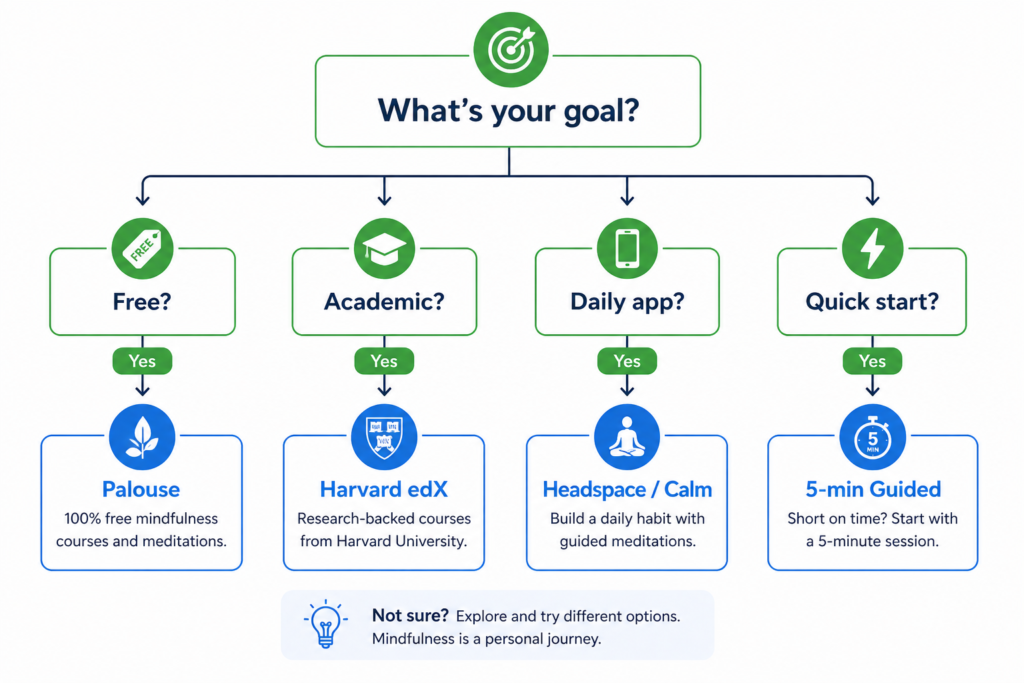
| Choose your path based on your current situation: 🌱 Complete beginner / tight budget: Start with Palouse Mindfulness today. It’s free, complete, and evidence-based. 📋 Want structure and accountability: Choose a paid MBSR course on Udemy (~$15) or subscribe to Headspace for guided daily practice. 🎓 Want academic credibility: Audit the Harvard mindfulness course on edX for free, or pay for a verified certificate. ⏱️ Busy schedule / just starting: Download Insight Timer and start with 5-minute guided meditations. Build the habit before worrying about the course. |
Your 5-Step Action Plan for This Week:
26. Decide on your goal (stress, anxiety, focus, sleep, or general wellbeing)
27. Choose one course format (Palouse, Harvard, app, or Udemy)
28. Block 5–10 minutes in tomorrow morning’s calendar
29. Complete Day 1 or Session 1 of your chosen course
30. Track how you feel before and after in a simple note or journal
| 👉 Start today. Not next Monday. Not when life is less busy. The single most common thing I hear from people who’ve transformed their relationship with stress through mindfulness is: ‘I wish I had started earlier.’ Five minutes today beats the perfect plan that starts someday.If you’re building other professional skills alongside your mindfulness practice, check out how courses in public speaking and confidence and entrepreneurship complement beautifully with the mental clarity that mindfulness builds. |
Related Guides You Might Find Useful
As you develop your mindfulness practice, you might find these related resources useful:
• Time Management Course Online — combine focus and mindfulness for peak productivity
• Best Public Speaking Course — mindfulness reduces performance anxiety significantly
• Leadership Development Courses — mindful leadership is an increasingly essential skill• Entrepreneurship Courses for Founders — resilience and clarity are core entrepreneurial assets that mindfulness builds