Introduction
Let me be straight with you. Every week, someone messages me asking some version of the same question: ‘I’m thinking about doing the IBM Data Analyst Professional Certificate — but is it actually worth my time and money?’ And honestly? It’s one of the most important questions you can ask before sinking 6 months into any program.
Data analytics is absolutely booming. Companies across every industry are hiring analysts, and the demand for people who can clean data, build dashboards, and extract business insights is only accelerating in 2026. But the market is also flooded with online certifications, and not all of them deliver on their promises.
In this guide, I’m going to walk you through everything I know about the IBM Data Analyst Professional Certificate — from what you actually learn in the ibm data analyst course, to real career outcomes, cost breakdown, honest comparisons with other programs, and a step-by-step plan to turn this certificate into a real job. By the end, you’ll know exactly whether this is right for you — or whether you should look elsewhere.

Quick Verdict — Should You Invest in the IBM Data Analyst Professional Certificate?
Before I go into full detail, here’s my honest, experience-based verdict for people who want a fast answer.
Who Gets the Most Value (Clear YES Cases)
This certificate genuinely delivers strong ROI for a specific type of learner. In my experience, the people who benefit most are complete beginners who need structured, hand-held guidance from zero to job-ready basics. If you’ve never touched SQL, Python, or a BI tool in your life, this program gives you a real foundation.
Career switchers from non-tech fields — teachers, marketers, HR professionals — also find massive value here. The ibm data analyst certification gives you a credible signal to put on your resume while you build your portfolio. It tells a hiring manager: ‘This person was serious enough to complete a structured, IBM-backed program.’
Additionally, if you’re already working in a company and want to move into a data-related role internally, this certificate can be the formal credential that opens that door — especially in companies that recognize Coursera credentials.
Who Should Skip It (Honest NO Cases)
However, if you already have hands-on SQL and Python experience, you’ll find this course moves too slowly. It’s not built for intermediate or advanced analysts. You’ll spend time on things you already know, and that’s a waste of your most valuable resource — time.
Similarly, if your primary goal is machine learning or AI, this isn’t your path. For example, I’d point you toward a dedicated ML or AI program instead — something like the courses covered in our guide on
Similarly, if your primary goal is machine learning or AI, this isn’t your path. For that direction, check out our detailed breakdown of machine learning courses online — which goes far deeper than anything this certificate covers.
Final 30-Second Decision Framework
Ask yourself three things: Am I a complete beginner? Do I need a structured, time-bound program? Do I want an IBM-branded credential on my resume? If you answered YES to at least two of those, this certificate is worth your investment. If not, keep reading — because I’ll show you better alternatives later.
Who This Guide Is For (And Who It’s Not)
Beginners With Zero Background
If you’re starting from scratch — no coding, no statistics, no spreadsheet experience — the IBM Data Analyst Professional Certificate is one of the most beginner-friendly structured programs out there. The Coursera ibm data analyst program is designed to onboard you gently. You don’t need a math degree or a computer science background to start.
I’ve seen complete beginners finish this program and land entry-level data analyst roles within 6–9 months of starting — but only when they also built a solid portfolio alongside it. The certificate alone isn’t a silver bullet.
Career Switchers From Non-Tech Fields
This is probably the strongest use case for this certificate. If you’re in marketing, sales, education, or any field adjacent to data, transitioning into analytics is very achievable. The ibm data analyst professional gives you structured exposure to the tools employers care about: Excel, SQL, Python, and Tableau.
Moreover, career switchers tend to have one major advantage — domain expertise. A former marketing manager who learns data analytics becomes an extremely valuable hire in a marketing analytics role. Your background becomes your differentiator.
Existing Analysts Looking to Upskill
Honestly? This program is probably too basic for working analysts. If you already know SQL and have used Python for data work, you’ll find yourself bored through large sections of the ibm data analyst course. However, if there are specific gaps — like Python or data visualization — you might cherry-pick individual courses from the program instead of doing the full certificate.
When This Certificate Is the Wrong Move
Skip this if you want deep statistical modeling, machine learning, or advanced data engineering. Also skip it if you are comparing it purely on cost and thinking that free YouTube content covers the same ground — because while that is partly true, it lacks structure, accountability, and the credential itself.
What You Actually Learn (Not Just Marketing Claims)
Real Skills Covered Across the IBM Data Analyst Course
The ibm data analyst course covers a genuinely useful toolkit for entry-level work. Here’s what you’ll actually walk away knowing how to do:
- Clean and analyze data using Excel and Python (Pandas, NumPy)
- Write SQL queries to extract and filter data from relational databases
- Build interactive dashboards using IBM Cognos Analytics and Tableau
- Apply basic statistical analysis to real datasets
- Communicate findings through data storytelling and visualization
- Work through a capstone project that simulates a real analyst workflow
In addition to these skills, you’ll also pick up familiarity with Jupyter Notebooks — which is the standard working environment for most data analysts who use Python. That alone has real-world value.
Tools You’ll Work With (Excel, SQL, Python, Visualization)
The tool stack in this program is genuinely relevant. Let me break it down:
| Tool | What You Learn | Industry Relevance |
| Microsoft Excel | Data cleaning, pivot tables, basic formulas | Very High — used in almost every company |
| SQL | Database querying, filtering, joins | Very High — core analyst skill |
| Python (Pandas/NumPy) | Data manipulation, analysis scripts | High — increasingly expected |
| IBM Cognos Analytics | Dashboard creation, reporting | Moderate — IBM-specific tool |
| Tableau / Data Viz | Visual storytelling, chart creation | Very High — top requested skill |
One honest caveat: the Python coverage, while useful, is introductory. If Python is your primary goal, I’d recommend supplementing with a dedicated course. We’ve covered the best options in our guide on the
One honest caveat: the Python coverage is introductory. If Python is your primary goal, supplement with a dedicated course. Our guide to the best Python course in 2026 will help you go deeper after completing this certificate.
How Practical the Projects Really Are
This is where the IBM program earns genuine credit. The capstone project at the end is based on a realistic analyst scenario — you’re given raw datasets and asked to clean, analyze, and present insights as if you were a real analyst presenting to stakeholders. That kind of applied work is far more valuable than pure theory.
However, the guided projects throughout the course are structured in a way that holds your hand quite tightly. Therefore, you should treat them as learning exercises, not finished portfolio pieces. You’ll need to do independent projects on top of these to build a portfolio that actually impresses recruiters.
Gaps You Should Be Aware Of
No program is perfect. Here are the honest gaps I’ve found in the IBM Data Analyst Professional Certificate:
- Limited depth in statistical analysis — no regression or hypothesis testing
- Python coverage is beginner-only — no advanced pandas or automation
- No exposure to cloud data tools (BigQuery, Snowflake, AWS data services)
- IBM Cognos Analytics is not the most widely requested BI tool in job postings
- No dbt, Airflow, or modern data pipeline concepts
These gaps aren’t dealbreakers for beginners — but you should know they exist so you can fill them intentionally after completing the program.
How the Coursera IBM Data Analyst Program Is Structured
Course Breakdown and Learning Flow
The Coursera IBM Data Analyst program consists of 11 courses that build on each other progressively. Here’s the full breakdown:
| # | Course Name | Duration (est.) | Key Skill |
| 1 | Introduction to Data Analytics | ~8 hrs | Foundations |
| 2 | Excel Basics for Data Analysis | ~11 hrs | Excel |
| 3 | Data Visualization and Dashboards | ~11 hrs | Visualization |
| 4 | Python for Data Science, AI & Dev | ~25 hrs | Python |
| 5 | Python Project for Data Science | ~8 hrs | Applied Python |
| 6 | Databases and SQL for Data Science | ~20 hrs | SQL |
| 7 | Data Analysis with Python | ~15 hrs | Pandas/NumPy |
| 8 | Data Visualization with Python | ~20 hrs | Matplotlib/Seaborn |
| 9 | IBM Data Analyst Capstone Project | ~10 hrs | Full Project |
| 10 | Generative AI: Enhance Your DA Career | ~8 hrs | AI Integration |
| 11 | Data Analyst Career Guide & Interview Prep | ~8 hrs | Job Readiness |
Time Commitment and Completion Timeline
Coursera estimates approximately 11 months at 10 hours per week to complete the full program. In reality, most dedicated learners finish in 4–6 months by putting in 15–20 hours per week. If you’re working full time, a realistic target is 6–8 months.
The key is consistency. I always tell people: 1 hour every day beats 7 hours on Sunday. The programs that lead to job outcomes are the ones you finish — so build a schedule you can actually maintain.
Difficulty Level (Beginner vs Intermediate Reality)
Here’s my honest assessment: this course is truly beginner-friendly. If you’ve taken any online course before, you’ll find the pacing manageable. The SQL and Python sections are where most beginners feel the first real challenge — and that’s healthy.
However, for anyone who already knows Python or has done SQL before, sections 1–4 will feel very slow. Many learners in that position skip directly to the Python data analysis courses and the capstone, which is a valid approach since Coursera lets you audit courses individually.
Certification Process Explained
Once you complete all 11 courses and pass the required quizzes and assignments, you receive a shareable digital certificate from both Coursera and IBM. This credential can be added to your LinkedIn profile, resume, and portfolio. You also get an IBM digital badge via Credly — which is a verifiable credential that employers can authenticate online.
The ibm certification data analyst badge is a real signal. It’s not a degree, but it’s a credible, verifiable indicator of structured learning from an IBM-backed program — and that counts for something in a competitive job market.
IBM Data Analyst Professional Certificate Review (Real-World Perspective)

What Learners Usually Like
After reviewing dozens of real learner experiences, here’s what consistently comes up as genuine positives:
- Structured, well-organized curriculum that doesn’t assume prior knowledge
- Hands-on labs using real tools — especially Jupyter Notebooks and SQL editors
- The capstone project gives a tangible, shareable work product
- IBM’s name adds credibility — it’s a recognizable brand in enterprise contexts
- Flexible pacing — you learn on your own schedule
- The AI and generative AI supplementary module is a genuinely useful addition in 2026
Common Complaints and Limitations
On the other side, here’s what learners consistently push back on:
- Some video content feels dated and could use refreshing for 2025–2026 realities
- Peer-graded assignments can be inconsistent and slow to receive feedback
- IBM Cognos Analytics is not the industry-standard tool — Power BI and Tableau dominate job postings
- The Python section is too shallow for anyone who plans to do serious analysis work
- The discussion forums are less active than Google’s equivalent program
These aren’t dealbreakers — but they’re honest limitations you should factor in.
How It Compares to Other Popular Data Analyst Certifications
I’ve done a deep dive on this comparison in a dedicated post, but here’s the short version: the IBM program is broader in its tool coverage, while Google’s program is more polished and has a stronger hiring ecosystem. If you want more on that comparison, check out our full
I’ve done a deep dive on this comparison. The IBM program is broader in tool coverage, while Google’s program is more polished. For more detail, read our full Google Data Analytics Certificate review — it covers ROI, job outcomes, and how recruiters actually compare the two.
Realistic Expectations vs Hype
Here’s the truth no one tells you upfront: completing this certificate will not automatically get you a job. What it will do is give you a structured foundation, a verifiable credential, and a starting point. The people who turn this into a job are the ones who combine the certificate with a strong portfolio, targeted networking, and persistent job applications.
In short: the certificate opens the door. Your portfolio and preparation are what walk you through it.
What Can You Do With an IBM Data Analyst Professional Certificate?
This is one of the most searched questions I see: What can I do with an IBM data analyst professional certificate? Let me give you a real, grounded answer.
Entry-Level Roles You Can Target
With this certificate plus a solid portfolio, here are the roles realistically within reach:
| Role Title | Avg Salary (US) | Fit Level | Key Skills Needed |
| Junior Data Analyst | $55,000–$75,000 | Strong Fit | SQL, Excel, Python basics |
| Business Analyst | $60,000–$80,000 | Good Fit | Data analysis, reporting |
| Data Reporting Analyst | $50,000–$70,000 | Strong Fit | Dashboards, visualization |
| Operations Analyst | $55,000–$72,000 | Good Fit | Excel, SQL, insight delivery |
| Marketing Data Analyst | $60,000–$85,000 | Moderate Fit | Analytics + domain knowledge |
Freelancing and Remote Work Opportunities
Beyond traditional employment, the ibm data analyst professional certificate also opens the door to freelance work. Platforms like Upwork and Fiverr have growing demand for analysts who can clean data, build dashboards, and create reports for small businesses. Many early-career analysts use freelancing to build portfolio work and income simultaneously while job hunting.
For additional context on building a career in tech through certifications and skills, it’s also worth understanding the broader landscape — including things like
For additional context on building a marketable tech career, it’s worth knowing which skills are in demand. Our guide to top AI skills for 2026 shows where data skills intersect with AI — giving you a longer career runway.
How Recruiters Actually View This Certification
Here’s the honest truth about recruiter perception: most hiring managers won’t specifically know the IBM Data Analyst Professional Certificate by name. However, what they will recognize is Coursera + IBM, the tools on your resume (SQL, Python, Tableau), and the fact that you completed a structured, 11-course program. That completion signals discipline and seriousness.
The certification works best as a supporting credential — not as the lead item on your resume. Your projects, portfolio, and demonstrated skills are what drive callbacks.
Portfolio vs Certificate — What Matters More
Portfolio. Every time. I’ve seen people with zero certificates land data analyst roles because their portfolio showed real problem-solving. I’ve also seen people with 3 certificates who couldn’t get past the phone screen because they had nothing to show.
Therefore, treat the ibm data analyst course as the vehicle that teaches you the skills — but invest equal time in building 3–5 real projects that demonstrate those skills independently.
Cost Breakdown — Is There a Free Way to Take It?
Coursera Pricing Model Explained
Coursera operates on a subscription model. As of 2026, a Coursera Plus subscription costs approximately $59/month or $399/year — and this gives you access to the IBM Data Analyst Professional Certificate along with thousands of other courses. Alternatively, you can subscribe to just this specialization individually, which typically runs at a similar monthly rate.
How to Access the IBM Data Analyst Professional Certificate Free (Legally)
Yes, there are legitimate ways to access this program for free or at significantly reduced cost:
- Financial Aid: Apply through Coursera’s financial aid program. If approved (and many people are), you can complete the full program for free. Apply at least 15 days before you want to start.
- Audit Mode: You can audit individual courses within the specialization for free — you get access to all video content and readings, but not graded assignments or the certificate.
- Free Trial: Coursera sometimes offers 7-day free trials on individual course access. Use this window strategically to start the first course.
- Employer Benefits: Many companies offer Coursera as part of their L&D (Learning & Development) budget. Ask your employer before paying out of pocket.
- Government/Non-Profit Programs: In some countries, government upskilling programs partner with Coursera to offer subsidized access. Check local options.
So when people ask about the ibm data analyst professional certificate free option — the financial aid route is the most reliable and legitimate path for learners who genuinely can’t afford the subscription.
ROI Analysis: Cost vs Career Outcome
| Factor | With Coursera Plus ($399/yr) | With Financial Aid (Free) |
| Total Cost | $399 (if finished in 1 year) | $0 |
| Certificate Access | Full | Full |
| Career Salary Increase (est.) | $10,000–$25,000/yr jump | $10,000–$25,000/yr jump |
| ROI Timeline | Positive within 2–4 weeks of first job | Immediate |
Hidden Costs (Time, Effort, Opportunity Cost)
The real cost of any certificate isn’t the subscription fee — it’s your time. At 10–15 hours per week over 5–6 months, you’re investing 200–360 hours into this program. That’s the cost you should be evaluating most seriously.
Use that time well. Structure your learning, build projects as you go, and stay consistent. Treat it like a part-time job with career-changing upside.
Beginner vs Advanced — Is This Enough to Get a Job?
What Beginners Gain From This Program
For a true beginner, this program is a comprehensive starting point. You’ll go from knowing nothing about data analysis to being able to query a database, clean a dataset in Python, and build a dashboard. That’s a genuinely significant transformation in 5–6 months of focused work.
However, beginners need to understand: this is the start of your journey, not the finish line. The job market for data analysts is competitive, and therefore the certificate needs to be paired with real projects, networking, and interview preparation.
Why Advanced Learners May Find It Basic
If you already know SQL at an intermediate level and have written Python scripts before, you will be frustrated by the pace of this program. The SQL section, for example, starts from absolute scratch — SELECT statements, WHERE clauses, basic JOINs. For someone who’s already done this, it’s painfully slow.
Advanced learners are better served by a targeted upskilling approach: take a specialized course in data visualization or advanced Python analytics, build a showcase project, and perhaps pursue a more advanced certification like a cloud data certification. Our guide on
Advanced learners are better served by targeted upskilling. You might also consider cloud certifications to strengthen your profile — our AWS certification course guide covers how cloud skills complement a data analyst role beautifully.
What You Still Need to Learn After Completion
Even after finishing the IBM program, here are the skills you’ll still need to develop to be job-competitive:
- Advanced SQL (window functions, CTEs, query optimization)
- Power BI (the most in-demand BI tool in 2026 job postings)
- Git and version control basics
- Data cleaning at scale with Pandas
- Storytelling with data — presenting insights to non-technical audiences
- Basic understanding of data pipelines and ETL concepts
Skill Gap Between Certificate Holders and Job-Ready Analysts
The most common mistake I see is people finishing the certificate and then immediately applying for jobs — and wondering why they’re not getting callbacks. The gap isn’t the certificate — it’s the portfolio.
Recruiters need to see that you can solve real problems with data. That means personal projects, Kaggle notebooks, or even fictional business case studies where you’ve taken raw data and turned it into a clear insight. For additional guidance on structuring your data analyst certification journey, our
Recruiters need proof of problem-solving. For guidance on structuring your overall certification journey, check out our page on data analyst certification online — which covers how to layer credentials for maximum career impact.
Step-by-Step Plan to Turn This Certificate Into a Job
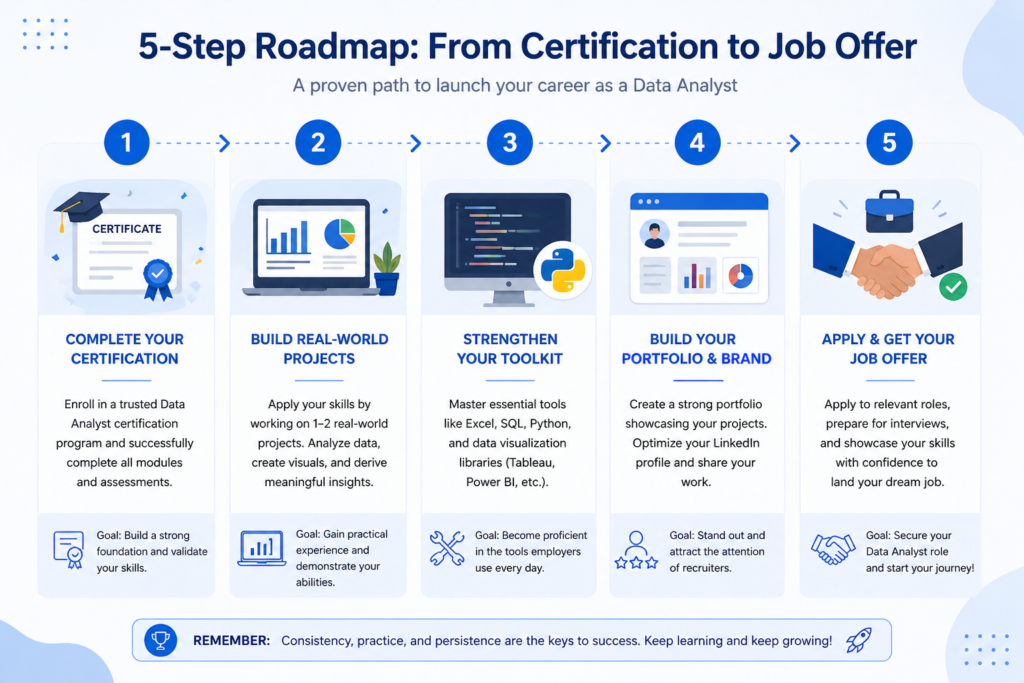
Step 1: Complete the Course With a Portfolio Mindset
From day one, approach every project and assignment as a potential portfolio piece. Take screenshots, save notebooks, document your thought process. Even the guided labs can be the foundation for a project you later rebuild independently.
Also, don’t just click through quizzes to get grades. Make sure you actually understand why each concept matters — because interviews test understanding, not memorization.
Step 2: Build Real Projects Beyond the Course
This is the most important step. After or during the course, build 3–5 independent projects using real public datasets. Good sources include Kaggle, data.gov, and Google Dataset Search. Pick topics you genuinely care about — sports, finance, healthcare, e-commerce — because that genuine interest shows in the quality of your work.
Each project should have: a clear business question, a cleaned dataset, analysis with SQL or Python, a visualization or dashboard, and a written summary of insights. Host everything on GitHub.
Step 3: Optimize Resume and LinkedIn With Certification
Add the IBM Data Analyst Professional Certificate to both your resume and LinkedIn. On LinkedIn, use the Licenses & Certifications section and link directly to your Credly badge. In your resume skills section, list the specific tools: SQL, Python (Pandas, NumPy, Matplotlib), Tableau, Excel — not just ‘data analysis.’
If your resume needs a structural overhaul alongside adding this credential, our resume writing course guide covers exactly how to position a career-change story effectively.
Step 4: Apply Strategically to Entry-Level Roles
Don’t apply to 200 jobs randomly. Instead, identify 20–30 companies where you genuinely want to work, research their data teams, and tailor your application to match their specific tool stack. A targeted application with a relevant portfolio project beats a generic mass application every time.
Also look beyond the title ‘Data Analyst.’ Business Intelligence Analyst, Reporting Analyst, Operations Analyst, and Marketing Analyst roles all use the same skill set and may have less competition.
Step 5: Prepare for Data Analyst Interviews
Data analyst interviews typically cover three areas: SQL coding (writing queries under pressure), Python/data manipulation tasks, and business case questions (how would you analyze X business problem?). Prepare for all three.
Practice SQL on platforms like LeetCode and Mode Analytics SQL Tutorial. For business cases, study how companies use data to make decisions in their industry. And always prepare a clear walkthrough of at least one portfolio project — because the question walk me through a project you have done is an almost universal interview question.
Common Mistakes That Kill Your ROI
Relying Only on the Certificate Without Projects
I’ll say this clearly: a certificate with no portfolio is a liability in 2026. Recruiters have seen hundreds of Coursera certificates. What stands out is the person who can say ‘I analyzed 3 years of sales data for a real e-commerce store and found that 30% of revenue came from 8% of SKUs — here’s the dashboard I built.’
The ibm data analyst professional certificate is the foundation. Build on top of it.
Skipping SQL/Python Practice
Many learners watch the videos but don’t actually practice the code. This is a fatal mistake. SQL and Python are muscle memory skills — you only get them by doing them, failing, debugging, and doing again. Spend at least 30 minutes per day writing actual code, not just watching someone else write it.
Not Building a Portfolio
Your portfolio is your proof of work. Without it, you’re asking hiring managers to take your word that you know what you’re doing. With it, you’re showing them. There’s no substitute for this step.
Expecting Instant Job Results
The job search after completing this certificate typically takes 3–6 months of consistent effort. That’s not a failure — that’s normal. Keep building, keep applying, keep improving your portfolio. The people who give up at month 2 miss the offers that were coming at month 4.
Tools & Resources to Maximize Your Learning
Platforms to Practice SQL, Python, and Visualization
- SQLZoo — free, interactive SQL practice for all levels
- LeetCode (Database section) — SQL questions used in real interviews
- Kaggle — Python notebooks, real datasets, competitions
- Mode Analytics SQL Tutorial — structured SQL practice in a real environment
- Tableau Public — build and share free dashboards
- DataCamp (supplementary) — good for Python and SQL drills
Portfolio Project Ideas to Stand Out
- Sales Performance Dashboard: Take retail sales data and build a Tableau/Power BI dashboard showing revenue trends, top products, and regional breakdown
- COVID-19 Data Analysis: Classic Kaggle dataset — analyze spread patterns, vaccination rates, and create time-series visualizations
- Job Market Analysis: Scrape or use public job posting datasets to analyze which data skills are most in demand by location
- Customer Churn Analysis: Use a telecom or SaaS dataset to identify patterns in customer churn using Python and Pandas
- Personal Finance Tracker: Build an Excel/Python dashboard that categorizes and visualizes personal spending data
Where to Find IBM Data Analyst Professional Certificate Notes
Many learners share IBM Data Analyst Professional Certificate notes publicly. Here’s where to find quality resources:
- GitHub — search ‘IBM Data Analyst Professional Certificate’ for shared notebooks and notes
- Kaggle — many learners publish their capstone projects as notebooks
- Reddit r/learnpython and r/dataanalysis — community threads with resources and advice
- YouTube — instructors like Alex The Analyst have built entire companion video series
That said, I always encourage learners to take their own notes. The act of writing what you’ve learned forces retention in a way that reading someone else’s notes never does.
Communities and Networking Channels
Join the AI courses for beginners community discussions for learners at the intersection of data and AI. Also actively engage in LinkedIn, Slack communities like DataTalks.Club, and Discord servers dedicated to data analytics. Networking accounts for a surprising percentage of entry-level job placements — don’t underestimate it.
IBM vs Other Data Analyst Certifications — Which One Wins?
IBM vs Google Data Analytics Certificate
This is the comparison I get asked about most often. Both programs are on Coursera, both are beginner-friendly, and both lead to similar entry-level roles. Here’s the honest breakdown:
| Criteria | IBM Data Analyst Certificate | Google Data Analytics Certificate |
| Duration | ~11 months / 6 months intensive | ~6 months / 4 months intensive |
| Tools Covered | Python, SQL, Excel, Cognos, Tableau | R, SQL, Tableau, Spreadsheets |
| Python Coverage | Yes (moderate depth) | No |
| Brand Recognition | IBM — strong enterprise brand | Google — universally recognized |
| Job Support | Credly badge, LinkedIn integration | Grow with Google hiring partners |
| Best For | Python-curious beginners | Fastest path to entry-level role |
For a full side-by-side analysis, our Google Data Analytics Professional Certificate guide covers every detail including hiring outcomes and ROI comparison.
IBM vs Microsoft / Azure Data Certifications
Microsoft’s data certifications (like the DP-900 Azure Data Fundamentals) are more technically rigorous and enterprise-focused. They’re better suited for people targeting cloud data engineering or analytics roles in Microsoft-heavy environments. The IBM certificate is more beginner-accessible and broader in scope.
If your target is a data-focused cloud role, pairing the IBM certificate with an Azure or AWS certification is a smart long-term strategy.
IBM vs Self-Learning (YouTube + Projects)
This is the debate that never ends. Self-learning via YouTube and Kaggle can absolutely work — and it’s free. However, it requires an enormous amount of self-discipline, curation, and structure that most beginners struggle to provide for themselves.
The IBM certificate provides accountability, structure, and a credential. Self-learning provides flexibility and unlimited depth. My recommendation: start with the certificate to build foundations, then go deep with self-learning on the specific areas you want to specialize in.
Best Choice Based on Your Career Stage
- Complete Beginner: IBM or Google Data Analytics Certificate — both are excellent starting points
- Has Basic Python Knowledge: IBM Certificate — the Python courses will still add structured depth
- Already Knows SQL + Python: Skip the certificate, focus on advanced projects and cloud skills
- Career Switcher in Marketing/Business: IBM Certificate — tools directly overlap with business analytics roles
Final Checklist — Should You Take It or Not?
If You Answer YES to These, It’s Worth It
| ✓ | Condition |
| ✅ | I am a complete beginner with no SQL, Python, or data background |
| ✅ | I want a structured, guided learning path rather than self-studying |
| ✅ | I want an IBM-backed credential to add credibility to my resume |
| ✅ | I am willing to build a portfolio of projects alongside the certificate |
| ✅ | I can commit 10–15 hours per week consistently for 5–6 months |
| ✅ | I’m switching careers from a non-tech background and need foundational skills |
If You Answer NO to These, Skip It
| ✗ | Condition |
| ❌ | I already have solid SQL and Python skills (intermediate+) |
| ❌ | My primary interest is machine learning or AI, not analytics |
| ❌ | I expect the certificate alone to get me a job without building projects |
| ❌ | I am not willing to invest time in independent practice and portfolio building |
| ❌ | My target role requires deep cloud engineering or advanced statistical modeling |
Quick Self-Evaluation Matrix
Score yourself 1 point for each YES above. If you scored 4 or more YES answers, the IBM Data Analyst Professional Certificate is worth it for you. If you scored 2 or fewer, explore alternatives or take a more advanced path.
FAQs — Based on Real User Searches
Is the IBM Data Analyst Professional Certificate Worth It for Beginners?
Yes — for beginners, it’s one of the most structured and comprehensive entry points into data analytics available online. The combination of SQL, Python, Excel, and visualization tools in one program is genuinely valuable. Just pair it with independent portfolio projects and consistent practice.
Can I Get a Job With IBM Data Analyst Certification?
Yes, but not from the certificate alone. The ibm data analyst certification is a strong supporting credential — it adds credibility and shows structured learning. However, the job offers come from your demonstrated skills (portfolio, projects, GitHub), your networking, and your interview preparation. Treat the certificate as your foundation, not your finish line.
How Long Does the IBM Data Analyst Course Take?
Coursera estimates 11 months at 10 hours/week. Realistically, most dedicated learners complete it in 4–6 months at 15–20 hours/week. Part-time learners working full jobs typically finish in 6–9 months.
Is Coursera IBM Data Analyst Recognized by Employers?
The Coursera IBM Data Analyst program is recognized in the sense that Coursera and IBM are both credible brands. Hiring managers won’t necessarily know the specific program, but they recognize the issuing organizations. The tools on your resume and your portfolio work are ultimately what drive hiring decisions.
Is There a Free Version of the IBM Data Analyst Professional Certificate?
Yes. You can apply for Coursera financial aid, which — if approved — gives you full access to all courses and the certificate at no cost. You can also audit individual courses for free (video and readings, no certificate). The financial aid application takes 2 weeks to process, so plan ahead.
Final Action Plan — What You Should Do Next
If You’re Just Starting Out
Enroll in the IBM Data Analyst Professional Certificate today. Apply for financial aid if cost is a barrier. Start with Course 1 (Introduction to Data Analytics) and commit to 1 hour every day. By the end of week 2, you should be into Excel and getting hands-on with real data.
If You’re Switching Careers
Combine this certificate with your existing domain expertise. If you’re in marketing, focus your portfolio projects on marketing data — attribution analysis, campaign performance dashboards, customer segmentation. Your non-tech background is an advantage, not a liability. Position it that way on your resume and in interviews.
If You Already Have Some Experience
Skip the first 3–4 courses and go directly to the Python and SQL sections. Complete the capstone project. Then focus aggressively on building advanced portfolio projects, exploring cloud certifications, and networking actively in data communities.
Exact Next Steps for the Next 30 Days
- Day 1–3: Research and enroll (or apply for financial aid) on Coursera
- Day 4–7: Complete Course 1 (Introduction to Data Analytics)
- Day 8–14: Start Course 2 (Excel) and set up your project tracking system
- Day 15–21: Begin SQL module — practice daily in SQLZoo or Mode Analytics
- Day 22–28: Start Python section — write at least one script per day
- Day 29–30: Identify your first independent portfolio project topic and collect the dataset
That’s your 30-day launch plan. Stick to it, and you’ll be 25–30% through the program with real skills already forming.
Conclusion
So — is the IBM Data Analyst Professional Certificate worth it in 2026? My honest answer is: yes, for the right person, with the right expectations.
If you’re a beginner who needs structure, wants an IBM-backed credential, and is willing to build a strong portfolio alongside the certificate, this program delivers real value. It covers the tools employers actually want — SQL, Python, Excel, and data visualization — in a structured, progressive format that works even if you’ve never touched code before.
However, it won’t hand you a job. The certificate opens the door. Your portfolio, your projects, your networking, and your interview preparation are what walk you through it. Approach this program with that mindset, and you’ll be one of the people who actually lands a role.
The ibm data analyst professional certificate is a genuinely solid investment for beginners and career switchers in 2026. Go in with clear expectations, build real projects, and commit to the full process — and this program can absolutely change your career trajectory.Ready to level up further? Explore our related guide on the Google Data Analytics Certificate and see which path makes the most sense for your specific goals.